
2 layers364.4 × 167.3 mm

 dcpedit/redherring253
Red Herring Keyboard PCB and case files
Redherring is an open-source printed circuit board by dcpedit, from the dcpedit/redherring repository on GitHub, published under the CC-BY-4.0 licence. It is a 2-layer board of 364.4 × 167.3 mm with 221 parts on 137 nets, routed with 2,478 tracks and 36 vias.
It is built around the ATMEGA32A-PU. Its parts include 94 diodes, 8 resistors, 5 capacitors, 1 IC and 1 connector. It belongs with the AVR (ATmega, ATtiny) boards of this library.
The files here were created with KiCad 6.
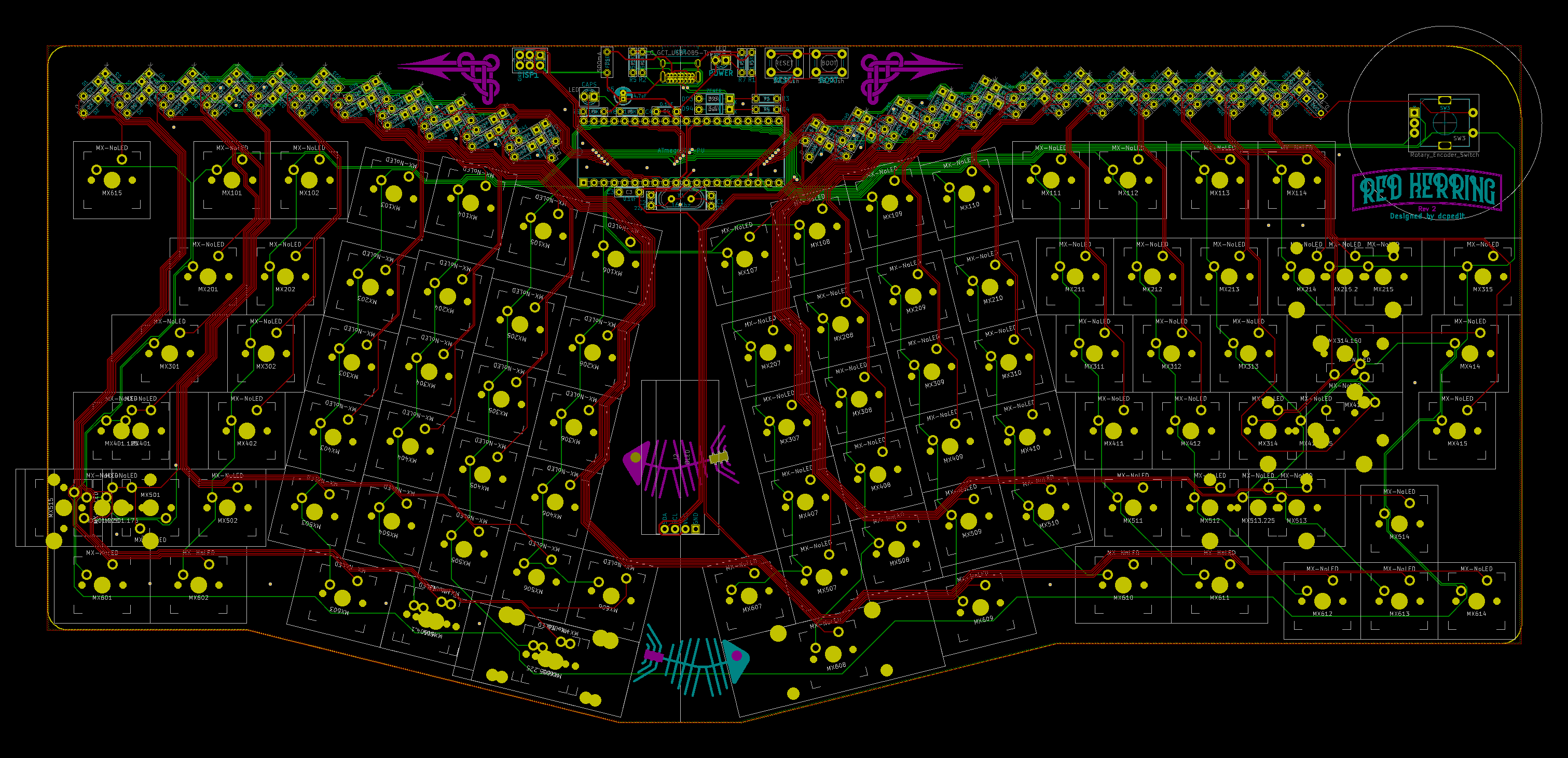
I used JLCPCB.com to get this manufactured. They have a good tutorial on how to generate the Gerber files from KiCad. If the website is not able to calculate the dimensions, you can enter it in manually. Here are the details
| Qty | Value | Footprint | References |
|---|---|---|---|
| 92 | D_Small | cftkb:D_DO-35_SOD27_P5.08mm_Horizontal | D1, D2, D10, D11, D12, D13, D14, D15, D16, D17, D18, D19, D20, D21, D22, D23 +76 |
| 77 | MX-NoLED | MX_Only:MXOnly-1U-Hotswap_w_VIA | MX101, MX102, MX103, MX104, MX105, MX106, MX107, MX108, MX109, MX110, MX111, MX112, MX113, MX114, MX201, MX202 +61 |
| 9 | MX-NoLED | MX_Only:MXOnly-1.25U-Hotswap_w_VIA | MX401.125, MX513, MX601, MX602, MX603, MX604, MX609, MX610, MX611 |
| 3 | 1.5K | Resistor_THT:R_Axial_DIN0204_L3.6mm_D1.6mm_P5.08mm_Horizontal | R1, R7, R8 |
| 3 | MX-NoLED | MX_Only:MXOnly-2.25U-Hotswap_w_VIA | MX413.225, MX501.225, MX513.225 |
| 2 | 0.1uF | Capacitor_THT:C_Disc_D4.3mm_W1.9mm_P5.00mm | C3, C4 |
| 2 | 22pF | Capacitor_THT:C_Disc_D3.0mm_W2.0mm_P2.50mm | C1, C2 |
| 2 | 3.6V | Diode_THT:D_DO-35_SOD27_P7.62mm_Horizontal | D93, D94 |
| 2 | 5.1K | Resistor_THT:R_Axial_DIN0204_L3.6mm_D1.6mm_P5.08mm_Horizontal | R2, R5 |
| 2 | 75 | Resistor_THT:R_Axial_DIN0204_L3.6mm_D1.6mm_P5.08mm_Horizontal | R3, R4 |
| 2 | LED | LED_THT:LED_D3.0mm_Clear | CAPS1, POWER1 |
| 2 | LOGO | redherring:logo | FISH1, FISH2 |
| 2 | MX-NoLED | MX_Only:MXOnly-1.5U-Hotswap_w_VIA | MX301, MX314.150 |
| 2 | SW_Push | Button_Switch_THT:SW_PUSH_6mm | BOOT1, RESET1 |
| 1 | 10K | Resistor_THT:R_Axial_DIN0204_L3.6mm_D1.6mm_P5.08mm_Horizontal | R6 |
| 1 | 16Mhz | Crystal:Crystal_HC49-4H_Vertical | Y1 |
| 1 | 4.7uF | Capacitor_THT:CP_Radial_D4.0mm_P1.50mm | C5 |
| 1 | 500mA | cftkb:polyfuse_5.1mm | F1 |
| 1 | ATmega32A-PU | Package_DIP:DIP-40_W15.24mm | U1 |
| 1 | AVR-ISP-6 | Connector_PinHeader_2.54mm:PinHeader_2x03_P2.54mm_Vertical | ISP1 |
| 1 | LOGO | redherring:knot_arrow_right | ARROW2 |
| 1 | LOGO | redherring:text_border | LOGO2 |
| 1 | LOGO | redherring:knot_arrow_left | ARROW1 |
| 1 | LOGO | redherring:red_herring_text | LOGO1 |
| 1 | MX-NoLED | MX_Only:MXOnly-2.75U-Hotswap-ReversedStabilizers_w_VIA | MX608 |
| 1 | MX-NoLED | MX_Only:MXOnly-2.25U-Hotswap-ReversedStabilizers_w_VIA | MX605.225 |
| 1 | MX-NoLED | MX_Only:MXOnly-2U-Hotswap-ReversedStabilizers_w_VIA | MX605 |
| 1 | MX-NoLED | MX_Only:MXOnly-2U-Hotswap | MX413 |
| 1 | MX-NoLED | MX_Only:MXOnly-2U-Hotswap_w_VIA | MX215.2 |
| 1 | MX-NoLED | MX_Only:MXOnly-1.75U-Hotswap_w_VIA | MX401 |
| 1 | OLED | Custom_Footprints:SSD1306_OLED | J2 |
| 1 | Rotary_Encoder_Switch | Rotary_Encoder:RotaryEncoder_Alps_EC11E-Switch_Vertical_H20mm | SW3 |
| 1 | USB_C_GCT_USB4085-Type-C | Type-C:USB_C_GCT_USB4085 | USB |
It measures 364.4 × 167.3 mm and has 2 copper layers, 1.6 mm thick.
221 parts, built around the ATMEGA32A-PU. The full list of its parts is on this page, with links to each part's symbol and footprint where PCBKit's library has them.
From the dcpedit/redherring repository on GitHub, at the commit this page was made from: the board is pcb-hotswap/redherring.kicad_pcb and its schematic pcb-hotswap/redherring.kicad_sch. PCBKit opens the board in the browser, with nothing to install.
Its repository publishes it under the CC-BY-4.0 licence: you may reuse it on that licence's terms (keep the author's notice, and for a copyleft licence share your changes alike).


coseyfannitutti/mysterium
TKL keyboard that can be entirely assembled using only through hole components, including usb type-c


null-ll/basketweave
Through-hole Alice-style keyboard with arrow keys and a rotary encoder


lyso1/LCK75
a 75% through-hole keyboard designed by myself with inspiration from the CFTKB Discipline and Yiancar Gingham

dsanchezseco/punk75
Ortholinear keyboard with 75 keys and all components through hole
