4 layers60 × 110 mm
Retrospector Components
dchwebb/Kishoof
Eurorack Wavetable Synthesizer; Dual channel; 64MB internal storage accessed via USB
123 parts17

 dchwebb/Kishoof17
Eurorack Wavetable Synthesizer; Dual channel; 64MB internal storage accessed via USB
Retrospector Controls is an open-source printed circuit board by dchwebb, from the dchwebb/Kishoof repository on GitHub. It is a 2-layer board of 60 × 110 mm with 23 parts on 27 nets, routed with 138 tracks and 5 vias.
Its parts include 13 connectors and 2 diodes. It belongs with the audio and music boards of this library.
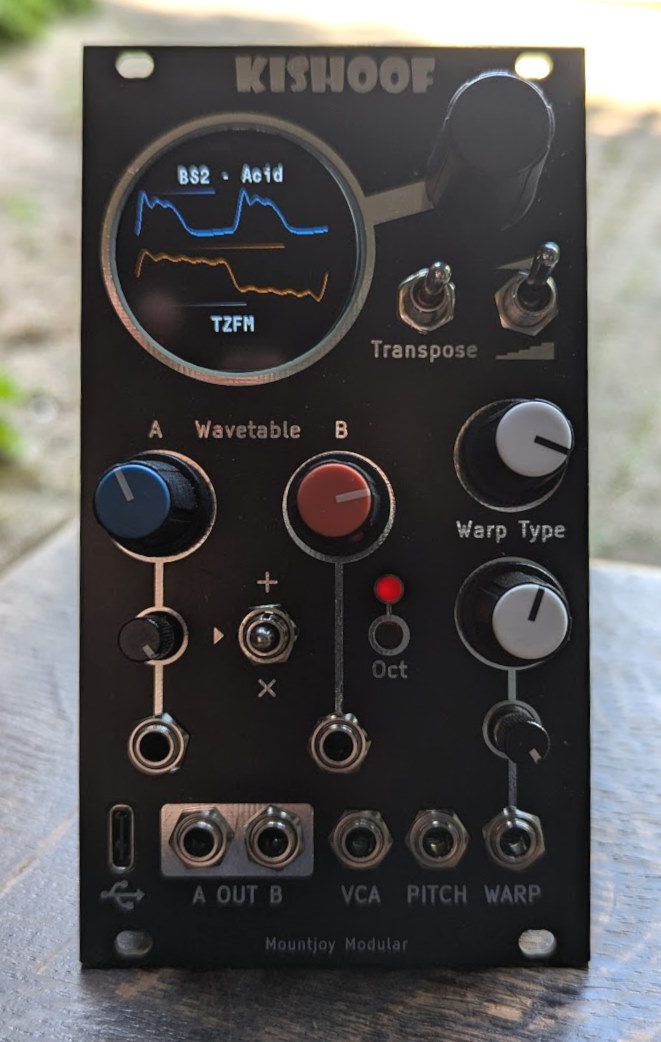
Kishoof is a Wavetable synthesizer designed for use in a Eurorack modular system. A dual channel architecture allows simultaneous playback of two channels each offering a different range of capabilities. Wavetables are held in 64MB of internal flash storage which is exposed as a USB disk drive via a front-panel USB C connector.
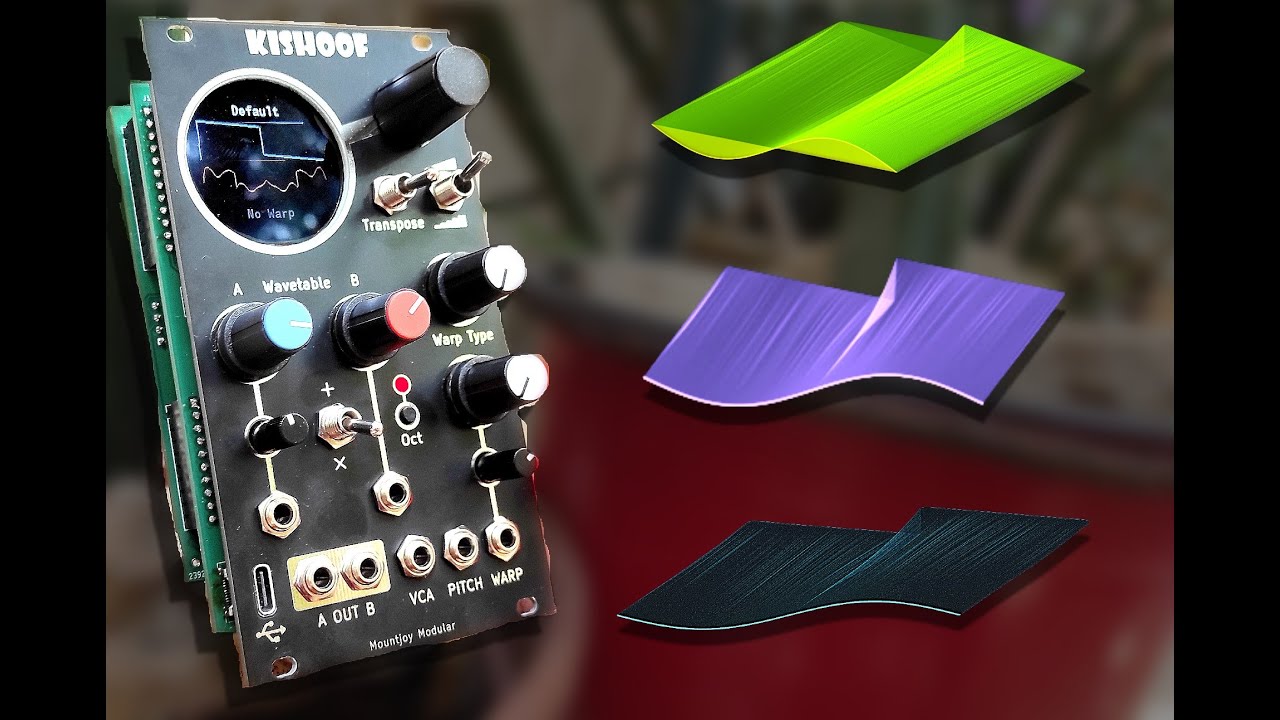
Two modes of operation are available with one stepping between individual wavetable frames and one smoothly interpolating between frames. In stepped mode channel A and B can each play any of the available wavetable frames. In smooth mode Channel A plays the loaded wavetable and channel B plays an internal wavetable that can be configured to hold a range of standard waveforms and harmonics.
A warp engine allows a range of warping effects to alter channel A's signal, with Bend, Squeeze, Mirror and though-Zero Frequency Modulation from channel B available. Channel B can be modulated via addition (mixing) and multiplication (ring modulation) with channel A and its playback direction can be reversed. Dynamic anti-aliasing filters eliminate aliasing regardless of modulation settings.
A circular TFT LCD display shows both or either channel's waveform with any warping and modulation applied. A serial console available over a USB virtual COM port allows advanced configuration, calibration and trouble-shooting facilities.
The module was designed in conjunction with musician Tal Shoshani who produced the following demonstration video:
Kishoof is based on an STM32H7B0 microcontroller clocked at 280MHz. Internal flash storage uses a Macronix MX25LM51245G 512Mbit NOR flash IC, clocked at 76.8MHz. The flash is controlled by the MCU using OctoSPI.
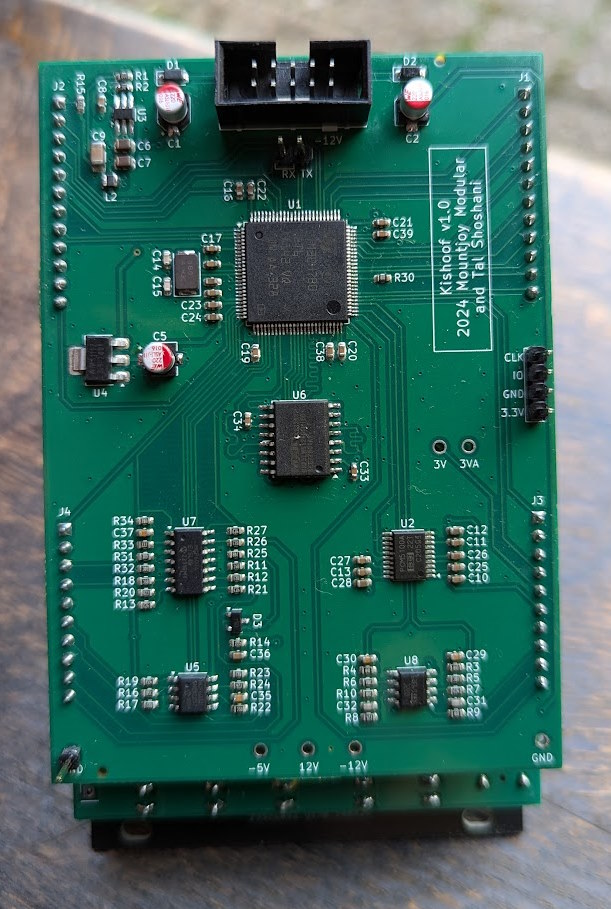
A TI PCM5100APW audio DAC is used for wavetable playback, operating in stereo at 48KHz. This is interfaced to the MCU over I2S. The MCU's internal 12 bit ADCs receive potentiometer and scaled Control voltage inputs.
The display is a circular 1.28 inch 240x240 IPS TFT LCD with GC9A01 Driver and is controlled via SPI. USB is connected via a front-panel USB C connector with ESD Protection.
Construction
The module is constructed of four PCBs: Component board, Control board, LCD daughterboard and Front Panel. The Component board is a 4-layer board. All others are 2 layer.
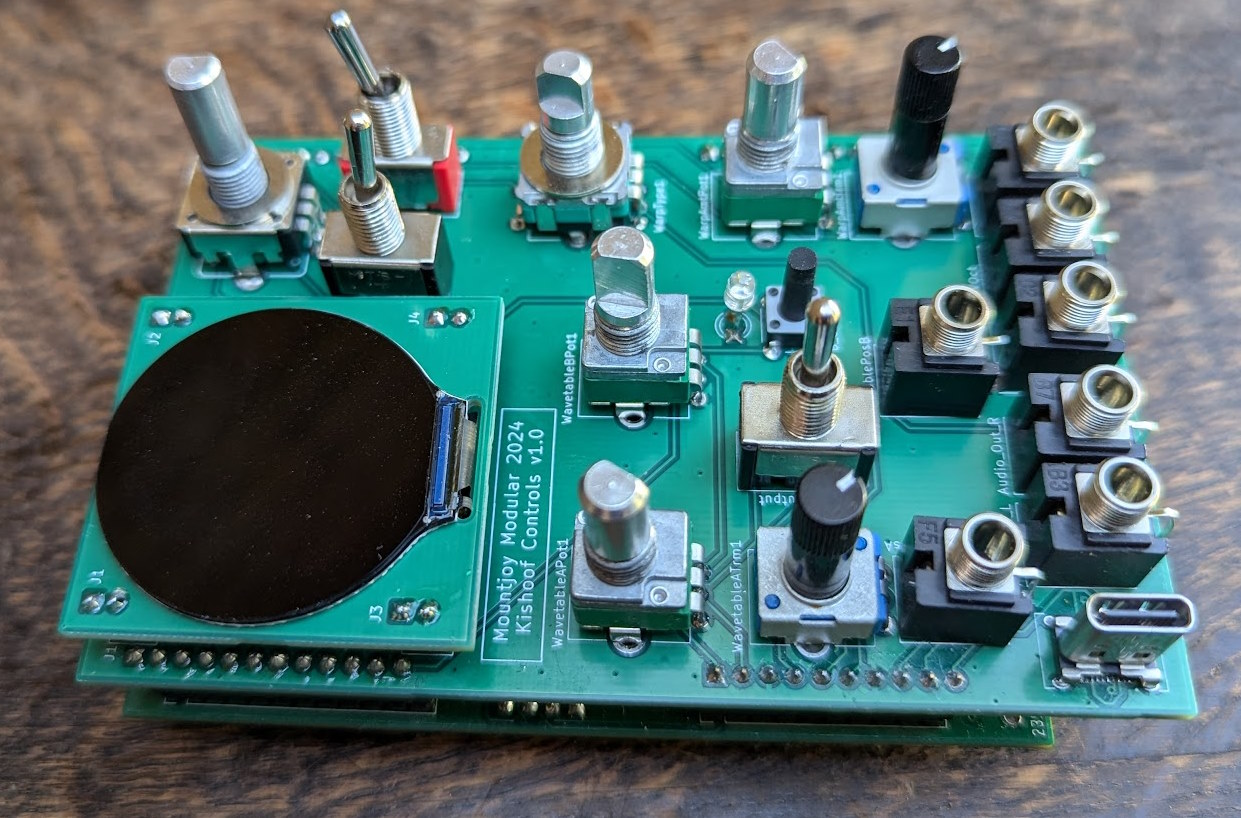
Circuit Design and layout using Kicad v8:
Firmware
Firmware written in C++20 using STM32CubeIDE version 1.15.1 and is available here
Digital power is supplied through a TI TPS561201 3.3V switching power supply and analog power via a 3.3V linear regulator.
| Qty | Value | Footprint | References |
|---|---|---|---|
| 5 | A10k | Custom_Footprints:Alpha_9mm_Potentiometer | Delay_Pot_L1, Delay_Pot_R1, Feedback_Pot1, Mix_Pot1, Tone_Pot1 |
| 4 | Conn_01x08_Female | Socket_Strips:Socket_Strip_Straight_1x08_Pitch2.54mm | J3, J4, J5, J6 |
| 2 | LED | LEDs:LED_D3.0mm | D1, D2 |
| 1 | Audio_In_L | Custom_Footprints:THONKICONN_hole | J1 |
| 1 | Audio_In_R | Custom_Footprints:THONKICONN_hole | J11 |
| 1 | Audio_Out_L | Custom_Footprints:THONKICONN_hole | J13 |
| 1 | Audio_Out_R | Custom_Footprints:THONKICONN_hole | J12 |
| 1 | Clock | Custom_Footprints:THONKICONN_hole | J9 |
| 1 | Delay_CV_L | Custom_Footprints:THONKICONN_hole | J2 |
| 1 | Delay_CV_R | Custom_Footprints:THONKICONN_hole | J8 |
| 1 | Feedback_CV | Custom_Footprints:THONKICONN_hole | J10 |
| 1 | Mix_CV | Custom_Footprints:THONKICONN_hole | J7 |
| 1 | SW_Push | Buttons_Switches_THT:SW_PUSH_6mm | RESET1 |
| 1 | SW_SPDT_MSM | Custom_Footprints:SPDTSubMiniature | FXMODE1 |
| 1 | SW_SPST | Custom_Footprints:SPDTSubMiniature | FXTYPE1 |
dchwebb/Kishoof
Eurorack Wavetable Synthesizer; Dual channel; 64MB internal storage accessed via USB

dchwebb/Kishoof
Eurorack Wavetable Synthesizer; Dual channel; 64MB internal storage accessed via USB

dchwebb/Kishoof
Eurorack Wavetable Synthesizer; Dual channel; 64MB internal storage accessed via USB

dchwebb/Kishoof
Eurorack Wavetable Synthesizer; Dual channel; 64MB internal storage accessed via USB

dchwebb/Kishoof
Eurorack Wavetable Synthesizer; Dual channel; 64MB internal storage accessed via USB

dchwebb/Kishoof
Eurorack Wavetable Synthesizer; Dual channel; 64MB internal storage accessed via USB


google/mozc-devices
Circuit diagrams and firmware source code for Gboard DIY keyboards


Duet3D/Duet-2-Hardware
The KiCAD source for the Duet 3d printer controller see www.duet3d.com
It measures 60 × 110 mm and has 2 copper layers, 1.6 mm thick.
23 parts. The full list of its parts is on this page, with links to each part's symbol and footprint where PCBKit's library has them.
From the dchwebb/Kishoof repository on GitHub, at the commit this page was made from: the board is bu/Proto_Hardware/Retrospector_Controls.kicad_pcb and its schematic Hardware/Combined_Controls_Components/Kishoof_Components.kicad_sch. PCBKit opens the board in the browser, with nothing to install.
Its repository states no licence, so its author keeps all rights: ask dchwebb before reusing the design.