2 layers116.8 × 30 mm
Type d
google/mozc-devices
Circuit diagrams and firmware source code for Gboard DIY keyboards
14 parts3kApache-2.0

 DasReyxr/STM32F-CAR1
Este proyecto presenta un carrito autónomo seguidor de línea basado en un microcontrolador STM32 y un sistema de control por lógica difusa (Fuzzy Logic).
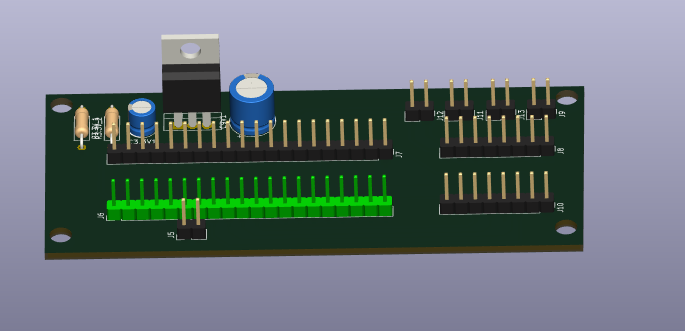
KicadDesign is an open-source printed circuit board by DasReyxr, from the DasReyxr/STM32F-CAR repository on GitHub. It is a 2-layer board of 95.9 × 42.8 mm with 14 parts on 46 nets, routed with 140 tracks and 0 vias.
Its parts include 9 connectors, 2 capacitors, 2 resistors and 1 IC.
Este proyecto presenta un carrito autónomo seguidor de línea basado en un microcontrolador STM32 y un sistema de control por lógica difusa (Fuzzy Logic). El objetivo es detectar la posición de la línea y ajustar la velocidad de los motores para mantener el seguimiento de manera estable y eficiente.
El sistema lee la señal de los sensores, identifica si el carrito está ligeramente a la izquierda, a la derecha o sobre la línea, y genera una respuesta para corregir el movimiento de los motores, manteniéndose sobre la trayectoria.
El sistema sigue una secuencia clara de procesamiento:
flowchart LR
    A[Sensor izquierdo] --> B[Lecturas de entrada]
    C[Sensor derecho] --> B
    B --> D[Difusificación]
    D --> E[Reglas de Mamdani]
    E --> F[Centroide]
    F --> G[Control de motores]
    G --> H[Motor izquierdo]
G --> I[Motor derecho]A continuación se muestra una vista del prototipo desarrollado para el carrito seguidor de línea:
Aquí puedes ver una demostración del funcionamiento del carrito:
https://github.com/user-attachments/assets/0d9d8957-ae0a-4fae-b08e-12143651e8d6
| Qty | Value | Footprint | References |
|---|---|---|---|
| 2 | Conn_01x20_Socket | Connector_PinHeader_2.54mm:PinHeader_1x20_P2.54mm_Vertical | J6, J7 |
| 1 | 100uF | Capacitor_THT:CP_Radial_D5.0mm_P2.50mm | C3.3V1 |
| 1 | 100uF | Capacitor_THT:CP_Radial_D8.0mm_P3.50mm | C9V1 |
| 1 | 1500 | Resistor_THT:R_Axial_DIN0207_L6.3mm_D2.5mm_P10.16mm_Horizontal | R3.3V_1 |
| 1 | 1K | Resistor_THT:R_Axial_DIN0207_L6.3mm_D2.5mm_P10.16mm_Horizontal | R3.3V_2 |
| 1 | 9V | Connector_PinHeader_2.54mm:PinHeader_1x02_P2.54mm_Vertical | J9 |
| 1 | A MOTOR | Connector_PinHeader_2.54mm:PinHeader_1x02_P2.54mm_Vertical | J11 |
| 1 | B MOTOR | Connector_PinHeader_2.54mm:PinHeader_1x02_P2.54mm_Vertical | J12 |
| 1 | LM317_TO-220 | Package_TO_SOT_THT:TO-220-3_Vertical | U3.3V1 |
| 1 | Puente H | Connector_PinHeader_2.54mm:PinHeader_1x08_P2.54mm_Vertical | J8 |
| 1 | Puente_H2 | Connector_PinHeader_2.54mm:PinHeader_1x08_P2.54mm_Vertical | J10 |
| 1 | SENSOR | Connector_PinHeader_2.54mm:PinHeader_1x02_P2.54mm_Vertical | J5 |
| 1 | SENSOR_SOURCE | Connector_PinHeader_2.54mm:PinHeader_1x02_P2.54mm_Vertical | J13 |
google/mozc-devices
Circuit diagrams and firmware source code for Gboard DIY keyboards


hackclub/OnBoard
💡 Join 1,000 teenagers and make your first PCB with a $100 grant!


Twotoz/C5VRX
Ultra-minimal, zero-CPU 5.8 GHz analog FPV video receiver using ESP32-C5 Wi-Fi 6 PHY MODEM_DIAG, BitScrambler WBFM demodulation & resistor DAC CVBS


It measures 95.9 × 42.8 mm and has 2 copper layers, 1.6 mm thick.
14 parts. The full list of its parts is on this page, with links to each part's symbol and footprint where PCBKit's library has them.
From the DasReyxr/STM32F-CAR repository on GitHub, at the commit this page was made from: the board is design/KicadDesign/Design/Design.kicad_pcb and its schematic design/KicadDesign/Design/Design.kicad_sch. PCBKit opens the board in the browser, with nothing to install.
Its repository states no licence, so its author keeps all rights: ask DasReyxr before reusing the design.