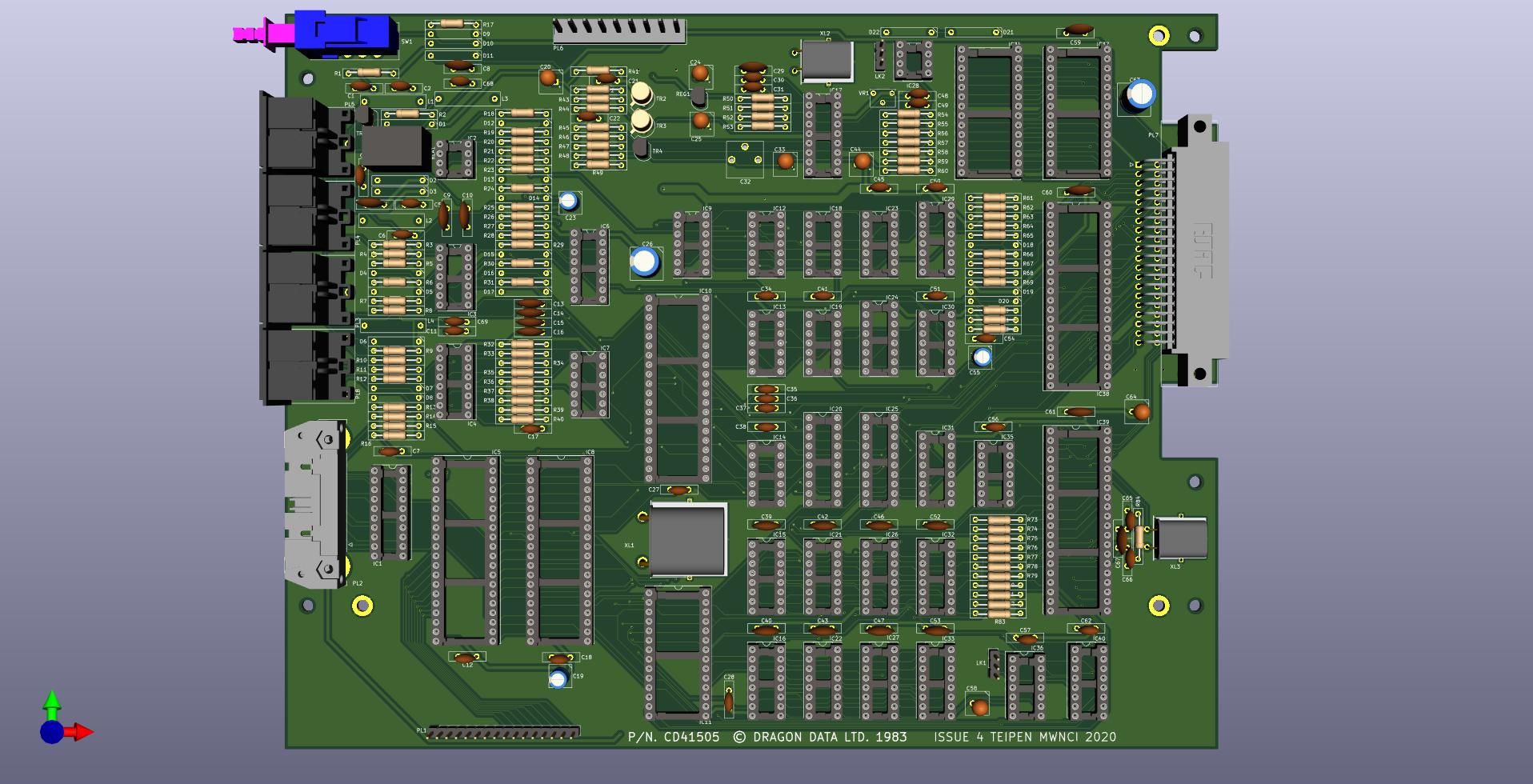
2 layers333.2 × 205.9 mm

 danwerner21/Dragon6434
A clone board for the Dragon64 and Tandy Color Computer
DragonKeyboard is an open-source printed circuit board by danwerner21, from the danwerner21/Dragon64 repository on GitHub. It is a 2-layer board of 359.1 × 124.5 mm with 64 parts on 16 nets, routed with 590 tracks and 27 vias.
Its parts include 53 switches and 2 connectors.
... and PCB layout, in KiCad.
The schematic capture is complete, and I've done one full verification pass. But I'm still making no promises about correctness! I've uploaded a PDF for those without access to KiCad.
A lot of the PCB positioning is now correct - at least to the nearest mm, usually better - and everything's pointing in a sensible direction with the exception of some diodes: Dragon Data ensured they always had the cathode to the right, presumably to avoid manufacturing confusion, and I've preserved that decision.
As it stands the PCB is now fully routed. I think it has reasonable power distribution, and where possible, I've tried to route such that the decoupling capacitor positions make sense. Crystal tracks should be reasonably well separated from anything else, and apart from a tiny skirt around the outside of the ACIA crystal housing, no tracks pass underneath them either.
Freerouting did the rest, and it looks ok to me! Less than 200 vias in the end. Fully autorouted achieves a lot less, but I wasn't terribly happy with how it dealt with the sensitive bits above. I think 200 still compares pretty well to the original boards.
It would be nice to learn some FreeCAD to make the 3D view nicer, but I must admit that's looking pretty low priority for now.
Changes from the original:
Note also that the mounting holes for the edge connector are placed differently, and not very well with respect to the board, so definitely don't use this layout as-is. 40-way 2.54mm pitch card edge connector sockets seem to be like hen's teeth at the moment. Stewart Orchard points out that EDAC list some, and that's the footprint you currently see. Not that anyone appears to sell it. Likely I'll update the footprint to match what's in our Dragons so that if anyone's fool enough to get a board made, they can take a donor.
Thanks to Richard Harding for hosting high quality copies of the original drawings - doing this from the old scans would have been nigh on impossible.
Thanks also to Stewart Orchard, who has done a similar capture of the Dragon's PSU board. I also nabbed his 3D model of the DIN socket to represent all the similar ports in this project (you'll notice they're the wrong shape for the joystick ports, and none of them have more than three pins).
| Qty | Value | Footprint | References |
|---|---|---|---|
| 8 | MountingHole | MountingHole:MountingHole_3.2mm_M3_Pad | H1, H2, H3, H4, H5, H6, H7, H8 |
| 1 | 0 | Cherry_MX:CHERRY_PCB_100H | SW1 |
| 1 | 1 | Cherry_MX:CHERRY_PCB_100H | SW2 |
| 1 | 2 | Cherry_MX:CHERRY_PCB_100H | SW3 |
| 1 | 3 | Cherry_MX:CHERRY_PCB_100H | SW4 |
| 1 | 4 | Cherry_MX:CHERRY_PCB_100H | SW5 |
| 1 | 5 | Cherry_MX:CHERRY_PCB_100H | SW6 |
| 1 | 6 | Cherry_MX:CHERRY_PCB_100H | SW7 |
| 1 | 7 | Cherry_MX:CHERRY_PCB_100H | SW8 |
| 1 | 8 | Cherry_MX:CHERRY_PCB_100H | SW9 |
| 1 | 9 | Cherry_MX:CHERRY_PCB_100H | SW10 |
| 1 | A | Cherry_MX:CHERRY_PCB_100H | SW23 |
| 1 | AT | Cherry_MX:CHERRY_PCB_100H | SW14 |
| 1 | B | Cherry_MX:CHERRY_PCB_100H | SW24 |
| 1 | BREAK | Button_Switch_Keyboard:SW_Cherry_MX_1.75u_PCB | SW61 |
| 1 | C | Cherry_MX:CHERRY_PCB_100H | SW25 |
| 1 | CLEAR | Cherry_MX:CHERRY_PCB_100H | SW66 |
| 1 | COLON | Cherry_MX:CHERRY_PCB_100H | SW16 |
| 1 | COMMA | Cherry_MX:CHERRY_PCB_100H | SW19 |
| 1 | CoCo_CONNECTION | Connector_PinHeader_2.54mm:PinHeader_1x16_P2.54mm_Vertical | J2 |
| 1 | D | Cherry_MX:CHERRY_PCB_100H | SW26 |
| 1 | DOWN | Button_Switch_Keyboard:SW_Cherry_MX_1.00u_PCB | SW50 |
| 1 | DRAGON_CONNECTION | Connector_PinHeader_2.54mm:PinHeader_1x16_P2.54mm_Vertical | J1 |
| 1 | E | Cherry_MX:CHERRY_PCB_100H | SW27 |
| 1 | ENTER | Cherry_MX:CHERRY_PCB_225H | SW64 |
| 1 | F | Cherry_MX:CHERRY_PCB_100H | SW28 |
| 1 | G | Cherry_MX:CHERRY_PCB_100H | SW29 |
| 1 | H | Cherry_MX:CHERRY_PCB_100H | SW30 |
| 1 | I | Cherry_MX:CHERRY_PCB_100H | SW31 |
| 1 | J | Cherry_MX:CHERRY_PCB_100H | SW32 |
| 1 | K | Cherry_MX:CHERRY_PCB_100H | SW33 |
| 1 | L | Cherry_MX:CHERRY_PCB_100H | SW34 |
| 1 | LEFT | Cherry_MX:CHERRY_PCB_100H | SW69 |
| 1 | LOGO | logo:we_small_neg | G*** |
| 1 | M | Cherry_MX:CHERRY_PCB_100H | SW35 |
| 1 | MINUS | Cherry_MX:CHERRY_PCB_100H | SW12 |
| 1 | N | Cherry_MX:CHERRY_PCB_100H | SW36 |
| 1 | O | Cherry_MX:CHERRY_PCB_100H | SW37 |
| 1 | P | Cherry_MX:CHERRY_PCB_100H | SW38 |
| 1 | PERIOD | Cherry_MX:CHERRY_PCB_100H | SW20 |
| 1 | Q | Cherry_MX:CHERRY_PCB_100H | SW39 |
| 1 | R | Cherry_MX:CHERRY_PCB_100H | SW40 |
| 1 | RIGHT | Cherry_MX:CHERRY_PCB_100H | SW11 |
| 1 | S | Cherry_MX:CHERRY_PCB_100H | SW41 |
| 1 | SEMICOLON | Cherry_MX:CHERRY_PCB_100H | SW17 |
| 1 | SHIFT | Cherry_MX:CHERRY_PCB_225H | SW49 |
| 1 | SHIFT | Cherry_MX:CHERRY_PCB_275H | SW73 |
| 1 | SLASH | Cherry_MX:CHERRY_PCB_100H | SW21 |
| 1 | SPACE | Cherry_MX:CHERRY_PCB_625H | SW65 |
| 1 | T | Cherry_MX:CHERRY_PCB_100H | SW42 |
| 1 | U | Cherry_MX:CHERRY_PCB_100H | SW43 |
| 1 | UP | Cherry_MX:CHERRY_PCB_100H | SW70 |
| 1 | V | Cherry_MX:CHERRY_PCB_100H | SW44 |
| 1 | W | Cherry_MX:CHERRY_PCB_100H | SW45 |
| 1 | X | Cherry_MX:CHERRY_PCB_100H | SW46 |
| 1 | Y | Cherry_MX:CHERRY_PCB_100H | SW47 |
| 1 | Z | Cherry_MX:CHERRY_PCB_100H | SW48 |

hackclub/OnBoard
💡 Join 1,000 teenagers and make your first PCB with a $100 grant!

drandyhaas/KiCadRoutingTools
A set of Python/Rust tools to aid routing in KiCad

BlueSCSI/BlueSCSI-v2
BlueSCSI v2/Ultra - an open source, open hardware, SCSI emulator using the Pi Pico PR2040 and Pico 2 RP2350


PyrooL/Alpha
A 28-key semi-ortholinear mechanical keyboard designed by PyroL

ugcs/ddc
Drone Show Software is software designed for drone shows, allowing flight path planning as well as control of dozens of drones simultaneously in a synchronized manner.

It measures 359.1 × 124.5 mm and has 2 copper layers, 1.6 mm thick.
64 parts. The full list of its parts is on this page, with links to each part's symbol and footprint where PCBKit's library has them.
From the danwerner21/Dragon64 repository on GitHub, at the commit this page was made from: the board is Dragon64Keyboard/DragonKeyboard.kicad_pcb. PCBKit opens the board in the browser, with nothing to install.
Its repository states no licence, so its author keeps all rights: ask danwerner21 before reusing the design.