4 layers17.8 × 50.8 mm

 daglem/reDIP-CIA66
MOS 6520 PIA / MOS 6522 VIA / MOS 6526/8520/8521 CIA replacement
ReDIP CIA is an open-source printed circuit board by daglem, from the daglem/reDIP-CIA repository on GitHub, published under the CERN-OHL-S-2.0 licence. It is a 4-layer board of 17.8 × 50.8 mm with 61 parts on 93 nets, routed with 766 tracks and 94 vias.
It is built around the ICE5LP1K-SG48ITR, 74AHCT1G14SE and AT25EU0011A-SSHN-T, with the BAS16W among its other parts. Its parts include 21 resistors, 12 capacitors, 7 ICs, 3 connectors and 1 diode. It belongs with the FPGA and CPLD boards of this library.


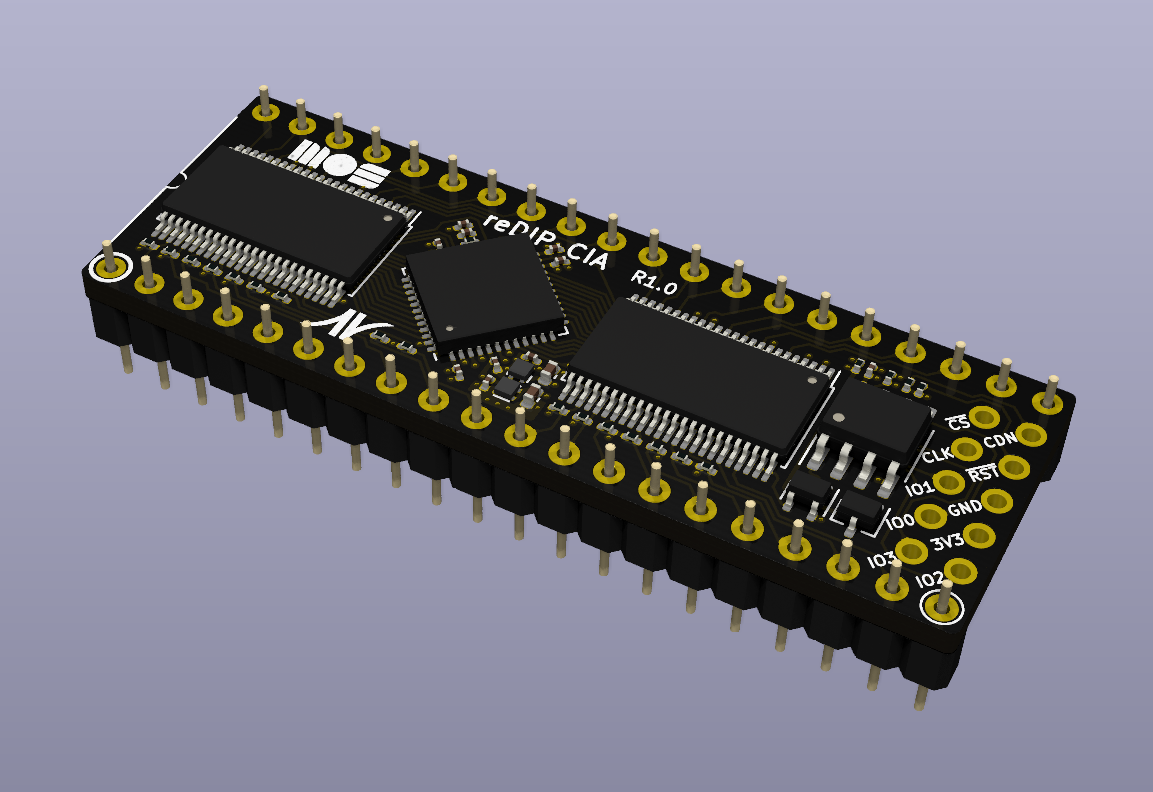
The reDIP CIA is an open source FPGA board which combines the following in a DIP-40 size package:
The reDIP CIA provides an open source hardware platform for MOS 6520 PIA / MOS 6522 VIA / MOS 6526/8520/8521 CIA replacements.
Designs for the iCE5LP1K FPGA can be processed by yosys and nextpnr.
All FPGA header I/O is 5V tolerant, and can drive 5V TTL.
A separate header footprint is provided for (Q)SPI flash programming, with pinout borrowed from the iCEBreaker Bitsy.
The board is fully pin compatible with the venerable MOS 6526/8521 and MOS 8520 CIA chips.
Cycle accurate emulation of the MOS 6526/8521 and MOS 8520 CIA chips has been implemented in gateware, configurable via software.
Cycle accurate emulation of the MOS 6522 VIA chip has been implemented in gateware.
Cycle accurate emulation of the MOS 6520 PIA chip has been implemented in gateware.
The gateware implementations would not have been possible without the outstanding work on varius MOS chips by Frank "androSID" Wolf and Dieter "ttlworks" Müller.
Wagner Rodriguez has tested the 8520 CIA implementation with the Versatile Amiga Testprogram.
Mateusz Nalewajski has hunted down and fixed two bugs while working on integrating the VIA gateware in icepi-zero-c64.
André Fachat has tested the VIA and PIA implementations with his PET PIA and VIA test suite.
| Qty | Value | Footprint | References |
|---|---|---|---|
| 16 | 4.7k | Resistor_SMD:R_0201_0603Metric | R1, R2, R3, R4, R5, R6, R7, R8, R9, R10, R11, R12, R13, R14, R15, R16 |
| 9 | SolderMask_D0.25mm | reDIP:SolderMask_D0.25mm | SolderMask_D0.25mm, SolderMask_D0.25mm, SolderMask_D0.25mm, SolderMask_D0.25mm, SolderMask_D0.25mm, SolderMask_D0.25mm, SolderMask_D0.25mm, SolderMask_D0.25mm, SolderMask_D0.25mm |
| 7 | 0.1uF | Capacitor_SMD:C_0201_0603Metric | C5, C6, C7, C8, C9, C10, C12 |
| 3 | 1uF | Capacitor_SMD:C_0201_0603Metric | C2, C4, C11 |
| 3 | TestPoint | reDIP:TestPoint_Pad_D1.00mm | TP1, TP2, TP3 |
| 2 | 10k | Resistor_SMD:R_0201_0603Metric | R19, R20 |
| 2 | 1uF | Capacitor_SMD:C_0402_1005Metric | C1, C3 |
| 2 | 2.87k | Resistor_SMD:R_0201_0603Metric | R17, R21 |
| 2 | Conn_01x20 | reDIP:PinHeader_1x20_P2.54mm_Vertical_Machined | J1, J2 |
| 2 | SN74CBT16210CDGGR | Package_SO:TSSOP-48_6.1x12.5mm_P0.5mm | U3, U4 |
| 1 | 100 | Resistor_SMD:R_0201_0603Metric | R18 |
| 1 | 74AHCT1G14 | reDIP:SOT-353_SC-70-5 | U5 |
| 1 | AT25EU0011A-SSHN | Package_SO:SOIC-8_3.9x4.9mm_P1.27mm | U7 |
| 1 | BAS16W | reDIP:SOT-323_SC-70 | D1 |
| 1 | Conn_02x05_Odd_Even | reDIP:PinHeader_2x05_P2.54mm_Vertical | J3 |
| 1 | ICE5LP1K-SG48 | Package_DFN_QFN:QFN-48-1EP_7x7mm_P0.5mm_EP5.6x5.6mm | U6 |
| 1 | NCP115AMX120TCG | onsemi:CASE_711AJ_1.0x1.0mm_P0.65mm | U1 |
| 1 | NCP115AMX330TCG | onsemi:CASE_711AJ_1.0x1.0mm_P0.65mm | U2 |
The 56 most common of 61 parts.
It measures 17.8 × 50.8 mm and has 4 copper layers, 1.61 mm thick.
61 parts, built around the ICE5LP1K-SG48ITR, 74AHCT1G14SE, AT25EU0011A-SSHN-T and BAS16W. The full list of its parts is on this page, with links to each part's symbol and footprint where PCBKit's library has them.
From the daglem/reDIP-CIA repository on GitHub, at the commit this page was made from: the board is hardware/reDIP-CIA.kicad_pcb and its schematic hardware/reDIP-CIA.kicad_sch. PCBKit opens the board in the browser, with nothing to install.
Its repository publishes it under the CERN-OHL-S-2.0 licence: you may reuse it on that licence's terms (keep the author's notice, and for a copyleft licence share your changes alike).

AJain9199/AOS16
Table of Contents About The Project Pictures Technical Details Directory Structure To-Do Acknowledgments


Oak-Development-Technologies/RPGA-Feather
Home of everything RPGA! From schematics and board files to buildable examples!

Oak-Development-Technologies/Lattice-FeatherWing
Home of the Lattice FeatherWing


jerry-kerenzikov/ytterbium
Project files for Ytterbium modular CPU platform and Yprog programming tool

hackclub/OnBoard
💡 Join 1,000 teenagers and make your first PCB with a $100 grant!