
4 layers150 × 114 mm
Mackerel-10-v1
crmaykish/mackerel-68k
A series of single-board Motorola 68k computers with support for modern Linux
65 parts96MIT

 crmaykish/mackerel-68k96
A series of single-board Motorola 68k computers with support for modern Linux
Mackerel-30-proto is an open-source printed circuit board by crmaykish, from the crmaykish/mackerel-68k repository on GitHub, published under the MIT licence. It is a 4-layer board of 215 × 150 mm with 133 parts on 290 nets, routed with 2,615 tracks and 294 vias.
It is built around the MC68030RC16C, 74HC245D and LM2576T-5.0, with the AMS1117-3.3, AS6C4008-55PCN and DS1233 among its other parts. Its parts include 57 capacitors, 29 resistors, 16 ICs, 15 connectors and 4 diodes. It belongs with the computers and single-board computers and retro computing and games boards and the FPGA and CPLD boards of this library.


Mackerel 68k is a family of homebrew single-board computers built around the Motorola 68000 line of processors plus a from-scratch effort to run mainline Linux on each one.
The project works its way up the 68k family one chip at a time, from the 68008 to the 68040. Each new board adds capability: more memory, faster CPUs, an FPU, an MMU, and richer peripherals. But the throughline is software - every Mackerel runs the latest mainline Linux kernel, from a tiny NOMMU uClinux shell on the 68008 up to a full MMU + hardware-FPU install on the 68030.
What's in the box, top to bottom:
Three discrete boards are running today (68008, 68010, and 68030), with a 68040 system in the works - plus Mackerel-F, an FPGA build that runs a full Mackerel system on a soft 68000 core.
Status: Complete
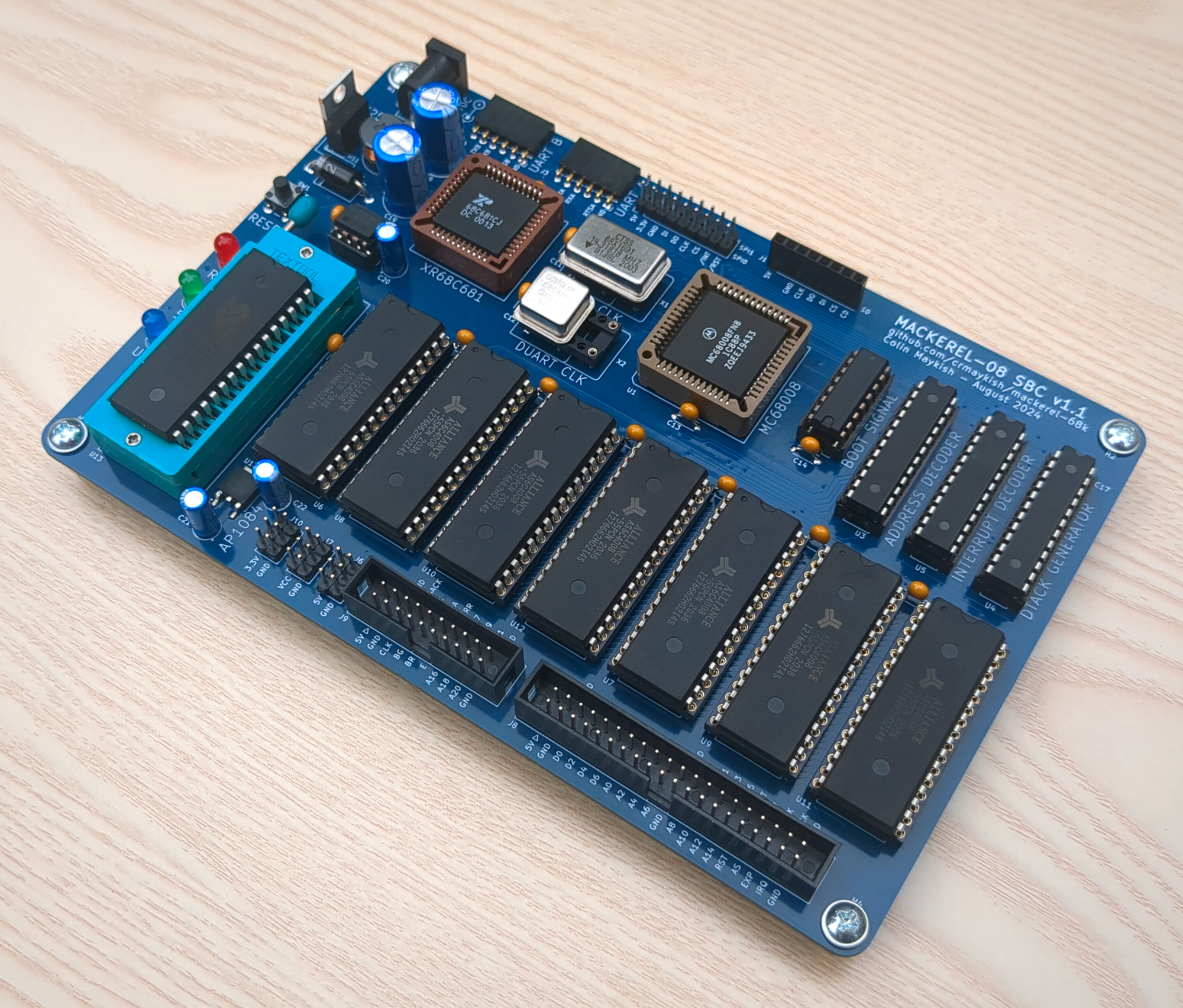
Based on the original prototype hardware, this SBC combines the 52-pin PLCC MC68008, a 512KB Flash ROM, up to 3.5MB of SRAM, and a XR68C681 DUART on a single PCB. The DUART exposes two serial ports and three bit-banged SPI headers. One of these headers is currently used with an SD card breakout board to provide bulk storage.
Three 22V10 PLDs are used for address decoding, interrupt mapping, and DTACK generation. An expansion header breaks out address, data, and control lines to allow additional peripherals to be connected directly to the processor bus.
The address space is mapped as follows:
Mackerel-08 uses a 74HC595 shift register to create a BOOT signal for the first eight /AS cycles of the CPU after reset. This BOOT signal is used by the address decoder PLD to map the ROM to address 0x000000 long enough for the CPU to read the initial stack pointer and program counter vectors from ROM. RAM is mapped to 0x000000 after that.
Status: Complete
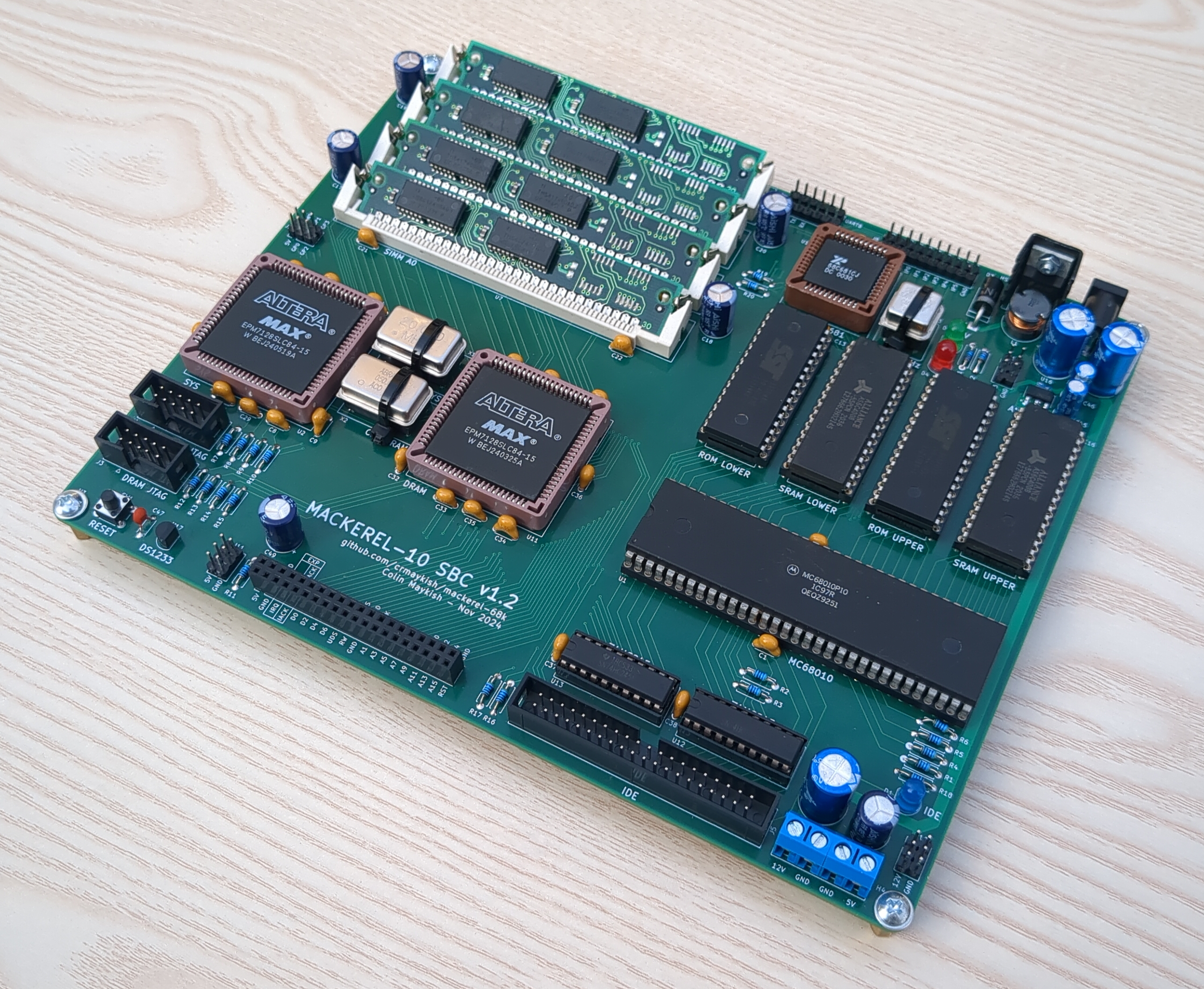
Mackerel-10 is the second SBC in the project. It expands on the design of Mackerel-08 with a MC68010 CPU (or equivalent), the same XR68C681 DUART, 1MB of Flash ROM, 1MB of SRAM, up to 16 MB of DRAM, and an IDE drive interface. Two CPLDs act as the glue logic and DRAM controller for the board. The SRAM is optional and the address space can be filled almost entirely with DRAM.
The memory map looks like this:
It's also possible to install a MC68SEC000 CPU on an adapter for a major speed boost. This CPU can run at 33 MHz with the correct CPU oscillator installed and an updated system controller CPLD.
Status: Prototype
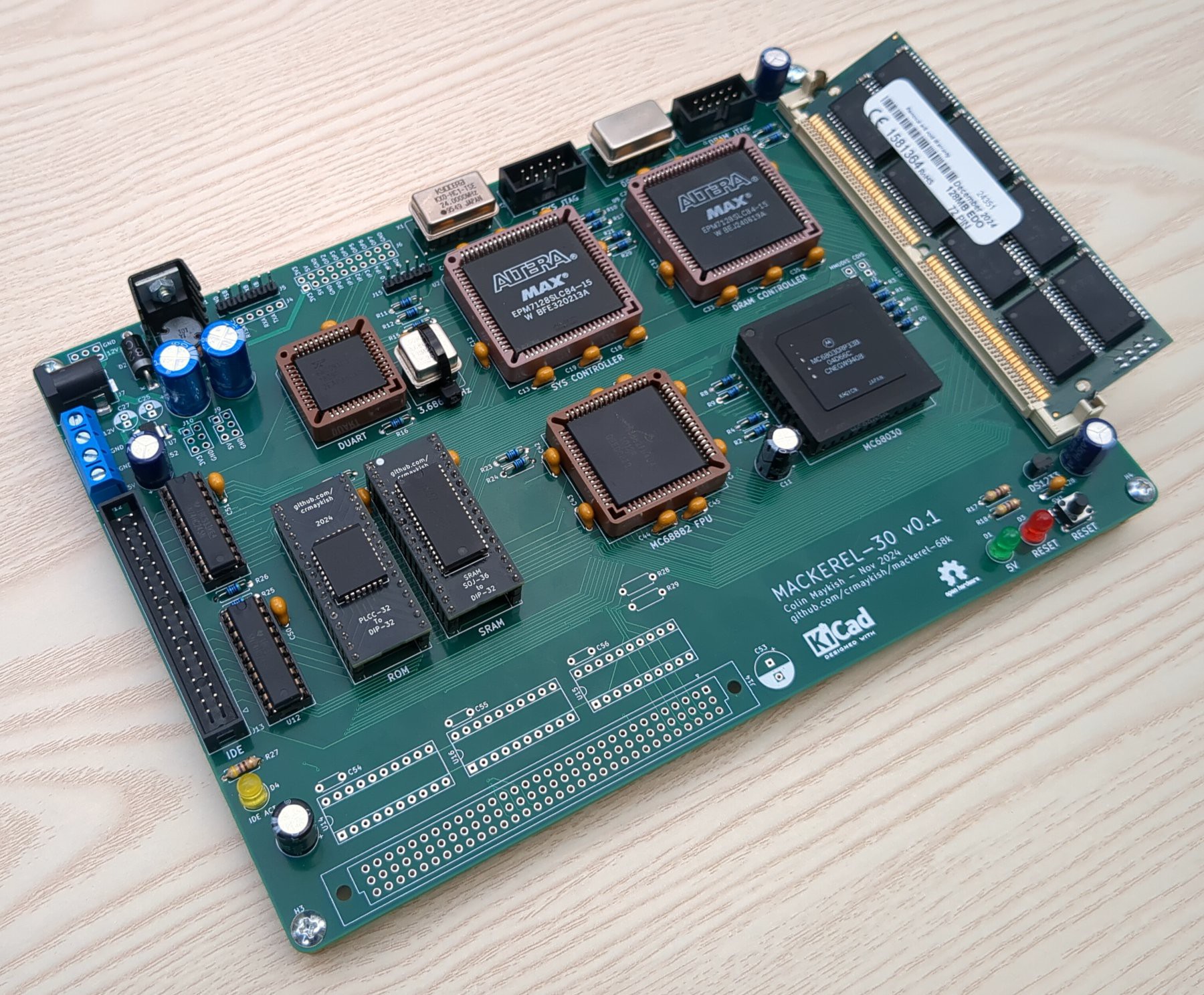
Mackerel-30 is based on the 68030 CPU. It includes the DUART and IDE interface from Mackerel-10 and upgrades the DRAM controller to use a 72-pin SIMM. It also includes a MC68882 FPU.
Status: Design
Status: Prototype (FPGA)
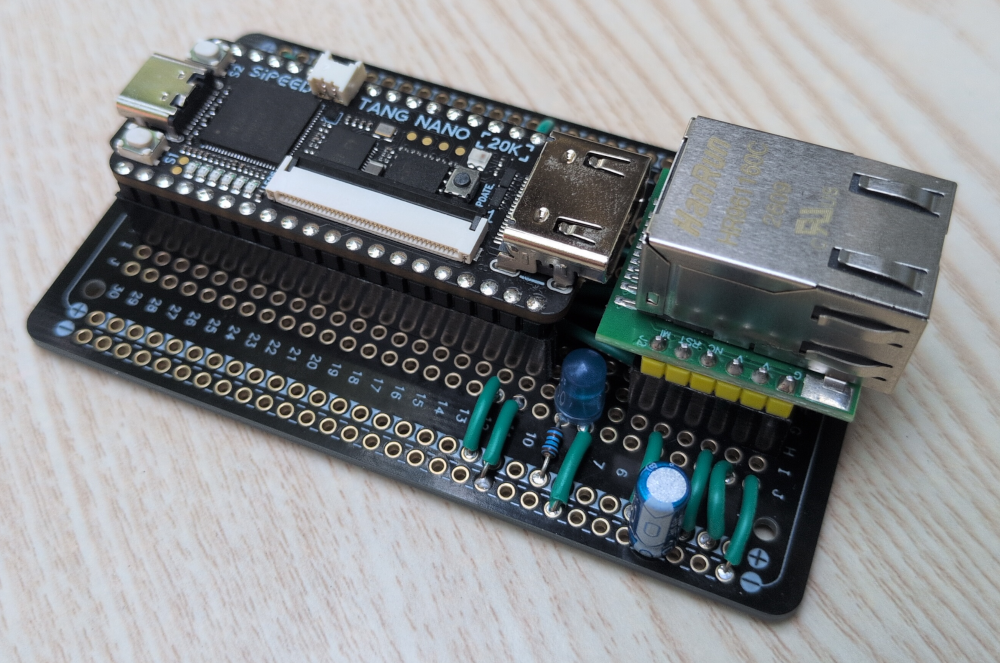
Mackerel-F is an entire Mackerel system implemented inside an FPGA. Everything that is discrete hardware on the other boards - the CPU, glue logic, memory controller, UART, timer, interrupt controller, and SPI masters - is RTL here, built around the fx68k soft 68000 core and synthesized for the Tang Nano 20k. The SoC runs at 75.6 MHz with the 68000 core clocked at half that (37.8 MHz).
Unlike the other boards there is no separate ROM chip: the bootloader is baked into the FPGA bitstream as on-chip ROM and its scratch RAM lives in block RAM, so the entire 8 MB of SDRAM is free for Linux. Alongside the usual boot (from SD) and YMODEM transfer, the bootloader adds a netboot command that pulls the kernel over Ethernet (raw TCP, with a small host server) and a five-second SD autoboot.
The memory map:
It boots mainline NOMMU uClinux to a BusyBox shell from a ROMfs root run in place from SDRAM, with the microSD for storage and the W5500 for networking. See Building and Running Mackerel-F (FPGA).
Every version of Mackerel runs a small bootloader program installed on the Flash ROM. This provides a simple set of debugging tools (peek, poke, memtest, etc.) as well as two methods for loading external code.
The bootloader supports the YMODEM protocol for loading programs and data into RAM (see the ymodem command), using lrzsz-sb on the PC for example. Other terminal programs like TeraTerm should also work.
The boot command is used to load the Linux kernel from disk (SD or IDE). It expects a IMAGE.BIN file on the first FAT16 partition of the drive. See the prepare_disk.sh script in the mackerel-linux repository.
On Mackerel-F the bootloader also supports netboot (pulling the kernel over Ethernet) and a five-second SD autoboot on power-up.
Every Mackerel board runs the latest mainline kernel (v7.1.x). Mackerel-08, Mackerel-10, and the FPGA-based Mackerel-F run NOMMU and are more limited in their capabilities. Mackerel-30 supports the MMU and the external FPU in Linux and functions more like a traditional headless Linux install. Userspace is made up of busybox (init and shell) with driver support for the DUART, IDE storage, and networking over SPI.
There are three different toolchains for Mackerel. The baremetal toolchain builds the bootloader and other low level programs in this repo. There are also two variants of the Linux toolchain - one for Mackerel-30 with MMU support and the other for NOMMU/ucLinux on Mackerel-08/10. Prebuilt toolchains are available on the releases page; see Building the Mackerel Toolchains for both the download steps and instructions on building them all with crosstools-ng.
| Qty | Value | Footprint | References |
|---|---|---|---|
| 34 | 0.1uF | Capacitor_THT:C_Disc_D4.3mm_W1.9mm_P5.00mm | C12, C13, C14, C15, C16, C17, C18, C19, C20, C21, C22, C23, C29, C30, C31, C32 +18 |
| 16 | 4k7 | Resistor_THT:R_Axial_DIN0207_L6.3mm_D2.5mm_P7.62mm_Horizontal | R1, R2, R3, R4, R5, R6, R7, R8, R9, R14, R23, R24, R25, R26, R28, R29 |
| 10 | 0.1uF | Capacitor_SMD:C_1206_3216Metric_Pad1.33x1.80mm_HandSolder | C1, C2, C3, C4, C5, C6, C7, C8, C9, C10 |
| 10 | R | Resistor_THT:R_Axial_DIN0207_L6.3mm_D2.5mm_P7.62mm_Horizontal | R10, R11, R12, R13, R15, R16, R19, R20, R21, R22 |
| 6 | 470uF | Capacitor_THT:CP_Radial_D8.0mm_P3.50mm | C11, C37, C41, C52, C53, C57 |
| 5 | 74HC245 | Package_DIP:DIP-20_W7.62mm_Socket | U12, U13, U14, U15, U16 |
| 4 | MountingHole_Pad | MountingHole:MountingHole_3.2mm_M3_Pad_Via | H1, H2, H3, H4 |
| 3 | Conn_02x03_Odd_Even | Connector_PinHeader_2.54mm:PinHeader_2x03_P2.54mm_Vertical | J8, J9, J10 |
| 3 | LED | LED_THT:LED_D5.0mm | D1, D3, D4 |
| 2 | 1000uF | Capacitor_THT:CP_Radial_D10.0mm_P5.00mm | C24, C26 |
| 2 | 10uF | Capacitor_THT:CP_Radial_D5.0mm_P2.00mm | C25, C27 |
| 2 | 1k | Resistor_THT:R_Axial_DIN0207_L6.3mm_D2.5mm_P7.62mm_Horizontal | R17, R18 |
| 2 | C | Capacitor_THT:C_Disc_D4.3mm_W1.9mm_P5.00mm | C50, C51 |
| 2 | CXO_DIP14 | Oscillator:Oscillator_DIP-14 | X1, X3 |
| 2 | Conn_01x02 | Connector_PinHeader_2.54mm:PinHeader_1x02_P2.54mm_Vertical | J1, J2 |
| 2 | Conn_01x06 | Connector_PinHeader_2.54mm:PinHeader_1x06_P2.54mm_Vertical | J4, J5 |
| 2 | Conn_02x05_Odd_Even | Connector_IDC:IDC-Header_2x05_P2.54mm_Vertical | J3, J11 |
| 2 | EPM7128 | Package_LCC:PLCC-84_THT-Socket | U2, U9 |
| 1 | 0.01uF | Capacitor_THT:C_Disc_D4.3mm_W1.9mm_P5.00mm | C28 |
| 1 | 100uH | Inductor_THT:L_Radial_D10.0mm_P5.00mm_Fastron_07M | L1 |
| 1 | 1N5822 | Diode_THT:D_DO-27_P15.24mm_Horizontal | D2 |
| 1 | 3.6864MHz | Oscillator:Oscillator_DIP-8 | X2 |
| 1 | 470 | Resistor_THT:R_Axial_DIN0207_L6.3mm_D2.5mm_P7.62mm_Horizontal | R27 |
| 1 | AMS1117-3.3 | Package_TO_SOT_SMD:SOT-223-3_TabPin2 | U7 |
| 1 | AS6C4008-55PCN | Package_DIP:DIP-32_W15.24mm_Socket | U4 |
| 1 | Barrel_Jack_MountingPin | Connector_BarrelJack:BarrelJack_Horizontal | J7 |
| 1 | Conn_01x05 | Connector_PinHeader_2.54mm:PinHeader_1x05_P2.54mm_Vertical | J15 |
| 1 | Conn_02x10_Odd_Even | Connector_PinHeader_2.54mm:PinHeader_2x10_P2.54mm_Vertical | J6 |
| 1 | Conn_02x20_Odd_Even | Connector_IDC:IDC-Header_2x20_P2.54mm_Vertical | J13 |
| 1 | DIN41612_03x32_ABC | Connector_DIN:DIN41612_C_3x32_Female_Vertical_THT | J14 |
| 1 | DS1233 | Package_TO_SOT_THT:TO-92L_Inline | U8 |
| 1 | Heatsink | Heatsink:Heatsink_Stonecold_HS-S02_13.21x9.53mm | HS1 |
| 1 | LM2576T-5 | Package_TO_SOT_THT:TO-220-5_Vertical | U6 |
| 1 | MC68030RC | mackerel:PGA169 | U1 |
| 1 | MC68882 | Package_LCC:PLCC-68_THT-Socket | U11 |
| 1 | SIMM72 | mackerel:SIMM-72 | U10 |
| 1 | SST39SF040 | Package_DIP:DIP-32_W15.24mm_Socket | U3 |
| 1 | SW_Push | Button_Switch_THT:SW_PUSH_6mm_H5mm | SW1 |
| 1 | Screw_Terminal_01x04 | TerminalBlock:TerminalBlock_bornier-4_P5.08mm | J12 |
| 1 | XR68C681 | Package_LCC:PLCC-44_THT-Socket | U5 |
The 131 most common of 133 parts.
crmaykish/mackerel-68k
A series of single-board Motorola 68k computers with support for modern Linux

crmaykish/mackerel-68k
A series of single-board Motorola 68k computers with support for modern Linux

crmaykish/mackerel-68k
A series of single-board Motorola 68k computers with support for modern Linux

punkfab/pcb-corpus
235 real KiCad boards from open-source hardware repositories, prepared as a placement and routing benchmark


lynchaj/duodyne
Duodyne is a hobbyist retrocomputer system designed to run ROMWBW. It is comprised of modules on a system bus


transistorfet/retroverse
A collection of VME-based hardware and software for modular computers

It measures 215 × 150 mm and has 4 copper layers, 1.6 mm thick.
133 parts, built around the MC68030RC16C, 74HC245D, LM2576T-5.0 and AMS1117-3.3. The full list of its parts is on this page, with links to each part's symbol and footprint where PCBKit's library has them.
From the crmaykish/mackerel-68k repository on GitHub, at the commit this page was made from: the board is hardware/mackerel-30-proto/mackerel-30-proto.kicad_pcb and its schematic hardware/mack-10-proto/mackerel-10-dram/mackerel-10-dram.kicad_sch. PCBKit opens the board in the browser, with nothing to install.
Its repository publishes it under the MIT licence: you may reuse it on that licence's terms (keep the author's notice, and for a copyleft licence share your changes alike).