
2 layers70.1 × 43.2 mm
Iaq device
nkitanov/iaq_board
IAQ Board is a DIY (Do-It-Yourself) device for measuring internal air quality
19 parts396
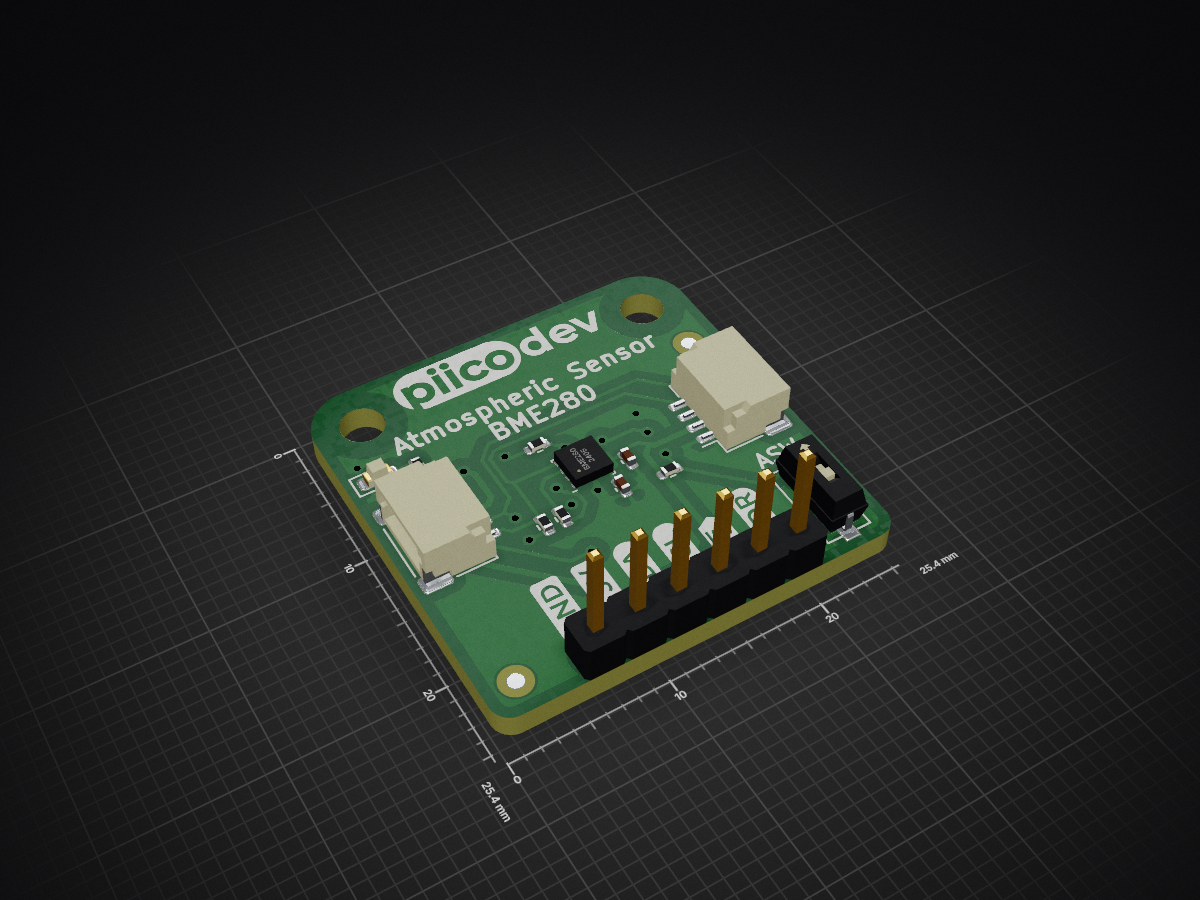
 CoreElectronics/CE-PiicoDev-Atmospheric-Sensor-BME2801
Hardware repo for the Core Electronics PiicoDev Atmospheric Sensor BME280
PiicoDev Atmospheric Sensor BME280 is an open-source printed circuit board by CoreElectronics, from the CoreElectronics/CE-PiicoDev-Atmospheric-Sensor-BME280 repository on GitHub. It is a 2-layer board of 25.4 × 25.4 mm with 30 parts on 11 nets, routed with 139 tracks and 16 vias.
It is built around the BME280. Its parts include 5 resistors, 3 connectors, 2 capacitors, 1 IC and 1 diode. It belongs with the sensors and measurement boards of this library.

This is the repo for the Core Electronics PiicoDev Atmospheric Sensor BME280.
The PiicoDev® Atmospheric Sensor allows you to easily measure barometric pressure, humidity, and temperature. Use it to build your own weather station or perform experiments. Better still, you can connect to this sensor using our PiicoDev system - no soldering is required to connect the PiicoDev Atmospheric Sensor to other devices in the PiicoDev family.
Features
Technical Specifications
This project is open source - please review the LICENSE.md file for further licensing information.
If you have any technical questions, or concerns about licensing, please contact technical support on the Core Electronics forums.
The hardware design of this module is influenced by the design from Sparkfun.
"PiicoDev" and the PiicoDev logo are trademarks of Core Electronics Pty Ltd.
| Qty | Value | Footprint | References |
|---|---|---|---|
| 5 | 10k | Resistor_SMD:R_0402_1005Metric | R1, R2, R3, R4, R5 |
| 2 | MountingHole:MountingHole_2.7mm_M2.5 | H1, H2 | |
| 2 | 100n | Capacitor_SMD:C_0402_1005Metric | C1, C2 |
| 2 | Fiducial | Fiducial:Fiducial_1mm_Mask2mm | FID1, FID2 |
| 2 | piico | Connector_JST:JST_SH_SM04B-SRSS-TB_1x04-1MP_P1.00mm_Horizontal | J1, J2 |
| 1 | CoreElectronics_Connectors:PinHeader_1x06_P2.54mm_Vertical_no-silk | J3 | |
| 1 | BME280 | Package_LGA:Bosch_LGA-8_2.5x2.5mm_P0.65mm_ClockwisePinNumbering | U1 |
| 1 | EN I2C MODE | CoreElectronics_Components:SolderJumper-2_P1.3mm_Bridged_RoundedPad1.0x1.5mm | JP3 |
| 1 | LED | LED_SMD:LED_0603_1608Metric | D1 |
| 1 | LED | CoreElectronics_Components:SolderJumper-2_P1.3mm_Bridged_RoundedPad1.0x1.5mm | JP2 |
| 1 | LOGO | CoreElectronics_Logos:pin-label_CS | G*** |
| 1 | LOGO | CoreElectronics_Logos:pin-label_GND | G*** |
| 1 | LOGO | CoreElectronics_Logos:pin-label_ADR | G*** |
| 1 | LOGO | CoreElectronics_Logos:pin-label_SDA | G*** |
| 1 | LOGO | CoreElectronics_Logos:pin-label_SCL | G*** |
| 1 | LOGO | CoreElectronics_Logos:pin-label_3V3 | G*** |
| 1 | LOGO_CoreElectronics_made-with-love | CoreElectronics_Artwork:piicodev_logo_14.2x3.4mm | G1 |
| 1 | LOGO_CoreElectronics_no-text | CoreElectronics_Artwork:CoreElectronics_logo_5mm | G1 |
| 1 | LOGO_made-with-love | CoreElectronics_Artwork:piicodev_logo_14.2x3.4mm | G3 |
| 1 | Logo_Open_Hardware_Small | CoreElectronics_Artwork:oshw | LOGO1 |
| 1 | SW_DIP_x01 | CoreElectronics_Components:SW_DIP_x01_Slide_CHS-01A1 | SW1 |
| 1 | SolderJumper_3_Bridged123 | CoreElectronics_Components:SolderJumper-3_P1.3mm_Closed_RoundedPad1.0x1.5mm_NumberLabels | JP1 |
It measures 25.4 × 25.4 mm and has 2 copper layers, 1.6 mm thick.
30 parts, built around the BME280. The full list of its parts is on this page, with links to each part's symbol and footprint where PCBKit's library has them.
From the CoreElectronics/CE-PiicoDev-Atmospheric-Sensor-BME280 repository on GitHub, at the commit this page was made from: the board is PCB/PiicoDev-Atmospheric-Sensor-BME280.kicad_pcb. PCBKit opens the board in the browser, with nothing to install.
Its repository states no licence, so its author keeps all rights: ask CoreElectronics before reusing the design.
nkitanov/iaq_board
IAQ Board is a DIY (Do-It-Yourself) device for measuring internal air quality


New-England-Weather-Balloon-Society/Tiny4FSK
Horus Binary v2 HAB Tracker


kbx81/ClimateSprinklerController
ESP32-based climate and sprinkler controller for use with ESPHome

crnicholson/StratoSoar-MK3
StratoSoar MK3, an autonomous glider meant for high-altitudes, accessible to everyone


CCHS-Melbourne/ESPlant
Environmental Sensor Plant - solar WiFi gardening/meteorological sensor using ESP8266