
4 layers95 × 95 mm
Cube motherboard
willem-pennings/balancing-cube
A cube that balances itself in a corner or edge using reaction wheels
52 parts1.1kGPL-3.0

 conradspiteri-alt/vetus-ec4-decode
An independent, listen-only decode of the CAN bus inside a Vetus EC4 electronic engine control (made by Flexball Italiana, 4500 series), plus the isolated sniffer hardware and firmware that captured it.
EC4-Carrier is an open-source printed circuit board by conradspiteri-alt, from the conradspiteri-alt/vetus-ec4-decode repository on GitHub, published under the MIT licence. It is a 2-layer board of 88 × 74 mm with 13 parts on 11 nets, routed with 57 tracks and 33 vias.
It is built around the ESP32-S3-DEVKITC-1-N8. Its parts include 4 connectors, 2 capacitors, 2 diodes and 1 fuse. It belongs with the ESP32 boards of this library.
An independent, listen-only decode of the CAN bus inside a Vetus EC4 electronic engine control (made by Flexball Italiana, 4500 series), plus the isolated sniffer hardware and firmware that captured it.
Version 0.2, October 2026. By Dr.FireFly.
Listen only. Do not transmit on an engine-control bus. See
NOTICE.md.
Some findings are not in this release: they are being disclosed to the manufacturers first.
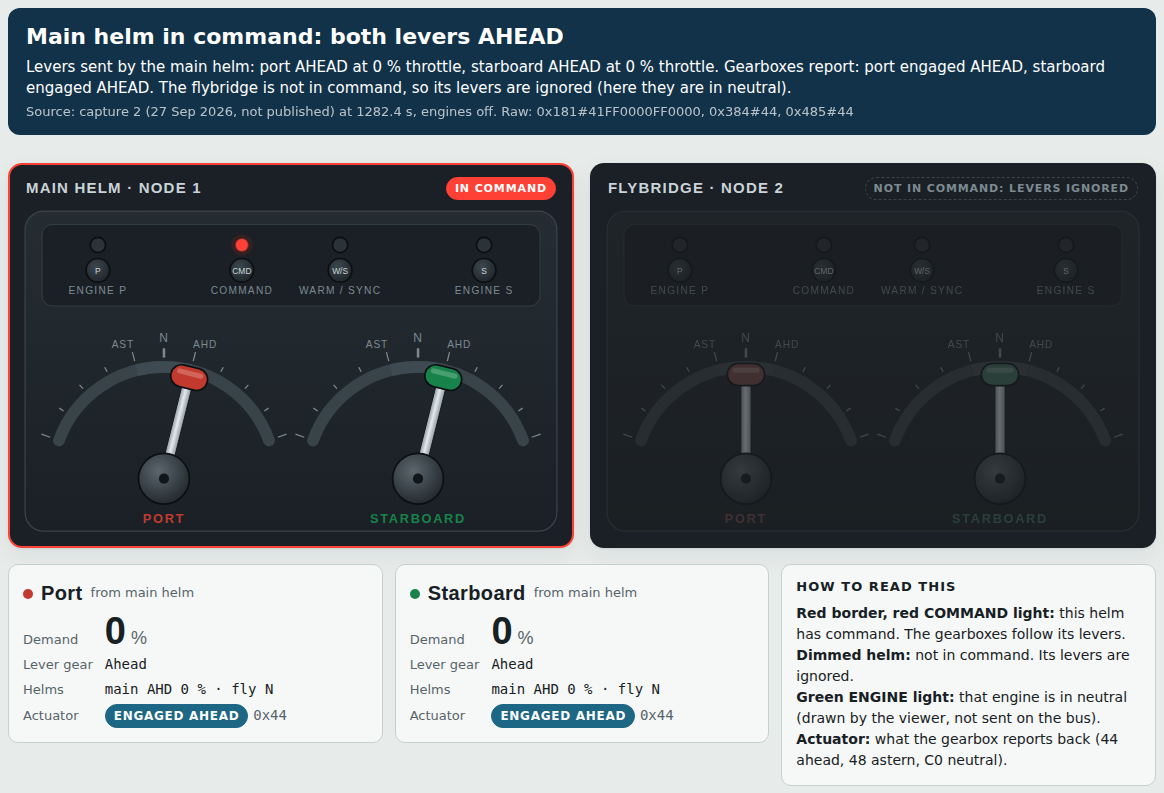
New to this? Start with docs/examples.md: ahead and astern at each helm, one picture each. Then docs/protocol.md for the decode, and docs/events.md for a full sequence from power-on to fast reversals.
| Path | What |
|---|---|
docs/examples.md | Simple examples: ahead and astern at each helm, one annotated picture each |
docs/protocol.md | The decode, with every value tagged measured, inferred or from the manual |
docs/events.md | Event gallery: the sample capture in the viewer at nine key moments |
docs/background-research.md | Desk research before the first capture (sources linked) |
docs/capture-procedures/ | Step lists used for captures 2 and 3 |
dbc/ec4.dbc | DBC for SavvyCAN and cantools; every message observed |
data/reference/*.csv | Reference tables: IDs and timing, byte maps, codes, boot, every shift event, reversals, findings, captures |
captures/ | candump logs with phone notes, and sample/ec4-sample.log, the viewer's built-in sample |
tools/ | Log reader, statistics, DBC validator, replay extractor, secrets check, browser playback viewer |
firmware/sniffer/ | ESP32-S3 listen-only logger firmware. Edit secrets.h before flashing |
hardware/sniffer/ | Carrier PCB (KiCad, gerbers), enclosure (OpenSCAD, STL, drawings), wiring diagrams, full BOM including the Vetus CANT T-piece |
Open tools/lever-playback/dist/EC4-Lever-Playback.html after building it, or build it with python3 tools/lever-playback/build.py. It opens on the sample capture; load any sniffer log with "Open log file".
pip install cantools
python3 tools/validate_dbc.py                       # decodes the published captures with the DBC
python3 tools/log_stats.py                          # periods, boots, gear response, bus load
python3 hardware/sniffer/tools/check_netlist.py     # PCB nets against the firmware pin map
python3 tools/check_secrets.py                      # run before every commit
python3 tools/lever-playback/build.py               # builds dist/EC4-Lever-Playback.html with the sample built in
python3 tools/lever-playback/screenshots.py # regenerates docs/images/events (needs Playwright)A Fairline Phantom 42, twin Volvo Penta TAMD63P, owner-installed EC4 with every parameter at factory default, two twin-lever heads (main helm and flybridge), two actuator boxes. Engines off in every capture.
Code: MIT (LICENSE). Documentation, data and hardware design files: CC BY 4.0 (LICENSE-DOCS.md). Dr.FireFly, 2026.
Captures from other EC4 installations are the most useful contribution: one labelled step per note, engines off, listen-only. The procedures in docs/capture-procedures/ are a template.
| Qty | Value | Footprint | References |
|---|---|---|---|
| 2 | 2.4mm | ec4:MountingHole | H3, H4 |
| 2 | 3.4mm | ec4:MountingHole | H1, H2 |
| 1 | 100nF-5.08 | ec4:C2 | C2 |
| 1 | 100uF-16V-radial-2.5 | ec4:C1 | C1 |
| 1 | 1N5819-DO41-7.62 | ec4:D2 | D2 |
| 1 | ESP32-S3-DevKitC-1 | ec4:J1 | J1 |
| 1 | P6KE6.8A-DO15-10.16 | ec4:D1 | D1 |
| 1 | PTC-1A-radial-5.08 | ec4:F1 | F1 |
| 1 | SKPang-ISO1050 | ec4:J3 | J3 |
| 1 | TerminalBlock_2x3.5mm | ec4:J2 | J2 |
| 1 | microSD-SB | ec4:J4 | J4 |
willem-pennings/balancing-cube
A cube that balances itself in a corner or edge using reaction wheels

jazzmonger/Traeger-PID-Controller
Traeger Smoker/Grill Controller based on an

ohasanov-hbrw/tribit32-advanced
A tri-microcontroller, overengineered GameBoy Advance clone. More value was given to the controls and the exterior look, which is cool!


FIPATECH/CDFR26_PAMI
Open source firmware and PCB for a differential mobile robot (PAMI) based on ESP32-S3 - Coupe de France de Robotique

dnhutchins/ETC_Express_Reverse_Eng
The ultimate goal of this work is to develop an interface to use the control surface from a legacy ETC Express 24/48 lighting controller as a modern EOSNomad compatible programming and fader wing.

heckler/esphome-device-configs
Configuration definitions for local ESPHome files
It measures 88 × 74 mm and has 2 copper layers, 1.6 mm thick.
13 parts, built around the ESP32-S3-DEVKITC-1-N8. The full list of its parts is on this page, with links to each part's symbol and footprint where PCBKit's library has them.
From the conradspiteri-alt/vetus-ec4-decode repository on GitHub, at the commit this page was made from: the board is hardware/sniffer/carrier-pcb/kicad-EC4-Carrier/EC4-Carrier.kicad_pcb. PCBKit opens the board in the browser, with nothing to install.
Its repository publishes it under the MIT licence: you may reuse it on that licence's terms (keep the author's notice, and for a copyleft licence share your changes alike).