
2 layers60 × 40 mm
 computerjazz/pico-next
Simple connected toys built from a single action — turn a knob, press a button, flip a switch.
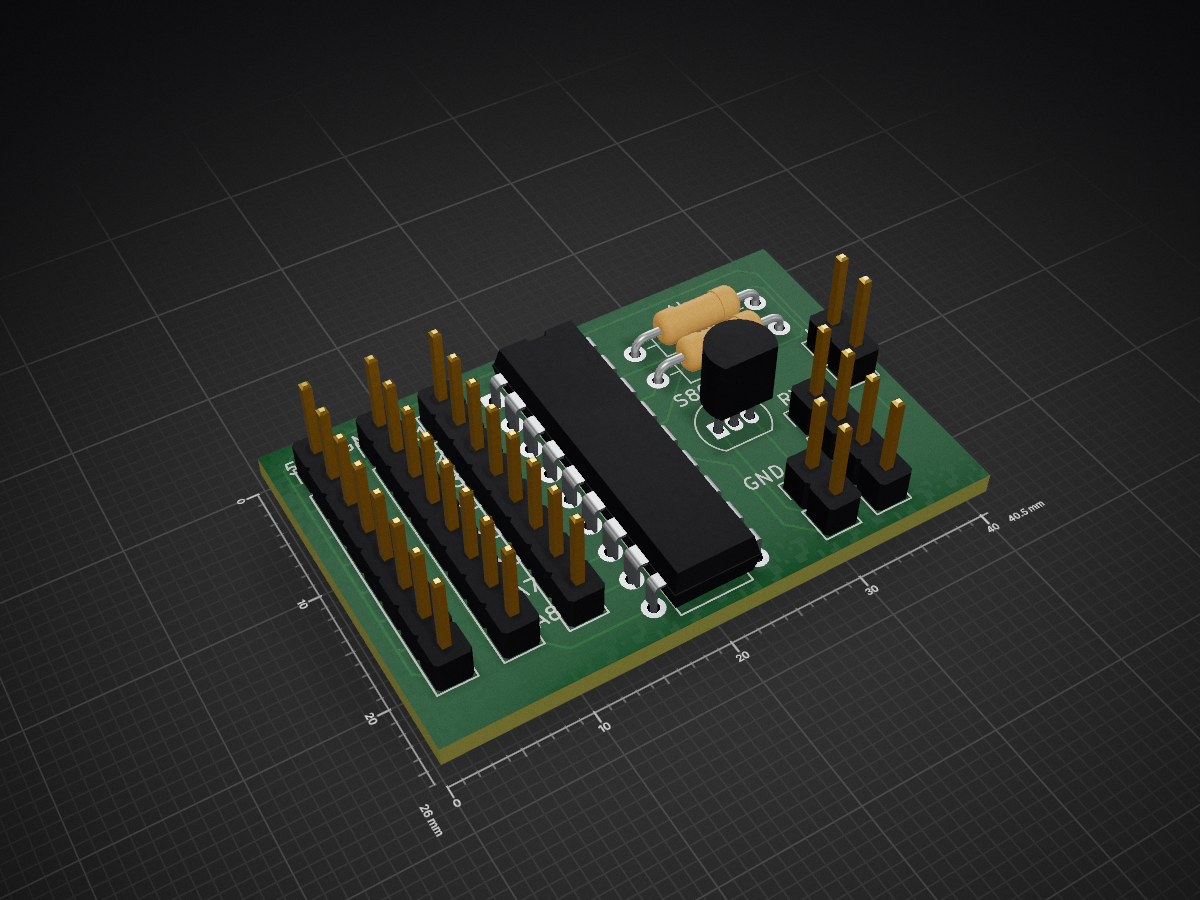
Glowstick is an open-source printed circuit board by computerjazz, from the computerjazz/pico-next repository on GitHub. It is a 2-layer board of 40.5 × 26 mm with 10 parts on 21 nets, routed with 108 tracks and 0 vias.
It is built around the S8050.

Simple connected toys built from a single action — turn a knob, press a button, flip a switch.
Each toy is a small wooden box with one big, satisfying control on top. WiFi-enabled ESP32 modules handle the electronics; this repo is the web app and backend that ties them together.
Picopi started as a sandbox — a place to explore modern Next.js with Server Actions and React Server Components, and to figure out how to self-host the whole stack on a Raspberry Pi.
From there it grew into something much more physical. ESP32 modules, custom PCBs, woodworking, product design — all in service of one goal: building meaningful connected experiences for kids. Not apps on screens, but real objects with weight and texture that do one thing well.
sh0rtwave is the one that struck a chord. A little answering machine for voice messages between kids and the people who love them. Press the button, leave a message. When the light blinks, someone left one for you. The recordings pile up over time into a collection of audio I'll cherish forever.
| Route | Toy | Action | What it does |
|---|---|---|---|
/shortwave | sh0rtwave | Push a button | Trade voice messages — no screens attached |
/toggle | toggle | Flip a switch | Keep two toggles in sync from afar; compete on the leaderboard |
/hidden-radio | hidden radio | Turn a knob | Discover what's hiding in the FM spectrum off the usual radio dial |
Firmware for each device lives under esp32/.
server.ts) — Next.js request handler plus a WebSocket server for live device communicationesp32/shortwave, esp32/toggle, and esp32/knobesp32/shortwave/sh0rtwave_pcb/)The whole stack runs self-hosted on a Raspberry Pi, deployed and managed through Coolify. The app ships as a Docker image (multi-stage build; production image includes ffmpeg).
| Layer | Tool | Role |
|---|---|---|
| Compute | Raspberry Pi + Coolify | Self-hosted app platform |
| Containers | Docker | Build, ship, and run the Next.js app + custom server |
| Database | PostgreSQL | Primary data store (devices, recordings, users, toggle groups) |
| Cache / pub-sub | Redis | Real-time command routing to WebSocket clients |
| Private network | Tailscale | Secure mesh VPN — access the Pi and services without exposing ports |
| Public ingress | Cloudflare Tunnels | Expose the app to the internet (and ESP32 devices) without port forwarding |
app/           Next.js pages, components, server actions, and API routes
db/            Drizzle schema and database client
esp32/         Device firmware and PCB files
lib/           Shared utilities (auth, redis, websocket, push, etc.)
scripts/       CLI helpers (Gmail auth, token generation, DB seeding)
server.ts      Custom HTTP + WebSocket server for production
drizzle/       Database migrations
public/ Static assets and OTA firmware binariesnpm install
npm run devOpen http://localhost:3000.
In production the app runs on a Raspberry Pi via Coolify, behind a Cloudflare Tunnel, with PostgreSQL and Redis as managed services on the same host.
npm run build          # Next.js build
npm run build:server   # Bundle custom server
npm run build:release  # Build + run with .env.local
Or build the Docker image directly:
docker build -t picopi .
docker run -p 3000:3000 picopiCopy and configure environment variables for your local setup (database URL, Redis, auth secrets, API keys). See .env.local and the env.h.example files under esp32/ for device-side credentials.
npx drizzle-kit migratePrivate — not open source.
| Qty | Value | Footprint | References |
|---|---|---|---|
| 3 | Conn_01x08_Pin | Connector_PinHeader_2.54mm:PinHeader_1x08_P2.54mm_Vertical | 5v, A1, GND |
| 2 | Conn_01x02_Pin | Connector_PinHeader_2.54mm:PinHeader_1x02_P2.54mm_Vertical | GND OUT, J4 |
| 1 | Conn_01x04_Pin | Connector_PinHeader_2.54mm:PinHeader_1x04_P2.54mm_Vertical | RX |
| 1 | Conn_02x09_Odd_Even | Package_DIP:DIP-18_W7.62mm | 2272 |
| 1 | R_US 1k | Resistor_THT:R_Axial_DIN0207_L6.3mm_D2.5mm_P10.16mm_Horizontal | 1k |
| 1 | R_US 750k | Resistor_THT:R_Axial_DIN0207_L6.3mm_D2.5mm_P10.16mm_Horizontal | 750k |
| 1 | S8050 | Package_TO_SOT_THT:TO-92_Inline | S8050 |
It measures 40.5 × 26 mm and has 2 copper layers, 1.6 mm thick.
10 parts, built around the S8050. The full list of its parts is on this page, with links to each part's symbol and footprint where PCBKit's library has them.
From the computerjazz/pico-next repository on GitHub, at the commit this page was made from: the board is esp32/glowstick/Untitled/Untitled.kicad_pcb and its schematic esp32/glowstick/Untitled/Untitled.kicad_sch. PCBKit opens the board in the browser, with nothing to install.
Its repository states no licence, so its author keeps all rights: ask computerjazz before reusing the design.

drandyhaas/HaasoscopePro
Affordable 2 GHz 3.2 GS/s 12 bit open-source open-hardware expandable USB real-time oscilloscope


doudar/SmartSpin2k
Transform your spin bike into a Smart Trainer!


