2 layers80 × 120 mm
 ComplacencyKillz/GhostMesh5
Meshtastic + Flipper Zero integration for offline red team comms — remote Bad USB, killswitch, and mesh-based C2 over LoRa
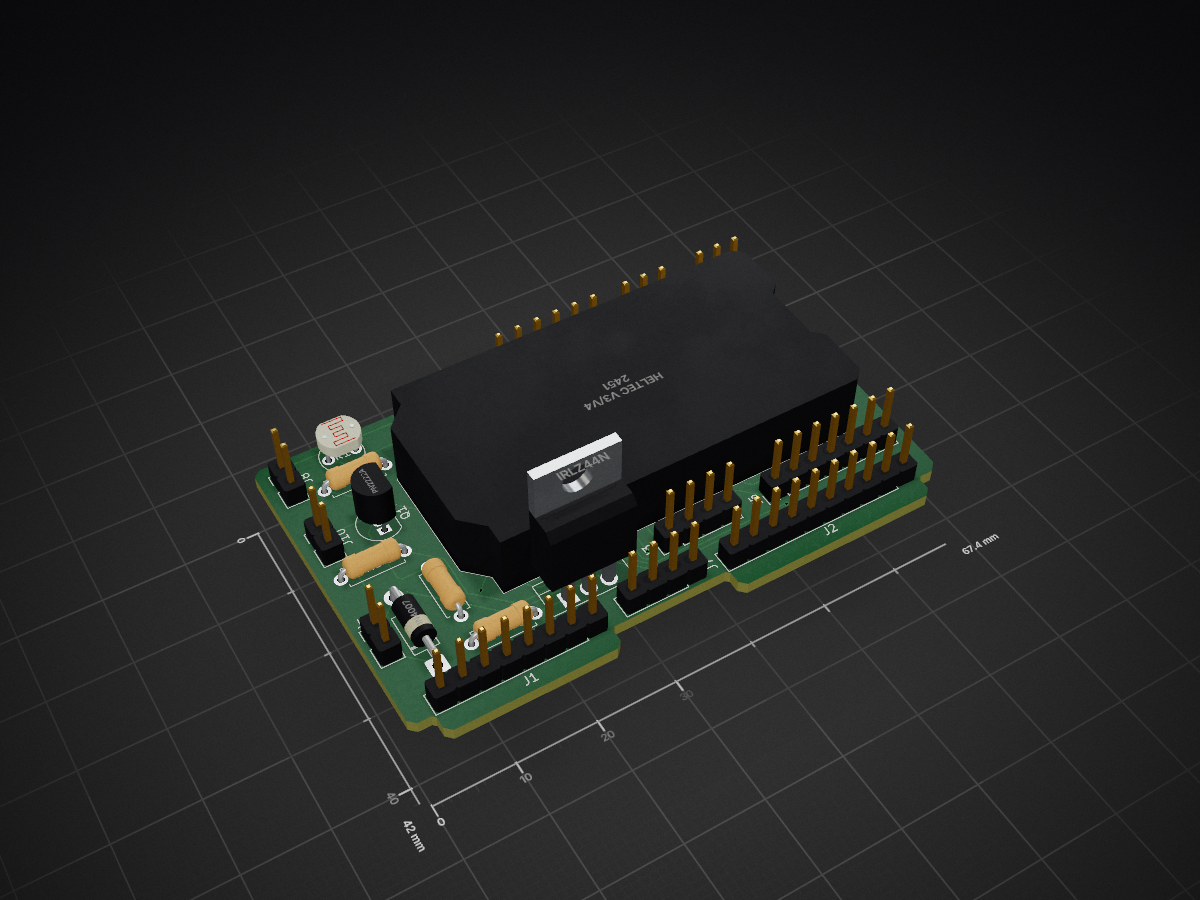
FlipperZeroModule is an open-source printed circuit board by ComplacencyKillz, from the ComplacencyKillz/GhostMesh repository on GitHub, published under the MIT licence. It is a 2-layer board of 67.4 × 42 mm with 23 parts on 62 nets, routed with 165 tracks and 18 vias.
It is built around the BME280, IRLZ44N and PN2222A, with the SK6812 among its other parts. Its parts include 11 connectors, 6 resistors, 2 diodes, 2 transistors and 1 IC. It belongs with the radio and wireless boards of this library.


A deployable red-team mesh platform — planted sensors, encrypted command-and-control, line-of-sight control, and a destruct — running on nothing the target owns.
GhostMesh is a backpack that snaps onto a Flipper Zero — then detaches and stays in the field. Attached, it turns your Flipper into a long-range mesh radio: messaging and control over LoRa, no phone, no cell, no internet, nothing the target controls. Detached and planted, it becomes an autonomous node — watching its own perimeter, holding its place on the mesh, and taking orders by line-of-sight IR from you or over the encrypted mesh from your team. Drop it, walk away, and it stays yours.
This repository is the framework — the sensing, signaling, and command backbone that offensive capability is built on top of. It reports, it takes commands, and it erases itself on capture. Unlicensed by design.
Everything to build one, end to end — all of it open source:
| Deliverable | Location | Status |
|---|---|---|
| Operator app — the Flipper FAP (C99) | flipper-app/ | working |
| Backpack firmware — custom Heltec Meshtastic modules (C++) | heltec-firmware/ | working |
| Board CAD — the GhostMesh PCB | kicad/ | in progress |
| Case CAD — 3D-printable enclosure (FreeCAD) | — | planned |
| Hardware spec — every component, datasheet-trackable | docs/hardware.md | in progress |
| Wiring schematic — the full system, end to end | kicad/ · docs/wiring.md | in progress |
The two software halves work today. The board is being designed; the case, the finished component spec, and the whole-system schematic follow it. The transmission — ghostmesh.info.
The backpack is a shield. It plugs onto the Flipper Zero's GPIO header, taps the three pins it needs — TX, RX, GND — and passes the header through to the Heltec and sensor stack riding on top. One board. It runs from its own battery; the Flipper runs from its own. The header is the only link, and it's a link you can break on purpose.
   ATTACHED — comms terminal            DETACHED — planted node
  ┌──────────────────────┐            ┌──────────────────────┐
  │  backpack             │  pull off  │  backpack             │  ))) mesh → teammate's Flipper
  │  Heltec + sensors     │  ───────▶  │  on its own battery   │
  │ ══ GPIO header ══     │  ◀───────  │  sensing · on mesh    │   ~~ IR → your Flipper
  │  Flipper Zero         │  snap on   │                       │
  └──────────────────────┘            └──────────────────────┘
Attached — a comms terminal. The backpack rides on the Flipper, which drives it over the header link: send and receive over the LoRa mesh, read telemetry, work the Control screen. Your handheld is now a long-range, infrastructure-free field radio.
Detached — a planted node. Pull the backpack off. The header disconnects; it keeps running on its own battery as an isolated asset — sensing its surroundings, holding its place on the mesh, waiting.
Controlled from anywhere.
Operator terminal — Flipper FAP
tools/log_to_kml.py)Web configurator — ghostmesh.info/config (Chrome/Edge, USB, no install)
/set//cfg) — every setting as a slider/toggle.bin from the browser/put chunked file transfer to the node's flash, CRC32-verifiedBackpack — custom Heltec firmware
/cmd @target: status, arm/disarm, buzz, vibrate, led, fx, /set//cfg, /put, wipesilent stealth mode (screen + LEDs + buzzer/vibration off), per-sensor battery gating, GPS/telemetry rate control — all live, no reflashARM → WIPE → CONFIRM destructHardware
Full phase-by-phase status: docs/roadmap.md.
The GhostMesh backpack — the custom board that integrates all of this into one Flipper shield — is under active development (kicad/). Until it's fabricated, you build on off-the-shelf parts:
Core — send / receive over the mesh:
Full backpack — sensing + security: adds a BME280, a GPS module, tilt / photoresistor / proximity sensors, an IR receiver, a buzzer, a vibration motor, and their driver parts.
The complete bill of materials — every component, GPIO, and driver circuit — is in docs/hardware.md.
Visit flasher.meshtastic.org, select Heltec WiFi LoRa 32 V3, flash, and set your region. See docs/meshtastic-setup.md for the private-channel configuration you'll want before any real use.
On the backpack PCB these run through the GPIO header automatically. On the bench, jumper them:
Flipper U_TX (pin 13)  →  Heltec GPIO7  (Serial module RX)
Flipper U_RX (pin 14)  →  Heltec GPIO6  (Serial module TX)
Flipper GND            →  Heltec GND
Then configure the Meshtastic Serial module: PROTO mode, RX 7, TX 6, 115200, override-console OFF. Not GPIO43/44 — the CP2102 USB bridge clamps those on battery. Never bridge the power rails — the backpack and Flipper each run from their own battery. See docs/wiring.md.
pip install ufbt
cd flipper-app
ufbt
Copy dist/ghostmesh.fap to SD:/apps/Tools/ on the Flipper, or ufbt launch over USB. See docs/flipper-setup.md.
The custom Heltec modules build on top of stock Meshtastic. See heltec-firmware/README.md.
Apps → Tools → GhostMesh. The title bar shows ... during the handshake (~3 s), then RDY, then the backpack's battery %. You land on the menu hub — Messages, RX History, Sensors, Control, Status, Backup. See docs/user-guide.md.
Start here
docs/overview.md — the system end to end: architecture, concepts, the platform visionBuild & operate
docs/hardware.md — full BoM, GPIO allocation, powerdocs/wiring.md — pinouts, driver circuits, sensor wiringdocs/meshtastic-setup.md — Meshtastic config, private channelsdocs/flipper-setup.md — ufbt build & installheltec-firmware/README.md — building the backpack firmwaredocs/user-guide.md — the FAP, screen by screenOperate the backpack
docs/command-cli.md — the mesh command CLI + wipe safetydocs/opsec.md — encryption, the destruct, stealth, metadataReference
docs/developer-guide.md — architecture, ISR rules, contributingdocs/serial-modes.md — PROTO framing & protobuf field numbersdocs/roadmap.md — the phased plan (Phases 0–14)docs/red-team-lab-use-cases.md — authorized use casesMIT — see LICENSE.
// so light your candles| Qty | Value | Footprint | References |
|---|---|---|---|
| 3 | 10k | Resistor_THT:R_Axial_DIN0207_L6.3mm_D2.5mm_P7.62mm_Horizontal | R2, R3, R6 |
| 2 | 1k | Resistor_THT:R_Axial_DIN0207_L6.3mm_D2.5mm_P7.62mm_Horizontal | R4, R5 |
| 1 | 1N4007 | Diode_THT:D_DO-41_SOD81_P10.16mm_Horizontal | D1 |
| 1 | BME_280 | Connector_PinHeader_2.54mm:PinHeader_1x07_P2.54mm_Vertical | J5 |
| 1 | Buzzer | Connector_PinHeader_2.54mm:PinHeader_1x02_P2.54mm_Vertical | J10 |
| 1 | Flipper_10_pin | Connector_PinHeader_2.54mm:PinHeader_1x10_P2.54mm_Vertical | J2 |
| 1 | Flipper_8_pin | Connector_PinHeader_2.54mm:PinHeader_1x08_P2.54mm_Vertical | J1 |
| 1 | GPS.v3 | Connector_PinHeader_2.54mm:PinHeader_1x04_P2.54mm_Vertical | J7 |
| 1 | Heltec V3/V4 | Library:heltech v4 | U1 |
| 1 | IRLZ44N | Package_TO_SOT_THT:TO-220-3_Vertical | Q3 |
| 1 | IR_Receiver | Connector_PinHeader_2.54mm:PinHeader_1x03_P2.54mm_Vertical | J4 |
| 1 | MAX17048 | Connector_PinHeader_2.54mm:PinHeader_1x06_P2.54mm_Vertical | J6 |
| 1 | PN2222A | Package_TO_SOT_THT:TO-92_Inline | Q1 |
| 1 | R_Photo | OptoDevice:R_LDR_5.1x4.3mm_P3.4mm_Vertical | R1 |
| 1 | SK6812 | LED_SMD:LED_SK6812_PLCC4_5.0x5.0mm_P3.2mm | D2 |
| 1 | SW_Wipe | Button_Switch_THT:SW_PUSH-12mm | SW2 |
| 1 | Switch | Connector_PinHeader_2.54mm:PinHeader_1x03_P2.54mm_Vertical | J9 |
| 1 | Tilt | Connector_PinHeader_2.54mm:PinHeader_1x02_P2.54mm_Vertical | J8 |
| 1 | Ulrasonic | Connector_PinHeader_2.54mm:PinHeader_1x04_P2.54mm_Vertical | J3 |
| 1 | coin | Connector_PinHeader_2.54mm:PinHeader_1x02_P2.54mm_Vertical | J11 |
It measures 67.4 × 42 mm and has 2 copper layers, 1.6 mm thick.
23 parts, built around the BME280, IRLZ44N, PN2222A and SK6812. The full list of its parts is on this page, with links to each part's symbol and footprint where PCBKit's library has them.
From the ComplacencyKillz/GhostMesh repository on GitHub, at the commit this page was made from: the board is kicad/FlipperZeroModule/FlipperZeroModule.kicad_pcb and its schematic kicad/FlipperZeroModule/FlipperZeroModule.kicad_sch. PCBKit opens the board in the browser, with nothing to install.
Its repository publishes it under the MIT licence: you may reuse it on that licence's terms (keep the author's notice, and for a copyleft licence share your changes alike).


IaMdEvJaXoN/industry_temperature_control_system
This project entails Dallas Temperature sensors sending data to the ESP32 which then determines the PWM output to the actuators after the PID engine runs.The ESP32 also sends telemetry to Firebase RTDB which then sends…


Pingu207/ROCKET
Designing and building a TVC rocket controlled by a custom PCB wired to a ESP32-WROOM board

wwwansarmhd2-ctrl/Cryofrost-PCB
A single-sided PCB controller motherboard designed for an environmental test chamber (CryoFrost) driven by an ESP32, featuring precision temperature/humidity control, thermoelectric Peltier cooling, ultrasonic…

yoganshbhalla/payl_theseus_2026_HW
Repository containing all Payload PCBs and FW for Theseus 2026
