4 layers93.5 × 94.5 mm
RC Buggy
TheFlocke/rc-buggy
Autonomous rover with BLE control and robotic arm, built for a DLR high school competition.
162 partsGPL-3.0

 CentyLab/RotoPD176
Repo for RotoPD hardware and documentation
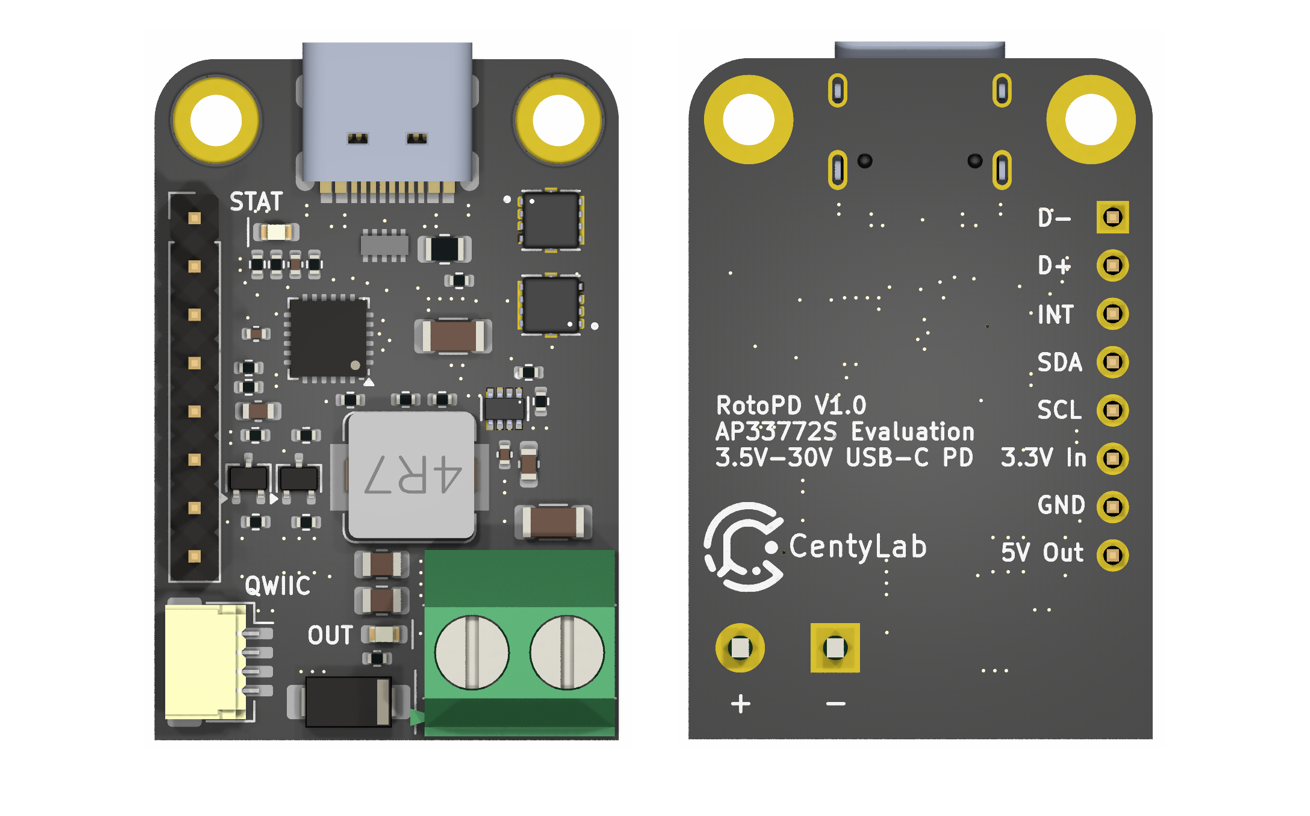
RotoPD is an open-source printed circuit board by CentyLab, from the CentyLab/RotoPD repository on GitHub. It is a 2-layer board of 24.4 × 35.8 mm with 44 parts on 39 nets, routed with 272 tracks and 68 vias.
It is built around the AON7262E, BSS138 and TPD4E05U06DQAR. Its parts include 16 resistors, 9 capacitors, 4 ICs, 4 diodes and 4 connectors.


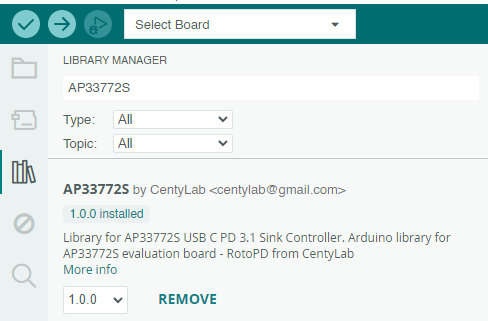
You can install the library directly on ArduinoIDE
While traditional power adapters can provide a variety of current but fixed to 5V output, our RotoPD leverages advanced power delivery protocols to achieve a versatile output range— 3.5V to 30V at 150W max. The breakout board use a stand alone Power Delivery Sink controller to negotiate with your modern charger and provide different output voltage.
Centylab's RotoPD can unlock more advance mode in your USB-C power supplies like Programmable Power Supply (PPS) and Adjustable Voltage Supply (AVS), to provide even more granular voltage adjustment. The RotoPD simplifies power negotiation with USB-C adapters, handling the complex process of establishing power delivery contracts. The controller does all the heavy lifting of power negotiation and provides an easy way to configure over I2C, free your micro-controller from the complicated USB-C PD protocol.
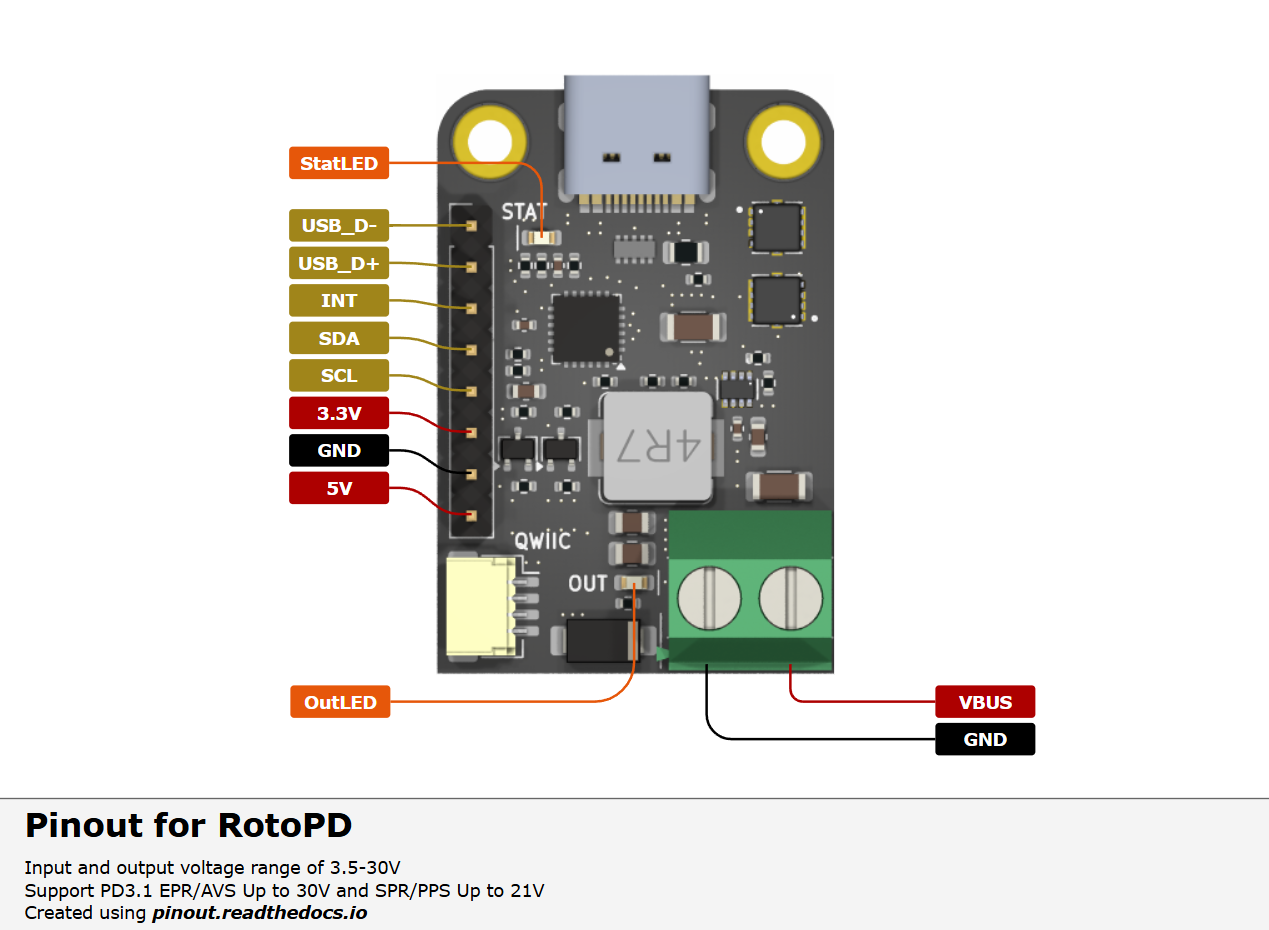
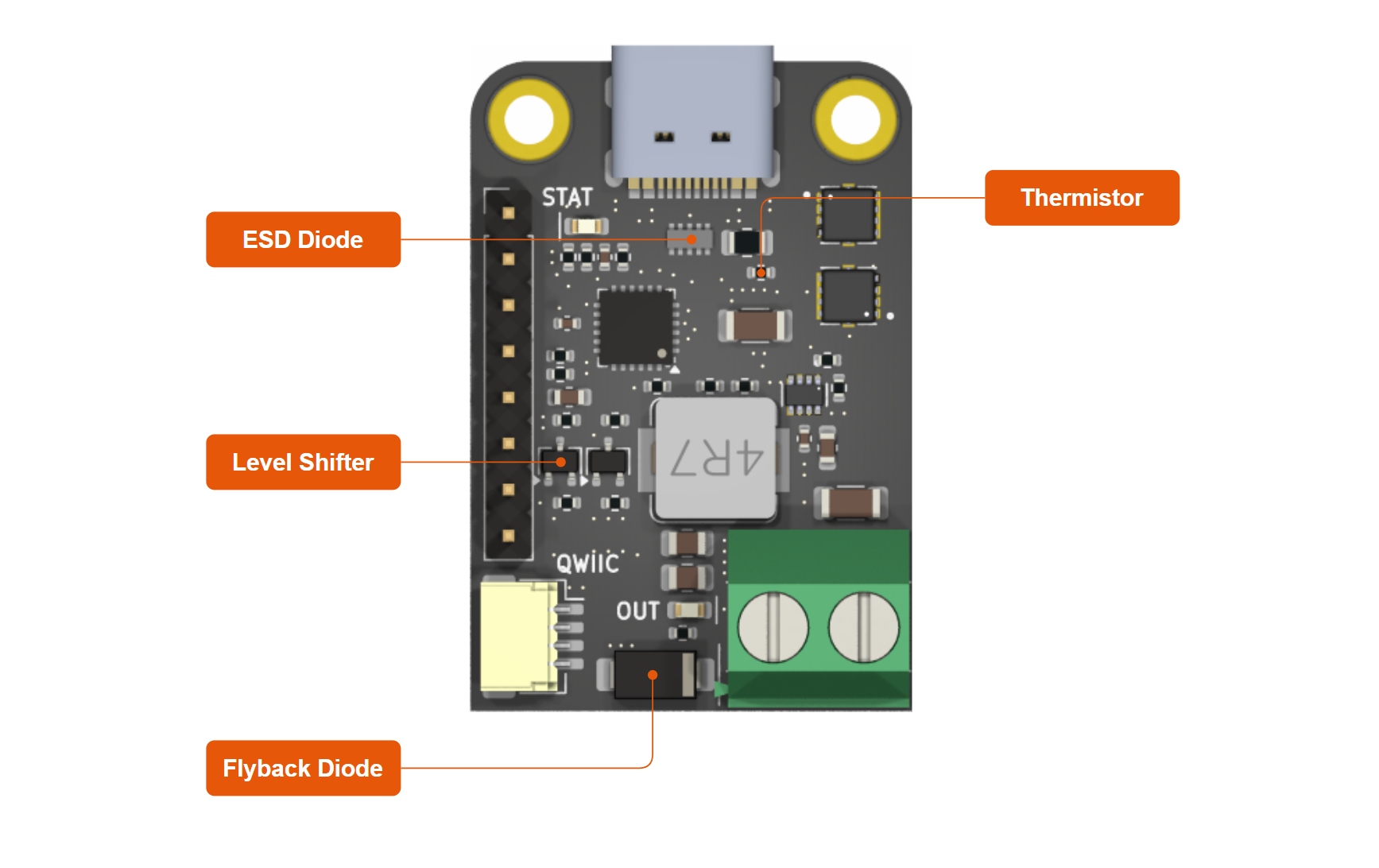
To config the board, you will need an I2C bus. The board integrates seamlessly into the Qwiic and STEMMA QT ecosystems, no soldering is required. We also include an logic level shifter on board to work with 3.3V or 5V I2C system.
To make it even easier to use, RotoPD includes a built-in buck converter that efficiently steps down USB-C VBUS power to a stable 5V 2A output, making it perfect for powering microcontrollers, sensors, and other low-voltage components in your project.
To ultilize AVS power profile, you will need a powerbank or charger that has AVS profile and a 240W USB-C cable. Here are some chargers that we found support AVS profile.
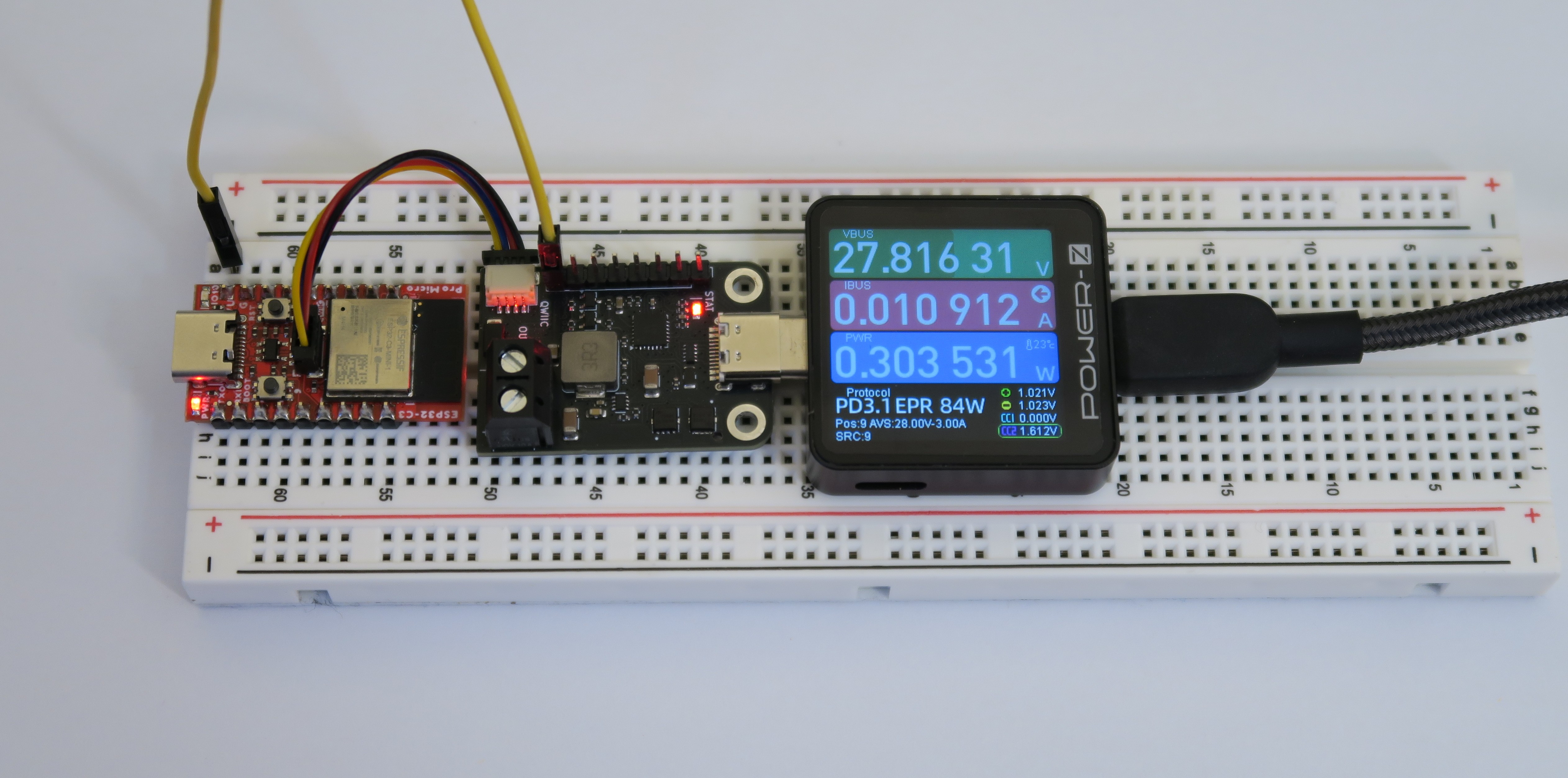
AVSFixed example with Sparkfun Pro Micro ESP32-C3. We are requesting AVS 28V.
| Qty | Value | Footprint | References |
|---|---|---|---|
| 8 | 5.1k | Resistor_SMD:R_0402_1005Metric | R1, R2, R6, R7, R10, R11, R13, R15 |
| 5 | 10k | Resistor_SMD:R_0402_1005Metric | R3, R4, R9, R14, R18 |
| 3 | 100nF | Capacitor_SMD:C_0402_1005Metric | C2, C8, C10 |
| 2 | 10u | Capacitor_SMD:C_1206_3216Metric | C3, C6 |
| 2 | 22u | Capacitor_SMD:C_0805_2012Metric | C4, C5 |
| 2 | AON7262E | Transistor_MOSFET:DFN-8(3.3x3.3) | U4, U6 |
| 2 | BSS138 | Package_TO_SOT_SMD:SOT-323_SC-70 | Q1, Q2 |
| 2 | MountingHole | MountingHole:MountingHole_2.7mm_M2.5_DIN965_Pad_TopBottom | H1, H2 |
| 2 | RED | LED_SMD:LED_0603_1608Metric | D1, D2 |
| 1 | 1u | Capacitor_SMD:C_0603_1608Metric | C9 |
| 1 | 27R | Resistor_SMD:R_0402_1005Metric | R12 |
| 1 | 3.3u | Inductor_SMD:L_Bourns_SRP7028A_7.3x6.6mm | L1 |
| 1 | 33n | Capacitor_SMD:C_0603_1608Metric | C1 |
| 1 | 52.3k | Resistor_SMD:R_0402_1005Metric | R8 |
| 1 | 5m | Resistor_SMD:R_0805_2012Metric | R5 |
| 1 | AP33772S | Interface_USBC:QFN-24-1EP_4x4mm_P0.5mm_EP2.6x2.6mm | U5 |
| 1 | Conn_01x08 | Connector_PinHeader_2.54mm:PinHeader_1x08_P2.54mm_Vertical | J4 |
| 1 | D_Schottky | Diode_SMD:D_SMA | D3 |
| 1 | LOGO | Logo:CentyLab_logo | G*** |
| 1 | QWIIC | Connector_JST:JST_SH_SM04B-SRSS-TB_1x04-1MP_P1.00mm_Horizontal | J2 |
| 1 | Screw_Terminal_5mm | TerminalBlock_Phoenix:TerminalBlock_Phoenix_MKDS-1,5-2_1x02_P5.00mm_Horizontal | J3 |
| 1 | TPD4E05U06DQAR | Diode_TVS:SON50P100X255X50-10N | D4 |
| 1 | TPS62933DRLR | Power_Converter:SOT583 | U3 |
| 1 | Thermistor_NTC | Resistor_SMD:R_0402_1005Metric | TH1 |
| 1 | USB_C_Receptacle_USB2.0_16P | Connector_USBC:USB_C_GSwitch | J1 |
It measures 24.4 × 35.8 mm and has 2 copper layers, 1.6 mm thick.
44 parts, built around the AON7262E, BSS138 and TPD4E05U06DQAR. The full list of its parts is on this page, with links to each part's symbol and footprint where PCBKit's library has them.
From the CentyLab/RotoPD repository on GitHub, at the commit this page was made from: the board is Hardware/RotoPD.kicad_pcb and its schematic Hardware/RotoPD.kicad_sch. PCBKit opens the board in the browser, with nothing to install.
Its repository states no licence, so its author keeps all rights: ask CentyLab before reusing the design.
TheFlocke/rc-buggy
Autonomous rover with BLE control and robotic arm, built for a DLR high school competition.


hugoNN1001/LattePanda-Mu-Custom-Carrier-Board
Personal project, work in progress - Learning digital high-speed PCB design by designing a custom carrier board for the LattePanda Mu - based on the reference design: https://github.com/LattePandaTeam/LattePanda-Mu

Keyaan-07/Hotplate
Check out the Project's files on KiCanvas(PCB and Heating element) and Onshape!

Keyaan-07/Zenith
A battery powered single board computer capable of running linux
