2 layers50 × 35 mm

 cellularmitosis/817-TTL-Serial-Optoisolator
A board for isolating a TTL serial RX / TX pair using 817 (4-pin) optoisolators.
817-TTL Serial Optoisolator is an open-source printed circuit board by cellularmitosis, from the cellularmitosis/817-TTL-Serial-Optoisolator repository on GitHub, published under the MIT licence. It is a 2-layer board of 40.6 × 22.9 mm with 17 parts on 14 nets, routed with 69 tracks and 0 vias.
Its parts include 6 resistors, 2 ICs, 2 transistors and 2 connectors. It belongs with the interfaces and adapters boards of this library.
A board for isolating a TTL serial RX / TX pair using 817 (4-pin) optoisolators.
This board is untested.
See Designing a TTL Serial Opto isolator
Initial board design.
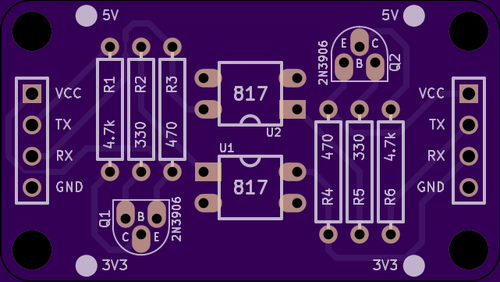
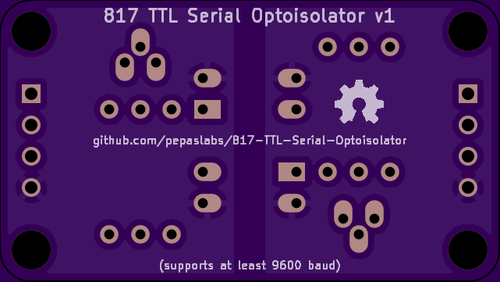
PDF.
This board design is Open-Source Hardware. It is licensed under the MIT License. It was designed by Jason Pepas.
| Qty | Value | Footprint | References |
|---|---|---|---|
| 4 | Val** | hole_M3_2 | H***, H***, H***, H*** |
| 2 | 2N3906 | TO-92_Q_EBC_059Bo_PL | Q1, Q2 |
| 2 | 330 | R_AXIAL_0W25_059A_PL | R2, R5 |
| 2 | 4.7k | R_AXIAL_0W25_059A_PL | R1, R6 |
| 2 | 470 | R_AXIAL_0W25_059A_PL | R3, R4 |
| 2 | 817 | DIP4_059Bi_PL | U1, U2 |
| 2 | CONN_4 | PIN_ARRAY_4x1 | P1, P2 |
| 1 | OSHW-logo_silkscreen-back_4mm | OSHW-logo_silkscreen-back_4mm | G*** |


hoglet67/RGBtoHDMI
Bare-metal Raspberry Pi project that provides pixel-perfect sampling of Retro Computer RGB/YUV video and conversion to HDMI


hackclub/OnBoard
💡 Join 1,000 teenagers and make your first PCB with a $100 grant!

DDeGonge/OS-ARM
This arm is not industrial and it will not be fast, but that is not my goal. But it will hopefully be a very nice looking arm fully capable of 6dof motion, cheap enough to keep it accessable but capable enough to…


It measures 40.6 × 22.9 mm and has 2 copper layers, 1.6 mm thick.
17 parts. The full list of its parts is on this page, with links to each part's symbol and footprint where PCBKit's library has them.
From the cellularmitosis/817-TTL-Serial-Optoisolator repository on GitHub, at the commit this page was made from: the board is kicad/817-TTL-Serial-Optoisolator.kicad_pcb. PCBKit opens the board in the browser, with nothing to install.
Its repository publishes it under the MIT licence: you may reuse it on that licence's terms (keep the author's notice, and for a copyleft licence share your changes alike).