


2 layers98 × 27 mm

Repo to contain all 5 DS4 charging boards in Type-C variant. Currently holds JDS 001, 040, 050, and 055.
001-v2 is an open-source printed circuit board by CasualCodersProjects, from the CasualCodersProjects/DS4-Type-C repository on GitHub, published under the MIT licence. It is a 2-layer board of 24.4 × 21.3 mm with 5 parts on 12 nets, routed with 85 tracks and 23 vias.
Its parts include 2 resistors, 2 connectors and 1 diode.
This project has reached EOL. It is no longer under active development. PRs will be merged, but I no longer intend to update boards. Feel free to use all of the info provided here to make modifications to boards like using new parts or LEDs. These are pretty basic though, so this should hopefully hold until the DS4 controller is well discontinued.
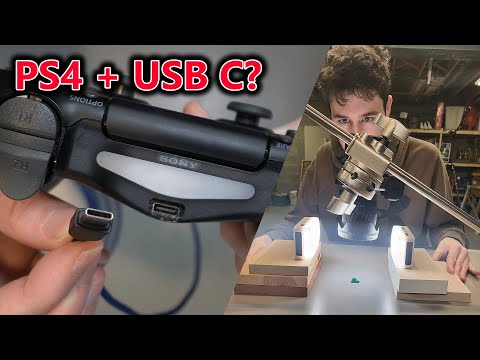
Hate microUSB? Looking to decrease cable clutter? This is the PS4 mod for you. This repo aims to host mostly drop-in USB Type C replacement boards for all revisions of PS4 controller. Each board follow the USB Type C legacy standard, allowing C to C charging and data transfer at USB 2.0 speeds. The overall project goal is to keep all possible parts the same between boards, and to make it reasonablly easy for a person of moderate skill to populate these boards. This is an open source project though, so you're free to download KiCad and start making modifications to these boards so that you can more easily populate them.
I used a 0.8mm PCB when I originally made these, and found it worked quite well. Gives a little more room to work inside the controller. Cost will likely depend on which board house you choose to go through.
| DS4 Board | Tested | PCB | Connector | Pictures | Credits |
|---|---|---|---|---|---|
| JDS-001 | ✔ | 001 | 14 | Schematic, Front, Back | 1 |
| JDS-011 | ✔ | 011 | 12 | Schematic, Front, Back | 2 1 |
| JDS-030 | ✔ | 030 | 12 | Schematic, Front, Back | 3 |
| JDS-040 | ✔ | 040-055 | 12 | Schematic, Front, Back | 4 |
| JDS-05X | ✔ | 040-055 | 12 | Schematic, Front, Back | 4 |
The idea here is to create one "panelized" board which contains all above boards (JDS 001, 011, 030, 040, 050, 055). This means that someone could easily acquire a board for all controllers, then populate the one they need.
Work can now begin for this panel.
This is not something I plan to do anymore. If you'd like to do this and submit a PR, feel free and I'll merge it.
-Ian
The original shape for this board was done here by Martin Refseth. Thxandbye created the schematic and laid the traces on top. ↩ ↩2
Thanks to IcicaSora for providing the schematic for 011 ↩
Thanks to 12brendan3 for providing the schematic for 030 ↩
According to reddit user u/Mcorgano the pinout is supposedly the same between JDS-040 and JDS-055. The idea for this dual board also comes from the same user.
As of 11/08/2021, the 055 pinout has been confirmed by reddit user u/jrmanpt ↩ ↩2
| Qty | Value | Footprint | References |
|---|---|---|---|
| 2 | 5.1k | Resistor_SMD:R_0603_1608Metric_Pad0.98x0.95mm_HandSolder | R1, R2 |
| 1 | Conn_01x14 | Connector_Custom:FPC_Connector | J2 |
| 1 | LED_RAGB | LED_Custom:FM-3510RGBA-SG | D1 |
| 1 | USB_C_Receptacle_USB2.0 | Connector_Custom:USB_C | J1 |
It measures 24.4 × 21.3 mm and has 2 copper layers, 1.6 mm thick.
5 parts. The full list of its parts is on this page, with links to each part's symbol and footprint where PCBKit's library has them.
From the CasualCodersProjects/DS4-Type-C repository on GitHub, at the commit this page was made from: the board is 001-v2/001-v2.kicad_pcb and its schematic 001-v2/001-v2.kicad_sch. PCBKit opens the board in the browser, with nothing to install.
Its repository publishes it under the MIT licence: you may reuse it on that licence's terms (keep the author's notice, and for a copyleft licence share your changes alike).

joypad-ai/joypad-os
Universal controller firmware for building adapters, dongles, and custom controllers.

OLIMEX/OLINUXINO
OLINUXINO is Open Source / Open Hardware, low cost from EUR 24 Linux Industrial grade Single Board Computer capable to operate -25+85C

jamro/tiny-engineer
A small desktop robot that brings an AI coding assistant to life, physically acting out when it reads files, thinks, writes code, and finishes work.

hackclub/OnBoard
💡 Join 1,000 teenagers and make your first PCB with a $100 grant!


Luos-io/luos_engine
Open-source and real-time orchestrator for cyber-physical-systems, to easily design, test and deploy embedded applications and digital twins.