
2 layers231.1 × 106.7 mm

 captainchapster/Entropy32-Recorder1
A standalone entropy recording instrument that streams Geiger pulse time stamp data over USB serial for the purpose of collecting data for NIST testing.
Entropy32-Recorder is an open-source printed circuit board by captainchapster, from the captainchapster/Entropy32-Recorder repository on GitHub, published under the MIT licence. It is a 2-layer board of 36 × 47 mm with 12 parts on 32 nets, routed with 36 tracks and 82 vias.
It is built around the LM393. Its parts include 5 resistors, 2 capacitors, 1 IC and 1 connector. It belongs with the sensors and measurement boards and the AVR (ATmega, ATtiny) boards of this library.
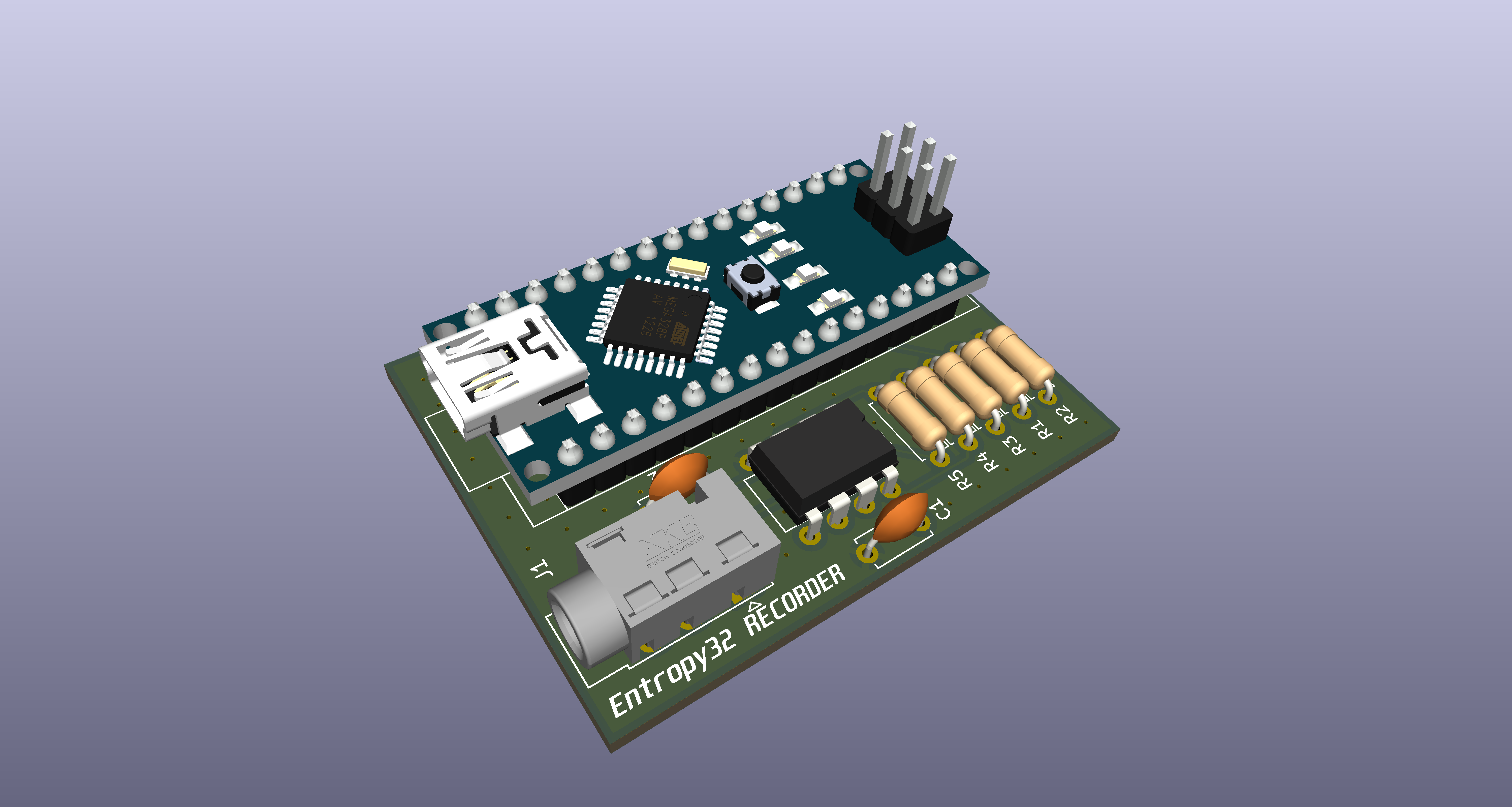
Firmware, hardware, and tooling for the Entropy32 Recorder — a standalone Geiger-counter-based board, built around an ATmega328P (Arduino Nano form factor), for recording raw entropy source data.
This is a separate board from Entropy32 / Entropy32 Plus, not a mode or alternate firmware of it. It does not generate seeds or any conditioned output. Its only job is to capture raw, unconditioned edge timing data from the entropy source (Geiger tube + LM393 comparator) so it can be run through statistical test suites (e.g. NIST STS) to validate the quality of the entropy source itself, before that source is trusted for use in Entropy32 Plus's seed generation.
entropy32_evidence_protocol.md — the SP 800-90B reproducible
evidence protocol these tools implement: capture requirements, the
raw/derived evidence package layout, exact firmware reconstruction
semantics, and the pinned NIST toolchain invocation.entropy32_recorder.ino — the recorder's firmware. It timestamps
every rising edge on D2 (post-LM393 comparator output) and streams
edge_index,timestamp_us CSV rows over serial. It does no filtering,
interval pairing, or SHA-256 conditioning by design — it's for capturing
raw edge timing data only, unmodified, for statistical testing.tools/capture_serial_to_csv.py — reads the serial stream produced by
the sketch above and writes it to a CSV file matching the evidence
protocol's raw/raw_edges.csv shape (edge_index, raw_timer_ticks,
monotonic_timestamp_us). raw_timer_ticks is the board's micros()
reading exactly as received (wraps every ~71.58 min);
monotonic_timestamp_us is that value unwrapped into an ever-increasing
64-bit microsecond count, reconstructed on the host (via
tools/edge_timing.py) so the firmware/ISR stays minimal. Every row is
flushed and fsynced to disk as soon as it's written — negligible cost at
this source's event rate, and each edge is an irreplaceable physical
event, so nothing is ever buffered short of an actual power loss. One
capture is one continuous, uninterrupted run from edge 0 — per the
evidence protocol, there is no resume; the tool refuses to run at all
if --out already has data, and an interrupted capture must be
restarted under a new --out rather than continued. On a fully
complete run, also writes a capture_status.json sibling (e.g.
raw_edges.status.json) recording edge count, start/end UTC
timestamps, and the zero overrun/drop counts implied by reaching that
point at all — this feeds tools/package_evidence.py and the
protocol's capture_status.json (§4). Requires pyserial.tools/edge_timing.py — the timer-wrap-unwrapping math used by the
capture tool, in its own module mainly so it can be tested in isolation.tools/check_edges.py — pre-flight sanity check for a captured CSV:
confirms edge_index/monotonic_timestamp_us are well-formed, and
compares the inter-arrival distribution against a Poisson expectation to
flag comparator bounce/chatter. Run this before feeding a capture into
NIST STS / SP 800-90B tooling:
python tools/check_edges.py tools/raw_edges.csv.tools/derive_evidence.py — reconstructs Entropy32's actual
bit-extraction (200us reject filter, non-overlapping interval pairing,
second-longer=1/second-shorter=0, ties discarded) per
entropy32_evidence_protocol.md §5,
producing the protocol's derived/ package — all_intervals_us.csv,
firmware_accepted_intervals_us.csv, comparison_bits.bin,
derivation_report.json.
python tools/derive_evidence.py tools/raw_edges.csv --out-dir tools/derived --source-dir ../entropy32_plus.
comparison_bits.bin is ready for ea_non_iid -i -v comparison_bits.bin 1
(bits_per_symbol=1, per the protocol's §8 — not a byte-per-symbol
truncation). --source-dir (optional but recommended) points at a local
checkout of the firmware these constants are claimed to match, and
auto-fills derivation_report.json's source_repo/source_commit/
entropy32_firmware_blob_sha from its git metadata and .ino hash —
left "unknown" rather than guessed if omitted.tools/package_evidence.py — assembles the protocol's immutable
evidence directory (§4) from a capture, a derive_evidence.py run, and
a separately-run ea_non_iid pass: copies raw/ and derived/ in,
records the exact NIST command/toolchain/exit status under nist/,
writes capture_status.json and a manifest.json (fields it can't
know from the data — hardware, physical source, environment — are
filled from setup.json via --setup, otherwise left null), and
computes a SHA256SUMS covering every file in the package.tools/verify_evidence.py — independently checks a finished
package: hashes, raw structure, a byte-for-byte re-derivation, and the
saved NIST run. The one command a replicator needs.tools/make_evidence.py — runs everything from a finished capture
to a verified package (check, derive, NIST via WSL, package, verify).setup.json — the recording rig's description (manifest fields)
and local tool paths, read by make_evidence.py.KiCad/ — PCB design (schematic, layout, 3D models, and
fabrication/production outputs for the Entropy32 Recorder board).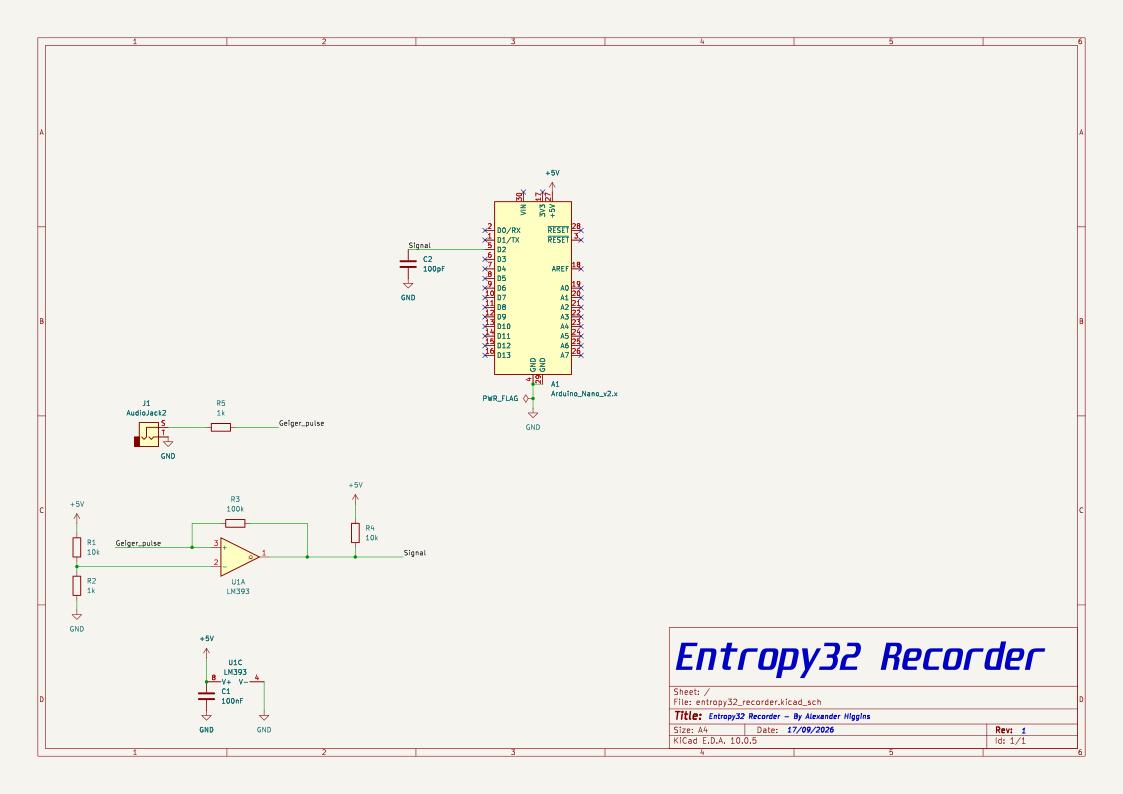
The board pairs a Geiger tube's LM393 comparator output with an ATmega328P
(D2, using the board's existing pull-down for bias). Design files are in
KiCad/, including BOM, designators, netlist, and pick-and-place
files under KiCad/production/.
All commands below run from the repo root (entropy32_recorder/).
If you're checking someone else's result, this is the only command you need (Python 3.8+, no dependencies):
python tools/verify_evidence.py entropy32_sp80090b_2026-10-03aIt checks every file against SHA256SUMS, checks the raw capture's
structure (no missing edges, consistent timer unwrapping), re-derives the
bit stream from raw/raw_edges.csv and requires it to match byte for
byte, and checks the saved NIST output belongs to this package's
comparison_bits.bin and reports all ten estimators. It ends with
VERIFIED, VERIFIED as a PILOT package (consistent, but below the
protocol's 1,000,000-sample gate), or FAILED, and exits non-zero on
failure. Two optional, slower checks:
python tools/verify_evidence.py entropy32_sp80090b_2026-10-03a \
  --firmware-dir ../entropy32_plus \
  --ea-non-iid ~/SP800-90B_EntropyAssessment/cpp/ea_non_iid
--firmware-dir (any clone of
Entropy32-Plus)
confirms the firmware at the commit the derivation claims is the one whose
hash is recorded. --ea-non-iid re-runs NIST (built as below) and
requires identical output; on Windows a ~/... or /... path runs inside
WSL automatically.
Flash entropy32_recorder.ino to the board, and pip install pyserial.
Clone the Entropy32 firmware next to this repo, so the derivation can
be pinned to it: git clone https://github.com/captainchapster/Entropy32-Plus.git ../entropy32_plus
Build the pinned NIST tool. ea_non_iid is a Linux build — on Windows
use WSL
(wsl --install, one-time) and run this inside it:
sudo apt update && sudo apt install -y build-essential libbz2-dev
git clone https://github.com/usnistgov/SP800-90B_EntropyAssessment.git
cd SP800-90B_EntropyAssessment
git checkout 68ed165fd7a3eeef26b87a546ba23f338e82a3f3  # pinned v1.1.8, see protocol §8
make
cd selftest && ./selftest && cd ..
make non_iid
Edit setup.json: tools points at the firmware
checkout and the built cpp/ea_non_iid; manifest describes your rig
(detector, source, environment — null for anything unknown, never a
guess); check_edges.dead_time_ns is your detector's dead time, if
known. These are written into every package, so you describe the
setup once, not per capture.
Run the capture:
python tools/capture_serial_to_csv.py --port COM5 --out tools/raw_edges.csv(COM5 on Windows, /dev/ttyUSB0 on Linux.) By default it runs until
the protocol's stop gate — 1,000,000 comparison bits, counted live
with the same reconstruction the derivation uses — so it can't stop one
bit short the way a fixed edge count can (2,000,000 edges yields only
999,999 bits). For a quick smoke test use --count 2000 instead.
If the board reports OVERRUN_DETECTED or the capture stops for any
other reason, that run is invalid — one capture is one continuous run
from edge 0, with no resume. Start over.
Build and verify the evidence package:
python tools/make_evidence.pyThis runs the edge sanity check, the derivation, NIST (through WSL on
Windows), packaging and verification, recording the NIST tool's commit
and compiler from the build itself. It refuses to package an
incomplete capture or an unpinned/modified NIST build. The package is
named from the capture's start date, e.g. entropy32_sp80090b_2026-11-20a/.
Commit the package directory it prints. Once committed it's immutable — never edit it; a new capture gets a new package.
make_evidence.py only strings together tools you can also run
yourself, e.g. to inspect an intermediate result:
python tools/check_edges.py tools/raw_edges.csv --dead-time-ns 720000
python tools/derive_evidence.py tools/raw_edges.csv --out-dir tools/derived --source-dir ../entropy32_plus
# in WSL, from SP800-90B_EntropyAssessment/cpp, save stdout/stderr/exit status verbatim:
./ea_non_iid -i -v /mnt/d/Programming/entropy32_recorder/tools/derived/comparison_bits.bin 1
python tools/package_evidence.py --raw tools/raw_edges.csv --derived-dir tools/derived \
  --capture-id <id> --setup setup.json --nist-command "<exact command>" \
  --nist-stdout <file> --nist-stderr <file> --nist-exit-status <n> \
  --nist-compiler-version "<compiler>"
python tools/verify_evidence.py entropy32_sp80090b_<id>micros() on the ATmega328P (16MHz, Timer0
prescaler 64) only increments in steps of 4us. That's negligible at the
observed ~3.7s mean inter-arrival time (1 part in ~10^6), so it isn't a
concern at current event rates. If a future hardware revision moves the
comparator output to the Timer1 input-capture pin (ICP1 / D8 on a
Nano) instead of D2, the ISR could latch TCNT1 directly for
microsecond-or-better hardware-timestamped edges with no software ISR
jitter — worth considering for a higher-throughput source, but out of
scope for the current board (D2 is fixed on the fabricated PCB).check_edges.py compares the inter-arrival
distribution against the Poisson process a radioactive source should
produce; a pileup of anomalously short gaps indicates LM393 output
chatter rather than genuine independent events. No bounce was observed
in the pilot 2000-edge run.entropy32_recorder.ino, tools/): MITKiCad/): CERN-OHL-S v2| Qty | Value | Footprint | References |
|---|---|---|---|
| 2 | 10k | Resistor_THT:R_Axial_DIN0207_L6.3mm_D2.5mm_P7.62mm_Horizontal | R1, R4 |
| 2 | 1k | Resistor_THT:R_Axial_DIN0207_L6.3mm_D2.5mm_P7.62mm_Horizontal | R2, R5 |
| 1 | 100k | Resistor_THT:R_Axial_DIN0207_L6.3mm_D2.5mm_P7.62mm_Horizontal | R3 |
| 1 | 100nF | Capacitor_THT:C_Disc_D5.0mm_W2.5mm_P5.00mm | C1 |
| 1 | 100pF | Capacitor_THT:C_Disc_D5.0mm_W2.5mm_P5.00mm | C2 |
| 1 | Arduino_Nano_v2.x | Module:Arduino_Nano | A1 |
| 1 | AudioJack2 | Connector_Audio:Jack_3.5mm_PJ320E_Horizontal | J1 |
| 1 | LM393 | Package_DIP:DIP-8_W7.62mm | U1 |
The 10 most common of 12 parts.


schlae/snark-barker-mca
A Sound Blaster compatible sound card for Micro Channel bus computers

michaelruppe/FSAE
Projects for Formula SAE Electric Vehicle competition (Australia 2019/2020)

AllYarnsAreBeautiful/ayab-hardware
Contains the schematics and layouts for the AYAB Arduino shield

17o2/bluetooth-minidisc
Adding built-in bluetooth connectivity to a 20-year-old Mindisc player

bluepylons/USB-C-3-way-splitter
A splitter board (for making a cable splitter) for turning a 5V 3A USB power source to 3 5V 1A USB sources
It measures 36 × 47 mm and has 2 copper layers, 1.6 mm thick.
12 parts, built around the LM393. The full list of its parts is on this page, with links to each part's symbol and footprint where PCBKit's library has them.
From the captainchapster/Entropy32-Recorder repository on GitHub, at the commit this page was made from: the board is KiCad/entropy32_recorder.kicad_pcb and its schematic KiCad/entropy32_recorder.kicad_sch. PCBKit opens the board in the browser, with nothing to install.
Its repository publishes it under the MIT licence: you may reuse it on that licence's terms (keep the author's notice, and for a copyleft licence share your changes alike).