2 layers150 × 68 mm
 candykingdom/firefly25
Small blinkenlight boards that sync up using radios
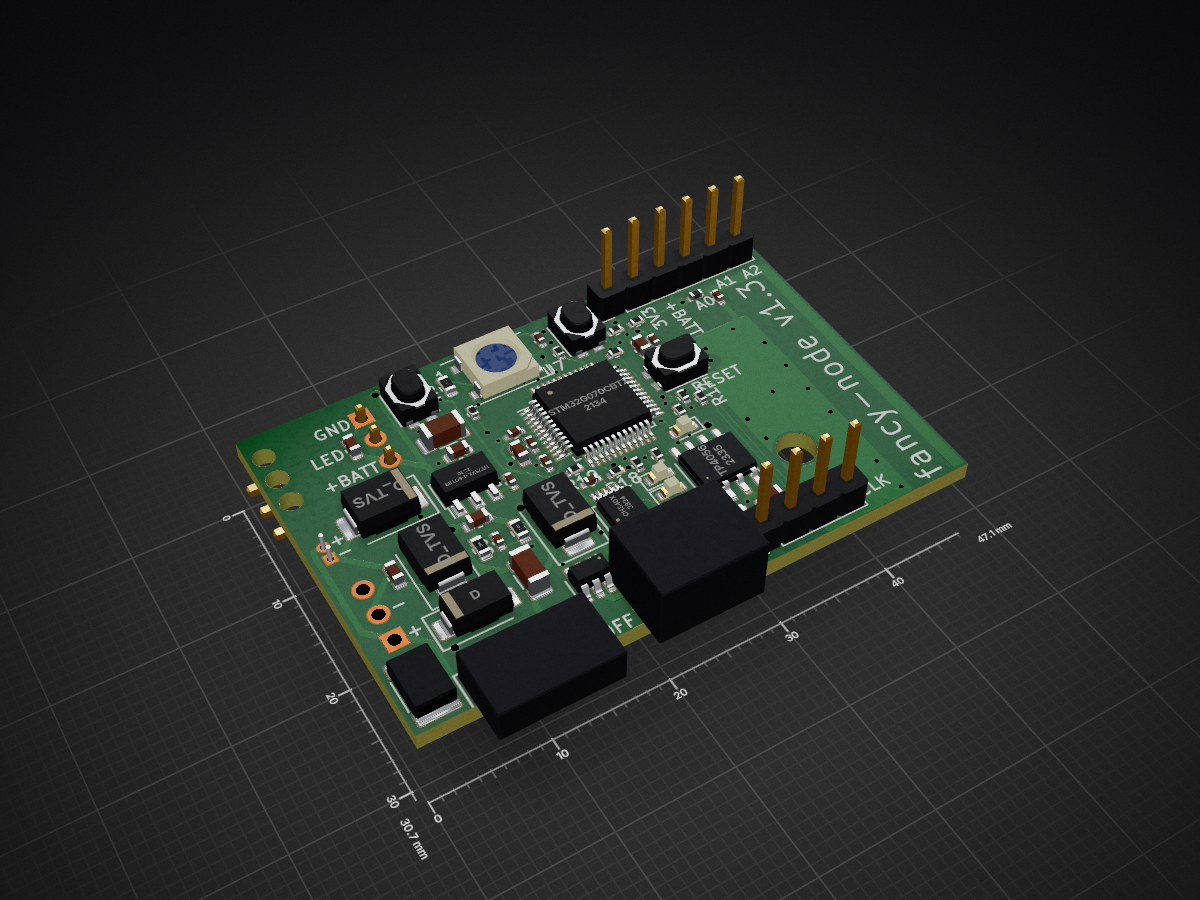
Fancy node is an open-source printed circuit board by candykingdom, from the candykingdom/firefly2 repository on GitHub. It is a 4-layer board of 47.1 × 30.7 mm with 67 parts on 81 nets, routed with 485 tracks and 100 vias.
It is built around the CH340X, TP4056 and WS2812B, with the SRV05-4-P-T7 among its other parts. Its parts include 19 resistors, 18 capacitors, 8 diodes, 7 connectors and 6 ICs. It belongs with the radio and wireless boards and the STM32 boards of this library.


Wireless LED control for Burning Man art installations, bikes, and wearables. Devices driving WS2812 strips self-organize over 915 MHz RFM69 radios into a flood mesh with exactly one master, share a network clock via heartbeats, and render effects as pure functions of network time — so every device animates in sync without streaming frames.
New to the project? Start with GETTING_STARTED.md. Working in the code (human or agent)? The mental model lives in docs/index.md and the shared Claude Code/Codex ground rules in CLAUDE.md.
python3 -m http.server 8642 -d sim
# open http://localhost:8642/
A zero-dependency browser simulator of the whole system: every effect and palette on the real device catalog, synced to a scrubbable network clock, with master-mode autoplay and control overrides. Byte-exact against the firmware (enforced by tests: npm test). See docs/simulator.md.
Firmware builds with PlatformIO (pip install platformio). One env per device target:
pio run -e node                  # SAMD21 rfboard node (node-arm64 on Apple silicon)
pio run -e fancy-node            # STM32G030 node
pio run -e controller            # STM32G070 handheld controller
pio run -e dmx                   # ESP32 DMX bridge
pio run -e fancy-node -t upload  # flash via ST-Link
pio device monitor               # 115200 baud
Note: [env:node]'s bossac platform_packages entry is OS-specific — uncomment the right line in platformio.ini for your OS. Full env/pin/flag details: docs/build-and-test.md.
The fancy-node device can be programmed either using an STLink, or via USB port. To program via USB, you must first install stm32loader using pip (pip install stm32loader). You may also need to pass the port (typically /dev/ttyUSB0), e.g. pio run -e fancy-node-usb -t upload --upload-port /dev/ttyUSB0.
Both node and fancy-node support reading the DeviceDescription from flash. The modes are defined by the DeviceMode enum within DeviceDescription.hpp. They work as follows:
CURRENT_FROM_HEADER: use the current device defined in Devices.hppREAD_FROM_FLASH: read the device saved in flash, if present. If not present (determined by the validity of check_value), fall back to current.WRITE_TO_FLASH: write current to flash, and then use it. This will only write the device to flash if it is different, to avoid causing flash wear.The platform-independent core (lib/, src/generic/) builds on the host against fakes, with ASan + UBSan on (and fatal). Requires cmake and a GCC/Clang toolchain (on Windows, use WSL or similar):
mkdir -p build && cd build
cmake .. -DBUILD_SIMULATOR=false   # true builds the SDL desktop simulator too
make && make test
./smalltests --gtest_filter=RadioStateMachineTest*./lint.sh check # clang-format, Google style — CI enforces this
./lint.sh format # format in place
./ci.sh # exactly what CI runs: cmake + smalltests + largetests
node --test "sim/test/cases/*.test.mjs" # simulator suite, incl. firmware byte-exactness
npm run test:e2e # served UI/API/canvas journeys in Chromium and FirefoxCI (GitHub Actions): host tests, lint, node/fancy-node/controller firmware
builds, the simulator suite, and CodeQL C/C++ security scanning.
| Path | Contents |
|---|---|
lib/, src/generic/ | Platform-independent core: radio protocol, mesh, effects, LED management |
src/arduino/ | Hardware backends (FastLED, RadioHead RFM69) |
src/devices/ | One main per device target (node, fancy-node, controller, dmx) |
test/ | Host GoogleTest suites + FakeNetwork multi-node mesh simulation |
sim/ | Browser simulator (production C++ renderer via committed Wasm, usable without hardware) |
docs/ | Architecture and per-subsystem notes — start at docs/index.md |
hardware/, boards/, bootloader/ | PCB designs, PlatformIO board definitions, bootloaders |
specs/ | Spec-kit feature specs (spec → plan → tasks workflow, see CLAUDE.md) |
AGENTS.md; shared skills remain canonical under .claude/skills/ and are exposed to Codex through .agents/skills/.speckit-specify → plan →
tasks → implement; use / in Claude Code or $ in Codex); specs live in specs/.| Qty | Value | Footprint | References |
|---|---|---|---|
| 11 | 1k | Resistor_SMD:R_0402_1005Metric | R1, R2, R3, R4, R5, R6, R7, R12, R13, R15, R17 |
| 8 | 100nF | Capacitor_SMD:C_0402_1005Metric_Pad0.74x0.62mm_HandSolder | C1, C2, C3, C5, C7, C9, C13, C15 |
| 7 | 10uF | Capacitor_SMD:C_0603_1608Metric | C4, C6, C8, C11, C12, C16, C18 |
| 3 | D_TVS | Diode_SMD:D_SMB | D3, D4, D5 |
| 3 | SW_Push | Homebrew:SW_TACTILE_3mmx3.5mm_TS-1071SA-A4B3-D4 | SW1, SW2, SW3 |
| 2 | 220 | Resistor_SMD:R_0402_1005Metric | R16, R19 |
| 2 | 47uF | Capacitor_SMD:C_1206_3216Metric | C10, C14 |
| 2 | RED | LED_SMD:LED_0603_1608Metric | D1, D7 |
| 1 | 10k | Resistor_SMD:R_0402_1005Metric | R18 |
| 1 | 180k | Resistor_SMD:R_0603_1608Metric | R11 |
| 1 | 1pF | Capacitor_SMD:C_0402_1005Metric_Pad0.74x0.62mm_HandSolder | C17 |
| 1 | 2337019-1 | Homebrew:CONN_2337019-1 | J7 |
| 1 | 27nH | Inductor_SMD:L_0402_1005Metric | L1 |
| 1 | 3k3 | Resistor_SMD:R_0603_1608Metric | R14 |
| 1 | 470 | Resistor_SMD:R_0603_1608Metric | R9 |
| 1 | 4k7 | Resistor_SMD:R_0402_1005Metric | R8 |
| 1 | 62k | Resistor_SMD:R_0603_1608Metric | R10 |
| 1 | CH340X | Package_SO:MSOP-10_3x3mm_P0.5mm | U1 |
| 1 | Conn_01x02 | Homebrew:JST_Micro_1x02_P1.25mm_Horizontal | J6 |
| 1 | Conn_01x03 | Homebrew:MiniPV_78208-X03XXX_1x03_P2.54mm_Polarized_Horizontal | J4 |
| 1 | Conn_01x03 | Connector_PinHeader_2.54mm:PinHeader_1x03_P2.54mm_Horizontal | J3 |
| 1 | Conn_01x04 | Connector_PinHeader_2.54mm:PinHeader_1x04_P2.54mm_Vertical | J5 |
| 1 | Conn_01x06 | Connector_PinHeader_2.54mm:PinHeader_1x06_P2.54mm_Vertical | J2 |
| 1 | D | Diode_SMD:D_SMA | D8 |
| 1 | HT75xx-1-SOT89 | Package_TO_SOT_SMD:SOT-89-3 | U4 |
| 1 | MountingHole | MountingHole:MountingHole_3.2mm_M3 | H4 |
| 1 | RFM69CW-915MHZ | Homebrew:RFM69CW-minimalpads | U5 |
| 1 | SRV05-4-P-T7 | Package_TO_SOT_SMD:SOT-23-6 | D2 |
| 1 | STM32G070CBTx | Package_QFP:LQFP-48_7x7mm_P0.5mm | U7 |
| 1 | SW_SPDT | Homebrew:SW_SLIDE_SPDT_K3-1204D-L | SW4 |
| 1 | SolderJumper_2_Open | Jumper:SolderJumper-2_P1.3mm_Open_TrianglePad1.0x1.5mm | JP2 |
| 1 | StrainRelief | Homebrew:3_pin_2.54mm_pitch_strain_relief | H1 |
| 1 | TP4056 | Homebrew:SOP-8_3.9x4.9mm_P1.27mm_Thermal | U6 |
| 1 | Thermistor_PTC | Fuse:Fuse_1812_4532Metric_Pad1.30x3.40mm_HandSolder | TH1 |
| 1 | USB_B_Micro | Homebrew:FRAMATOME_10118194-0001LF_fixed_bridges | J1 |
| 1 | WHITE | LED_SMD:LED_0603_1608Metric | D6 |
| 1 | WS2812b | Homebrew:LED_XINGLIGHT_WS2812B_PLCC4_5.0x5.0mm_P3.2mm | U3 |
It measures 47.1 × 30.7 mm and has 4 copper layers, 1.6 mm thick.
67 parts, built around the CH340X, TP4056, WS2812B and SRV05-4-P-T7. The full list of its parts is on this page, with links to each part's symbol and footprint where PCBKit's library has them.
From the candykingdom/firefly2 repository on GitHub, at the commit this page was made from: the board is hardware/fancy-node/fancy-node.kicad_pcb and its schematic hardware/controller/controller.kicad_sch. PCBKit opens the board in the browser, with nothing to install.
Its repository states no licence, so its author keeps all rights: ask candykingdom before reusing the design.


RoboticsBrno/Robutek
Robůtek je robotická platforma založená na čipu ESP32-S3. Je velice rozšitiřelný, ale ze základu umí jezdit, kreslit fixou, jezdit po čáře, pohybovat se bludištěm. Programování je přes Jaculus.

cester-ino/OTTO-hardware
those specs refer to the tactile buttons version, but a led backlight button version is in the works too.


I-AM-ENGINEER/AudMX
Alternative for Deej ( https://github.com/omriharel/deej ) with more features

skrmsh/skirmish-hardware
Skirmish Hardware © 2022-2023 by Ole Lange is licensed under CC BY-NC-SA 4.0. To view a copy of this license, visit http://creativecommons.org/licenses/by-nc-sa/4.0/

rowr111/blinky-badge-light
lighting badge with unique patterns and sound reactivity