2 layers66.9 × 74.5 mm
 c-base/raspberrylock20
Door-lock software for the Raspberry Pi using GPIOs
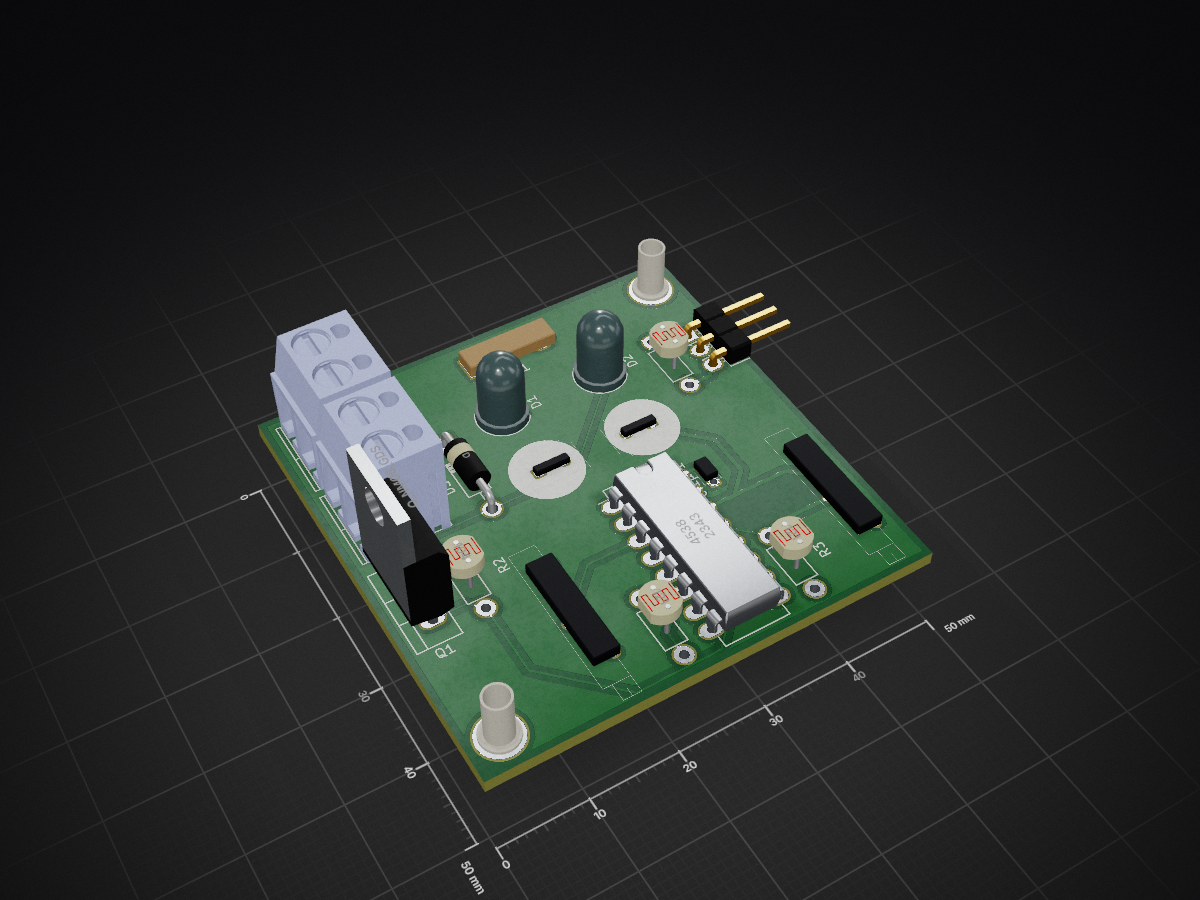
Soundlabor schloss is an open-source printed circuit board by c-base, from the c-base/raspberrylock repository on GitHub, published under the BSD-3-Clause licence. It is a 2-layer board of 50 × 50 mm with 20 parts on 12 nets, routed with 92 tracks and 0 vias.
Its parts include 3 resistors, 3 diodes, 3 connectors, 1 capacitor and 1 IC.
The raspberry lock is a small application that runs on a Raspberry Pi with a PiFace shield. It reads a 4-digit user-ID and a 4-6 digit passcode from a 4x4 matrix keypad. It then sends this data to a LDAP server to check if the entered user-id and passcode combination is correct. If the server answers with "correct", a door is opened by switching on an electric strike with a relais.
Install the piface module with the Raspberry Pi configuration tool:
sudo raspi-config (then follow the menu to Advanced -> SPI)

sudo apt-get install python3.2 python3.2-dev build-essential
sudo apt-get install libldap-2.4-2
sudo ln -s /usr/lib/arm-linux-gnueabihf/libldap_r-2.4.so.2 /usr/lib/arm-linux-gnueabihf/libldap.so
sudo ldconfig
sudo apt-get install python3-setuptools
sudo apt-get install python3-pifacedigitalios

git clone http://git.jaseg.net/python-lmap.git
cd python-lmap
python3 setup.py install
Now clone this repository and change into its subdirectory.
Copy config.py.sample to config.py and change the password/binddn/pin field/group membership test for your application.
python3 schloss.pyPress A, then enter your 4 digit UID code, then press A again. Now enter your 4-6 digit PIN code and hit A. If the code was correct, the door will open.
+-----------------------------------------------------------------------+
|+---------------------------------------------------------------------+|
||+-------------------------------------------------------------------+||
|||+-----------------------------------------------------------------+|||
||||  +------+.................                                      ||||
||||  |      |                :                   +---------------+  ||||
|||+---+0    |  RASPBERRY PI  :                   |    KEYPAD     |  ||||
||+----+1    +--------+       :                   |               |  ||||
|+-----+2             |       :                   | 1   2   3   F |  ||||
+------+3             |       :                   | 4   5   6   E |  ||||
      |+4             +-------+                   | 7   8   9   D |  ||||
      |+5                     |                   | A   0   B   C |  ||||
      |+6                     ^                   |               |  ||||
      |+7                     |                   |               |  ||||
      |+0V                    +                   +---++++-++++---+  ||||
      |                       |    to LEDs            |||| ||||      ||||
      |                       |      ^ ^              |||| |||+------+|||
      |        PIFACE         |   Red| |Green         |||| ||+--------+||
      |                       |      | |              |||| |+----------+|
      |                       |      | |              |||| +------------+
      | ++                  7+-------+ |              ||||
      | ||                  6+---------+              ||||
      | ||                  5+------------------------+|||
| || 4+-------------------------+||| Qty | Value | Footprint | References |
|---|---|---|---|
| 2 | 120R | Resistors_ThroughHole:Resistor_Horizontal_RM7mm | R1, R3 |
| 2 | CONN_01X02 | Terminal_Blocks:TerminalBlock_Pheonix_MKDS1.5-2pol | P2, P3 |
| 2 | CP | Capacitors_ThroughHole:C_Radial_D8_L11.5_P3.5 | 220µF1, 220µF2 |
| 2 | LED | LEDs:LED-5MM | D1, D2 |
| 2 | POT | Potentiometers:Potentiometer_Bourns_3006P_Angular_ScrewFront | 100k1, 100k2 |
| 1 | 100k | Resistors_ThroughHole:Resistor_Horizontal_RM7mm | R2 |
| 1 | 3300µ | raspberrylock_lib:ECA1EM332 | C1 |
| 1 | 4538 | Housings_DIP:DIP-16_W7.62mm_LongPads | U1 |
| 1 | C | Capacitors_ThroughHole:C_Disc_D3_P2.5 | 0.1µF1 |
| 1 | CONN_01X03 | Pin_Headers:Pin_Header_Angled_1x03 | P1 |
| 1 | D | Diodes_ThroughHole:Diode_DO-41_SOD81_Horizontal_RM10 | D3 |
| 1 | Q_NMOS_GDS | TO_SOT_Packages_THT:TO-220_Neutral123_Vertical | Q1 |
| 1 | R | Resistors_ThroughHole:Resistor_Horizontal_RM7mm | 10k1 |
The 18 most common of 20 parts.
It measures 50 × 50 mm and has 2 copper layers, 1.6 mm thick.
20 parts. The full list of its parts is on this page, with links to each part's symbol and footprint where PCBKit's library has them.
From the c-base/raspberrylock repository on GitHub, at the commit this page was made from: the board is schematics/soundlabor_schloss.kicad_pcb. PCBKit opens the board in the browser, with nothing to install.
Its repository publishes it under the BSD-3-Clause licence: you may reuse it on that licence's terms (keep the author's notice, and for a copyleft licence share your changes alike).


atopile/atopile
Design circuit boards with code! ✨ Get software-like design reuse 🚀, validation, version control and collaboration in hardware; starting with electronics ⚡️

davidphilipbarr/Sweep
Sweep - a small promicro based keyboard inspired by the Ferris.

rusefi/rusefi
rusefi - GPL internal combustion engine control unit

hoglet67/RGBtoHDMI
Bare-metal Raspberry Pi project that provides pixel-perfect sampling of Retro Computer RGB/YUV video and conversion to HDMI

hackclub/OnBoard
💡 Join 1,000 teenagers and make your first PCB with a $100 grant!

FreeYourStream/freedeck-hardware
all the stuff you need to build your own FreeDeck