


4 layers48.9 × 57.2 mm

Auto-flashing circuit based on the CP2102N
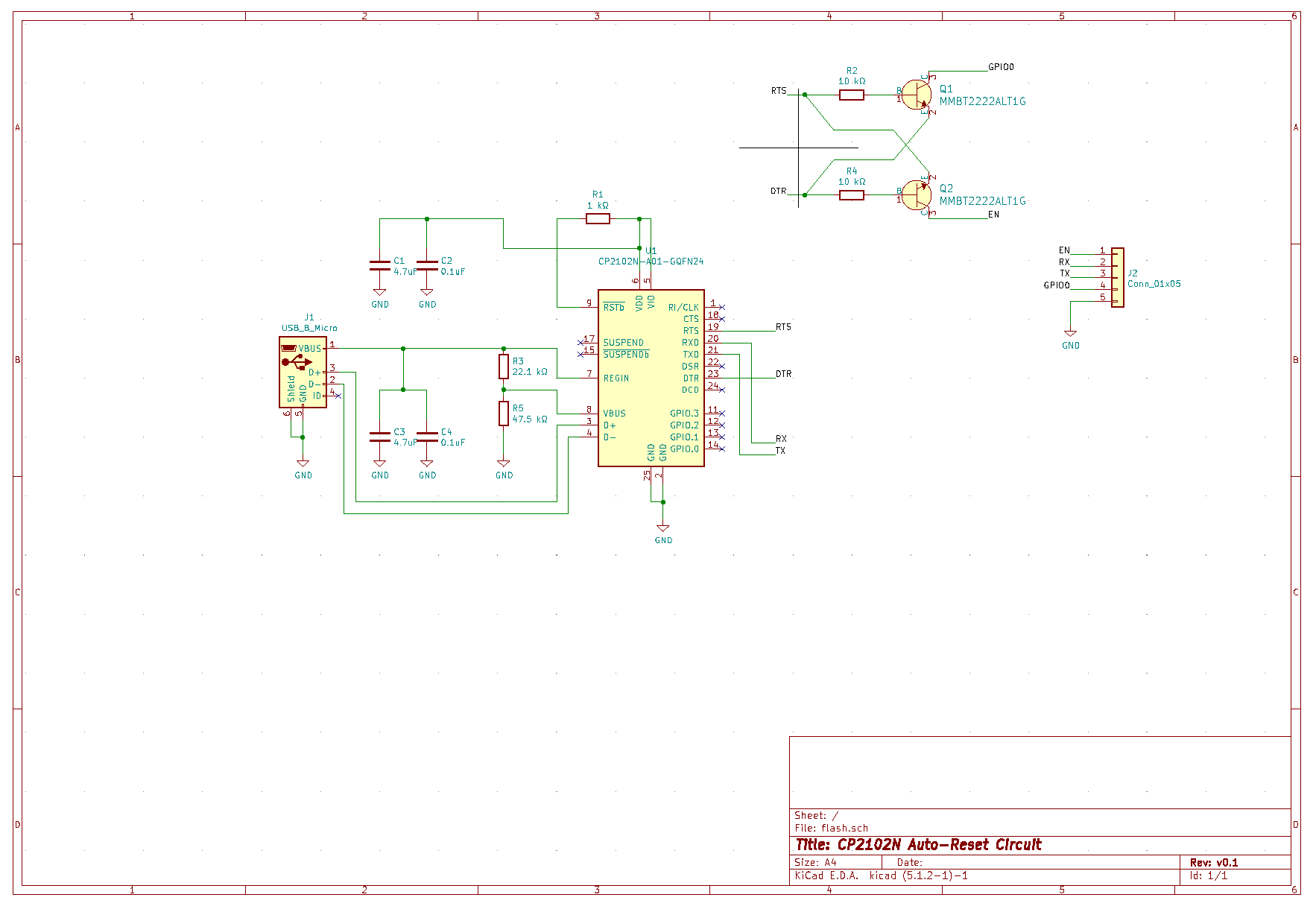
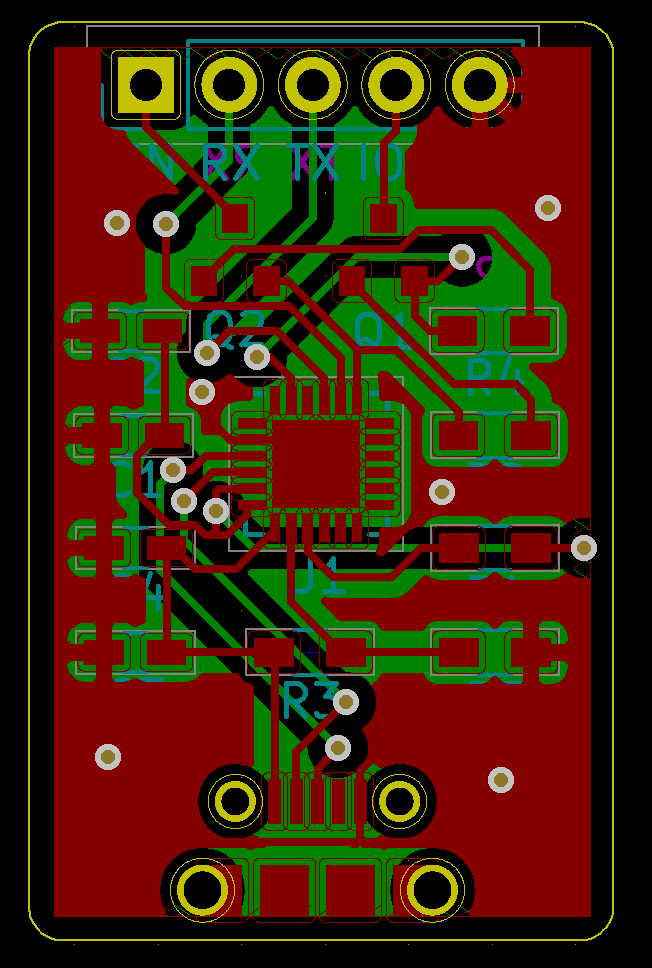
Flash is an open-source printed circuit board by bschwind, from the bschwind/esp32-autoflasher repository on GitHub, published under the MIT licence. It is a 2-layer board of 17.8 × 27.9 mm with 14 parts on 28 nets, routed with 137 tracks and 16 vias.
It is built around the CP2102N-A01-GQFN24 and MMBT2222ALT1G-CN. Its parts include 5 resistors, 4 capacitors, 2 transistors, 2 connectors and 1 IC.
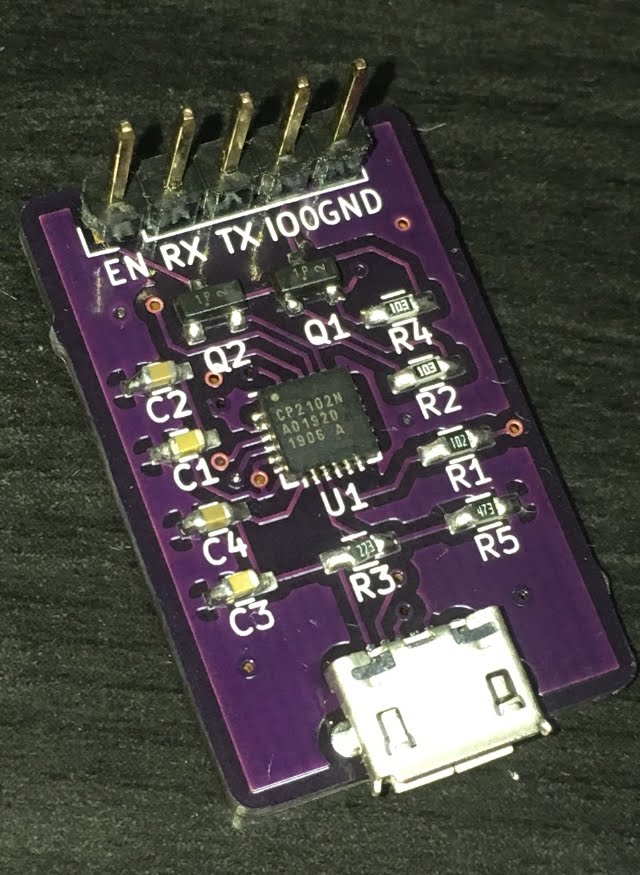
KiCad PCB based on the CP2102N USB-UART serial converter. This implements the "auto reset" circuits of most ESP32 dev boards. You can run things like esp-idf's make flash or flash code from the Arduino IDE without having to hold down any buttons.
Connect EN, RX, TX, IO0, and GND to their respective pins on the ESP32 (don't forget to swap the RX and TX pins!) and make sure you have the Silicon Labs CP210x driver installed on your OS.
You can order this PCB on OshPark
(All resistors and capacitors are size 1608 metric)
| Label | Description |
|---|---|
| U1 | CP2102N |
| R1 | 1 kOhm |
| R2 | 10 kOhm |
| R3 | 22.1 kOhm |
| R4 | 10 kOhm |
| R5 | 47.5 kOhm |
| C1 | 4.7 uF |
| C2 | 0.1 uF |
| C3 | 4.7 uF |
| C4 | 0.1 uF |
| Q1 | MMBT2222L transistor (SOT-23 package) |
| Q2 | MMBT2222L transistor (SOT-23 package) |
| Qty | Value | Footprint | References |
|---|---|---|---|
| 2 | 0.1uF | Capacitors_SMD:C_0603_HandSoldering | C2, C4 |
| 2 | 10 kΩ | Resistors_SMD:R_0603_HandSoldering | R2, R4 |
| 2 | 4.7uF | Capacitors_SMD:C_0603_HandSoldering | C1, C3 |
| 2 | MMBT2222ALT1G | mmbt2222alt1g:mmbt2222alt1g | Q1, Q2 |
| 1 | 1 kΩ | Resistors_SMD:R_0603_HandSoldering | R1 |
| 1 | 22.1 kΩ | Resistors_SMD:R_0603_HandSoldering | R3 |
| 1 | 47.5 kΩ | Resistors_SMD:R_0603_HandSoldering | R5 |
| 1 | CP2102N-A01-GQFN24 | Housings_DFN_QFN:QFN-24-1EP_4x4mm_Pitch0.5mm | U1 |
| 1 | Conn_01x05 | Pin_Headers:Pin_Header_Straight_1x05_Pitch2.54mm | J2 |
| 1 | USB_B_Micro | 10118194-0001lf-circle:10118194-0001lf-circle | J1 |
It measures 17.8 × 27.9 mm and has 2 copper layers, 1.6 mm thick.
14 parts, built around the CP2102N-A01-GQFN24 and MMBT2222ALT1G-CN. The full list of its parts is on this page, with links to each part's symbol and footprint where PCBKit's library has them.
From the bschwind/esp32-autoflasher repository on GitHub, at the commit this page was made from: the board is flash.kicad_pcb. PCBKit opens the board in the browser, with nothing to install.
Its repository publishes it under the MIT licence: you may reuse it on that licence's terms (keep the author's notice, and for a copyleft licence share your changes alike).

krikzz/open-ed
Open-ED is a very simple and cheap open source Genesis/Megadrive cartridge. The cartridge does not have its own processor or FPGA, it is built in the old school style using only memory and discrete logic.

testudor/LPM013M126C-breakout
A breakout board for the LPM013M126C MIP display from JDI

coelacant1/Protogen-Electronics
SmartMatrix SmartLED Shield breakout for Protogen hardware


arkandas/rp2350-macropad
RP2350A 3x3 mechanical macropad with a browser-programmable keymap and an on-board status LCD
