4 layers40 × 60 mm
Trinketcore
alph4345/test
TrinketCore puts everything a small rechargeable gadget needs on one 40 × 60 mm board, ready to order assembled from PCBWay:
113 parts
 bitshiftcrazy/clotty9
Uterus-shaped RP2040 PCB: period-tracking companion, sensor board, and tiny gaming device.
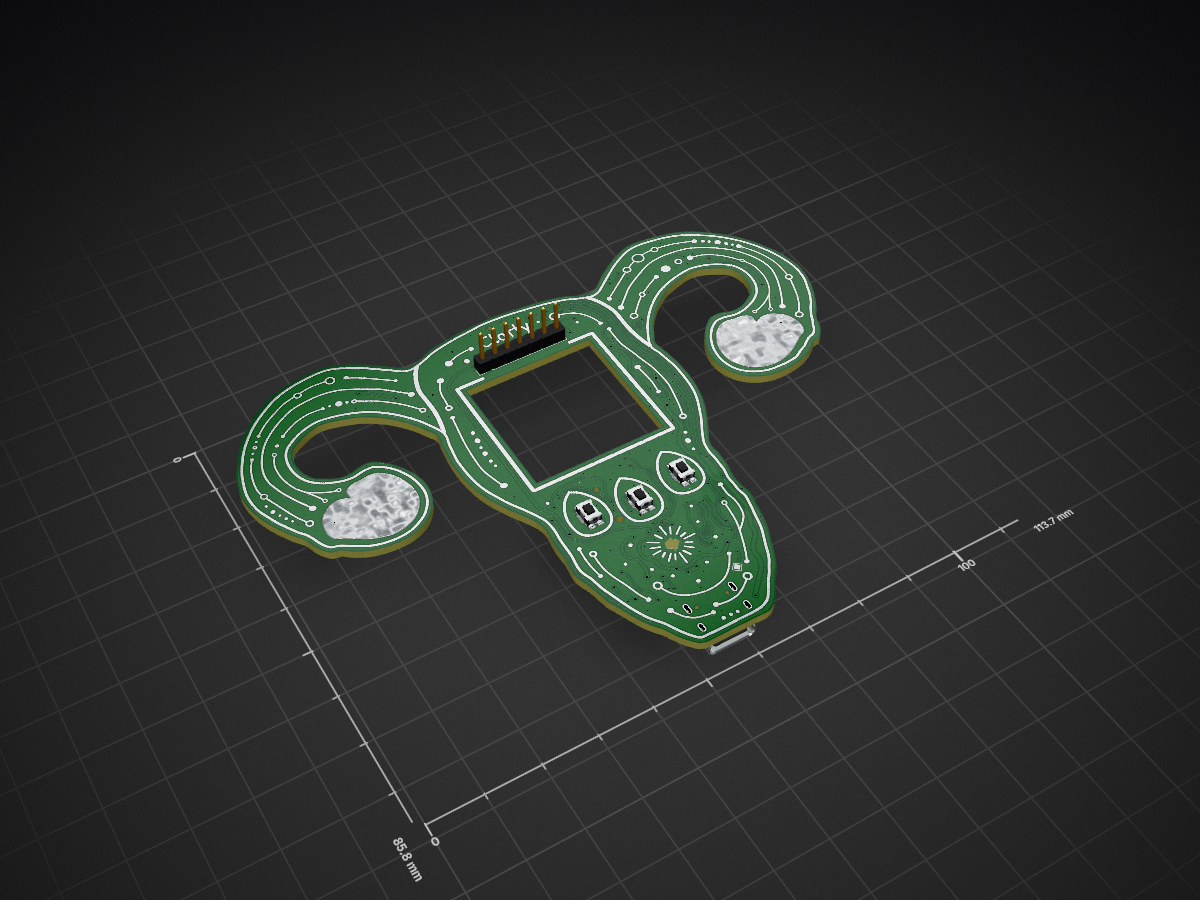
Clotty is an open-source printed circuit board by bitshiftcrazy, from the bitshiftcrazy/clotty repository on GitHub. It is a 2-layer board of 113.7 × 85.8 mm with 100 parts on 85 nets, routed with 1,989 tracks and 190 vias.
It is built around the RP2040, TPS63031DSKR and W25Q128JVSIQ, with the NCP18XH103F03RB among its other parts. Its parts include 10 ICs, 3 diodes, 2 connectors, 1 transistor and 1 switch. It belongs with the sensors and measurement boards and the RP2040 boards of this library.


Clotty is a uterus-shaped RP2040 period-tracking companion, sensor board and tiny gaming device.
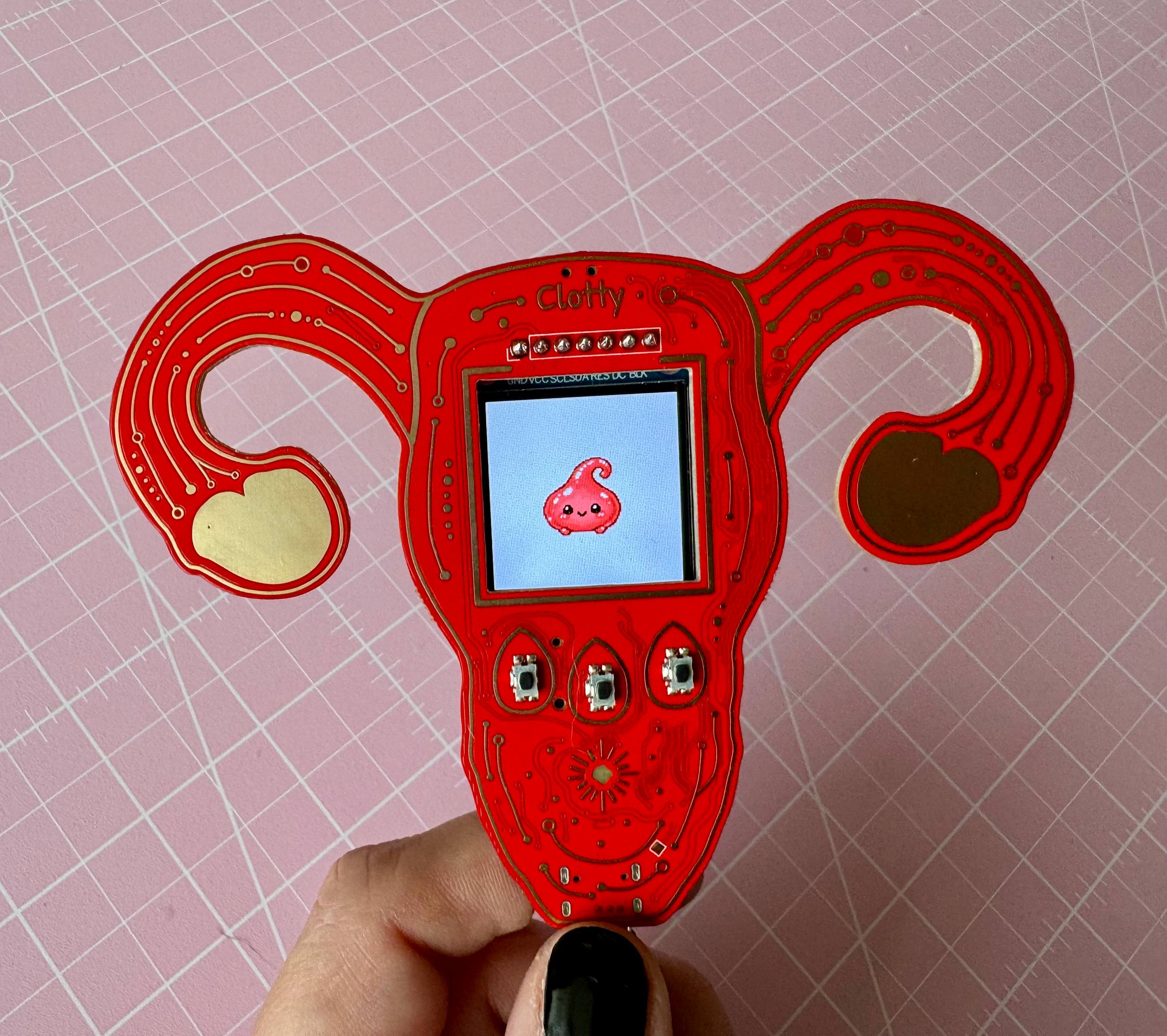
Clotty is a uterus-shaped, custom RP2040-based hybrid between a sensor board and a gaming device.
She originated from the wish to have an offline-only, privacy-focused period tracker that also happens to gamify the unpleasant, recurrent experience of, well, having a period.
Similar to a Tamagotchi, Clotty accompanies the user (currently: me) throughout the cycle. The goal is to keep her (and ideally myself) alive and happy, while her mood, constitution and little quests change according to the current cycle phase. Some of those quests interact with the physical environment through the board's sensors.
Clotty keeps track of cycle lengths and period dates, but she is not a medical device beyond that basic tracking functionality.
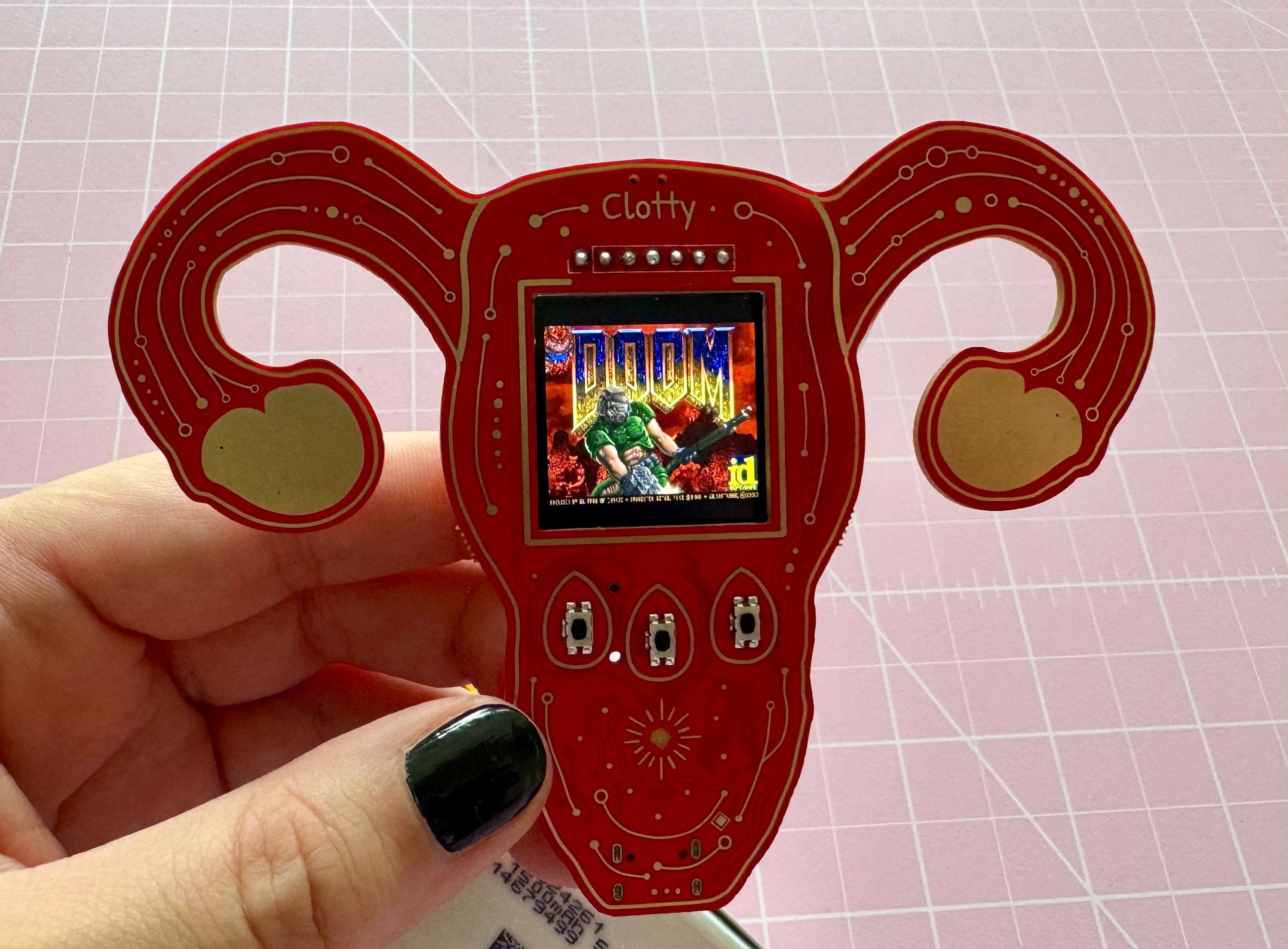
Naturally, she runs DOOM as well.
[!WARNING] Work in progress!
Clotty is currently at the first working prototype stage.
Basic board functionality has been tested and confirmed, but there are known hardware issues and plenty of things I still want to improve.
Please keep that in mind before having this revision fabricated.
Current (basic) bring-up status:
However, testing is still ongoing!
Clotty currently or eventually aims to provide:
Main hardware includes:
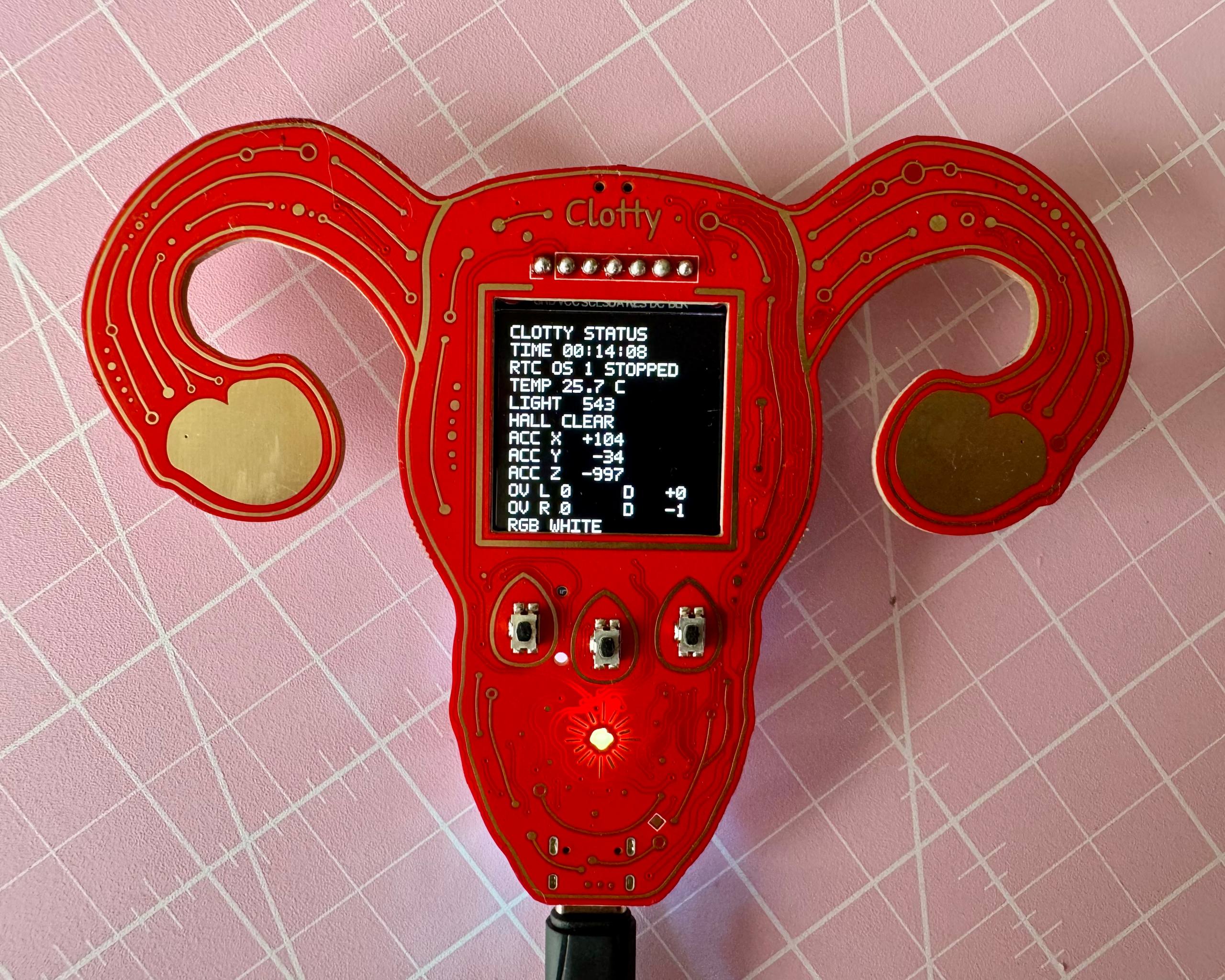
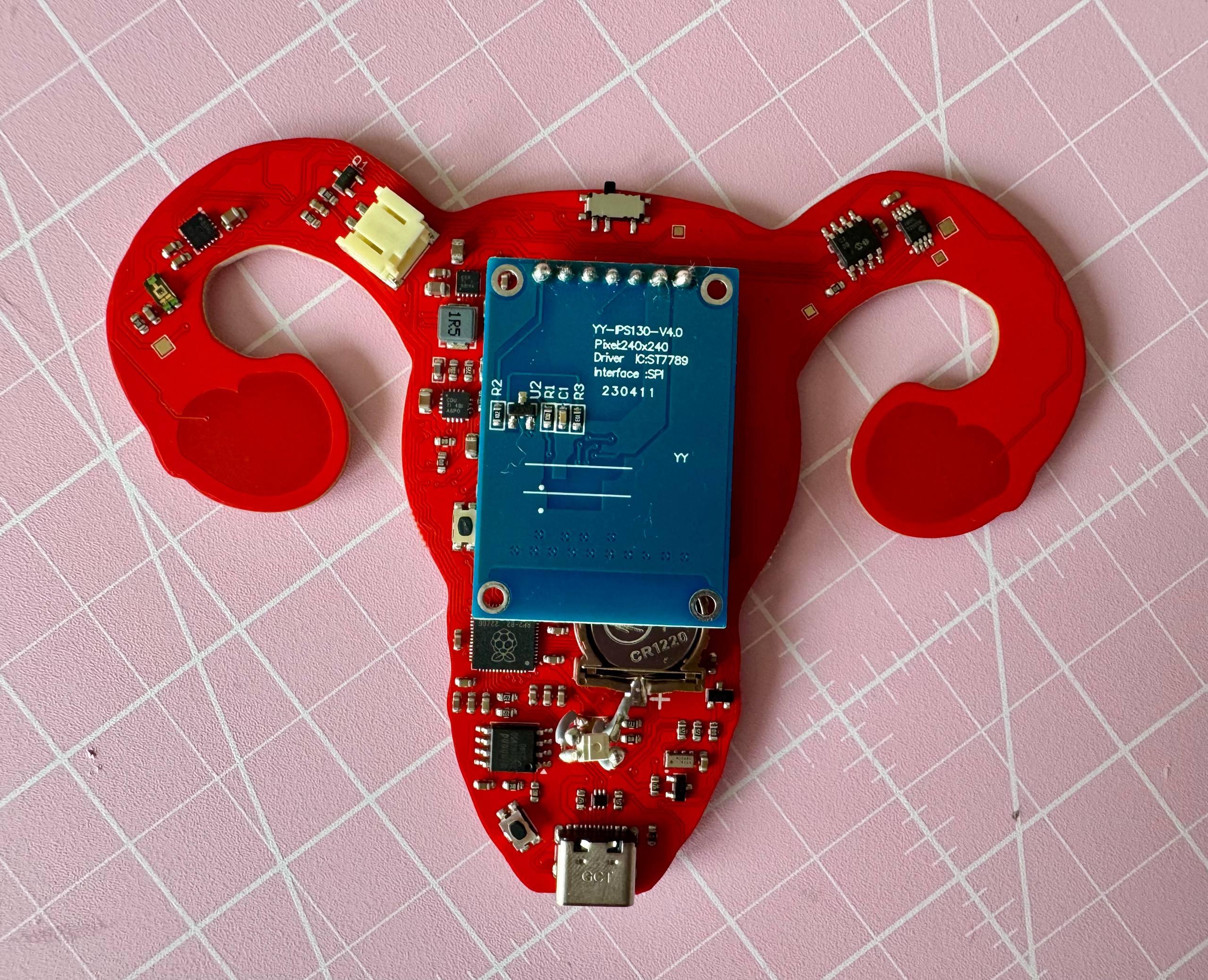
Clotty's sensor selection follows a very scientific design process largely based on "that would be kinda neat".
Possible gameplay uses include things like warming Clotty up for a "hot water bottle" quest, putting her somewhere dark for a nap, moving around, or interacting with magnets for no particularly defensible reason.
Clotty uses a 240×240 IPS TFT driven by an ST7789.
Controls consist of:
The physical buttons are intended mainly for menu navigation and will eventually receive translucent red resin caps shaped like blood drops.
The ovaries are intended for directional or contextual interaction.
Yes, the ovaries also work as controls in DOOM.
Clotty is designed for portable LiPo-powered operation.
The board includes:
See the schematic for the exact implementation.
Primarily, the uterus-shape was chosen because it's a period tracking device and subtlety is not exactly my strength. Periods and reproductive health are still stigmatised too often and Clotty's design is meant to help normalising a biological cycle thanks to which all of us are here in the first place.
But it also turns out that, for reasons nature most likely did not intend, a uterus is surprisingly game-controller-shaped.
The ovaries make convenient touch areas, the centre provides enough room for a display, and the overall shape sits well in the hands.
And yes, the USB-C connector is located at the cervix where it belongs.
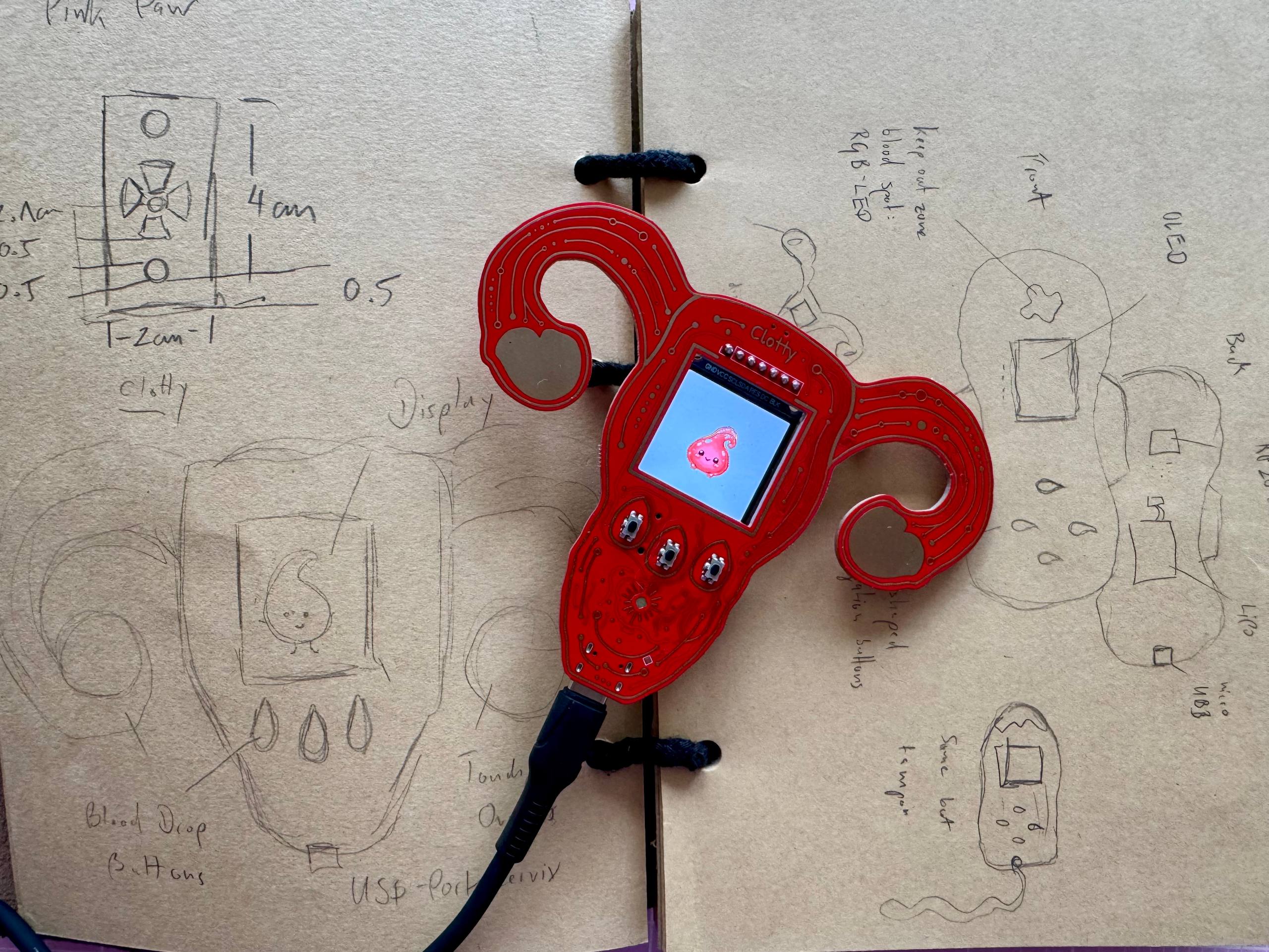
Earlier concepts included tampon-shaped and period-pad-shaped devices before the uterus eventually won.
This revision is a prototype and has known mechanical and layout problems.
Known issues currently include:
The board works, but this revision should not be mistaken for a polished production design!
Hardware fixes and cleanup will happen on the hw-devel branch before being merged into main.
Fabrication files are available in fabrication/.
The directory contains:
The current fabrication output corresponds to the prototype revision described above.
Again: read the Known Issues section before ordering boards.
The project is designed in KiCad.
The repository contains:
The local libraries are included so the project should not depend on random symbols and footprints disappearing from somewhere on the internet.
If you manufacture this board yourself, verify the BOM, footprints, component availability and fabrication files before ordering. Hardware is unforgiving and I am merely a person on the internet who likes putting USB ports into uteruses.
Clotty's main application software is still under development and is not yet part of a proper release. But the firmware will appear in this repo, too.
The planned first usable version includes:
The software is deliberately not intended to perform medical analysis!
Clotty can run DOOM.
The DOOM build is based on kilograham/rp2040-doom.
My Clotty-specific fork lives here:
For Clotty I replaced the original Pico scanvideo output with a simple blocking SPI backend for the 240×240 ST7789 display and adapted the controls to use the physical buttons and capacitive-touch ovaries.
DOOM renders at 320×200 and is horizontally scaled to 240×200 for the display.
.
├── artwork/              PCB artwork and source SVGs
├── docs/                 documentation and schematic PDF
├── fabrication/          Gerbers, BOM and placement files
├── libraries/            project-local KiCad symbols and footprints
├── pics/                 README images
├── clotty.kicad_dru      KiCad design rules
├── clotty.kicad_pcb      PCB layout
├── clotty.kicad_pro      KiCad project
├── clotty.kicad_sch      schematic
├── fp-lib-table
└── sym-lib-tableA PDF export of the current schematic can be found here:
The full KiCad project is available in the repository root.
More detailed project documentation, design background and development notes will also be published on my blog:
Roughly:
DOOM itself and the Clotty DOOM fork are not covered by the hardware licence of this repository.
| Qty | Value | Footprint | References |
|---|---|---|---|
| 22 | 100nF | Capacitor_SMD:C_0603_1608Metric | C_ACCEL_IO1, C_ACCEL_VDD1, C_ADCAVDD1, C_CAP1203_VDD1, C_DVDD1, C_DVDD2, C_FLASH1, C_HALL1, C_IOVDD1, C_IOVDD2, C_IOVDD3, C_IOVDD4, C_IOVDD5, C_IOVDD6, C_LIGHT1, C_MCP9808 +6 |
| 6 | 10uF | Capacitor_SMD:C_0805_2012Metric | C_ACCEL_BULK1, C_BAT1, C_BQ_OUT1, C_TPS_IN1, C_TPS_OUT1, C_TPS_OUT2 |
| 6 | LOGO | LOGO | G***, G***, G***, G***, G***, G*** |
| 5 | TestPoint | TestPoint:TestPoint_Pad_1.0x1.0mm | TP_FLASH1, TP_I2C_SCL1, TP_I2C_SDA1, TP_REG_EN1, TP_RUN1 |
| 5 | ~ | clotty:KEY-SMD_KMR2XXGXXX | SW_A1, SW_B1, SW_BOOTSEL1, SW_C1, SW_RST1 |
| 4 | 100kOhm | Resistor_SMD:R_0603_1608Metric | R_CHG_PULL1, R_PG_PULL1, R_RTC_INT1, R_TOUCH_INT1 |
| 3 | 1MOhm | Resistor_SMD:R_0603_1608Metric | R_BAT_BOTTOM1, R_BAT_TOP1, R_EN_PD1 |
| 2 | 100Ohm | Resistor_SMD:R_0603_1608Metric | R_B1, R_G1 |
| 2 | 15pF | Capacitor_SMD:C_0603_1608Metric | C_XIN1, C_XOUT1 |
| 2 | 1kOhm | Resistor_SMD:R_0603_1608Metric | R_BOOT1, R_XOUT1 |
| 2 | 1uF | Capacitor_SMD:C_0603_1608Metric | C_VREGIN1, C_VREGOUT1 |
| 2 | 27Ohm | Resistor_SMD:R_0603_1608Metric | R_USB_DM1, R_USB_DP1 |
| 2 | 4.7kOhm | Resistor_SMD:R_0603_1608Metric | R_PULL_SCL1, R_PULL_SDA1 |
| 2 | 5.1kOhm | Resistor_SMD:R_0603_1608Metric | R_CC1, R_CC2 |
| 2 | TestPoint | TestPoint:TestPoint_Pad_1.5x1.5mm | TP_3V3, TP_GND1 |
| 1 | 0Ohm | Resistor_SMD:R_0603_1608Metric | R_SHIELD1 |
| 1 | 1.5kOhm | Resistor_SMD:R_0603_1608Metric | R_ILIM1 |
| 1 | 1.5uH | clotty:IND-SMD_L4.5-W4.1_SRP4020TA | L_TPS1 |
| 1 | 10kOhm | Resistor_SMD:R_0603_1608Metric | R_LIGHT1 |
| 1 | 10kOm | Resistor_SMD:R_0603_1608Metric | R_CS_PULL1 |
| 1 | 12MHz | clotty:CRYSTAL-SMD_4P-L3.2-W2.5-BL | Y1 |
| 1 | 220Ohm | Resistor_SMD:R_0603_1608Metric | R_R1 |
| 1 | 3kOhm | Resistor_SMD:R_0603_1608Metric | R_ISET1 |
| 1 | 4.7uF | Capacitor_SMD:C_0805_2012Metric | C_BQ_IN1 |
| 1 | 46.4kOhm | Resistor_SMD:R_0603_1608Metric | R_TMR1 |
| 1 | 470Ohm | Resistor_SMD:R_0603_1608Metric | R_VBACKUP1 |
| 1 | Battery Conn | clotty:CONN-SMD_P2.00_S2B-PH-SM4-TB-LF-SN | J_BATT1 |
| 1 | Coincell | clotty:BAT-SMD_KEYSTONE-1056 | BT1 |
| 1 | Display | Connector_PinHeader_2.54mm:PinHeader_1x07_P2.54mm_Vertical | J1 |
| 1 | NCP18XH103F03RB | clotty:R0603 | TH1 |
| 1 | OVARY1 | clotty:ovary_left | TP1 |
| 1 | OVARY2 | clotty:ovary_right | TP2 |
| 1 | RP2040 | Package_DFN_QFN:QFN-56-1EP_7x7mm_P0.4mm_EP3.2x3.2mm | U1 |
| 1 | TPS63031DSKR | clotty:SON-10_L2.5-W2.5-P0.50-TL-EP | IC1 |
| 1 | USB_C_Receptacle_USB2.0_16P | Connector_USB:USB_C_Receptacle_GCT_USB4105-xx-A_16P_TopMnt_Horizontal | J2 |
| 1 | W25Q128JVS | Package_SO:SOIC-8_5.3x5.3mm_P1.27mm | U2 |
| 1 | ~ | clotty:SOT-23-3_L2.9-W1.3-P0.95-LS2.4-BR | U9 |
| 1 | ~ | clotty:SENSORS-SMD_TEMT6000X01 | U7 |
| 1 | ~ | clotty:MSOP-8_L3.0-W3.0-P0.65-LS4.9-BL | U5 |
| 1 | ~ | clotty:DFN-8_L3.2-W1.5-P0.9-BL | U10 |
| 1 | ~ | clotty:SOT-23-3_L2.9-W1.6-P1.90-LS2.8-BR | Q1 |
| 1 | ~ | clotty:SW-SMD_SSSS811101 | SW1 |
| 1 | ~ | clotty:LGA-16_L3.0-W3.0-P0.50-TL | U6 |
| 1 | ~ | clotty:SOT-23-3_L2.9-W1.3-P1.90-LS2.4-BR | D1 |
| 1 | ~ | clotty:VQFN-16_L3.0-W3.0-P0.50-TL-EP1.7 | U3 |
| 1 | ~ | clotty:LED-SMD_4P-L3.2-W2.8-LS3.5-TR_150141M173100 | LED1 |
| 1 | ~ | clotty:SOIC-8_L5.0-W4.0-P1.27-LS6.0-BL | U8 |
| 1 | ~ | clotty:SOT-666-6_L1.6-W1.2-P0.50-LS1.6-BR | D2 |
It measures 113.7 × 85.8 mm and has 2 copper layers, 1.6 mm thick.
100 parts, built around the RP2040, TPS63031DSKR, W25Q128JVSIQ and NCP18XH103F03RB. The full list of its parts is on this page, with links to each part's symbol and footprint where PCBKit's library has them.
From the bitshiftcrazy/clotty repository on GitHub, at the commit this page was made from: the board is clotty.kicad_pcb and its schematic clotty.kicad_sch. PCBKit opens the board in the browser, with nothing to install.
Its repository states no licence, so its author keeps all rights: ask bitshiftcrazy before reusing the design.
alph4345/test
TrinketCore puts everything a small rechargeable gadget needs on one 40 × 60 mm board, ready to order assembled from PCBWay:

Stab-Rabbit-coding/Serenity-UAV
A functional, security conscious, Unmanned Aerial Vehicle based on the Firefly Class spacecraft Serenity from the 2002 show..


jackw01/scanlight
A better light source for scanning color negative film

GuzziFlipFlops/ESP32-Walkie-Talkie
An open source ESPNOW based walkie talkie with a 600 meter tested distance, with an OLED and multiple buttons to interact with


bkuhn4/golf-gps
The Pocket Caddy hardware is built around the ESP32-C3 microcontroller and includes the following components:

Casasaviruz/Wearable-biosensor-PCB
A battery powered double sided PCB sensor meant to monitor the heart rate, breathing, temperature and sleep and active cycles of lab mice, made as small and non invasive as possible, data is transmitted through Bluetooth