4 layers163 × 174.4 mm
Gd rev3b
baldengineer/Mega-IIe
Using the Mega II from a IIgs to make a Apple IIe compatible computer: The Mega IIe!
440 parts33MIT

 baldengineer/Mega-IIe33
Using the Mega II from a IIgs to make a Apple IIe compatible computer: The Mega IIe!
Proto socket adapter is an open-source printed circuit board by baldengineer, from the baldengineer/Mega-IIe repository on GitHub, published under the MIT licence. It is a 2-layer board of 47.2 × 12.8 mm with 13 parts on 13 nets, routed with 26 tracks and 5 vias.
Its parts include 4 resistors, 4 diodes and 3 connectors. It belongs with the interfaces and adapters boards and the RP2040 boards of this library.
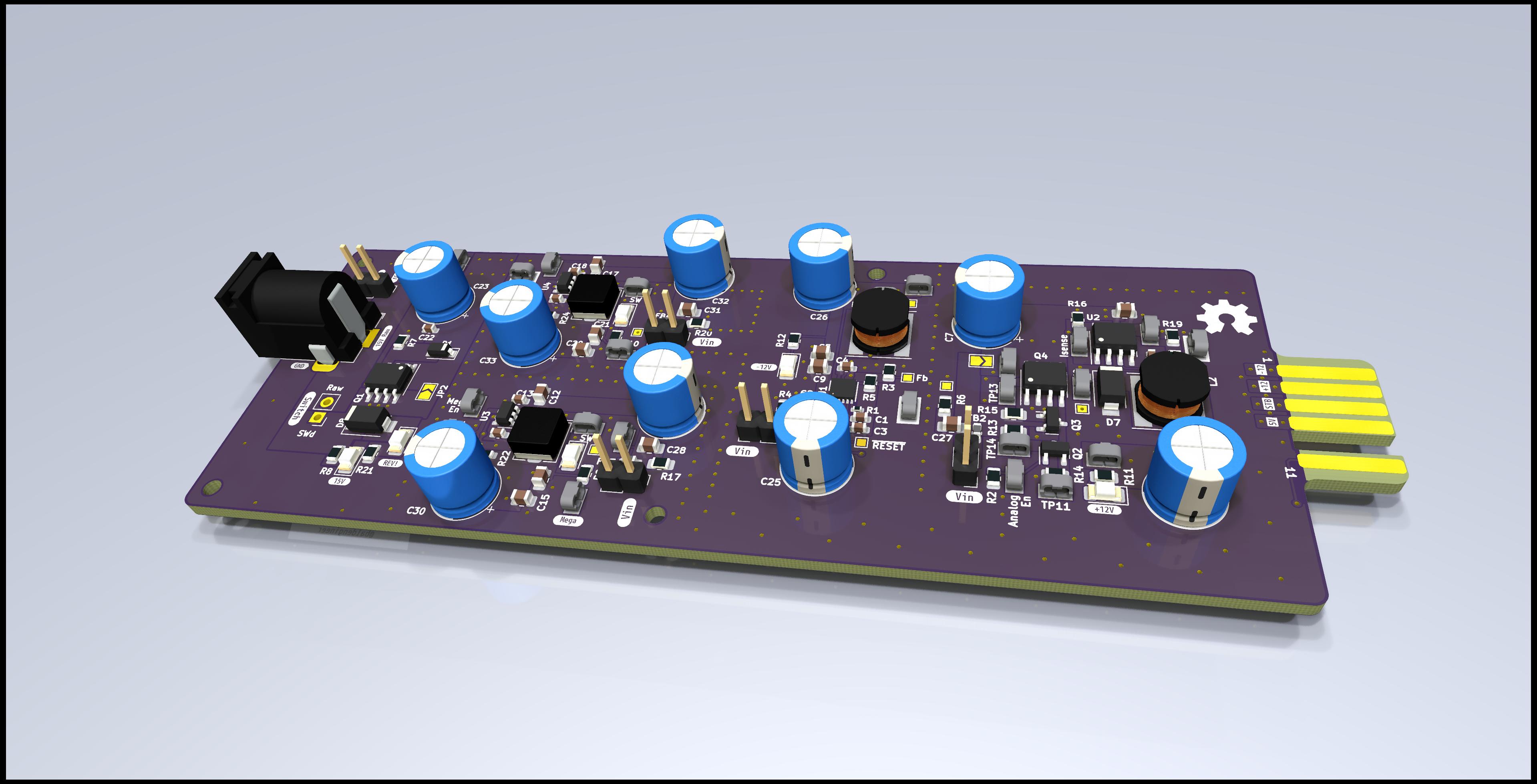
Four-rail SMPS for the Mega IIe.
Each 5V supply is designed for >1 Amp. The 12V supply was intended to provide at least 1 Amp. In rev1 testing it could provide 1 amp, but only for about 2 minutes. It's steady state max was around 750 mA.
The -12V supply can only provide a few hundred milliamps. However, in my testing other the analog video circuit used it. At most, it would draw 50 mA but usually sat around 10 mA.
The rev1 design suffered from severe conducted ripple from the 5V switchers. So the rev2 re-design is a 4-layer board with significant ground shielding of input and output rails.
| Qty | Value | Footprint | References |
|---|---|---|---|
| 4 | 1K | Resistor_SMD:R_0805_2012Metric | R1, R2, R3, R4 |
| 2 | MountingHole | MountingHole:MountingHole_2.2mm_M2 | H1, H2 |
| 1 | +12v | LED_SMD:LED_0805_2012Metric | D2 |
| 1 | -12v | LED_SMD:LED_0805_2012Metric | D1 |
| 1 | Mega | LED_SMD:LED_0805_2012Metric | D3 |
| 1 | RP2040 Header | Connector_PinSocket_2.54mm:PinSocket_2x03_P2.54mm_Vertical | J3 |
| 1 | Rev2 Header | Connector_PinSocket_2.54mm:PinSocket_2x04_P2.54mm_Vertical | J2 |
| 1 | Right Angle | My Libraries:TE 5650118-3 Right Angle 12 Pos Socket | J1 |
| 1 | Stby | LED_SMD:LED_0805_2012Metric | D4 |
baldengineer/Mega-IIe
Using the Mega II from a IIgs to make a Apple IIe compatible computer: The Mega IIe!

baldengineer/Mega-IIe
Using the Mega II from a IIgs to make a Apple IIe compatible computer: The Mega IIe!

baldengineer/Mega-IIe
Using the Mega II from a IIgs to make a Apple IIe compatible computer: The Mega IIe!

baldengineer/Mega-IIe
Using the Mega II from a IIgs to make a Apple IIe compatible computer: The Mega IIe!

baldengineer/Mega-IIe
Using the Mega II from a IIgs to make a Apple IIe compatible computer: The Mega IIe!

baldengineer/Mega-IIe
Using the Mega II from a IIgs to make a Apple IIe compatible computer: The Mega IIe!

baldengineer/Mega-IIe
Using the Mega II from a IIgs to make a Apple IIe compatible computer: The Mega IIe!

baldengineer/Mega-IIe
Using the Mega II from a IIgs to make a Apple IIe compatible computer: The Mega IIe!

baldengineer/Mega-IIe
Using the Mega II from a IIgs to make a Apple IIe compatible computer: The Mega IIe!

baldengineer/Mega-IIe
Using the Mega II from a IIgs to make a Apple IIe compatible computer: The Mega IIe!

baldengineer/Mega-IIe
Using the Mega II from a IIgs to make a Apple IIe compatible computer: The Mega IIe!

baldengineer/Mega-IIe
Using the Mega II from a IIgs to make a Apple IIe compatible computer: The Mega IIe!


samyk/magspoof
A portable device that can spoof/emulate any magnetic stripe, credit card or hotel card "wirelessly", even on standard magstripe (non-NFC/RFID) readers.

fossasia/pslab-scripts
Pocket Science Lab - Scripts for Sensor Experiments


willem-pennings/balancing-cube
A cube that balances itself in a corner or edge using reaction wheels

VoronDesign/Voron-Hardware
Cool Hardware designed by the Voron Design group

hoglet67/RGBtoHDMI
Bare-metal Raspberry Pi project that provides pixel-perfect sampling of Retro Computer RGB/YUV video and conversion to HDMI
It measures 47.2 × 12.8 mm and has 2 copper layers, 1.6 mm thick.
13 parts. The full list of its parts is on this page, with links to each part's symbol and footprint where PCBKit's library has them.
From the baldengineer/Mega-IIe repository on GitHub, at the commit this page was made from: the board is kicad files/gd power supply board pcb/proto socket adapter/proto socket adapter.kicad_pcb. PCBKit opens the board in the browser, with nothing to install.
Its repository publishes it under the MIT licence: you may reuse it on that licence's terms (keep the author's notice, and for a copyleft licence share your changes alike).