2 layers136.2 × 85.9 mm
BATDATUNIT01
mlab-modules/BATDATUNIT01
Multiple parallel Li-ion 18650 battery cell module with BMS and data storage with MCU control.
225 parts5GPL-3.0

 AstroMeters/AMFOC013
Open-source USB-C precize motorized telescope focuser with PC and manual control support.
AMFOC01 is an open-source printed circuit board by AstroMeters, from the AstroMeters/AMFOC01 repository on GitHub, published under the GPL-3.0 licence. It is a 2-layer board of 70.9 × 60.8 mm with 116 parts on 122 nets, routed with 846 tracks and 161 vias.
It is built around the RP2040, TMC5130A-TA and W25Q128JVSIQ, with the AT24CS64-SSHM-B, USBLC6-2SC6 and BC817-25 among its other parts. Its parts include 39 resistors, 36 capacitors, 12 connectors, 7 ICs and 5 diodes. It belongs with the RP2040 boards of this library.


AMFOC01 is a highly sophisticated focuser primarily designed for astronomical telescopes, although it can also be applied to other optical devices. It uses state-of-the-art technologies, such as the micro-stepping driver TMC5130 for stepper motors and the RP2040 processor. These components ensure smooth and quiet operation without the unpleasant vibrations that are common with traditional stepper motors.
The device is equipped with an OLED display and four buttons for easy user interaction. It can be connected to a computer via USB-C and controlled using software compatible with the MoonLight protocol, such as KStars or INDI.
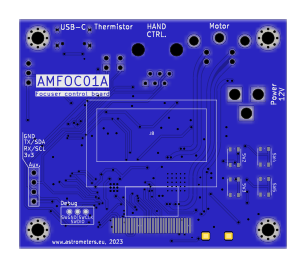
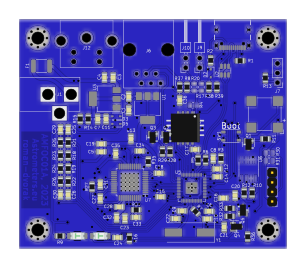
AMFOC01 can be utilized in several different scenarios:
For long-term astrophotography: AMFOC01 allows very precise focus control, which is essential for long-term astrophotography. This is particularly useful when photographing deep space, where it is necessary to maintain consistent focus over a long period of time.
With temperature mode: AMFOC01 can monitor the temperature of the surrounding environment and automatically refocus in case of its change. This is especially useful during long-term observation or photography, when the temperature can change throughout the night.
For eye observation: When exchanging eyepieces, it is often necessary to make a significant refocus. The focuser can be set for individual eyepieces and automatically refocuses to a preset position when they are exchanged. This simplifies and speeds up the observation process.
With a wired controller: It is possible to connect a wired controller to the focuser, which allows for fine focusing without touching the telescope, thereby eliminating vibrations and movement that could hinder observation.
AMFOC01 is designed to be easily connectable to a wide range of astronomical telescopes. Using 3D printing, customized mechanical adapters can be created for specific telescope models or optical systems.
AMFOC01 is developed as an open-source project. This means that all software, firmware (written in TinyGo), and hardware design are publicly available and can be modified according to the user's needs.
AMFOC01 can be used in a variety of scenarios where precise focusing of optical systems is needed. This device is primarily intended for astronomical telescopes but can also be used in other optical devices. Using 3D printing, mechanical adapters for specific telescope models or other optical systems can be quickly and easily created.
AMFOC01 uses the micro-stepping driver TMC5130, which provides the following features:
The device is also equipped with the RP2040 processor with the following features:
AMFOC01 is equipped with a stepper motor, which is controlled by the TMC5130 driver. This driver allows for precise micro-stepping control, eliminating vibrations and enabling smooth and quiet operation.
The driver is powered by a voltage of 9-16V. A coaxial DC connector 5.5/2.1 is used for power, which can be connected, for example, to a lead-acid battery (car battery). It's important to note that the motor cannot be powered via USB-C.
The device is operated using four buttons and an OLED display, which displays the current position of the focuser, the temperature, and the power status. It can be connected to a computer via USB-C and controlled using software compatible with the MoonLight protocol.
AMFOC01 is designed to be easily connectable to a wide range of astronomical telescopes. Using 3D printing, customized mechanical adapters can be created for specific telescope models or optical systems. This makes the focuser easily adaptable to your specific needs.
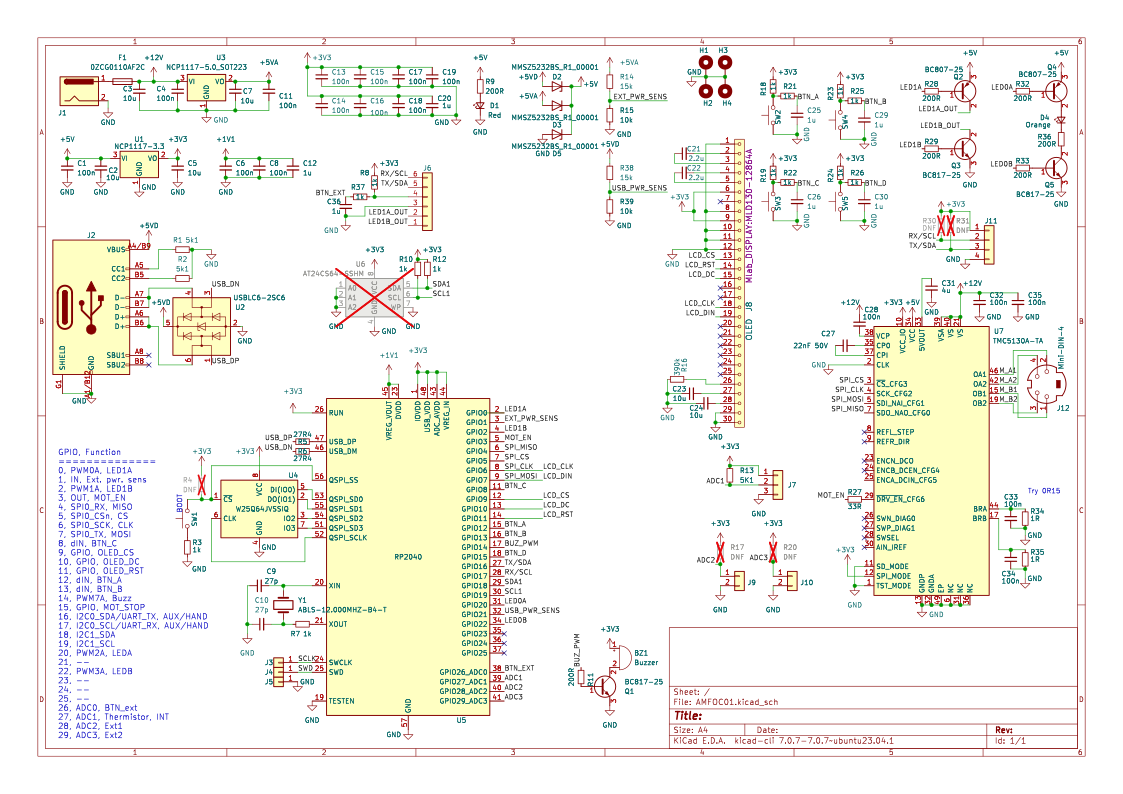
| Qty | Value | Footprint | References |
|---|---|---|---|
| 17 | 100n | Capacitor_SMD:C_0805_2012Metric | C1, C4, C6, C11, C13, C14, C15, C16, C17, C18, C19, C28, C32, C33, C34, C35 +1 |
| 14 | 1k | Resistor_SMD:R_0805_2012Metric | R3, R7, R8, R10, R12, R18, R19, R21, R22, R23, R24, R25, R26, R37 |
| 7 | 1u | Capacitor_SMD:C_0805_2012Metric | C12, C20, C25, C26, C29, C30, C36 |
| 6 | 10u | Capacitor_SMD:C_0805_2012Metric | C2, C3, C5, C7, C23, C24 |
| 5 | 100R | Resistor_SMD:R_0805_2012Metric | R11, R28, R29, R32, R33 |
| 5 | 434133025816 | Button_Switch_SMD:SW_Push_1P1T_NO_Vertical_Wuerth_434133025816 | SW1, SW2, SW3, SW4, SW5 |
| 5 | DNF | Resistor_SMD:R_0805_2012Metric | R4, R17, R20, R30, R31 |
| 4 | MountingHole_Pad | MountingHole:MountingHole_3.2mm_M3_Pad_Via | H1, H2, H3, H4 |
| 3 | BC817-25 | Package_TO_SOT_SMD:SOT-23 | locked, Q1, Q5 |
| 3 | Conn_01x01 | TestPoint:TestPoint_Pad_D1.0mm | J3, J4, J5 |
| 3 | MMSZ5232BS_R1_00001 | Diode_SMD:D_SOD-323 | D2, D3, D5 |
| 2 | 0R15 | Resistor_SMD:R_0805_2012Metric | R34, R35 |
| 2 | 10k | Resistor_SMD:R_0805_2012Metric | R14, R38 |
| 2 | 2.2u | Capacitor_SMD:C_0805_2012Metric | C21, C22 |
| 2 | 200R | Resistor_SMD:R_0805_2012Metric | R9, R36 |
| 2 | 20k | Resistor_SMD:R_0805_2012Metric | R15, R39 |
| 2 | 27R4 | Resistor_SMD:R_0805_2012Metric | R5, R6 |
| 2 | 27p | Capacitor_SMD:C_0805_2012Metric | C9, C10 |
| 2 | 5k1 | Resistor_SMD:R_0805_2012Metric | R1, R2 |
| 2 | BC807-25 | Package_TO_SOT_SMD:SOT-23 | Q2, Q4 |
| 2 | Conn_01x02 | Connector_PinHeader_2.54mm:PinHeader_2x01_P2.54mm_Horizontal | J9, J10 |
| 1 | 0ZCG0110AF2C | Fuse:Fuse_1812_4532Metric | F1 |
| 1 | 100k | Resistor_SMD:R_0805_2012Metric | R13 |
| 1 | 22nF 50V | Capacitor_SMD:C_0805_2012Metric | C27 |
| 1 | 33R | Resistor_SMD:R_0805_2012Metric | R27 |
| 1 | 390k | Resistor_SMD:R_0805_2012Metric | R16 |
| 1 | 4u | Capacitor_SMD:C_0805_2012Metric | C31 |
| 1 | ABLS-12.000MHZ-B4-T | Crystal:Crystal_SMD_HC49-SD | Y1 |
| 1 | AT24CS64-SSHM | Package_SO:SOIC-8_3.9x4.9mm_P1.27mm | U6 |
| 1 | Buzzer | Buzzer_Beeper:MagneticBuzzer_CUI_CMT-8504-100-SMT | BZ1 |
| 1 | Conn_01x03 | Connector_PinHeader_2.54mm:PinHeader_1x03_P2.54mm_Vertical | J7 |
| 1 | Conn_01x04 | Connector_RJ:RJ12_Amphenol_54601 | J6 |
| 1 | Conn_01x04 | Connector_PinHeader_2.54mm:PinHeader_1x04_P2.54mm_Vertical | J11 |
| 1 | Jack-DC | Mlab_CON:DC2,1MM | J1 |
| 1 | Mini-DIN-4 | Mlab_CON:MiniDIN-4 KMDGX4SN | J12 |
| 1 | NCP1117-3.3 | Package_TO_SOT_SMD:SOT-223-3_TabPin2 | U1 |
| 1 | NCP1117-5.0_SOT223 | Package_TO_SOT_SMD:SOT-223-3_TabPin2 | U3 |
| 1 | OLED | Mlab_DISPLAY:MLD130-12864A | J8 |
| 1 | Orange | Mlab_D:LED_1206_2 | D4 |
| 1 | RP2040 | Package_DFN_QFN:QFN-56-1EP_7x7mm_P0.4mm_EP3.2x3.2mm | U5 |
| 1 | Red | Mlab_D:LED_1206_2 | D1 |
| 1 | TMC5130A-TA | Package_QFP:TQFP-48-1EP_7x7mm_P0.5mm_EP5x5mm_ThermalVias | U7 |
| 1 | USBC_USB4105-GF-A | Mlab_CON:USBC GCT_USB4105-GF-A | J2 |
| 1 | USBLC6-2SC6 | Package_TO_SOT_SMD:SOT-23-6 | U2 |
| 1 | W25Q128JVS | Package_SO:SOIC-8_5.23x5.23mm_P1.27mm | U4 |
It measures 70.9 × 60.8 mm and has 2 copper layers, 1.6 mm thick.
116 parts, built around the RP2040, TMC5130A-TA, W25Q128JVSIQ and AT24CS64-SSHM-B. The full list of its parts is on this page, with links to each part's symbol and footprint where PCBKit's library has them.
From the AstroMeters/AMFOC01 repository on GitHub, at the commit this page was made from: the board is hw/sch_pcb/AMFOC01.kicad_pcb and its schematic hw/sch_pcb/AMFOC01.kicad_sch. PCBKit opens the board in the browser, with nothing to install.
Its repository publishes it under the GPL-3.0 licence: you may reuse it on that licence's terms (keep the author's notice, and for a copyleft licence share your changes alike).
mlab-modules/BATDATUNIT01
Multiple parallel Li-ion 18650 battery cell module with BMS and data storage with MCU control.


michaelswitzer/granola-beacon
Granola Beacon: arcade controller with hall effect switches

mlab-modules/LION1CELL02
Single-cell Li-Ion Battery management system with I2C interface


polpo/picogus
Emulation of ISA sound cards and CD-ROM on Raspberry Pi Pico (GUS, SB/Adlib, MPU-401, Tandy, CMS, Panasonic CD-ROM) with USB mouse/joystick support