
2 layers55 × 80 mm
Board esp32 v2
sudomesh/disaster-radio
A (paused) work-in-progress long-range, low-bandwidth wireless disaster recovery mesh network powered by the sun.
101 parts1.1k

 aslak3/ESP01LEDDriver
Small board for attaching an ESP01 to an addressable LED strip
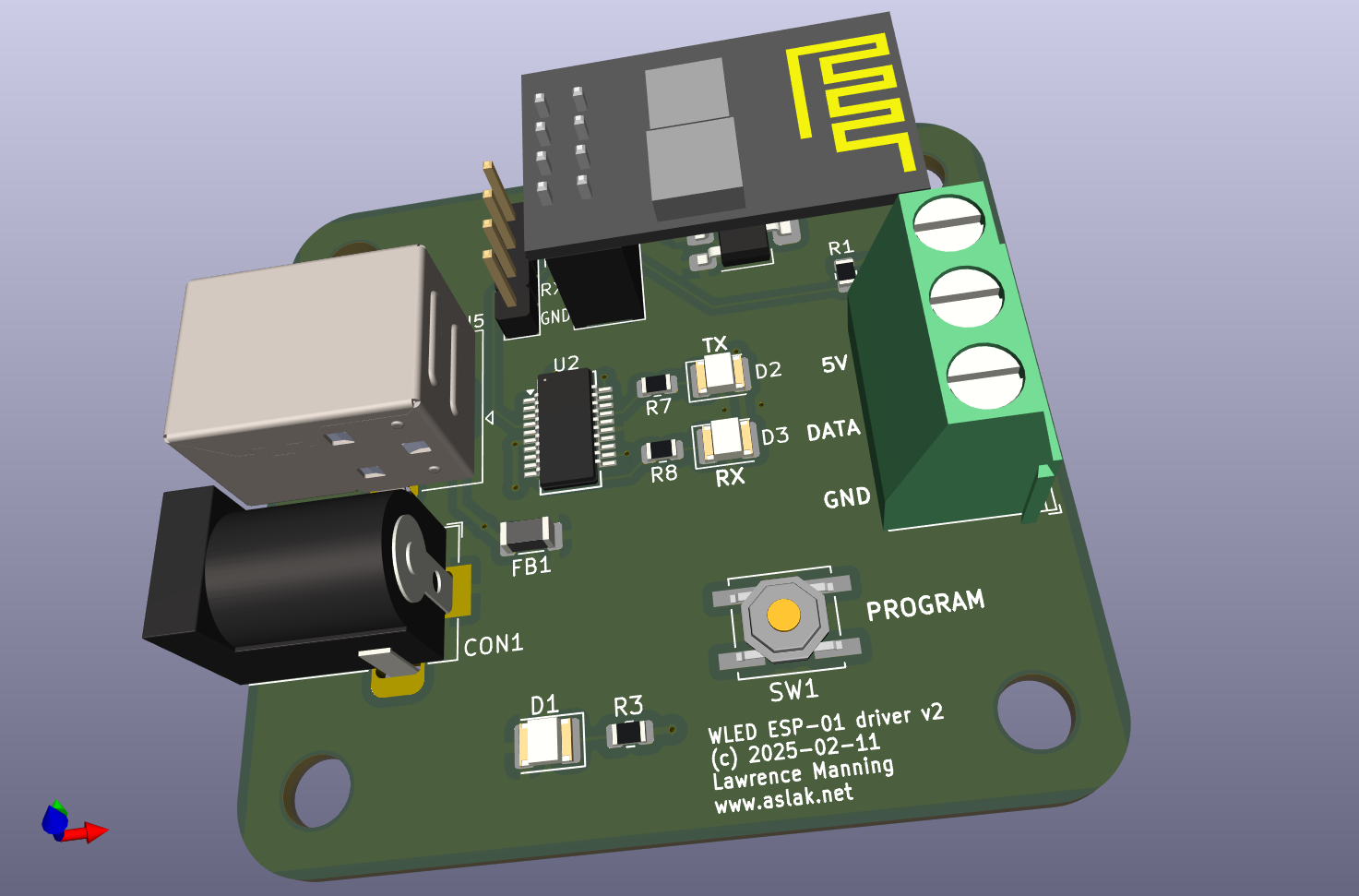
ESP01LEDDriver is an open-source printed circuit board by aslak3, from the aslak3/ESP01LEDDriver repository on GitHub, published under the GPL-2.0 licence. It is a 2-layer board of 53.3 × 49.5 mm with 32 parts on 27 nets, routed with 161 tracks and 23 vias.
It is built around the FT231XS-R. Its parts include 8 capacitors, 7 resistors, 5 connectors, 3 diodes and 2 ICs. It belongs with the ESP8266 boards of this library.
A schematic is included here, along with the KiCAD data files, whcih are in KiCAD 6 format.
The PCB is a trivial 2 layer board.
After coming across the ESP01 I was very impressed. It seemed like an excellent solution to problems where a very small controller board was needed, such as running WLED to control addressable LED strips. However the LED strip attachment board I could find used an odd arrangement of receiving power by attaching a USB-A plug directly to the board. I wanted to use a power lead of some description, going to the controller board which then had the LED strip screwed into it on terminals. As I was ordering some other boards, I thought I would knock up this board and order it at the same time.
Power can be supplied via 5V on the barell plug, or 5V via a USB-B connector. The FTDI FT231XS is optional: if included on the board then it is possible to program the ESP01 in-place via the USB connection. Otherwise it must either be programmed using a dedicated board, or programmed when attached to this board but via a USB TTL (in 3.3V mode!) UART attached to the four header pins.
In either case, the PROGRAM button can be used to bring up the ESP01 in programming mode.
When time allows I will CAD-up a small printable case for enclosing this board.
| Qty | Value | Footprint | References |
|---|---|---|---|
| 4 | HOLE | MountingHole:MountingHole_4.3mm_M4 | H1, H2, H3, H4 |
| 3 | 1K | Resistor_SMD:R_0805_2012Metric | R3, R7, R8 |
| 2 | 10k | Resistor_SMD:R_0805_2012Metric | R1, R2 |
| 2 | 27 | Resistor_SMD:R_0805_2012Metric | R5, R6 |
| 2 | 4.7u | Capacitor_SMD:C_0805_2012Metric | C7, C8 |
| 2 | 47p | Capacitor_SMD:C_0805_2012Metric | C5, C6 |
| 2 | UART_LED | LED_SMD:LED_1210_3225Metric | D2, D3 |
| 1 | 0.1u | Capacitor_SMD:C_0805_2012Metric | C2 |
| 1 | 10n | Capacitor_SMD:C_0805_2012Metric | C4 |
| 1 | 10u | Capacitor_Tantalum_SMD:CP_EIA-3216-10_Kemet-I | C3 |
| 1 | 2N7002 | Package_TO_SOT_SMD:SOT-23 | Q1 |
| 1 | 47u | Capacitor_Tantalum_SMD:CP_EIA-7343-15_Kemet-W | C1 |
| 1 | AZ1117-3.3 | Package_TO_SOT_SMD:SOT-223-3_TabPin2 | U1 |
| 1 | Bead | Inductor_SMD:L_1206_3216Metric | FB1 |
| 1 | Conn_01x04 | Connector_PinHeader_2.54mm:PinHeader_1x04_P2.54mm_Vertical | J1 |
| 1 | Conn_02x04_Odd_Even | Connector_PinHeader_2.54mm:PinHeader_2x04_P2.54mm_Vertical | J2 |
| 1 | FT231XS | Package_SO:SSOP-20_3.9x8.7mm_P0.635mm | U2 |
| 1 | POWERLED | LED_SMD:LED_1210_3225Metric | D1 |
| 1 | POWERLJACK | Connector_BarrelJack:BarrelJack_Horizontal | CON1 |
| 1 | RESETBUTTON | Button_Switch_SMD:SW_Push_1P1T_NO_CK_KSC6xxJ | SW1 |
| 1 | Screw_Terminal_01x03 | TerminalBlock_Philmore:TerminalBlock_Philmore_TB133_1x03_P5.00mm_Horizontal | J3 |
| 1 | USB_B | Connector_USB:USB_B_OST_USB-B1HSxx_Horizontal | J5 |
It measures 53.3 × 49.5 mm and has 2 copper layers, 1.6 mm thick.
32 parts, built around the FT231XS-R. The full list of its parts is on this page, with links to each part's symbol and footprint where PCBKit's library has them.
From the aslak3/ESP01LEDDriver repository on GitHub, at the commit this page was made from: the board is ESP01LEDDriver.kicad_pcb and its schematic ESP01LEDDriver.kicad_sch. PCBKit opens the board in the browser, with nothing to install.
Its repository publishes it under the GPL-2.0 licence: you may reuse it on that licence's terms (keep the author's notice, and for a copyleft licence share your changes alike).
sudomesh/disaster-radio
A (paused) work-in-progress long-range, low-bandwidth wireless disaster recovery mesh network powered by the sun.

shorepine/tulipcc
The Tulip Creative Computer and AMYboard - portable Python synthesizers


vaugerbird/sstv-backpack
A ESP32-CAM SSTV backpack for the Baofeng UV-5R + others!


hirakuni45/RL78
Renesas RL78 Microcontroller, C++ framework, Library, Sample