2 layers142.5 × 106.4 mm

 arunderwood/milsblo
USB-C PD powered ESP32-S3 backpack PCB for fan control and BME280 sensor
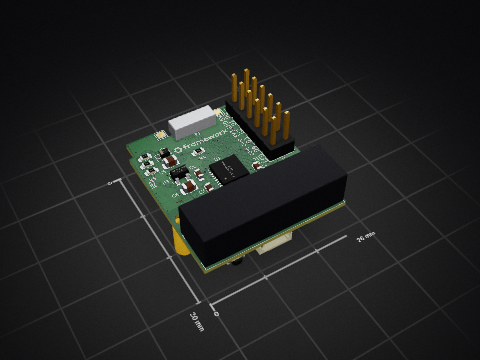
Layouts is an open-source printed circuit board by arunderwood, from the arunderwood/milsblo repository on GitHub. It is a 2-layer board with 34 parts on 64 nets.
Its parts include 15 resistors, 7 capacitors, 3 connectors, 2 ICs and 2 diodes.
milsblo is a portmanteau of MILSBO — IKEA's popular glass-door cabinet — and blow, for the fan-control feature at the heart of the board.
An experiment in vibe-coded circuit design by someone without much electronics experience.
Hobbyists convert MILSBO cabinets into miniature indoor greenhouses using grow lights, humidifiers, and fans. Circulation fans are critical: airflow strengthens stems and prevents the mold that thrives in warm, stagnant, humid air.
milsblo is the electronics backbone for that setup.
A single USB-C cable delivers 12V via USB Power Delivery — one cord powers both fans and the microcontroller. The board backpacks onto an ESP32-S3-DevKitC-1 via female pin headers.
USB-C PD charger (65W+)
    │
    ▼
CH224K (PD sink) → 12V rail ──→ Fan headers × 2 (always-on 12V)
                           └──→ AP63205 buck → 5V → ESP32-S3-DevKitC-1
                                                         │
                                                         ├── 25kHz PWM → Fan 1 & 2 speed control
                                                         ├── Tach input ← Fan RPM feedback
└── I2C → BME280 temp/humidity sensorfirmware/milsblo.yaml) — integrates with Home Assistant| Phase | Status |
|---|---|
| Phase 1: Component definitions | ✅ Complete |
| Phase 2: Atopile schematic | ✅ Complete |
| Phase 3: SPICE simulations | ✅ Complete |
| Phase 4: Firmware + test guide | ✅ Complete |
| Phase 5: PCB layout (KiCad) | 🔲 Not started |
| Phase 6: Manufacturing export | 🔲 Not started |
Designed in Atopile (code-first EDA); the schematic lives in .ato source files and compiles to a KiCad project for fabrication.
For full architecture decisions and build instructions, see CLAUDE.md.
uv pip install "atopile>=0.12,<0.13"
ato build                           # compile to KiCad project in build/
ngspice -b simulation/power_chain.cir
esphome run firmware/milsblo.yaml| Qty | Value | Footprint | References |
|---|---|---|---|
| 3 | 100nF ±10% 50V X7R | YAGEO_CC0603KRX7R9BB104:C0603 | C1, C6, C7 |
| 3 | 10kΩ ±1% 100mW | UNI_ROYAL_0603WAF1002T5E:R0603 | R4, R6, R15 |
| 2 | FemaleHeader_1x22_2v54mm:PinSocket_1x22_P2.54mm_Vertical | J1, J2 | |
| 2 | CJT_A2541WR_4P:HDR-TH_4P-P2.54-H-M-W10.3 | H1, H2 | |
| 2 | 100kΩ ±1% 62.5mW | UNI_ROYAL_0402WGF1003TCE:R0402 | R2, R14 |
| 2 | 100Ω ±1% 100mW | UNI_ROYAL_0603WAF1000T5E:R0603 | R3, R5 |
| 2 | 22µF ±10% 25V X5R | Samsung_Electro_Mechanics_CL31A226KAHNNNE:C1206 | C2, C3 |
| 2 | 4.7kΩ ±1% 62.5mW | UNI_ROYAL_0402WGF4701TCE:R0402 | R11, R12 |
| 2 | 470Ω ±1% 100mW | UNI_ROYAL_0603WAF4700T5E:R0603 | R10, R13 |
| 2 | 5.1kΩ ±1% 62.5mW | UNI_ROYAL_0402WGF5101TCE:R0402 | R7, R8 |
| 1 | JST_Sales_America_SM04B_SRSS_TB_LF__SN:CONN-SMD_4P-P1.00_SM04B-SRSS-TB-LF-SN | CN1 | |
| 1 | Shikues_MMBT3904:SOT-23-3_L2.9-W1.6-P1.90-LS2.8-BR | Q1 | |
| 1 | Diodes_Incorporated_AP63205WU_7:TSOT-23-6_L2.9-W1.6-P0.95-LS2.8-BL | U1 | |
| 1 | Everlight_Elec_19_217_GHC_YR1S2_3T:LED0603-RD | LED1 | |
| 1 | WCH_CH224K:ESSOP-10_L4.9-W3.9-P1.0-LS6.0-TL-EP | U2 | |
| 1 | CENKER_CKCS4018_4_7uH_M:IND-SMD_L4.0-W4.0_SWPA4018S | L1 | |
| 1 | MDD_Microdiode_Electronics_BZT52C5V1:SOD-123_L2.7-W1.6-LS3.7-RD | D1 | |
| 1 | SHOU_HAN_TYPE_C_16PIN_2MD_073:USB-C-SMD_TYPE-C-6PIN-2MD-073 | USB1 | |
| 1 | 100µF ±20% 35V | KNSCHA_RVT100UF35V167RV0082:CAP-SMD_BD6.3-L6.6-W6.6-FD | C4 |
| 1 | 1µF ±10% 25V X5R | Samsung_Electro_Mechanics_CL05A105KA5NQNC:C0402 | C5 |
| 1 | 24kΩ ±1% 62.5mW | UNI_ROYAL_0402WGF2402TCE:R0402 | R9 |
| 1 | 750kΩ ±1% 62.5mW | FOJAN_FRC0402F7503TS:R0402 | R1 |
FrameworkComputer/ExpansionCards
Reference designs and documentation to create Expansion Cards for the Framework Laptop

mntmn/amiga2000-gfxcard
MNT VA2000, an Open Source Amiga 2/3/4000 Graphics Card (Zorro II/III), written in Verilog

hackclub/OnBoard
💡 Join 1,000 teenagers and make your first PCB with a $100 grant!


strangeparts/niubi-headphones
Flexible circuit board design for adding a headphone jack to an iPhone 7


baldengineer/bit-preserve
Project for capturing vintage, classic, aka old computer schematics in KiCad.
34 parts. The full list of its parts is on this page, with links to each part's symbol and footprint where PCBKit's library has them.
From the arunderwood/milsblo repository on GitHub, at the commit this page was made from: the board is elec/layouts/default/default.kicad_pcb. PCBKit opens the board in the browser, with nothing to install.
Its repository states no licence, so its author keeps all rights: ask arunderwood before reusing the design.