2 layers150.6 × 171.7 mm
Kraft80V2
ARMCoderBR/z80computer-release
A Z80-based computer for nostalgic enthusiasts. With video output!
175 parts5GPL-2.0
 ARMCoderBR/z80computer-release5
A Z80-based computer for nostalgic enthusiasts. With video output!
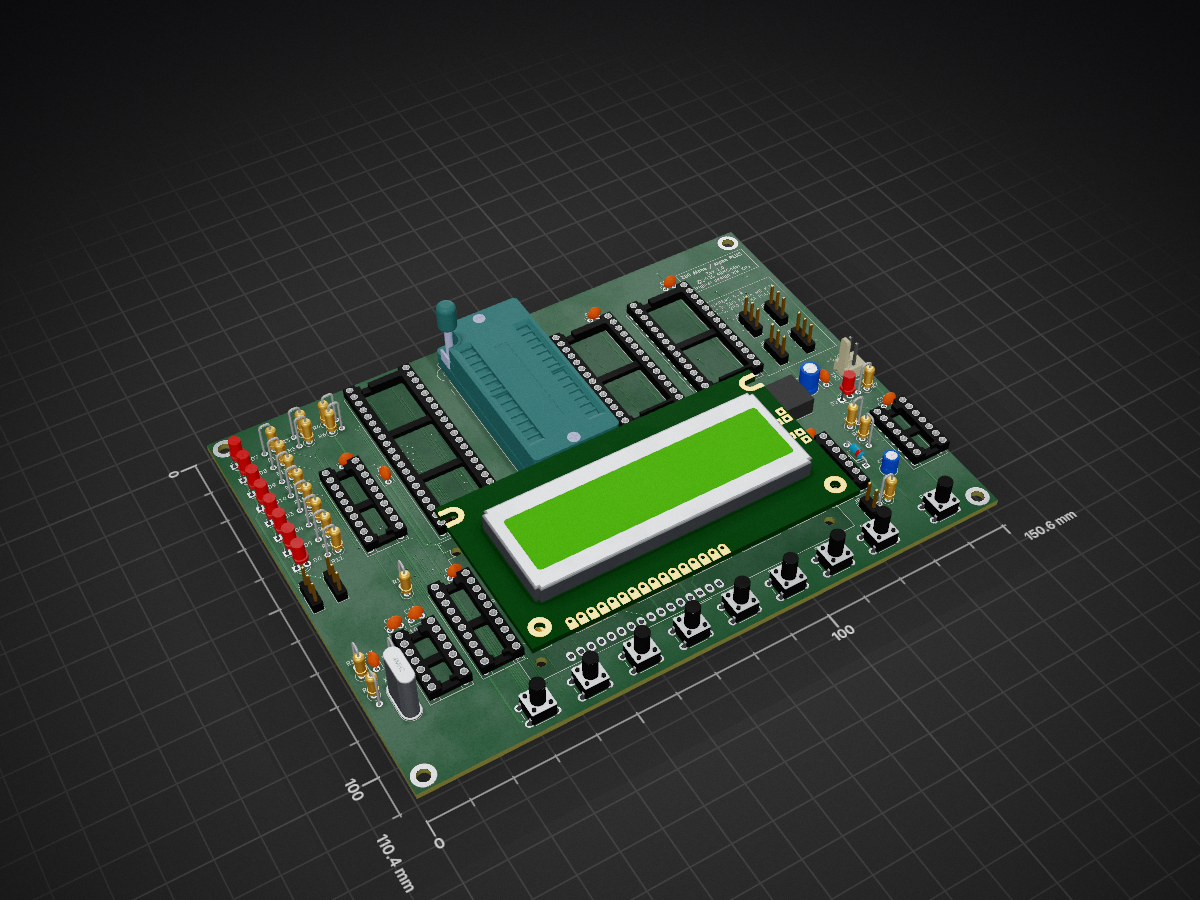
AlphaPlus is an open-source printed circuit board by ARMCoderBR, from the ARMCoderBR/z80computer-release repository on GitHub, published under the GPL-2.0 licence. It is a 2-layer board of 150.6 × 110.4 mm with 88 parts on 123 nets, routed with 1,327 tracks and 164 vias.
It is built around the 74LS245SC, 74LS273PC and HM62256BLP-7, with the 74HC04D, 74LS02PC and 100UF/16V among its other parts. Its parts include 20 resistors, 19 capacitors, 14 ICs, 10 diodes and 2 connectors. It belongs with the retro computing and games boards of this library.


A Z80-based computer for nostalgic enthusiasts
©2025 - ARMCoder
UPDATED 2025 - November 19

For starters, this is no more than a hobby project: a Z80-based computer. By no means it aims to be a practical solution to anything, as any modern microcontroller can do much better with lower cost, lower complexity, lower power consumption and much more ease of use. You can eventually make changes on it to perform some practical automation tasks and it WILL work, it's just not recommended nowadays. Get a PIC or Arduino instead.
I began building a 3rd party kit called "Z80 Alpha" from a company called WR Kits here in Brazil. The kit was a box of parts (minus PCB), a set of manuals and a minimalistic monitor software.
This was initially intended to be a quick pastime, but in time, I decided to expand the original kit with new features and write new software. See ALPHAPLUS-README.md for the historic background on that kit.
It's a homebrew computer in development. This is the first Kraft 80's prototype:

Then I've already built a first tentative true PCB for it, This one pictured here is the Rev 2.0:

There's a newer revision that's almost perfect in my opinion. This revision (called 2.2) fixes some mistakes and add some expansion connectors:

Characteristics:
  CPU:   Z80A, 4 MHz

  ROM BIOS + Monitor:  8 kbytes
  ROM BASIC: 8 kbytes

  RAM:   16 kbytes (disabled at boot) + 48 kbytes (the lower RAM can be remapped
         over the ROMs, yielding the full 64 kbytes ready for use)

  VIDEO: Text Mode: 48 rows x 80 columns - Monochrome
         Graphics Mode: 320x240 Framebuffer - 16 Color

  KEYBOARD: PS/2 compatible

  SOUND: Mono, compatible with GI AY3-891x (the famous so-called 'PSG' used in MSX computers and others from the 80s)

  TIMER Interrupt: Fixed, 300 Hz

  SERIAL: USB 19200 BPS, 8N1, RTS Flow control (via FTDI - USB chip)

  MICRO SD CARD CONTROLLER: Software still WIP, hardware already tested

  POWER: 5V 1A (via USB, the same of the FTDI above), or a separate Power connector (barrel P4 jack in PCB Rev 2.2)

EXTRA IOS:Through its serial port, it can have software downloaded to its RAM. A serial monitor, 'Sysmon' (that runs on the BIOS ROM), is supplied for this purpose.
Sysmon also has functions to edit and display the RAM contents using the PS/2 keyboard and monitor, or alternatively, through a serial terminal over the Serial port in the case you don't have a PS/2 keyboard or a spare VGA monitor.
BASIC Interpreter: The ROM BASIC is the Microsoft BASIC 4.7b interpreter. There are two ROM images made available: the one that uses the BIOS, so the VGA output and the PS/2 keyboard are functional, and a standalone image that works only over the serial port. For those really nostalgic, there are some nice text-only games written in BASIC at this repository:
http://vintage-basic.net/games.htmlRemember that in order to switch ROM programs, the actual ROM chip needs to be replaced (and because of that, a ZIF socket is instrumental to keep the process smooth and safe!).
As the VGA controller is the latest addition to the Kraft80, not much software is available for it (yet). Currently, there's a clock demo (written in C) and I'm writing a Space Invaders clone (this one in pure Assembly). I'm planning to find out whether I can integrate graphics function into that BASIC interpreter!
You will find some other documentation in the project's directories. This part is still WIP, so please be patient and check every few days. New documentation is being added often.
| Qty | Value | Footprint | References |
|---|---|---|---|
| 15 | 100nF | Capacitor_THT:C_Disc_D3.8mm_W2.6mm_P2.50mm | C1, C2, C5, C7, C8, C9, C10, C11, C12, C15, C16, C17, C90, C91, C93 |
| 9 | LED | LED_THT:LED_D3.0mm_FlatTop | D2, D3, D4, D5, D6, D7, D8, D9, D10 |
| 9 | SW_Push | Button_Switch_THT:SW_PUSH_6mm_H9.5mm | RST1, SW1, SW2, SW3, SW4, SW5, SW6, SW7, SW8 |
| 8 | 1k8 | Resistor_THT:R_Axial_DIN0207_L6.3mm_D2.5mm_P2.54mm_Vertical | R8, R9, R10, R11, R12, R13, R14, R15 |
| 6 | 10k | Resistor_THT:R_Axial_DIN0207_L6.3mm_D2.5mm_P2.54mm_Vertical | R1, R2, R3, R4, R5, R6 |
| 6 | Jumper_3_Bridged12 | Connector_PinHeader_2.54mm:PinHeader_1x03_P2.54mm_Vertical | JP1, JP2, JP5, JP6, JP7, JP8 |
| 2 | 1k | Resistor_THT:R_Axial_DIN0207_L6.3mm_D2.5mm_P2.54mm_Vertical | R16, R17 |
| 2 | 74LS08 | Package_DIP:DIP-14_W7.62mm_Socket | U8, U93 |
| 2 | 74LS138 | Package_DIP:DIP-16_W7.62mm_Socket | U3, U91 |
| 2 | 74LS273 | Package_DIP:DIP-20_W7.62mm_Socket | U5, U11 |
| 2 | HM62256BLP | Package_DIP:DIP-28_W15.24mm_Socket | U9, U90 |
| 1 | +5VCC | Connector_Molex:Molex_KK-254_AE-6410-02A_1x02_P2.54mm_Vertical | CN1 |
| 1 | 100k | Potentiometer_THT:Potentiometer_Bourns_3386F_Vertical | P1 |
| 1 | 100uF/16V | Capacitor_THT:C_Radial_D5.0mm_H7.0mm_P2.00mm | C6 |
| 1 | 10nF | Capacitor_THT:C_Disc_D3.8mm_W2.6mm_P2.50mm | C13 |
| 1 | 1M | Resistor_THT:R_Axial_DIN0207_L6.3mm_D2.5mm_P2.54mm_Vertical | R18 |
| 1 | 1N4148 | Diode_THT:D_DO-35_SOD27_P7.62mm_Horizontal | D1 |
| 1 | 1k5 | Resistor_THT:R_Axial_DIN0207_L6.3mm_D2.5mm_P2.54mm_Vertical | R7 |
| 1 | 22 | Resistor_THT:R_Axial_DIN0207_L6.3mm_D2.5mm_P2.54mm_Vertical | R20 |
| 1 | 33uF/16V | Capacitor_THT:C_Radial_D4.0mm_H5.0mm_P1.50mm | C3 |
| 1 | 4093 | Package_DIP:DIP-14_W7.62mm_Socket | U4 |
| 1 | 47pF | Capacitor_THT:C_Disc_D3.8mm_W2.6mm_P2.50mm | C14 |
| 1 | 4MHz | Crystal:Crystal_HC18-U_Vertical | X1 |
| 1 | 5k6 | Resistor_THT:R_Axial_DIN0207_L6.3mm_D2.5mm_P2.54mm_Vertical | R19 |
| 1 | 74HC04 | Package_DIP:DIP-14_W7.62mm_Socket | U10 |
| 1 | 74LS02 | Package_DIP:DIP-14_W7.62mm_Socket | U7 |
| 1 | 74LS245 | Package_DIP:DIP-20_W7.62mm_Socket | U6 |
| 1 | Jumper_2_Small_Bridged | Connector_PinHeader_2.54mm:PinHeader_1x02_P2.54mm_Vertical | JP4 |
| 1 | KM28C64A | Socket:DIP_Socket-28_W11.9_W12.7_W15.24_W17.78_W18.5_3M_228-1277-00-0602J | U2 |
| 1 | LCD16X2 | Display:RC1602A | LCD1 |
| 1 | R_Network08 | Resistor_THT:R_Array_SIP9 | RN1 |
| 1 | Z84C00xxP | Package_DIP:DIP-40_W15.24mm_Socket | U1 |
The 84 most common of 88 parts.
It measures 150.6 × 110.4 mm and has 2 copper layers, 1.6 mm thick.
88 parts, built around the 74LS245SC, 74LS273PC, HM62256BLP-7 and 74HC04D. The full list of its parts is on this page, with links to each part's symbol and footprint where PCBKit's library has them.
From the ARMCoderBR/z80computer-release repository on GitHub, at the commit this page was made from: the board is AlphaPlus/Hardware/AlphaPlus.kicad_pcb and its schematic AlphaPlus/Hardware/AlphaPlus.kicad_sch. PCBKit opens the board in the browser, with nothing to install.
Its repository publishes it under the GPL-2.0 licence: you may reuse it on that licence's terms (keep the author's notice, and for a copyleft licence share your changes alike).
ARMCoderBR/z80computer-release
A Z80-based computer for nostalgic enthusiasts. With video output!

RichCini/LomasBoards
Small repository of files/data related to Lomas Data Products S-100 boards.


The-Invent0r/8-bit-Computer-PCB
These are the KiCAD files for my 8-Bit Computer.

hkzlab/CGA_Redux
The Color Graphics Adapter Redux board is a more or less faithful clone of the original IBM CGA, based on the original schematics

btb/80ColumnCard
An Apple II 80-Column Card. Based on the Videx Videoterm

clemarfolly/Microdigital-TK2000
Reprodução da PCB do TK-2000 da Microdigital, clone do Micro-Professor MPF-II
