
2 layers70.1 × 43.2 mm
Iaq device
nkitanov/iaq_board
IAQ Board is a DIY (Do-It-Yourself) device for measuring internal air quality
19 parts396
 aresta/ESP32-C3_Supercaps17
The ESP32-C3 is nice RISC-V microcontroller with relatively low power consumption.
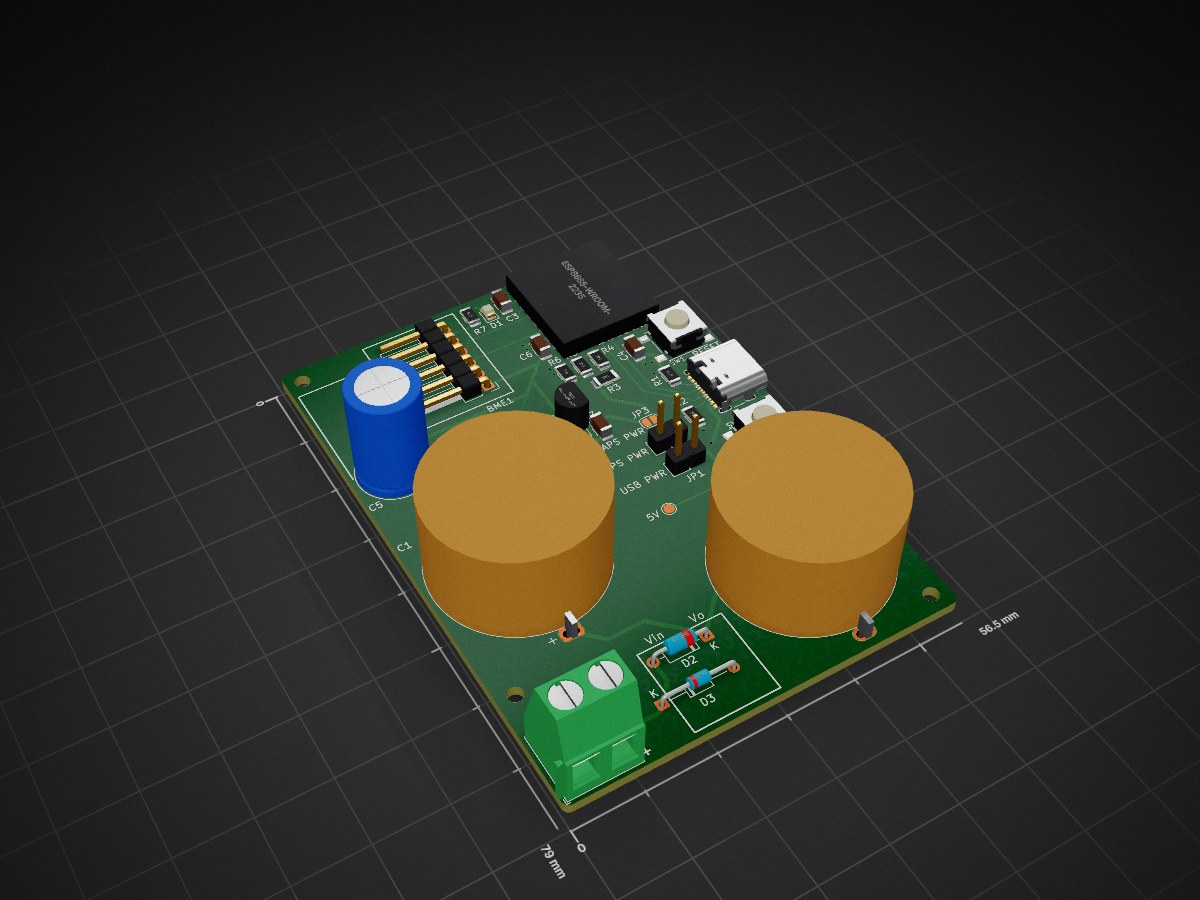
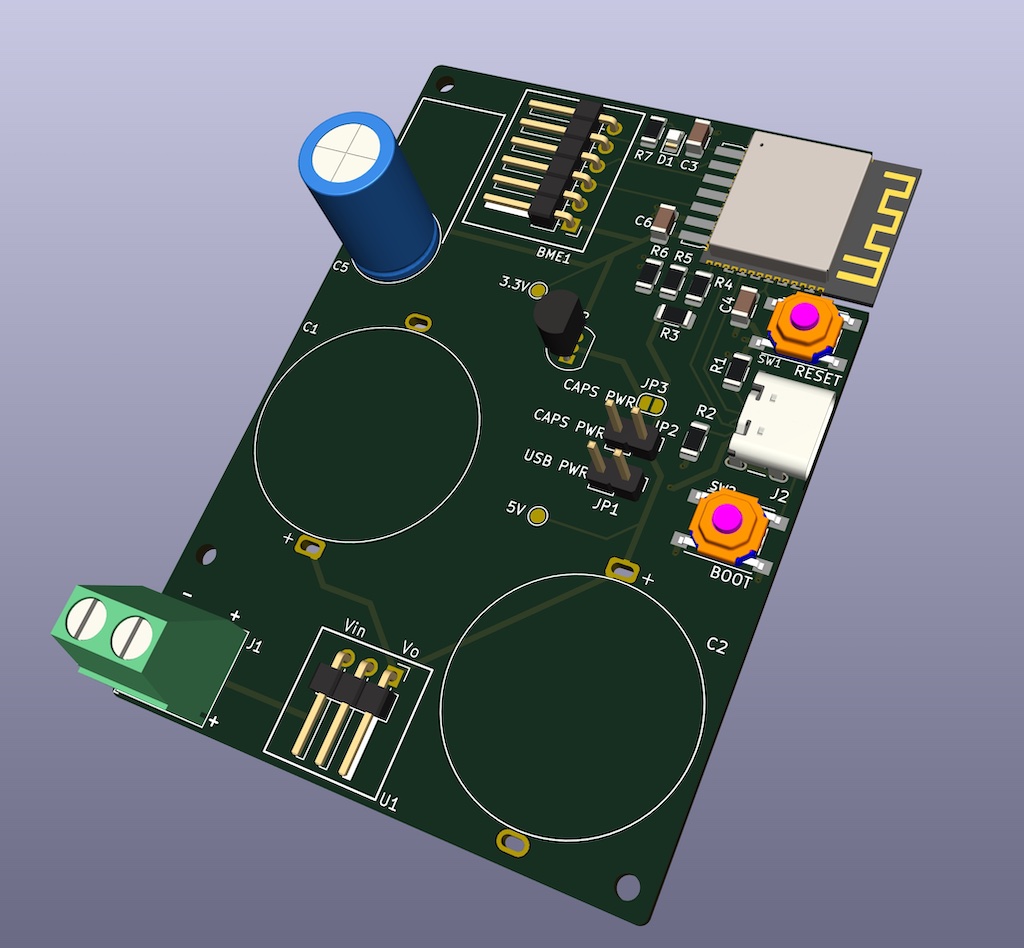
ESP8685-WeatherSt is an open-source printed circuit board by aresta, from the aresta/ESP32-C3_Supercaps repository on GitHub. It is a 2-layer board of 56.5 × 79 mm with 32 parts on 34 nets, routed with 166 tracks and 19 vias.
It is built around the BME280 and ESP8685-WROOM-06-H4. Its parts include 7 capacitors, 7 resistors, 3 diodes, 2 ICs and 2 connectors.
The ESP32-C3 is nice RISC-V microcontroller with relatively low power consumption.
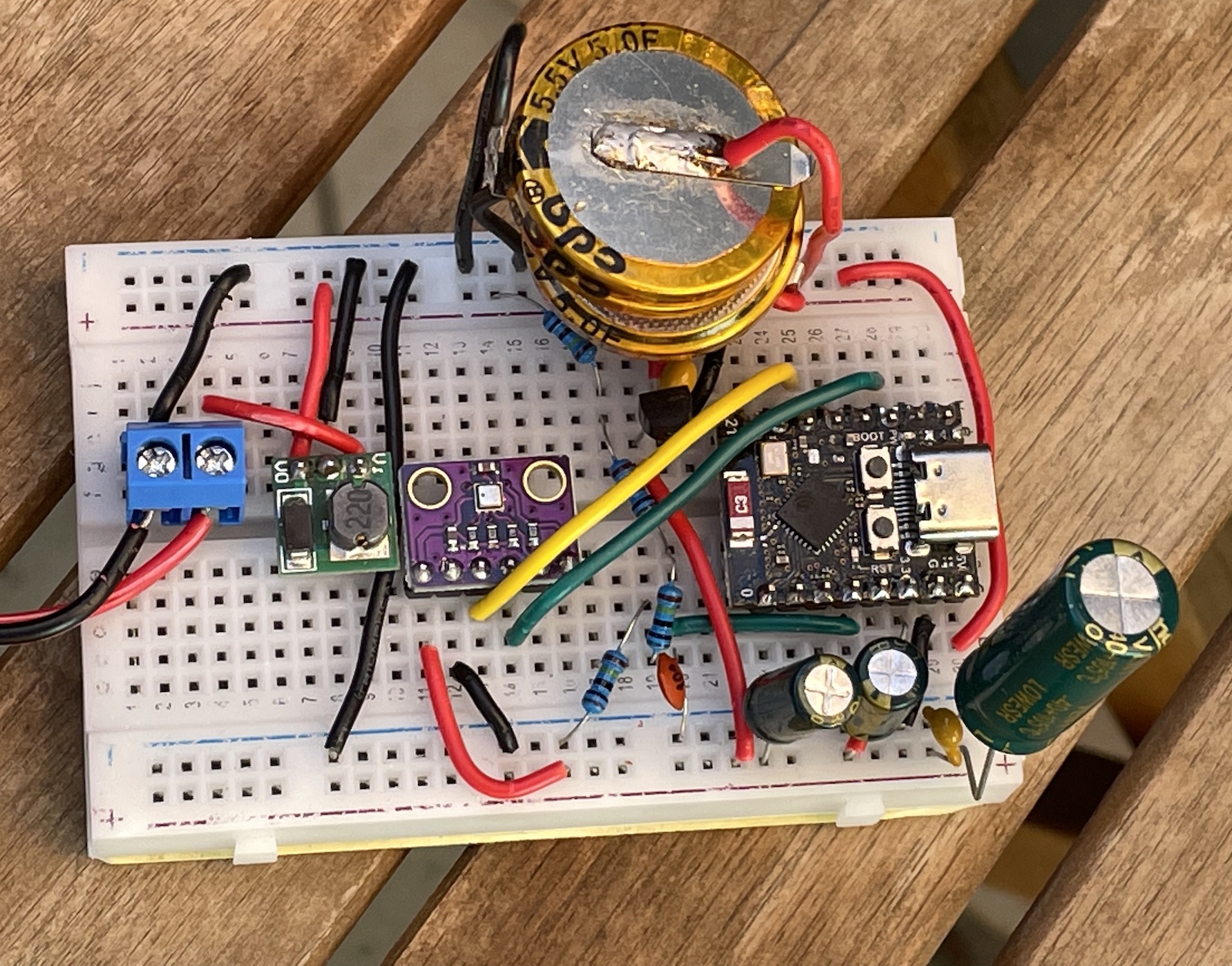
This project is a proof of concept on how to run a system like this, with regular wifi connection, without batteries. Just two small supercapacitors of 5F each, and a small solar panel (8 x 6 cms). It doesn't depend on any gateway in house, as it can directy connect to the internet to send the data.
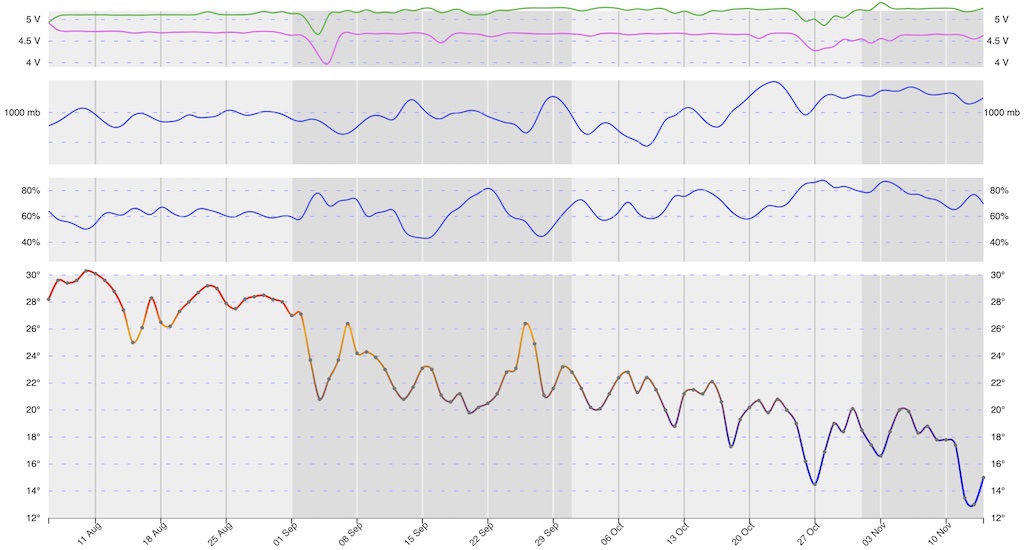
The setup and code is very simple. The microcontroller stays in deep sleep most of the time. It wakes up every 15 minutes to take the weather measurements from the BME280 sensor ( temperature, humidity, pressure) and the voltage of the supercap.
The measures are stored in the RTC memory and are only sent via WIFI if the charge of the supercap is at 95% or after a defined number of hours. This way the system can run and survive almost 3 days without any sun.
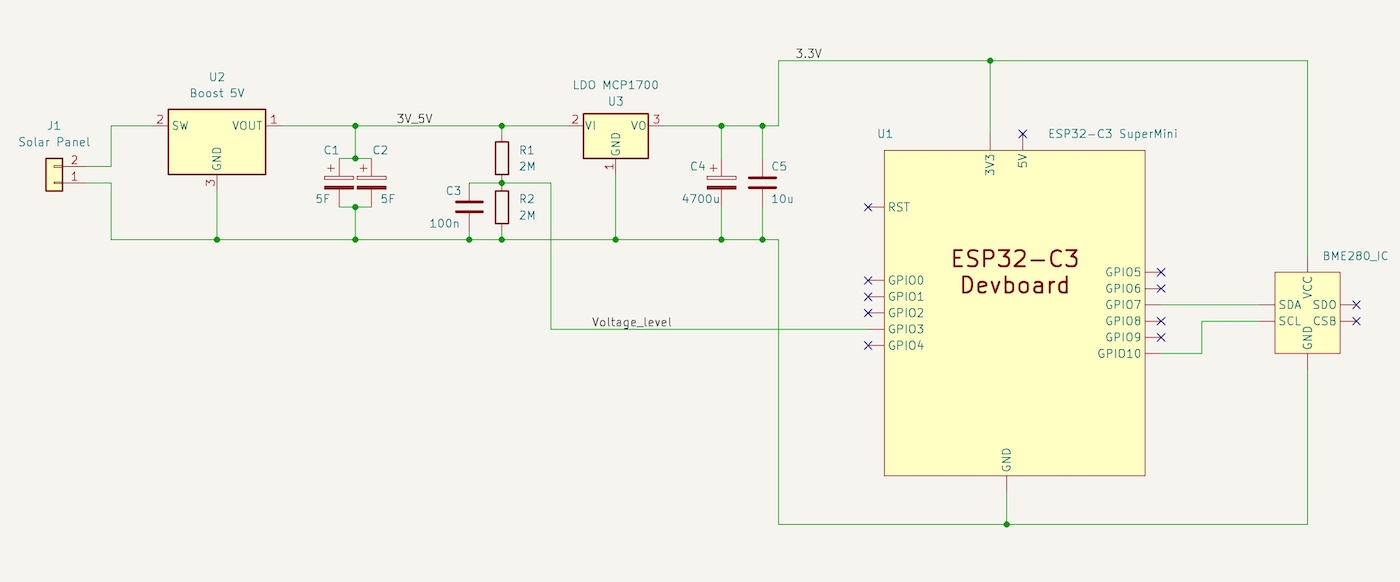
For the new version I designed a simple PCB and replaced the ESP32-C3 dev board by the ESP8685 WROOM module. It's still ESP32-C3 but as a module soldered to the PCB.
I have a new solar panel with the same size but the nominal voltage is 5.5V. This allows me to remove completely the boost converter and replace it by a schottky diode (D2), what is more effient; it starts pushing with any tiny current, and consumes almost nothing.
The Schottky should be choosen with very low reverse leakage current, to minize current lost during the night.
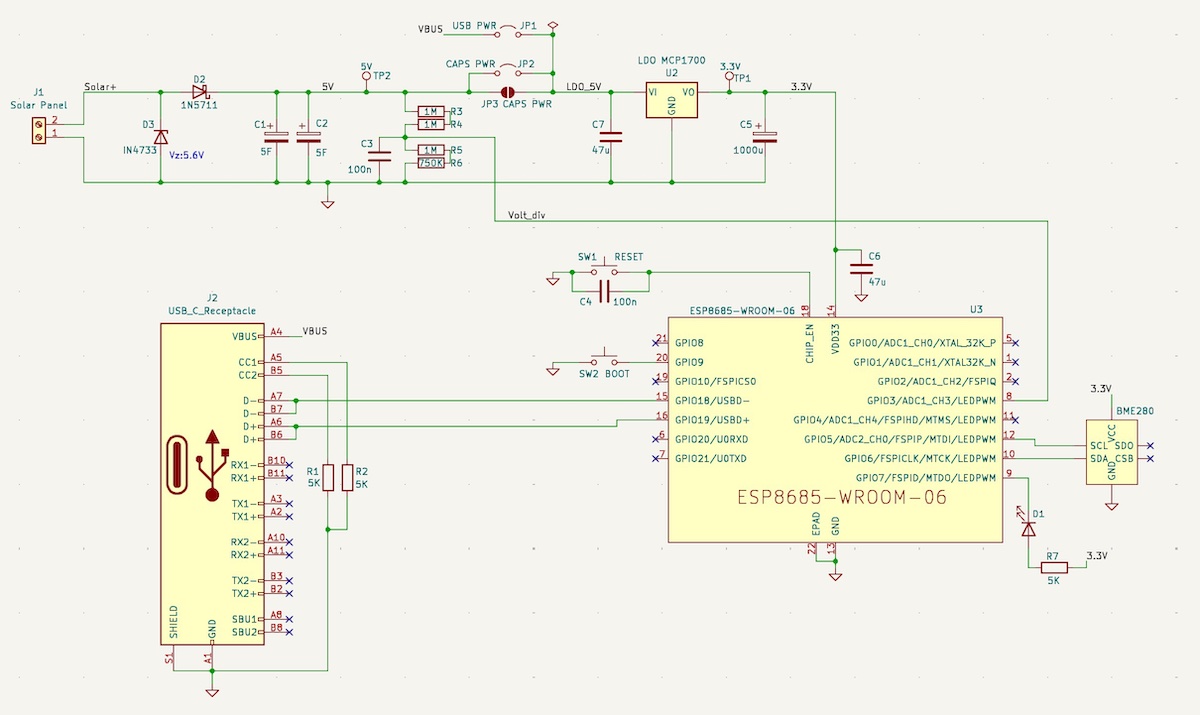
A 5.6V zener diode (D3) is added, because when the supercaps are full the panel could go above 5.5V. With this configuration the maximum voltage observed is around 5.3 V.
All together the system is much more efficient, charges even when the sky is covered and the losses are very small.
With this setup it survives more than 50 hours without any sun. When the sun is back in a couple of minutes the supercaps are fully charged and sends all pending samples.
In the RTC memory it can store about 1200 samples, so it can keep sampling and waitting until the sun is back and the supercap is charged again.
The system is running for more than 2 years now. Some example of the data collected:
| Qty | Value | Footprint | References |
|---|---|---|---|
| 3 | 1M | Resistor_SMD:R_1206_3216Metric | R3, R4, R5 |
| 3 | 5K | Resistor_SMD:R_1206_3216Metric | R1, R2, R7 |
| 3 | MountingHole | MountingHole:MountingHole_2.2mm_M2_DIN965 | H1, H2, H3 |
| 2 | 100n | Capacitor_SMD:C_1206_3216Metric | C3, C4 |
| 2 | 47u | Capacitor_SMD:C_1206_3216Metric | C6, C7 |
| 2 | 5F | 000_victor_footprints:supercap | C1, C2 |
| 1 | 1000u | PCM_Capacitor_THT_AKL:C_Radial_D10.0mm_H16.0mm_P5.00mm | C5 |
| 1 | 1N5711 | Diode_THT:D_DO-35_SOD27_P7.62mm_Horizontal | D2 |
| 1 | 3.3V | TestPoint:TestPoint_Pad_D1.5mm | TP1 |
| 1 | 5V | TestPoint:TestPoint_Pad_D1.5mm | TP2 |
| 1 | 750K | Resistor_SMD:R_1206_3216Metric | R6 |
| 1 | BME280 | Connector_PinHeader_2.54mm:PinHeader_1x06_P2.54mm_Horizontal | BME1 |
| 1 | BOOT | 000_victor_footprints:SW_Push_1P1T_NO_6x6mm_H9.5mm | SW2 |
| 1 | CAPS PWR | Jumper:SolderJumper-2_P1.3mm_Open_RoundedPad1.0x1.5mm | JP3 |
| 1 | CAPS PWR | Connector_PinHeader_2.54mm:PinHeader_1x02_P2.54mm_Vertical | JP2 |
| 1 | ESP8685-WROOM-06 | PCM_Espressif:ESP8685-WROOM-06 | U3 |
| 1 | IN4733 | Diode_THT:D_DO-34_SOD68_P10.16mm_Horizontal | D3 |
| 1 | LDO MCP1700 | Package_TO_SOT_THT:TO-92_Inline | U2 |
| 1 | LED | LED_SMD:LED_0805_2012Metric | D1 |
| 1 | RESET | 000_victor_footprints:SW_Push_1P1T_NO_6x6mm_H9.5mm | SW1 |
| 1 | Solar Panel | TerminalBlock_Phoenix:TerminalBlock_Phoenix_MKDS-1,5-2-5.08_1x02_P5.08mm_Horizontal | J1 |
| 1 | USB PWR | Connector_PinHeader_2.54mm:PinHeader_1x02_P2.54mm_Vertical | JP1 |
| 1 | USB_C_Receptacle | Connector_USB:USB_C_Receptacle_GCT_USB4105-xx-A_16P_TopMnt_Horizontal | J2 |
It measures 56.5 × 79 mm and has 2 copper layers, 1.6 mm thick.
32 parts, built around the BME280 and ESP8685-WROOM-06-H4. The full list of its parts is on this page, with links to each part's symbol and footprint where PCBKit's library has them.
From the aresta/ESP32-C3_Supercaps repository on GitHub, at the commit this page was made from: the board is img/ESP8685-WeatherSt.kicad_pcb and its schematic img/ESP8685-WeatherSt.kicad_sch. PCBKit opens the board in the browser, with nothing to install.
Its repository states no licence, so its author keeps all rights: ask aresta before reusing the design.
nkitanov/iaq_board
IAQ Board is a DIY (Do-It-Yourself) device for measuring internal air quality


New-England-Weather-Balloon-Society/Tiny4FSK
Horus Binary v2 HAB Tracker


kbx81/ClimateSprinklerController
ESP32-based climate and sprinkler controller for use with ESPHome

crnicholson/StratoSoar-MK3
StratoSoar MK3, an autonomous glider meant for high-altitudes, accessible to everyone


CCHS-Melbourne/ESPlant
Environmental Sensor Plant - solar WiFi gardening/meteorological sensor using ESP8266