2 layers59 × 55.2 mm
Lith
altofctrl/lith
In a ravein cut through the Serengeti plain, researchers discovered stones that had been deliberately broken, intentionally struck with larger ones till sharp flakes came away.
19 parts
 altofctrl/lith
In a ravein cut through the Serengeti plain, researchers discovered stones that had been deliberately broken, intentionally struck with larger ones till sharp flakes came away.
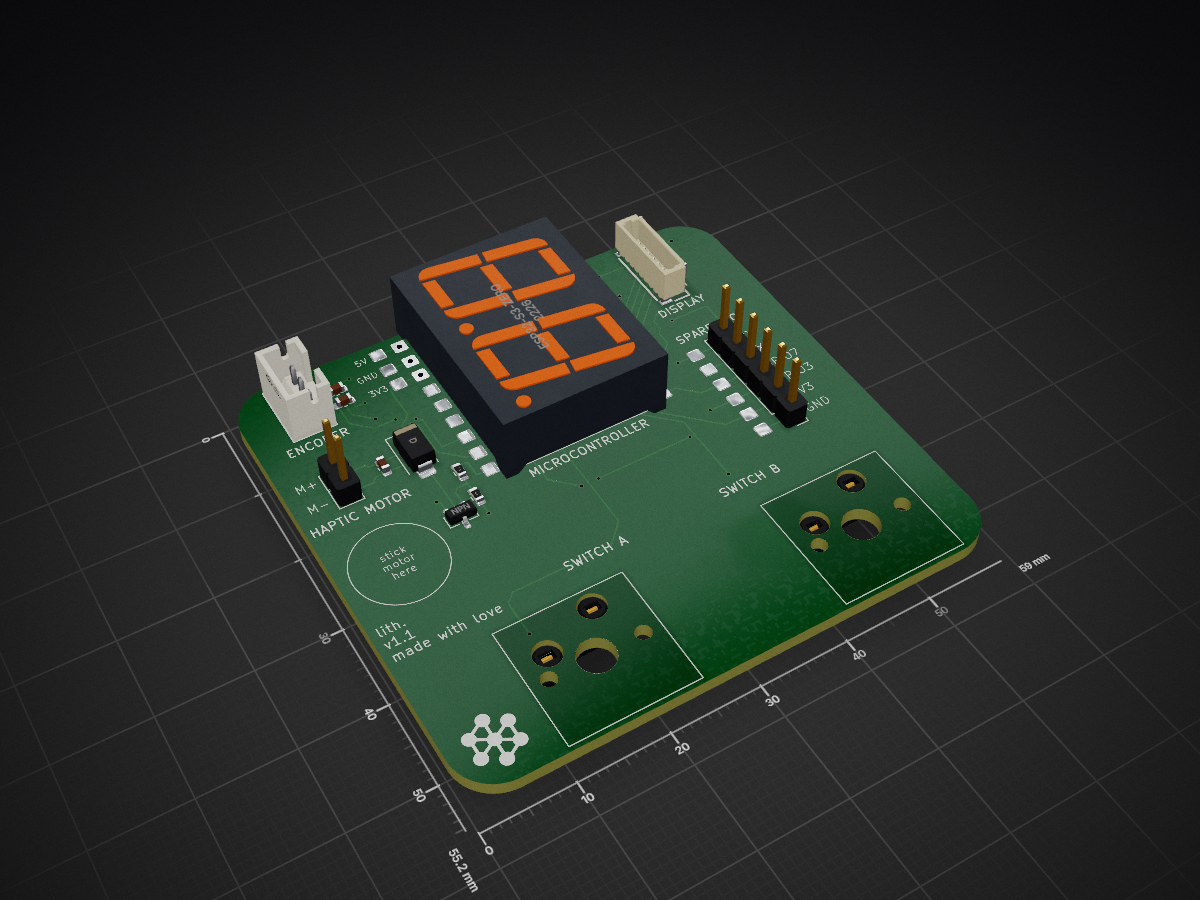
Lith is an open-source printed circuit board by altofctrl, from the altofctrl/lith repository on GitHub. It is a 2-layer board of 59 × 55.2 mm with 43 parts on 20 nets, routed with 226 tracks and 25 vias.
Its parts include 3 capacitors, 2 resistors, 2 switches, 1 IC and 1 diode. It belongs with the ESP32 boards of this library.
1931, Olduvai Gorge, Tanzania.
In a ravein cut through the Serengeti plain, researchers discovered stones that had been deliberately broken, intentionally struck with larger ones till sharp flakes came away. They call this era of tool making Oldowan after the gorge, and it has examples dating back to 2.6 million years ago.
A stone chopper is the simplest thing that is unmistakably made, and for most of the time there have been hominins at all, it was the most complicated thing anyone could do. Making one is harder than it looks: you have to read the stone, find a platform, and strike at an angle that takes a flake off rather than shattering the core. People who try it without being shown mostly fail.
These tools are some of the simplest things that can be unmistakably made, for most of the time we've been about it was the most complicated thing anyone could do. However making one takes some skill, finding the right stone, striking the right angle with enough force to flake off instead of shatter.
Knapping is difficult enough to learn, and useless enough to invent from scratch, that it had to be taught. A 2015 experiment by Morgan and colleagues found that transmitting Oldowan technique got measurably better as you moved from letting people watch, to gestural teaching, to teaching with words.[1] Their argument is that toolmaking and language leaned on each other as they grew. The first thing we made and the first thing we said may have been the same conversation: here, hold it like this.
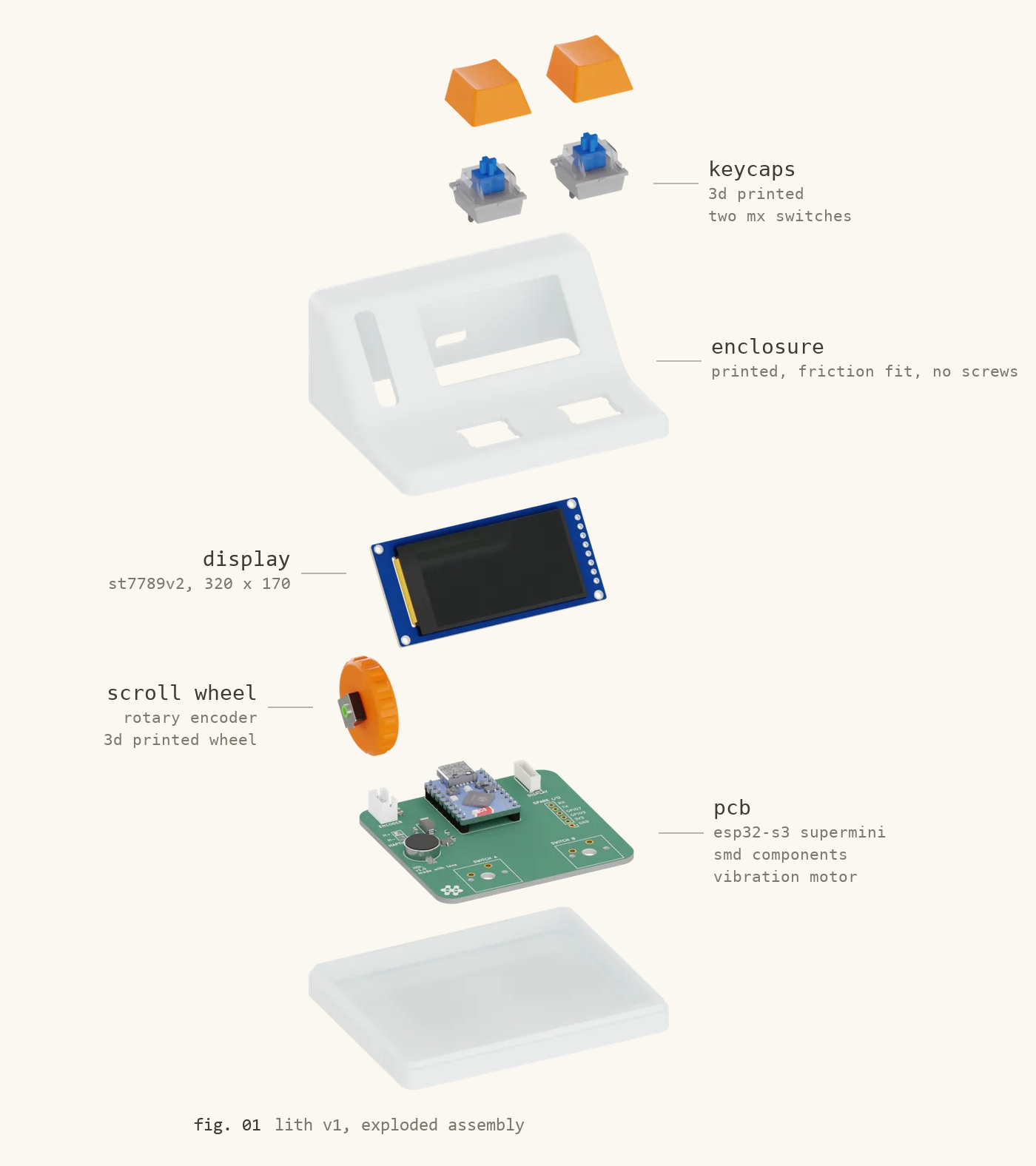
lith is a small desk object: an ESP32-S3, a 320x170 display, a scroll wheel, two key switches and a vibration motor in a printed shell. Out of the box it is a pomodoro timer. That is the shape it arrives in, not the shape it has to keep.
The name is from líthos, stone. You reconfigure it by knapping it: you describe what you want it to be, an agent called Oldowan writes the firmware, and it is flashed to the device from the browser. The tools people make get shared in the knappery.
The reason it is built this way is Bandura's: self-efficacy, the belief that you can actually do the thing, is built most strongly from mastery experience, and after that from watching someone like you succeed.[2] Which role model, and for whom, turns out to matter: a systematic review by Gladstone and Cimpian found that the effect depends on how similar the model seems and how attainable their success looks, and that a model whose success reads as out of reach can demotivate rather than encourage.[3] lith is arranged so a beginner gets all three. You watch it be made through short form video content. You make one, by building it from its constituent parts. Then you use the thing you made, on your desk, developing your own firmware by hand or with Oldowan's help.
[point on how overcoming the first hurdle towards that mastery experience improves continutity]
firmware/ | The PlatformIO project that runs on the device. The pomodoro timer, the metaball fluid renderer, the display and input drivers. This is the stock shape lith ships in. |
website/ | lith.vidalion.co. The scroll-driven homepage, the onboarding walkthrough, the knapping bench and the knappery, every earlier version of them, and the Oldowan agent that writes firmware from a conversation. |
research/ | Two studies run against the agent: whether the model tier behind Oldowan changes the quality of what it builds, and what the providers cost and how long they take. |
site/: the four pages as they are served. index.html is the scroll-driven
homepage, onboarding.html the walkthrough a new lith arrives with,
knapp.html the knapping bench where you talk to Oldowan and flash the
result from the browser, and knappery.html the shelf of builds other
people have published.agent/: Oldowan. oldowan.py is the conversation and prompt layer,
builder.py compiles and repairs the sketch it produces, knappery.py is the
sharing side. providers.json selects the model; keys come from a
secrets.json that is not in this repo.versions/: dated snapshots of every earlier version of the pages, back
to before the renders existed.assets/: the WebP sequences the site actually serves.ui-judge/: 19 firmware builds from 11 models across 5 providers, compiled,
rendered on the simulator and judged. The headline is that the repair loop
matters more than the model tier: first-pass compile rate was 26%, and the
builder's own repair passes took it to 79%.provider-cost-latency/: wall-clock latency and list price across the
providers Oldowan can run on, replayed through one real 3-turn conversation.Both are written up with their figures in
research/README.md.
Morgan, T. J. H., Uomini, N. T., Rendell, L. E., et al. (2015). Experimental evidence for the co-evolution of hominin tool-making teaching and language. Nature Communications, 6, 6029. https://doi.org/10.1038/ncomms7029
Bandura, A. (1997). Self-Efficacy: The Exercise of Control. W. H. Freeman.
Gladstone, J. R., & Cimpian, A. (2021). Which role models are effective for which students? A systematic review and four recommendations for maximizing the effectiveness of role models in STEM. International Journal of STEM Education, 8(1), 59. https://doi.org/10.1186/s40594-021-00315-x
| Qty | Value | Footprint | References |
|---|---|---|---|
| 3 | 100n | Capacitor_SMD:C_0603_1608Metric | C1, C2, C3 |
| 2 | SW_Push | PCM_Switch_Keyboard_Hotswap_Kailh:SW_Hotswap_Kailh_MX_1.00u | SW1, SW2 |
| 1 | 10k | Resistor_SMD:R_0603_1608Metric | R2 |
| 1 | 1k | Resistor_SMD:R_0603_1608Metric | R1 |
| 1 | Conn_01x06_Socket | Connector_PinHeader_2.54mm:PinHeader_1x06_P2.54mm_Vertical | SPARE I/O |
| 1 | Conn_01x08_Socket | lith:CONN-SMD_8P-P1.00_XUNPU_WAFER-100L-8P | DISPLAY |
| 1 | D | Diode_SMD:D_SMA | D1 |
| 1 | ESP32-S3-Zero | lith:Waveshare-ESP32-S3-Zero | U1 |
| 1 | LOGO | lith:multimodal_symbol | G*** |
| 1 | LOGO | lith:crewmate | G*** |
| 1 | Motor_DC | Connector_PinHeader_2.54mm:PinHeader_1x02_P2.54mm_Vertical | HAPTIC MOTOR |
| 1 | NPN | Package_TO_SOT_SMD:SOT-23 | Q1 |
| 1 | RotaryEncoder | lith:CONN-TH_3P-P2.00_HX-2.0MM-3P-ZZ-MS | ENCODER |
The 16 most common of 43 parts.
It measures 59 × 55.2 mm and has 2 copper layers, 1.6 mm thick.
43 parts. The full list of its parts is on this page, with links to each part's symbol and footprint where PCBKit's library has them.
From the altofctrl/lith repository on GitHub, at the commit this page was made from: the board is cad/pcb/v1.1/lith.kicad_pcb and its schematic cad/pcb/v1.0/lith.kicad_sch. PCBKit opens the board in the browser, with nothing to install.
Its repository states no licence, so its author keeps all rights: ask altofctrl before reusing the design.
altofctrl/lith
In a ravein cut through the Serengeti plain, researchers discovered stones that had been deliberately broken, intentionally struck with larger ones till sharp flakes came away.

google/mozc-devices
Circuit diagrams and firmware source code for Gboard DIY keyboards

rusefi/rusefi
rusefi - GPL internal combustion engine control unit


jrsteensen/OpenHornet
OpenHornet 1:1 F/A-18C Simulator Repository


tebl/RC6502-Apple-1-Replica
An expandable SBC-version of the Apple 1 computer, easy to get started with and lot of cool stuff that can be added to it!

nodestark/mdb-esp32-cashless
ESP32-based MDB cashless device for vending machines, supporting EVA DTS DEX/DDCMP telemetry and payments over the MDB protocol via Bluetooth and MQTT

zynthian/zynthian-hw
Zynthian hardware stuff: PCBs, schemes, parts specifications, pin assignment, ...