2 layers28.3 × 39.8 mm
LevelShifter
gusmanb/logicanalyzer
24 channel, 100Msps logic analyzer hardware and software
21 parts5.1kGPL-3.0

 alex-ong/TaikoPcb1
Simple arduino taiko pcb based on ShikyC's code
TaikoPcb is an open-source printed circuit board by alex-ong, from the alex-ong/TaikoPcb repository on GitHub, published under the MIT licence. It is a 2-layer board of 65.5 × 51.5 mm with 21 parts on 31 nets, routed with 134 tracks and 0 vias.
Its parts include 9 resistors, 5 ICs, 3 connectors and 1 capacitor. It belongs with the ESP32 boards of this library.
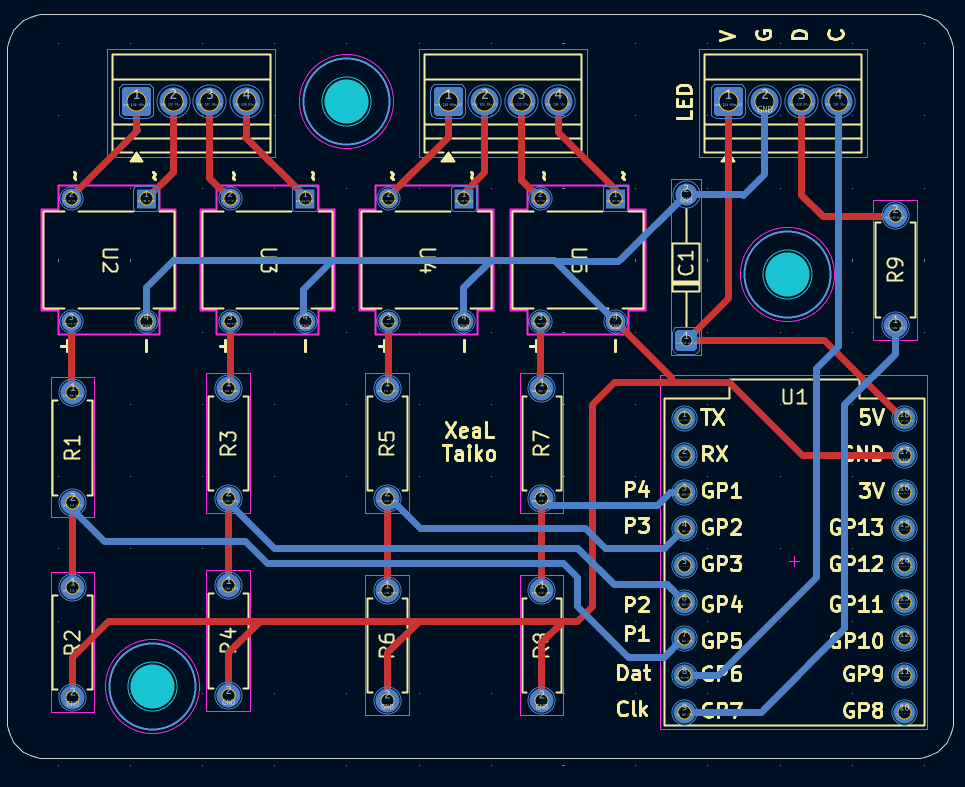
Simple taiko pcb based on https://github.com/ShikyC/Taiko-Drum-Controller-Arduino
It uses a ESP32 S3 Supermini
Pcb:
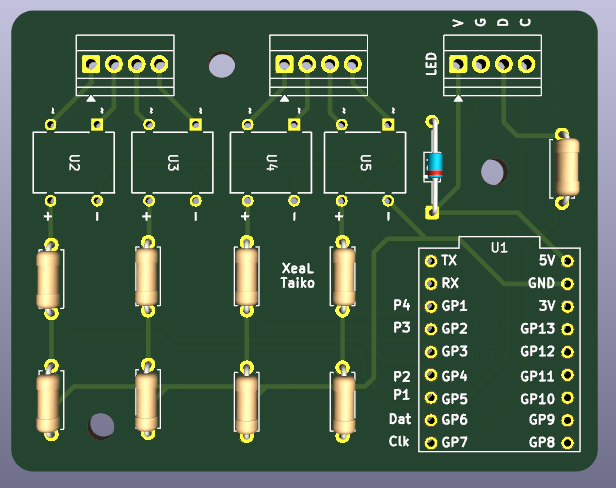
Render:
| Qty | Value | Footprint | References |
|---|---|---|---|
| 8 | 100k | Resistor_THT:R_Axial_DIN0207_L6.3mm_D2.5mm_P7.62mm_Horizontal | R1, R2, R3, R4, R5, R6, R7, R8 |
| 4 | DB107-G | DB107-G:DB107-G_CIP | U2, U3, U4, U5 |
| 3 | Screw_Terminal_01x04 | TerminalBlock:TerminalBlock_Xinya_XY308-2.54-4P_1x04_P2.54mm_Horizontal | J1, J2, J3 |
| 1 | 330 | Resistor_THT:R_Axial_DIN0207_L6.3mm_D2.5mm_P7.62mm_Horizontal | R9 |
| 1 | C_Polarized | Diode_THT:D_DO-34_SOD68_P10.16mm_Horizontal | C1 |
| 1 | ESP32-S3-Supermini | esp32-s3-supermini:esp32-s3-supermini | U1 |
The 18 most common of 21 parts.
gusmanb/logicanalyzer
24 channel, 100Msps logic analyzer hardware and software

mntmn/amiga2000-gfxcard
MNT VA2000, an Open Source Amiga 2/3/4000 Graphics Card (Zorro II/III), written in Verilog


hackclub/OnBoard
💡 Join 1,000 teenagers and make your first PCB with a $100 grant!

drandyhaas/KiCadRoutingTools
A set of Python/Rust tools to aid routing in KiCad

Arrow-air/project-quiver
Project Quiver documentation, designs, and project artifacts.


It measures 65.5 × 51.5 mm and has 2 copper layers, 1.6 mm thick.
21 parts. The full list of its parts is on this page, with links to each part's symbol and footprint where PCBKit's library has them.
From the alex-ong/TaikoPcb repository on GitHub, at the commit this page was made from: the board is TaikoPcb.kicad_pcb and its schematic TaikoPcb.kicad_sch. PCBKit opens the board in the browser, with nothing to install.
Its repository publishes it under the MIT licence: you may reuse it on that licence's terms (keep the author's notice, and for a copyleft licence share your changes alike).