
2 layers18 × 33 mm
 akouz/HBnode
Microcontroller boards for HBus
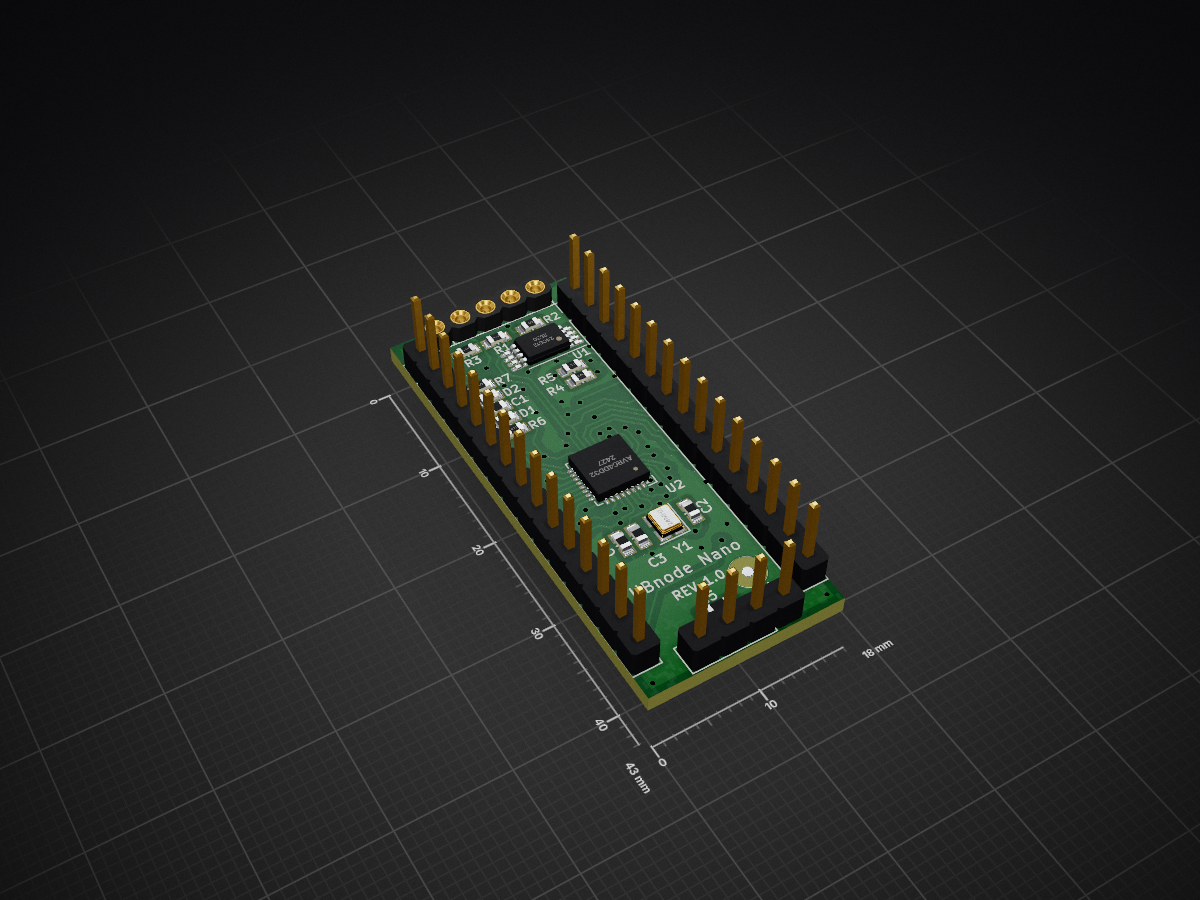
Nano DD32 is an open-source printed circuit board by akouz, from the akouz/HBnode repository on GitHub, published under the MIT licence. It is a 2-layer board of 18 × 43 mm with 22 parts on 37 nets, routed with 677 tracks and 59 vias.
It is built around the AVR64DD32-I/PT. Its parts include 7 resistors, 5 capacitors, 4 connectors, 2 ICs and 2 diodes.
Microcontroller boards for HBus based on AVR64DD32. Form factor is the same as Arduino Pro Mini and Arduino Nano, while pinout made as close as possible. Firmware update made using on-board I2C EEPROM; custom bootloader occupies 1K bytes.
Programmer HEXloader.exe can transfer compiled hex files from PC to EEPROM via Arduino UNO running sketch HEXloader.ino. When a board used in HBus network, firmware can be updated remotely via HBus.


Load HBus sketch. Connect HBnode to the programmer and transfer selected sketch to the HBnode using HEXLoader
When a correct sketch is programmed to the HBnode, a new sketch can be loaded to the board via HBus using NodeTest
| Qty | Value | Footprint | References |
|---|---|---|---|
| 5 | 4.7k | Discret:0603 | R1, R2, R3, R6, R7 |
| 2 | 100n | Discret:0603 | C1, C4 |
| 2 | 1k | Discret:0603 | R4, R5 |
| 2 | 22p | Discret:0603 | C2, C3 |
| 2 | CONN_01X15 | Connector_PinHeader_2.54mm:PinHeader_1x15_P2.54mm_Vertical | P1, P2 |
| 1 | 10uF | Discret:0805 | C5 |
| 1 | 24C512 | Package_SO:TSSOP-8_4.4x3mm_P0.65mm | U1 |
| 1 | 24MHz | Crystal:Crystal_SMD_2520-4Pin_2.5x2.0mm | Y1 |
| 1 | AVR64DD32 | Package_DFN_QFN:QFN-32-1EP_5x5mm_P0.5mm_EP3.1x3.1mm_pin0 | U2 |
| 1 | CONN_01X04 | Connector_PinHeader_2.54mm:PinHeader_1x04_P2.54mm_Vertical | P4 |
| 1 | CONN_01X05 | Connectors:HDR_5 | P3 |
| 1 | FIDUCIAL | Discret:Fiducial | FID1 |
| 1 | GRN | Discret:0603_LED | D1 |
| 1 | RED | Discret:0603_LED | D2 |


swharden/PressureSensor
Minimal complexity standalone digital pressure sensor

kiu/kha
Overengineered Modular RS-485 Multi-Master 19" Subrack Home Automation / Control

VoronDesign/Voron-Hardware
Cool Hardware designed by the Voron Design group

hoglet67/RGBtoHDMI
Bare-metal Raspberry Pi project that provides pixel-perfect sampling of Retro Computer RGB/YUV video and conversion to HDMI

hackclub/OnBoard
💡 Join 1,000 teenagers and make your first PCB with a $100 grant!

abhishek-kakkar/BeagleLogic
A Software Suite that implements a logic analyzer with the PRU on the BeagleBone / BeagleBone Black.

Chrismettal/flipper-zero-backpacks
Backpack-style addon boards for the Flipper Zero!
It measures 18 × 43 mm and has 2 copper layers, 1.6 mm thick.
22 parts, built around the AVR64DD32-I/PT. The full list of its parts is on this page, with links to each part's symbol and footprint where PCBKit's library has them.
From the akouz/HBnode repository on GitHub, at the commit this page was made from: the board is AVR64DD32/Hardware/Nano/Nano_DD32.kicad_pcb. PCBKit opens the board in the browser, with nothing to install.
Its repository publishes it under the MIT licence: you may reuse it on that licence's terms (keep the author's notice, and for a copyleft licence share your changes alike).