Skip to the content
2 layers36.5 × 17.5 mm2key, the printed circuit board in 3D
Size
36.5 × 17.5 mm
Copper layers
2
Thickness
1.6 mm
Parts
13
Nets
33
Pads
109
Tracks, vias
196, 23
Pours
1
Routed
Yes
KiCad
KiCad 4
Created
16 Sep 2017
Updated
19 Apr 2018

Overview

2key is an open-source printed circuit board by ahtn, from the ahtn/keyboard_pcb repository on GitHub. It is a 2-layer board of 36.5 × 17.5 mm with 13 parts on 33 nets, routed with 196 tracks and 23 vias.

Its parts include 4 capacitors, 2 switches, 1 IC and 1 connector. It belongs with the Silicon Labs (EFR32, EFM) boards of this library.

README

mu_board/README.md

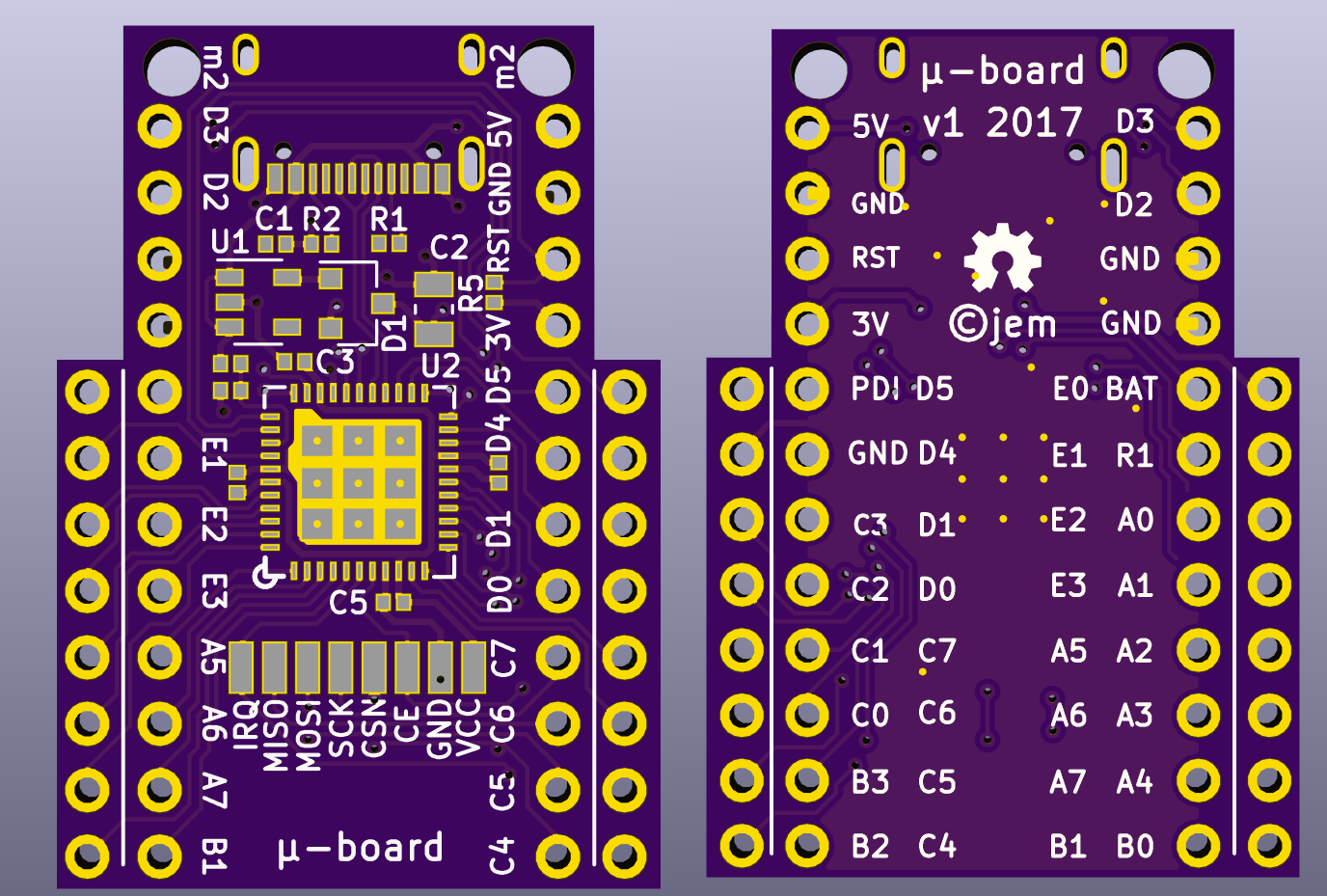
μ-board PCB

Image of μ-board PCB

Firmware

See here

License

CC-BY-SA

Parts

13
QtyValueFootprintReferences
4CCapacitor_SMD:C_0603_1608MetricC1, C2, C3, C4
2SW_PUSHkey_switch:Cherry_MX_Matias_No_Silk_BorderK1_1, K1_1
1EFM8UB2_32Package_QFP:TQFP-32_7x7mm_P0.8mmU1
1USB_OTGConnector_USB:USB_Micro-B_Molex-105017-0001J1

The 8 most common of 13 parts.

More from ahtn/keyboard_pcb

10
  • 2 layers109 × 71 mmGamma split, the printed circuit board in 3D

    Gamma split

    ahtn/keyboard_pcb

    156 parts96
  • 2 layers223 × 72.2 mmSpectre, the printed circuit board in 3D

    Spectre

    ahtn/keyboard_pcb

    79 parts96
  • 2 layers185 × 52 mmGhost, the printed circuit board in 3D

    Ghost

    ahtn/keyboard_pcb

    60 parts96
  • 2 layers23.1 × 33 mmMu board, the printed circuit board in 3D

    Mu board

    ahtn/keyboard_pcb

    32 parts96
  • 2 layers24 × 23 mmKeyplus mini, the printed circuit board in 3D

    Keyplus mini

    ahtn/keyboard_pcb

    24 parts96
  • 2 layers24 × 23 mmKeyplus mini, the printed circuit board in 3D

    Keyplus mini

    ahtn/keyboard_pcb

    22 parts96
  • 2 layers14.5 × 14.5 mmOne key, the printed circuit board in 3D

    One key

    ahtn/keyboard_pcb

    10 parts96
  • 2 layers14.4 × 14.4 mmOne key, the printed circuit board in 3D

    One key

    ahtn/keyboard_pcb

    8 parts96

Similar boards

  • 2 layers40 × 20 mmUsb uart, the printed circuit board in 3D

    Usb uart

    earthtojake/text-to-cad

    Design physical products with AI

    13 parts26kMIT
  • 2 layers35 × 29 mmMagSpoofTC, the printed circuit board in 3D

    MagSpoofTC

    samyk/magspoof

    A portable device that can spoof/emulate any magnetic stripe, credit card or hotel card "wirelessly", even on standard magstripe (non-NFC/RFID) readers.

    13 parts4.2k
  • 2 layers20.6 × 23.6 mmAO-03 signal amplifier, the printed circuit board in 3D

    AO-03 signal amplifier

    fossasia/pslab-scripts

    Pocket Science Lab - Scripts for Sensor Experiments

    13 parts1.6kApache-2.0
  • 2 layers47 × 35.6 mmMX7-C-35PL C11, the printed circuit board in 3D

    MX7-C-35PL C11

    rusefi/rusefi

    rusefi - GPL internal combustion engine control unit

    13 parts1.2k
  • 2 layers95 × 95 mmCube batteryboard, the printed circuit board in 3D

    Cube batteryboard

    willem-pennings/balancing-cube

    A cube that balances itself in a corner or edge using reaction wheels

    13 parts1.1kGPL-3.0
  • 2 layers15.2 × 20.3 mmPt100stick, the printed circuit board in 3D

    Pt100stick

    VoronDesign/Voron-Hardware

    Cool Hardware designed by the Voron Design group

    13 parts1.1kGPL-3.0
  • 2 layers53.9 × 23.2 mmBuffer, the printed circuit board in 3D

    Buffer

    hoglet67/RGBtoHDMI

    Bare-metal Raspberry Pi project that provides pixel-perfect sampling of Retro Computer RGB/YUV video and conversion to HDMI

    13 parts1kGPL-3.0

Questions

How big is the 2key PCB?

It measures 36.5 × 17.5 mm and has 2 copper layers, 1.6 mm thick.

What parts does the 2key use?

13 parts. The full list of its parts is on this page, with links to each part's symbol and footprint where PCBKit's library has them.

Where can I download the 2key KiCad files?

From the ahtn/keyboard_pcb repository on GitHub, at the commit this page was made from: the board is two_key_efm8/2key.kicad_pcb. PCBKit opens the board in the browser, with nothing to install.

Can I use the 2key design in my own project?

Its repository states no licence, so its author keeps all rights: ask ahtn before reusing the design.