
2 layers40.6 × 110 mm
Europi surface mount
Allen-Synthesis/EuroPi
EuroPi: A reprogrammable Eurorack module based on the Raspberry Pi Pico
92 parts584CC0-1.0
 AberDerBart/flamp
If you want or need another license for some reason (especially for commercial use), feel free to contact me.
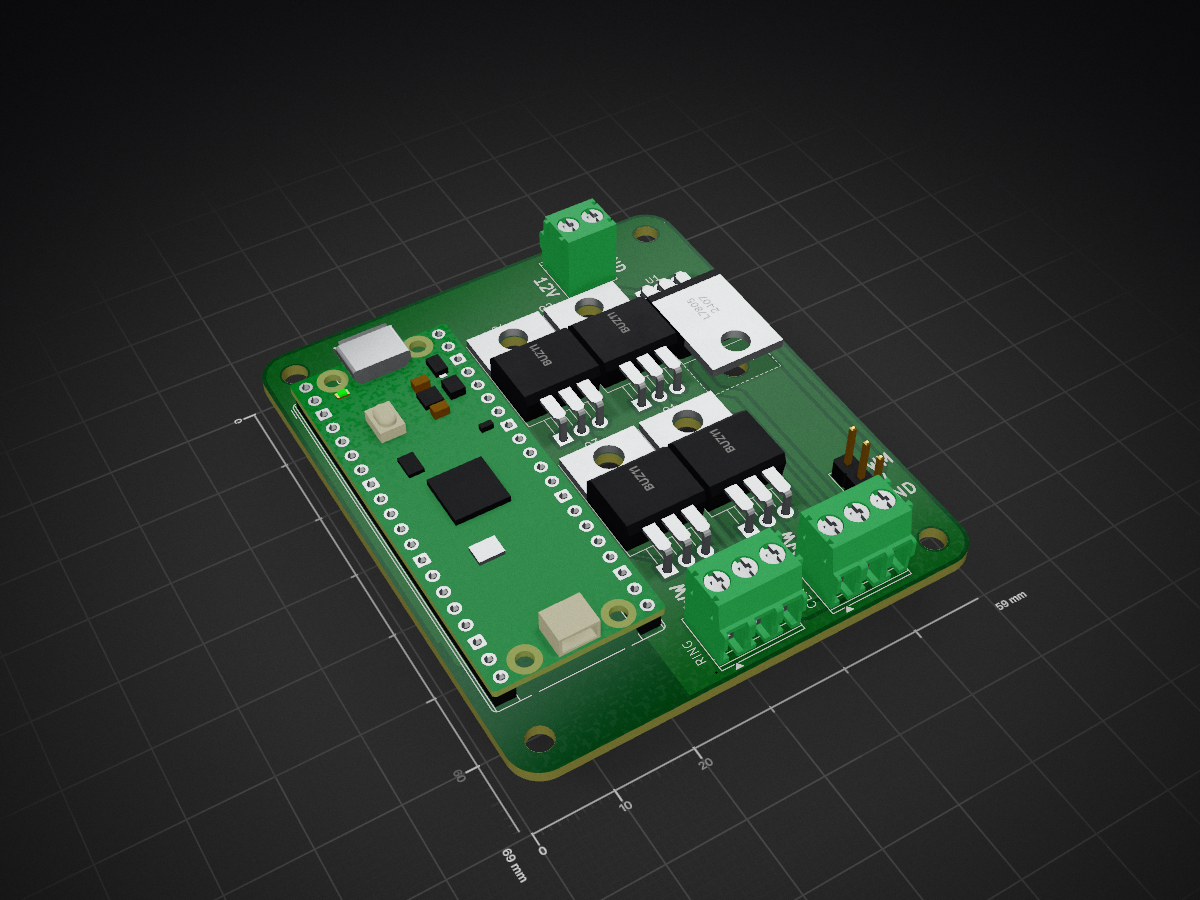
Flamp is an open-source printed circuit board by AberDerBart, from the AberDerBart/flamp repository on GitHub. It is a 2-layer board of 59 × 69 mm with 14 parts on 38 nets, routed with 58 tracks and 1 via.
It is built around the L7805. Its parts include 4 transistors, 4 connectors and 1 IC. It belongs with the RP2040 boards of this library.
Disclaimer: This has been developed as a personal project and the current state was good enough for me to build it but is problably not well suited to recreate. There are also changes planned (especially to the PCB and electronics). Please contact me or open an issue if you have any problems or questions on this project, I am happy to help (but not very motivated to do documentation work upfront).
If you want or need another license for some reason (especially for commercial use), feel free to contact me.
These are the design files for my flower lamp (short "Flamp"), A dimmable ceiling lamp inspired by a flower blossom with servo-actuated petals to open up or close down.
Check out this repository using the --recurse-submodules flag.
For the mechanical design, open lamp.scad in OpenSCAD. This gives an overview how the lamp is assembled.
For the PCB design, open pcb/pcb.kicad_pro in KiCad.
For hardware and electronic parts, see BOM.csv. You need to 3D print the parts from cad/printed_parts.scad. The design for the wooden parts can be found in cad/wooden_parts_12mm.scad and cad/wooden_parts_4mm.scad.
TODO
| Qty | Value | Footprint | References |
|---|---|---|---|
| 4 | BUZ11 | Package_TO_SOT_THT:TO-220-3_Horizontal_TabDown | Q1, Q2, Q3, Q4 |
| 4 | MountingHole | MountingHole:MountingHole_3.2mm_M3 | H1, H2, H3, H4 |
| 2 | Screw_Terminal_01x03 | TerminalBlock_Phoenix:TerminalBlock_Phoenix_PT-1,5-3-3.5-H_1x03_P3.50mm_Horizontal | J2, J3 |
| 1 | Conn_01x03_Pin | Connector_PinHeader_2.54mm:PinHeader_1x03_P2.54mm_Vertical | J4 |
| 1 | L7805 | Package_TO_SOT_THT:TO-220-3_Horizontal_TabUp | U1 |
| 1 | RaspberryPi_Pico_W | Module:RaspberryPi_Pico_Common_THT | A1 |
| 1 | Screw_Terminal_01x02 | TerminalBlock_Phoenix:TerminalBlock_Phoenix_PT-1,5-2-3.5-H_1x02_P3.50mm_Horizontal | J1 |
It measures 59 × 69 mm and has 2 copper layers, 1.6 mm thick.
14 parts, built around the L7805. The full list of its parts is on this page, with links to each part's symbol and footprint where PCBKit's library has them.
From the AberDerBart/flamp repository on GitHub, at the commit this page was made from: the board is pcb/pcb.kicad_pcb and its schematic pcb/pcb.kicad_sch. PCBKit opens the board in the browser, with nothing to install.
Its repository states no licence, so its author keeps all rights: ask AberDerBart before reusing the design.
Allen-Synthesis/EuroPi
EuroPi: A reprogrammable Eurorack module based on the Raspberry Pi Pico

peterheinrich/InternetOverSpaghetti
Transmitting IP packages over a pair of spaghetti thus demonstrating how media independent IP really is.


Tircown/ERCF-easy-brd
More informations on how to reset for flashing:\ https://wiki.seeedstudio.com/Seeeduino-XIAO/#enter-bootloader-mode

matthewcieplak/super-sixteen
Code and schematics for the Super Sixteen Eurorack sequencer

NikodemBartnik/Mini-Mars-Rover
Educational robotic platform made to look like a mini mars rover

starlightk7/OpenSFC
OSHW Reproduction Parts related to the Super Famicom / Super Nintendo game console

Redherring32/OpenTendo-TopLoader
An Open Source HardWare (OSHW) recreation of the 1993 toploading NES motherboard (Also known as NES-101)