2 layers36.3 × 37.2 mm
 a-mkader/UCT-Micromouse-Assignment
EEE3088F Micro-Mouse PCB Assignment
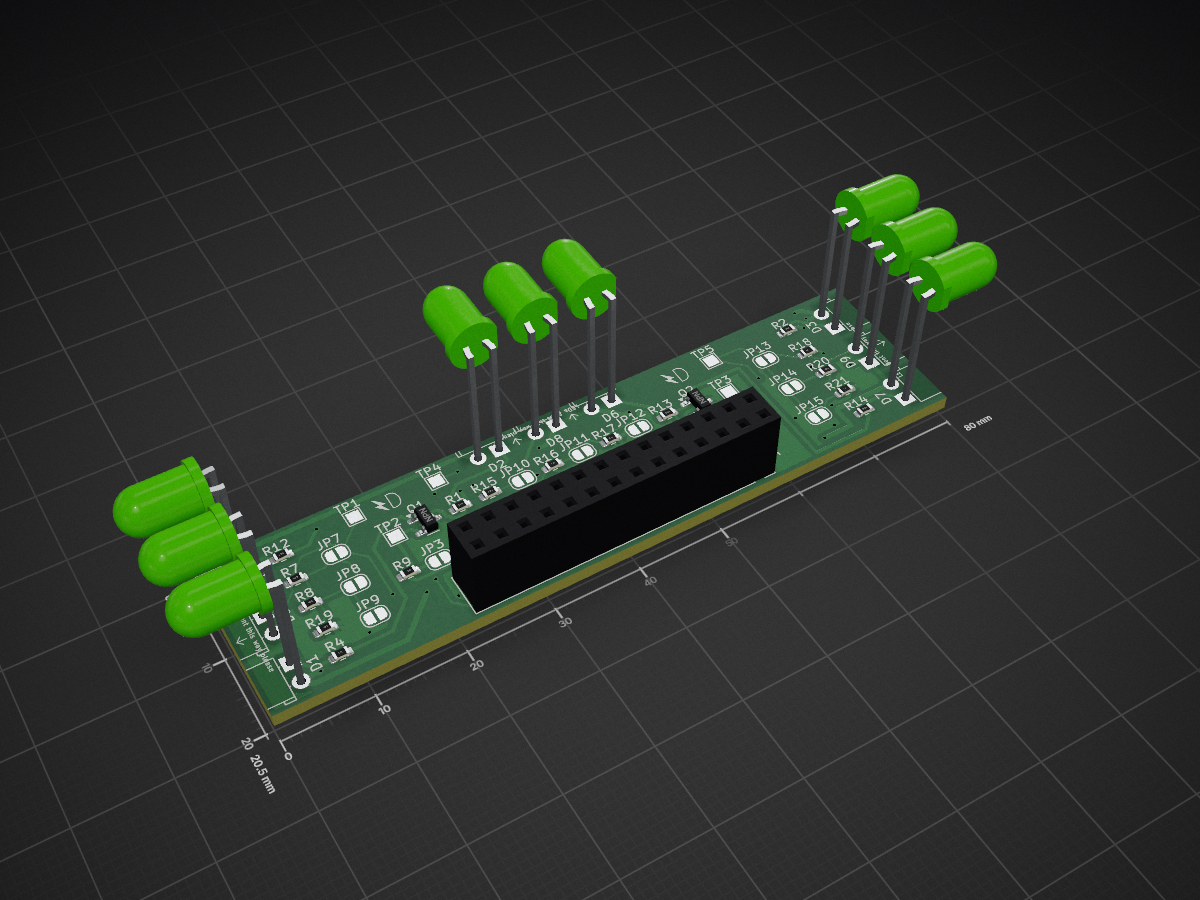
Sensing1 0 is an open-source printed circuit board by a-mkader, from the a-mkader/UCT-Micromouse-Assignment repository on GitHub. It is a 2-layer board of 80 × 20.5 mm with 53 parts on 43 nets, routed with 338 tracks and 43 vias.
Its parts include 21 resistors, 9 diodes, 2 transistors and 1 connector.
| Qty | Value | Footprint | References |
|---|---|---|---|
| 15 | SJ_Open | Jumper:SolderJumper-2_P1.3mm_Open_RoundedPad1.0x1.5mm | JP1, JP2, JP3, JP4, JP5, JP6, JP7, JP8, JP9, JP10, JP11, JP12, JP13, JP14, JP15 |
| 6 | 22 | Resistor_SMD:R_0603_1608Metric | R1, R2, R4, R12, R13, R14 |
| 6 | LED | LED_THT:LED_D5.0mm_Horizontal_O1.27mm_Z15.0mm | D1, D2, D3, D4, D6, D7 |
| 5 | TestPoint | TestPoint:TestPoint_Pad_1.5x1.5mm | TP1, TP2, TP3, TP4, TP5 |
| 3 | 10k | Resistor_SMD:R_0603_1608Metric | R8, R16, R20 |
| 3 | 4.7k | Resistor_SMD:R_0603_1608Metric | R17, R19, R21 |
| 3 | 47k | Resistor_SMD:R_0603_1608Metric | R7, R15, R18 |
| 3 | PhotoDiode | LED_THT:LED_D5.0mm_Horizontal_O1.27mm_Z15.0mm | D5, D8, D9 |
| 2 | 100 | Resistor_SMD:R_0603_1608Metric | R6, R10 |
| 2 | 150 | Resistor_SMD:R_0603_1608Metric | R3, R5 |
| 2 | 75 | Resistor_SMD:R_0603_1608Metric | R9, R11 |
| 2 | NPN | Package_TO_SOT_SMD:SOT-23 | Q1, Q2 |
| 1 | Conn_02x14_Odd_Even | Connector_PinSocket_2.54mm:PinSocket_2x14_P2.54mm_Vertical | J1 |

davidphilipbarr/Sweep
Sweep - a small promicro based keyboard inspired by the Ferris.

hoglet67/RGBtoHDMI
Bare-metal Raspberry Pi project that provides pixel-perfect sampling of Retro Computer RGB/YUV video and conversion to HDMI


polpo/picogus
Emulation of ISA sound cards and CD-ROM on Raspberry Pi Pico (GUS, SB/Adlib, MPU-401, Tandy, CMS, Panasonic CD-ROM) with USB mouse/joystick support

strangeparts/niubi-headphones
Flexible circuit board design for adding a headphone jack to an iPhone 7


Teslafly/Dead-OpenBMS-dead
A scalable, open source battery management system

nodestark/mdb-esp32-cashless
ESP32-based MDB cashless device for vending machines, supporting EVA DTS DEX/DDCMP telemetry and payments over the MDB protocol via Bluetooth and MQTT
It measures 80 × 20.5 mm and has 2 copper layers, 1.6 mm thick.
53 parts. The full list of its parts is on this page, with links to each part's symbol and footprint where PCBKit's library has them.
From the a-mkader/UCT-Micromouse-Assignment repository on GitHub, at the commit this page was made from: the board is EEE3088F/Sensing Circuit/Sensing1_0/Sensing1_0.kicad_pcb and its schematic EEE3088F/Power Subsystem/KiCad/Power Subsystem.kicad_sch. PCBKit opens the board in the browser, with nothing to install.
Its repository states no licence, so its author keeps all rights: ask a-mkader before reusing the design.