2 layers57 × 55.2 mm
LogicAnalyzer
gusmanb/logicanalyzer
24 channel, 100Msps logic analyzer hardware and software
10 parts5.1kGPL-3.0

 Wren6991/DVI-PMOD31
DVI PMOD adapter (HDMI connector)
DVI PMOD is an open-source printed circuit board by Wren6991, from the Wren6991/DVI-PMOD repository on GitHub, published under the CC0-1.0 licence. It is a 2-layer board of 17 × 18.5 mm with 10 parts on 25 nets, routed with 84 tracks and 21 vias.
Its parts include 8 resistors and 2 connectors. It belongs with the interfaces and adapters boards of this library.
This quick and dirty board adapts an HDMI A connector to a 12-pin PMOD expansion port, as found on many FPGA boards. The clock and data lanes are connected to PMOD IOs with 270-ohm series resistors, which gets close to correct CML logic levels from a 3.3V FPGA IO. This is suitable for DVI driven from an FPGA, but nominally not enough for HDMI, as the display data channel is not connected. A couple of people have asked me about this board on Twitter, so here are the design files -- go make some!
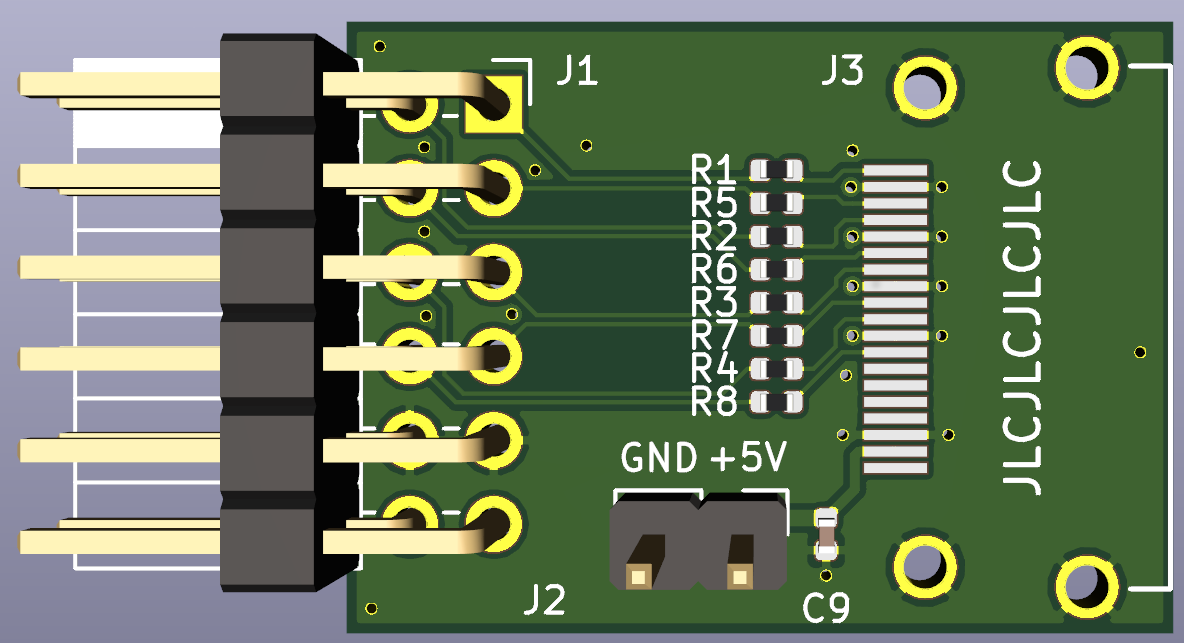
I had some of these boards made by JLCPCB (2 layers), and have tried them at up to 372 Mbps (720p 30Hz reduced blanking) on iCEBreaker and iCEstick boards.
Note that the mechanical drawing provided by Stewart is actually slightly wrong, and shows the contacts offset from the centreline in the wrong direction. The batch of boards I made had this issue, and it was no big deal, just bend the lugs on the HDMI connector to get the contacts to line up with the PCB lands. The version of the board hosted in this repo has a corrected footprint.
| Qty | Value | Footprint | References |
|---|---|---|---|
| 8 | 270 | Resistor_SMD:R_0402_1005Metric | R1, R2, R3, R4, R5, R6, R7, R8 |
| 1 | 02x06 | Connector_PinSocket_2.54mm:PinSocket_2x06_P2.54mm_Horizontal | J1 |
| 1 | NOT_HDMI_A | dvi-pmod:HDMI-SS-53000 | J3 |
gusmanb/logicanalyzer
24 channel, 100Msps logic analyzer hardware and software

byrantech/laptop
anyon_e, a highly integrated, high end, open source laptop. Attempt the impossible.

joeycastillo/Sensor-Watch
A board replacement for the classic Casio F-91W wristwatch


OLIMEX/OLINUXINO
OLINUXINO is Open Source / Open Hardware, low cost from EUR 24 Linux Industrial grade Single Board Computer capable to operate -25+85C

rusefi/rusefi
rusefi - GPL internal combustion engine control unit

VoronDesign/Voron-Hardware
Cool Hardware designed by the Voron Design group

hoglet67/RGBtoHDMI
Bare-metal Raspberry Pi project that provides pixel-perfect sampling of Retro Computer RGB/YUV video and conversion to HDMI
It measures 17 × 18.5 mm and has 2 copper layers, 1.6 mm thick.
10 parts. The full list of its parts is on this page, with links to each part's symbol and footprint where PCBKit's library has them.
From the Wren6991/DVI-PMOD repository on GitHub, at the commit this page was made from: the board is dvi_pmod.kicad_pcb and its schematic dvi_pmod.kicad_sch. PCBKit opens the board in the browser, with nothing to install.
Its repository publishes it under the CC0-1.0 licence: you may reuse it on that licence's terms (keep the author's notice, and for a copyleft licence share your changes alike).