

2 layers52.3 × 10.5 mm
StackLink
gusmanb/logicanalyzer
24 channel, 100Msps logic analyzer hardware and software
29 parts5.1kGPL-3.0

Macropad with stenograph style input
Weekone is an open-source printed circuit board by TheHalfBakedAsian, from the TheHalfBakedAsian/StenoMacropad repository on GitHub. It is a 2-layer board of 80 × 50 mm with 29 parts on 50 nets, routed with 350 tracks and 42 vias.
It is built around the GCM2165C2A202JA16D. Its parts include 18 capacitors and 10 ICs. It belongs with the keyboards and input boards and the ESP32 and RISC-V boards of this library.
Note: in the journal some hours are logged on one day despite being done on differnt days because I didn't realise how this worked and waited
The Steno-style macro-pad is designed to allow multiple keystrokes simultaneously to create new outputs. With conductive sensors, it creates a thin, portable wired macro-pad that still serves the functions of a much larger version.
The keyboard works by taking all inputs from each of the capacitive sensors and filling in their respective states into a larger bitmap to compare to a predefined table of char arrays to print out to the keyboard. I made it using char arrays of characters, because I have had difficulties otherwise, and it's pretty nice for coding to have a quick list of all your common phrases when autocorrect fails.
The traditional Macro-pad uses mechanical switches with 2 pins but is incredibly bulky and is much more prone to breaking. I opted to work with some capacitive touch sensors, which only need a copper pad to sense, with a Xiao Esp32 C3 for more ram/flash over an Arduino Pro Micro. The added flash allows me to code in more functions for the Macro-pad than the established Pro Micro. The UDFN/USON package of my sensor chip makes it smaller lets me get away with a smaller and thin pcb.
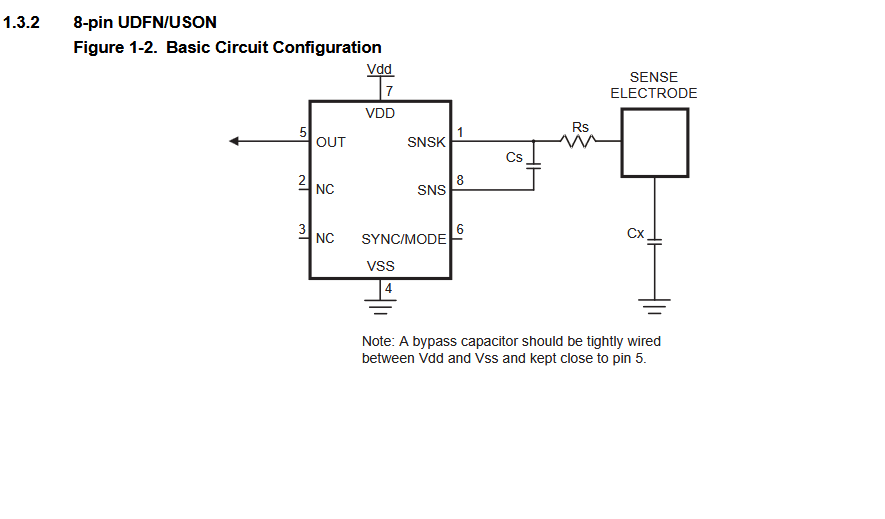
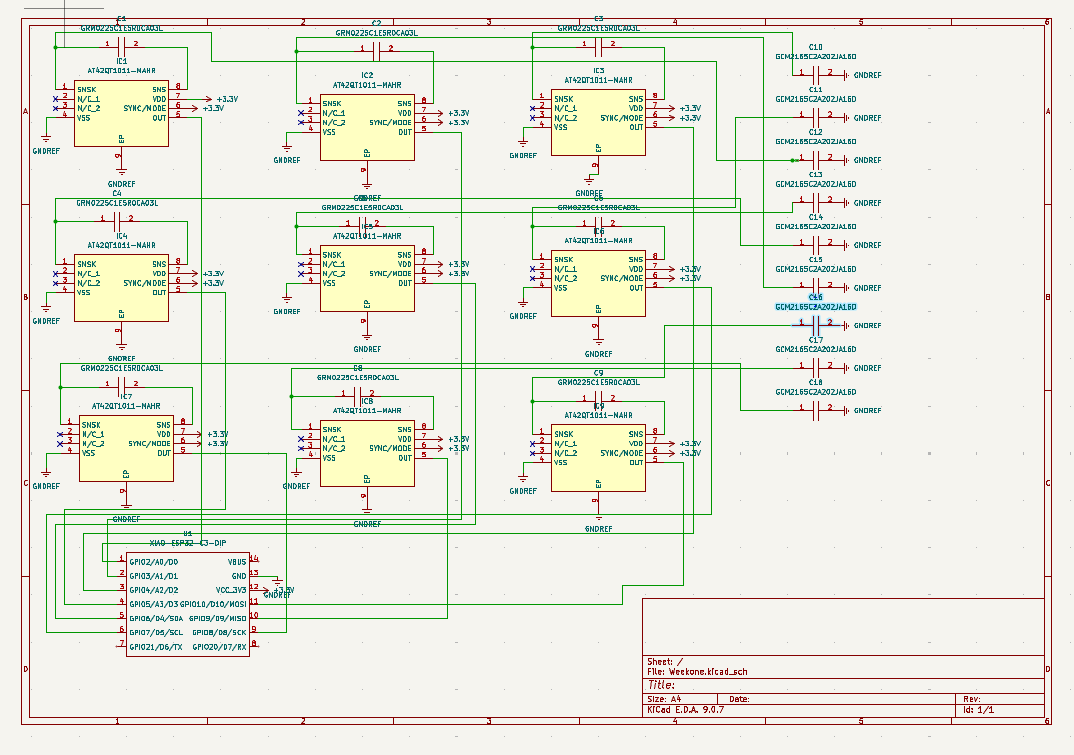
Following the provided circuit plan from the data sheet of the IC, I wired the Steno Macro-Pad
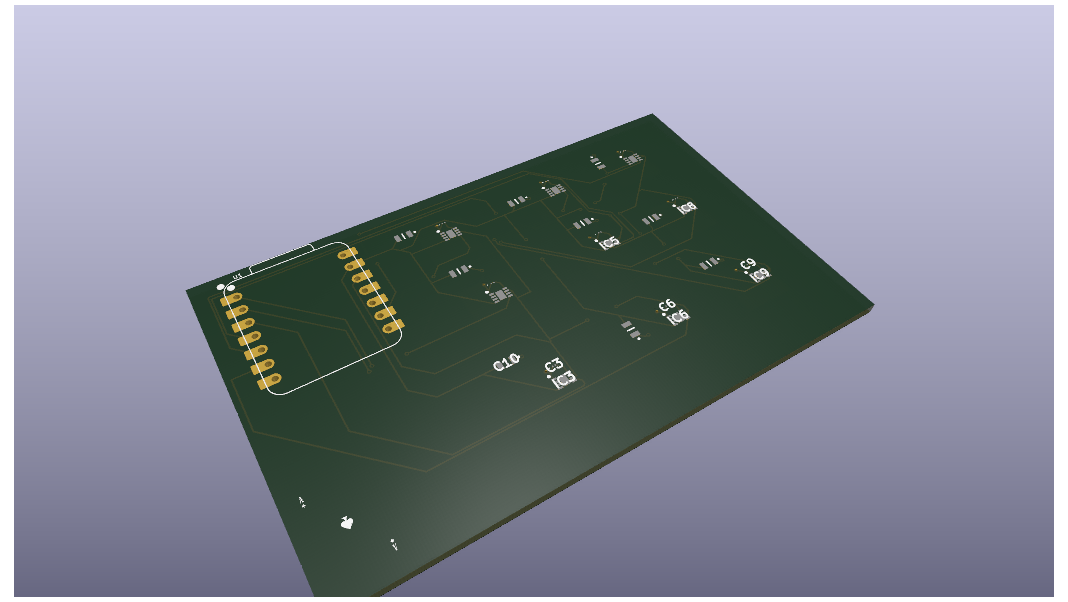
Originally I wanted to keep ALL signal traces on one side, but the size of the PCB and other traces made it so I had to use some buried vias near the back side’s copper sense pads. But who can forget adding some personal symbol in the silk screening, mine being an ace of spades. alt text The large blue squares being the copper pads on the back side. 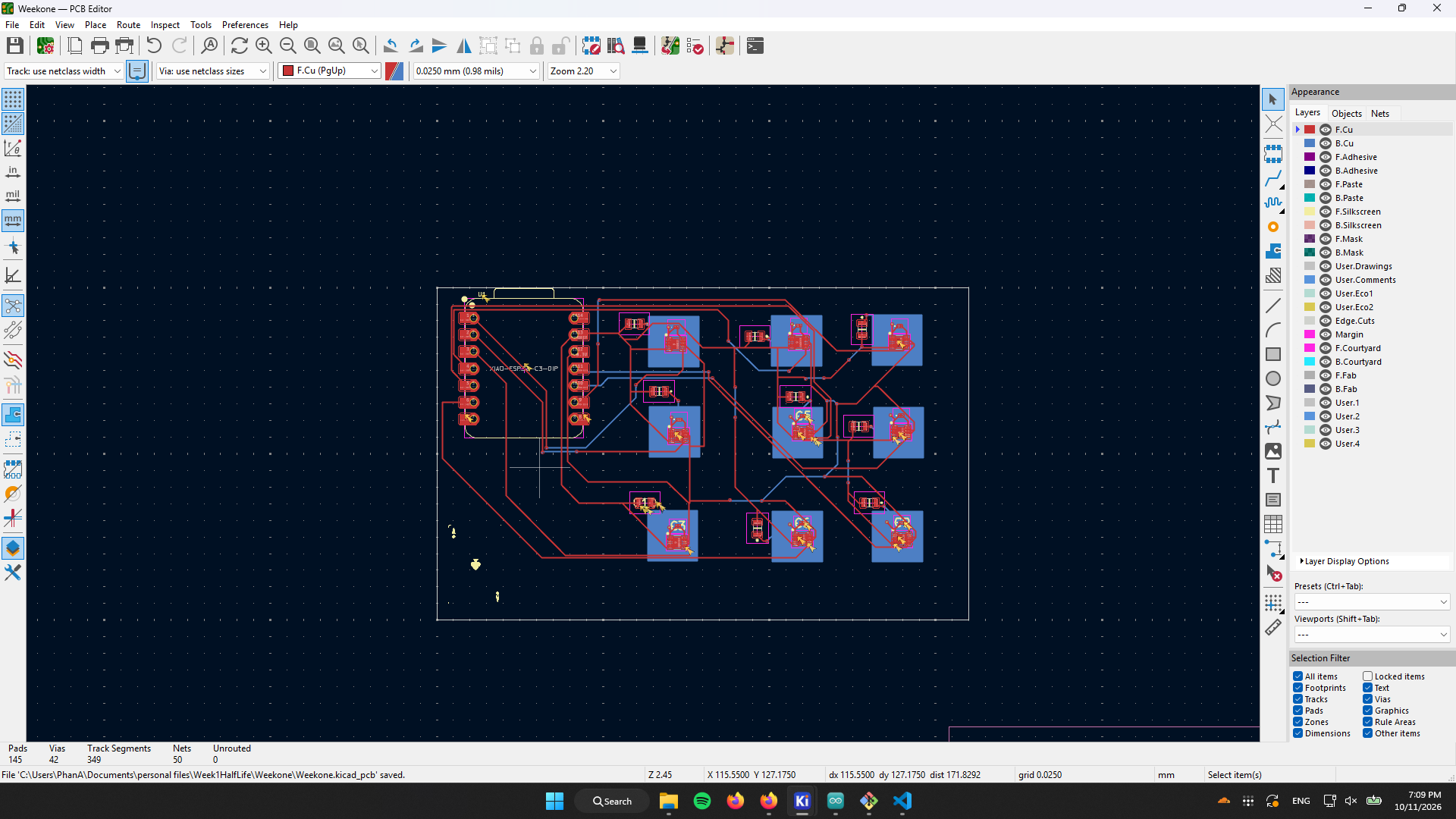 The large blue squares being the copper pads on the back side.
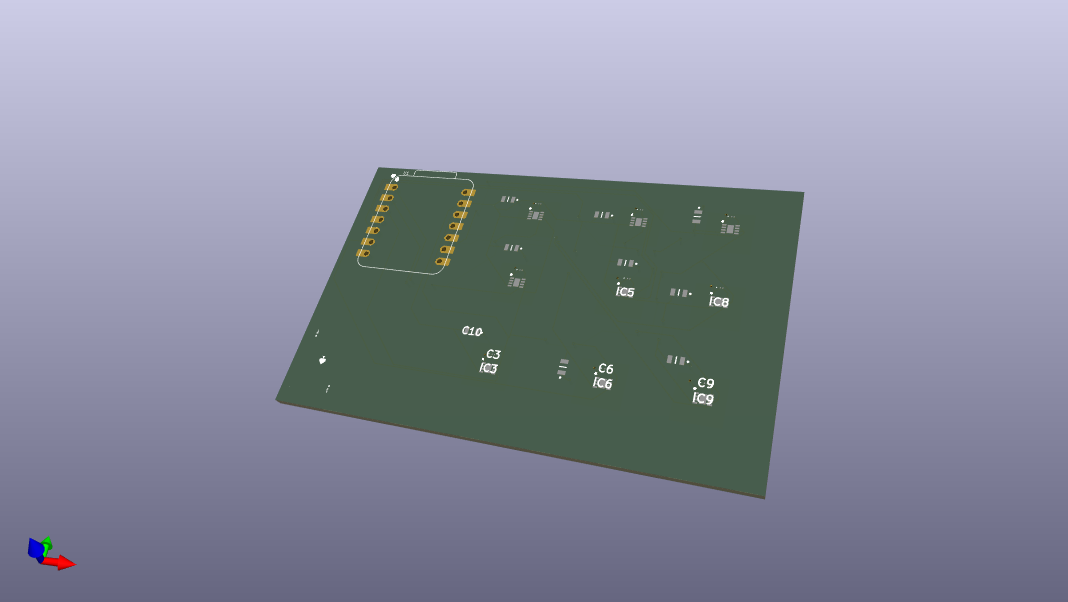
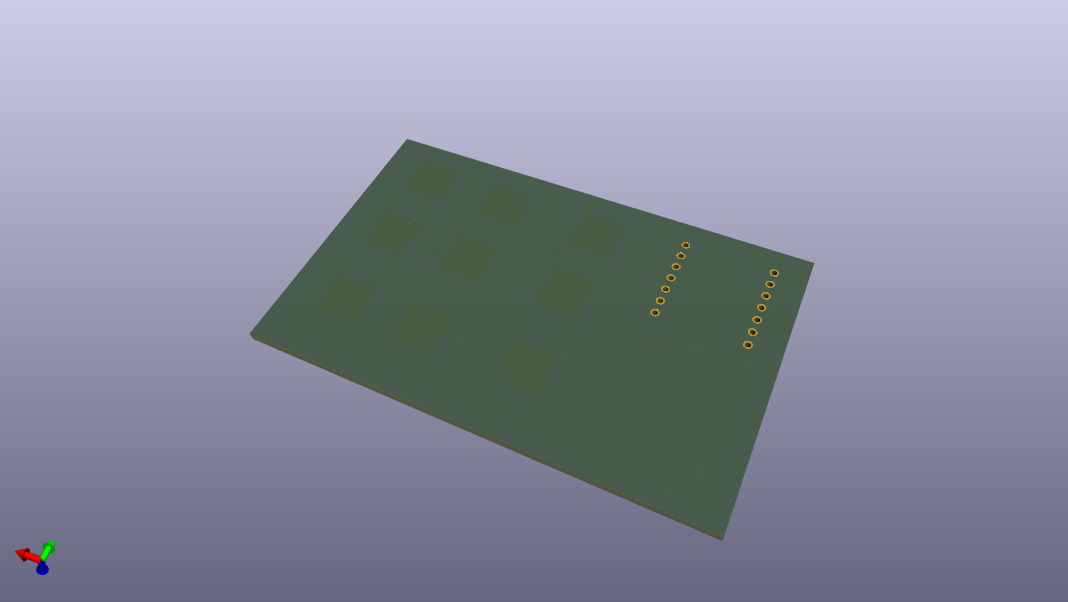
| Qty | Value | Footprint | References |
|---|---|---|---|
| 9 | AT42QT1011-MAHR | Weekone:SON50P200X200X60-9N | IC1, IC2, IC3, IC4, IC5, IC6, IC7, IC8, IC9 |
| 9 | GCM2165C2A202JA16D | 2nf cap:GCM21 | C10, C11, C12, C13, C14, C15, C16, C17, C18 |
| 9 | GRM0225C1E5R0CA03L | 5pf cap:GRM022C81C222KE01L | C1, C2, C3, C4, C5, C6, C7, C8, C9 |
| 1 | LOGO | LOGO | . |
| 1 | XIAO-ESP32-C3-DIP | Xiao:XIAO-ESP32S3-DIP | U1 |
gusmanb/logicanalyzer
24 channel, 100Msps logic analyzer hardware and software

VoronDesign/Voron-Hardware
Cool Hardware designed by the Voron Design group

hoglet67/RGBtoHDMI
Bare-metal Raspberry Pi project that provides pixel-perfect sampling of Retro Computer RGB/YUV video and conversion to HDMI

hackclub/OnBoard
💡 Join 1,000 teenagers and make your first PCB with a $100 grant!

OLIMEX/DIY-LAPTOP
Do It Yourself Open Source Hardware and Software Modular Hacker's Friendly Laptop

UtilitechAS/amsreader-firmware
ESP8266 and ESP32 compatible firmware to read, interpret and publish data to MQTT from smart electrical meters, both DLMS and DSMR is supported


It measures 80 × 50 mm and has 2 copper layers, 1.6 mm thick.
29 parts, built around the GCM2165C2A202JA16D. The full list of its parts is on this page, with links to each part's symbol and footprint where PCBKit's library has them.
From the TheHalfBakedAsian/StenoMacropad repository on GitHub, at the commit this page was made from: the board is Weekone/Weekone.kicad_pcb and its schematic Libaries/OPL_Kicad_Library-master/Grove Vision AI V2 Library/Grove - Vision AI Module V2.kicad_sch. PCBKit opens the board in the browser, with nothing to install.
Its repository states no licence, so its author keeps all rights: ask TheHalfBakedAsian before reusing the design.