2 layers57 × 55.2 mm
LogicAnalyzer
gusmanb/logicanalyzer
24 channel, 100Msps logic analyzer hardware and software
10 parts5.1kGPL-3.0

 Terstegge/LaunchPad-Tester
Board for testing all GPIOs on a TI Launchpad
LaunchPad Tester is an open-source printed circuit board by Terstegge, from the Terstegge/LaunchPad-Tester repository on GitHub. It is a 2-layer board of 50.8 × 30.5 mm with 10 parts on 51 nets, routed with 198 tracks and 3 vias.
Its parts include 5 resistors, 1 capacitor, 1 IC and 1 diode.
This is a small TI-LaunchPad compatible boosterpack board, which can be used for testing all GPIO pins on a TI LaunchPad.
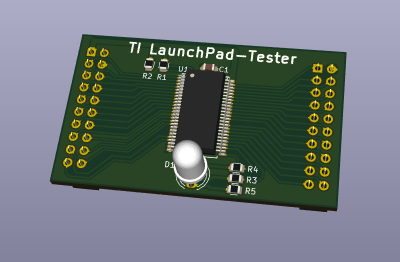
Background: When using TI LaunchPads for educational purposes, some of the IO-pins might be destroyed by students. So I needed a simple way to test all IO pins of such boards before using the boards during the next semester.
I had some spare CY8C9540A chips from Cypress and some 5mm 3-color LEDS, which are now used on this board. The CY8C9540A is a GPIO expander with 40 IO pins and a (slow) I2C interface. It also supports a programmable PWM signal on all pins. Two of the LaunchPad IO pins are used for the I2C interface to operate the CY8C9540A. When the CY8C9540A is not detected by the LaunchPad, we at least know that these two pins are not working :).
When the CY8C9540A is detected by software, we can test every single LaunchPad pin in input- and output-mode by programming the connected CY8C9540A-pin.
The 3-color LED can be used to show the results of the tests.
This project contains the hardware design files, which were developed using KiCad EDA. The related software will be published in a separate project.
| Qty | Value | Footprint | References |
|---|---|---|---|
| 3 | 470 | Resistors_SMD:R_0805 | R3, R4, R5 |
| 2 | 4K7 | Resistors_SMD:R_0805 | R1, R2 |
| 1 | 100nF | Capacitors_SMD:C_0805 | C1 |
| 1 | CY8C9540A | Housings_SSOP:SSOP-48_7.5x15.9mm_Pitch0.635mm | U1 |
| 1 | Header-J1-J3 | Socket_Strips:Socket_Strip_Straight_2x10_Pitch2.54mm | H1 |
| 1 | Header-J4-J2 | Socket_Strips:Socket_Strip_Straight_2x10_Pitch2.54mm | H2 |
| 1 | LED_RGB_5mm | LEDs:LED_D5.0mm-4 | D1 |
gusmanb/logicanalyzer
24 channel, 100Msps logic analyzer hardware and software

byrantech/laptop
anyon_e, a highly integrated, high end, open source laptop. Attempt the impossible.

joeycastillo/Sensor-Watch
A board replacement for the classic Casio F-91W wristwatch


OLIMEX/OLINUXINO
OLINUXINO is Open Source / Open Hardware, low cost from EUR 24 Linux Industrial grade Single Board Computer capable to operate -25+85C

rusefi/rusefi
rusefi - GPL internal combustion engine control unit

VoronDesign/Voron-Hardware
Cool Hardware designed by the Voron Design group

hoglet67/RGBtoHDMI
Bare-metal Raspberry Pi project that provides pixel-perfect sampling of Retro Computer RGB/YUV video and conversion to HDMI
It measures 50.8 × 30.5 mm and has 2 copper layers, 1.6 mm thick.
10 parts. The full list of its parts is on this page, with links to each part's symbol and footprint where PCBKit's library has them.
From the Terstegge/LaunchPad-Tester repository on GitHub, at the commit this page was made from: the board is LaunchPad-Tester.kicad_pcb. PCBKit opens the board in the browser, with nothing to install.
Its repository states no licence, so its author keeps all rights: ask Terstegge before reusing the design.