4 layers77.5 × 46.9 mm
LV MASTER A SAMPLE
Team-Swinburne/ts_23_Altium_Projects
Repository for all the custom PCBs on ts_23
111 parts

 Team-Swinburne/ts_23_Altium_Projects
Repository for all the custom PCBs on ts_23
LVBMS A Sample R2 is an open-source printed circuit board by Team-Swinburne, from the Team-Swinburne/ts_23_Altium_Projects repository on GitHub. It is a 2-layer board of 48.2 × 53.5 mm with 135 parts on 113 nets, routed with 591 tracks and 124 vias.
It is built around the LTC6811IG-1, BSS308PEH6327 and MFU0805FF04000P100, with the DTC114E and HX1188NL among its other parts. Its parts include 54 resistors, 20 capacitors, 15 transistors, 13 fuses and 4 connectors.


A Github repository by Team Swinburne for pcb development of the TS_22 vehicle and experimental projects. This will only contain files of the actual pcb design, more information such as design choice, circuit theory, simulation, etc can be located in the shared Pne Drive
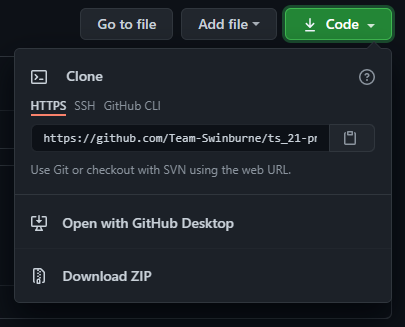
Once all prerequisite are install, clone this repository to your desired folder by opening it in Github Desktop
Follow this guide to ensure you meet the standard and is set up probably before diving into create your own pcb
Always name your project strictly following the naming scheme to avoid confusion in the future. When starting a new board, create a new folder name ts_22-"Board name". Then inside that folder, create a project in Altium called YYMMDD "Board name" "Revsion number"
ts_22-Brake-Module
Then:
210705 Brake Module R0
YYMMDD is the project's createtion date and Revision number starts with 0.
Altium libraries are collections of component intented for speeding up the design and manufacturing process. There are 2 libraries used in PnE: ts_22-standard-lib and ts_22-connectors-lib, located in the ~ts_22 Library.
To import them: In Altium with your project opened, right-click on the project name -> Add Existing -> Choose file "library name".DbLib, do this for both libraries.

Guide on how to add components into the library will be made available in video from. Please discuss with your section leader before attempting to modify these library.
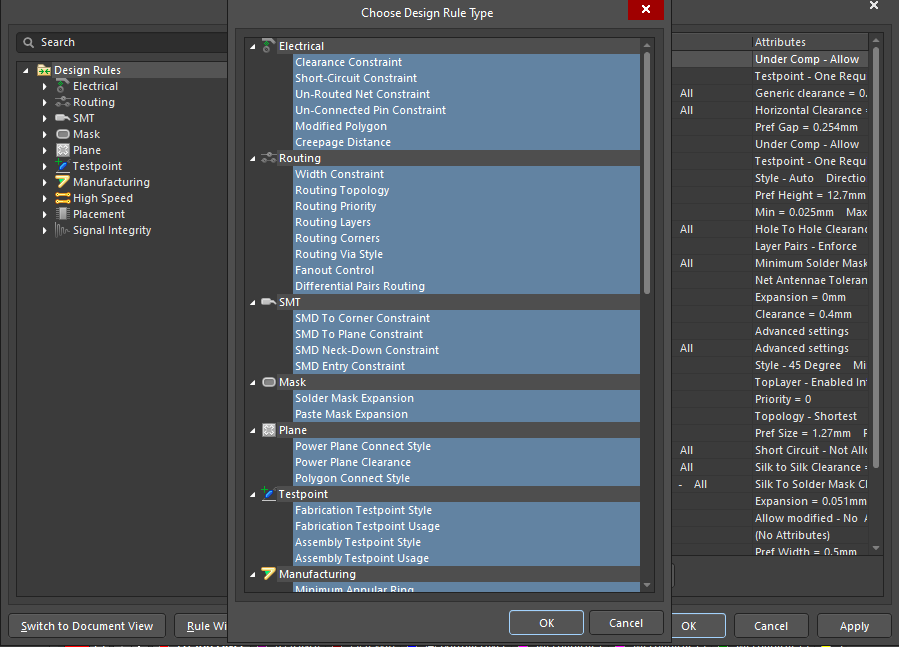
Design rules ensure all pcb meet Team Swinburne standards and more importantly, the competition rule. There are 2 sets of rules: ts_22-rules.RUL and ts_22-HV-rules.RUL. Choose the corresponding rule dependent on which board you are working on.
To import: In Altium with your project opened, choose Design -> Rules. Then in the pop-up windows, right-click on Design Rules -> Import Rules -> Select all entries -> OK -> Choose file "rules name".RUL.
| Qty | Value | Footprint | References |
|---|---|---|---|
| 27 | TestPoint | TestPoint:TestPoint_Pad_D1.0mm | TP1, TP2, TP3, TP10, TP11, TP12, TP13, TP14, TP15, TP16, TP17, TP25, TP27, TP28, TP29, TP30 +11 |
| 18 | 0.1uF | Capacitor_SMD:C_0603_1608Metric_Pad1.08x0.95mm_HandSolder | C2, C3, C4, C5, C6, C7, C10, C11, C12, C13, C14, C15, C16, C17, C19, C20 +2 |
| 18 | 100R | Resistor_SMD:R_0603_1608Metric_Pad0.98x0.95mm_HandSolder | R10, R11, R13, R15, R17, R19, R21, R29, R30, R31, R32, R33, R34, R35, R48, R49 +2 |
| 13 | BSS308PE_H6327 | BMS_Library:SOT95P260X110-3N | Q1, Q3, Q4, Q5, Q6, Q7, Q8, Q9, Q10, Q11, Q12, Q13, Q14 |
| 13 | MFU0805FF04000P100 | Fuse:Fuse_0603_1608Metric_Pad1.05x0.95mm_HandSolder | F1, F2, F3, F4, F5, F6, F7, F8, F9, F10, F11, F12, F13 |
| 12 | 3.3k | Resistor_SMD:R_0603_1608Metric_Pad0.98x0.95mm_HandSolder | R12, R14, R16, R18, R20, R22, R23, R24, R25, R26, R27, R28 |
| 12 | 33R | Resistor_SMD:R_1206_3216Metric_Pad1.30x1.75mm_HandSolder | R36, R37, R38, R39, R40, R41, R42, R43, R44, R45, R46, R47 |
| 4 | 100k | Resistor_SMD:R_0603_1608Metric_Pad0.98x0.95mm_HandSolder | R2, R50, R51, R54 |
| 4 | 50R | Resistor_SMD:R_0603_1608Metric_Pad0.98x0.95mm_HandSolder | R1, R3, R4, R5 |
| 2 | 0.01uF | Capacitor_SMD:C_0603_1608Metric_Pad1.08x0.95mm_HandSolder | C1, C18 |
| 2 | S2B-PH-K-S_LF__SN_ | Connector_JST:JST_EH_B2B-EH-A_1x02_P2.50mm_Vertical | J1, J3 |
| 1 | 1.0M | Resistor_SMD:R_0603_1608Metric_Pad0.98x0.95mm_HandSolder | R7 |
| 1 | 50k | Resistor_SMD:R_0603_1608Metric_Pad0.98x0.95mm_HandSolder | R52 |
| 1 | BIAS RESISTOR (VALUE CAN CHANGE) | Resistor_SMD:R_0603_1608Metric_Pad0.98x0.95mm_HandSolder | R8 |
| 1 | BIAS RESISTOR (VALUE CHANGES) | Resistor_SMD:R_0603_1608Metric_Pad0.98x0.95mm_HandSolder | R6 |
| 1 | CZT5551CT-ND | BMS_Library:SOT230P700X180-4N | Q2 |
| 1 | Conn_01x05_Male | Connector_PinSocket_2.54mm:PinSocket_1x05_P2.54mm_Vertical | J4 |
| 1 | Conn_01x13_Male | Connector_PinSocket_2.54mm:PinSocket_1x13_P2.54mm_Vertical | J2 |
| 1 | DTC114E | Package_TO_SOT_SMD:SOT-23 | Q15 |
| 1 | HX1188NL | BMS_Library:SOIC127P940X597-16N | T1 |
| 1 | LTC6811 | BMS_Library:LTC6811 | U1 |
Team-Swinburne/ts_23_Altium_Projects
Repository for all the custom PCBs on ts_23

Team-Swinburne/ts_20-pcb-development
This is the official repository for the PCB development of Team Swinburne FSAE 2020


NathanGrn/PCB_Parafoil_Serendipity
PCB for an autonomous parafoil guidance system integrated in Serendipity, an experimental rocket developed in-house at CNES by the PERSEUS project. Original project on GitLab:

ajisrawi/hologuard-hg1-radar
HoloGuard HG-1: Ku-band GaN 4D holographic (staring MIMO) counter-UAS radar in an EchoGuard-size envelope - system design, antenna, KiCad boards, FreeCAD enclosure, Blender renders, firmware

Stab-Rabbit-coding/Serenity-UAV
A functional, security conscious, Unmanned Aerial Vehicle based on the Firefly Class spacecraft Serenity from the 2002 show..

It measures 48.2 × 53.5 mm and has 2 copper layers, 1.2 mm thick.
135 parts, built around the LTC6811IG-1, BSS308PEH6327, MFU0805FF04000P100 and DTC114E. The full list of its parts is on this page, with links to each part's symbol and footprint where PCBKit's library has them.
From the Team-Swinburne/ts_23_Altium_Projects repository on GitHub, at the commit this page was made from: the board is ts_23_BMS_SLAVE/LVBMS_A_Sample_R2/LVBMS_A_Sample_R2.kicad_pcb and its schematic ts_23_BMS_SLAVE/LVBMS_A_Sample_R2/Balancing and Filtering.kicad_sch. PCBKit opens the board in the browser, with nothing to install.
Its repository states no licence, so its author keeps all rights: ask Team-Swinburne before reusing the design.