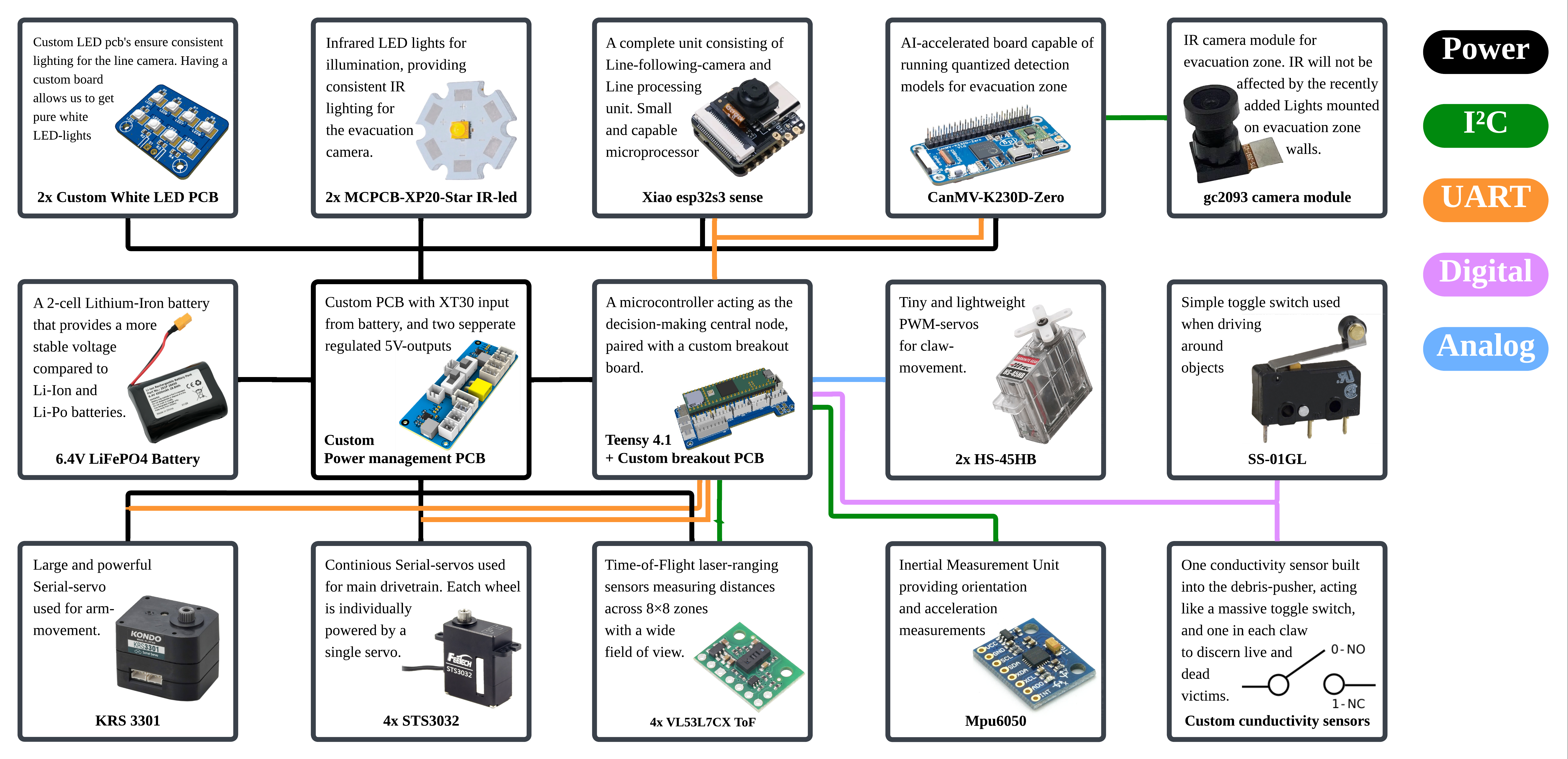
Key features we have. PostTrainingQuantization(PTQ) with results simulated on the K230D chip, half-duplex serial driver with 74HCT126, asymmetric PID dependent on the IMU, custom touch sensors, and an IR camera used on…
Archive is an open-source printed circuit board by Spadeyache, from the Spadeyache/FATEN-RCJ26 repository on GitHub. It is a 2-layer board of 89.3 × 92.6 mm with 61 parts on 115 nets, routed with 896 tracks and 95 vias.
It is built around the K230D, AP63201WU and DEV-16771, with the 1N4148WT, GF-126-0159 and SS8050 among its other parts. Its parts include 24 connectors, 17 capacitors, 6 resistors, 4 ICs and 4 diodes.
Key features we have. PostTrainingQuantization(PTQ) with results simulated on the K230D chip, half-duplex serial driver with 74HCT126, asymmetric PID dependent on the IMU, custom touch sensors, and an IR camera used on the hardware.
Firmware, vision, AI training pipeline, and electronics for team FATEN's RoboCupJunior Rescue Line robot. The robot follows a line course, handles gaps, obstacles, and intersections, then enters an evacuation zone where it detects, grabs, and carries victims using an onboard YOLO(formerly MobileNet-SSD-v2-Lite) model.
One microcontroller drives the robot; two smart co-processors digest the camera data which the control loop stays fast and deterministic.
mermaid
flowchart LR
    subgraph IN["Inputs — co-processors and sensors"]
        direction TB
        XIAO["📷 XIAO ESP32-S3<br/>camera vision:<br/>line, green, red, silver, gap"]
        K230["🧠 K230D Zero<br/>YOLOv8n victim/colour<br/>bounding boxes"]
        IMU["🧭 MPU6050 IMU"]
        TOF["📏 VL53L7CX ToF"]
        TCH["👆 Touch bumpers"]
    end
    subgraph T["Teensy 4.1 — the conductor"]
        direction TB
        RX["sensors/ — raw byte transport"]
        PROC["processing/ — decode · filter · fuse"]
        SM["state_machine/ — pick a behaviour"]
        ACT["actions/ — PID, turn, forward, arm"]
        RX --> PROC --> SM --> ACT
    end
    subgraph OUT["Outputs"]
        direction TB
        MOT["⚙️ 4× STS3032 wheels"]
        ARM["🦾 KRS arm / gripper"]
    end
    XIAO -- "UART @ 4 Mbps" --> RX
    K230 -- "UART @ 115200" --> RX
The Teensy firmware is a 5-layer architecture (drivers → sensors → processing → state_machine/actions) where calls only flow downward, with one file pair per state-machine state (LINE_Follow, LINE_Gap, LINE_Obstacle, EVAC_Entry, EVAC_SearchDeploy, EVAC_Exit, …). See teensy/STS-imuMerge/README.md and the interactive system map for the full picture.
Hardware
Part
Role
Teensy 4.1
Main controller: sensor fusion, state machine, motion control
Seeed XIAO ESP32-S3 Sense
Line-camera co-processor: line position, green/red markers, silver tape, gap detection
Sipeed CanMV K230D Zero
AI co-processor: YOLOv8n victim / colour detection (kmodel via nncase)
MPU6050
IMU — pitch / roll / yaw
Pololu VL53L7CX
Multizone ToF — walls and obstacle distance
4× Feetech STS3032
Serial-bus wheel servos (1 Mbps)
Kondo KRS servos & Hitech HS45HB
Victim arm and grippers
Custom PCBs (EasyEDA)
Power distribution, adapters, breakouts — see electronics/
The custom PCBs form a stacked electronics module. The map below shows how the boards connect:
Each firmware layer also documents itself: every src/<layer>/ folder has its own README.md with that layer's rules.
Building and running
Teensy firmware
Requires Teensyduino (Arduino IDE or arduino-cli with the teensy:avr core):
powershell
cd teensy/STS-imuMerge
arduino-cli compile --fqbn "teensy:avr:teensy41:usb=serial,speed=600,opt=o2std,keys=en-us" --build-path build .
XIAO camera firmware
Build profile is pinned in sketch.yaml (esp32 core 3.3.7):
powershell
cd xiaoesp/XIAOdev
arduino-cli compile --profile xiaoesp32s3
K230D AI co-processor
Flash the CanMV MicroPython image (CanMV_K230D_Zero_micropython_v1.5-legacy … nncase_v2.9.0, in dev-tools/) — see k230-inference/README.md
Copy the contents of k230-inference/ plus your .kmodel to the device SD card
Training a new model
Fully reproducible in Docker — annotated dataset in, deployable .kmodel out:
powershell
cd k230-final-train
.\competition_run.ps1 -Name victim_v2 -Epochs 100
See k230-final-train/README.md for the step-by-step scripts and the PTQ search/compare workflow. Note: kmodels must be converted with nncase 2.9.0-compatible tooling to match the flashed CanMV firmware.
Acknowledgements
Sponsors
Team FATEN thanks the sponsors who made this robot possible:
EasyEDA & JLCPCB — provided the PCB design software and board fabrication credit; the integrated design-to-manufacture workflow carried our boards smoothly from schematic to delivered PCB.
Keeppower — supplied high-spec protected batteries, with the protection circuit custom-designed for our robot, and covered most of the battery and shipping costs.
Hitec — provided motors for the robot arm along with battery chargers and maintenance jigs; their high-spec LiFePO4 balance charger kept our batteries reliably charged throughout the competition.
Pololu — supported the team's sensor hardware, including the VL53L7CX multizone time-of-flight sensor the robot uses for wall and obstacle detection.
This robot builds on Ultralytics YOLOv8, nncase, CanMV, Teensyduino, and the Arduino ESP32 core.
License
This project is licensed under the Creative Commons Attribution-NonCommercial 4.0 International License (CC BY-NC 4.0) see LICENSE for details.
In short: you're welcome to study this project, learn from it, and build your own work on top of it, as long as you credit team FATEN (a link back to this repository) and don't use it for commercial purposes. Please don't just lift the code wholesale.
Third-party components (YOLOv8, nncase, CanMV, Teensyduino, the Arduino ESP32 core, etc.) remain under their own licenses.
Key features we have. PostTrainingQuantization(PTQ) with results simulated on the K230D chip, half-duplex serial driver with 74HCT126, asymmetric PID dependent on the IMU, custom touch sensors, and an IR camera used on…
Key features we have. PostTrainingQuantization(PTQ) with results simulated on the K230D chip, half-duplex serial driver with 74HCT126, asymmetric PID dependent on the IMU, custom touch sensors, and an IR camera used on…
Key features we have. PostTrainingQuantization(PTQ) with results simulated on the K230D chip, half-duplex serial driver with 74HCT126, asymmetric PID dependent on the IMU, custom touch sensors, and an IR camera used on…
Key features we have. PostTrainingQuantization(PTQ) with results simulated on the K230D chip, half-duplex serial driver with 74HCT126, asymmetric PID dependent on the IMU, custom touch sensors, and an IR camera used on…
Key features we have. PostTrainingQuantization(PTQ) with results simulated on the K230D chip, half-duplex serial driver with 74HCT126, asymmetric PID dependent on the IMU, custom touch sensors, and an IR camera used on…
Key features we have. PostTrainingQuantization(PTQ) with results simulated on the K230D chip, half-duplex serial driver with 74HCT126, asymmetric PID dependent on the IMU, custom touch sensors, and an IR camera used on…
It measures 89.3 × 92.6 mm and has 2 copper layers, 1.6 mm thick.
What parts does the Archive use?
61 parts, built around the K230D, AP63201WU, DEV-16771 and 1N4148WT. The full list of its parts is on this page, with links to each part's symbol and footprint where PCBKit's library has them.
Where can I download the Archive KiCad files?
From the Spadeyache/FATEN-RCJ26 repository on GitHub, at the commit this page was made from: the board is electronics/archive/Main.kicad_pcb and its schematic electronics/archive/Batter Management v3.kicad_sch. PCBKit opens the board in the browser, with nothing to install.
Can I use the Archive design in my own project?
Its repository states no licence, so its author keeps all rights: ask Spadeyache before reusing the design.