2 layers170.2 × 170.2 mm
 RomualdRousseau/Miniish1
Homebrew 6502 Computer
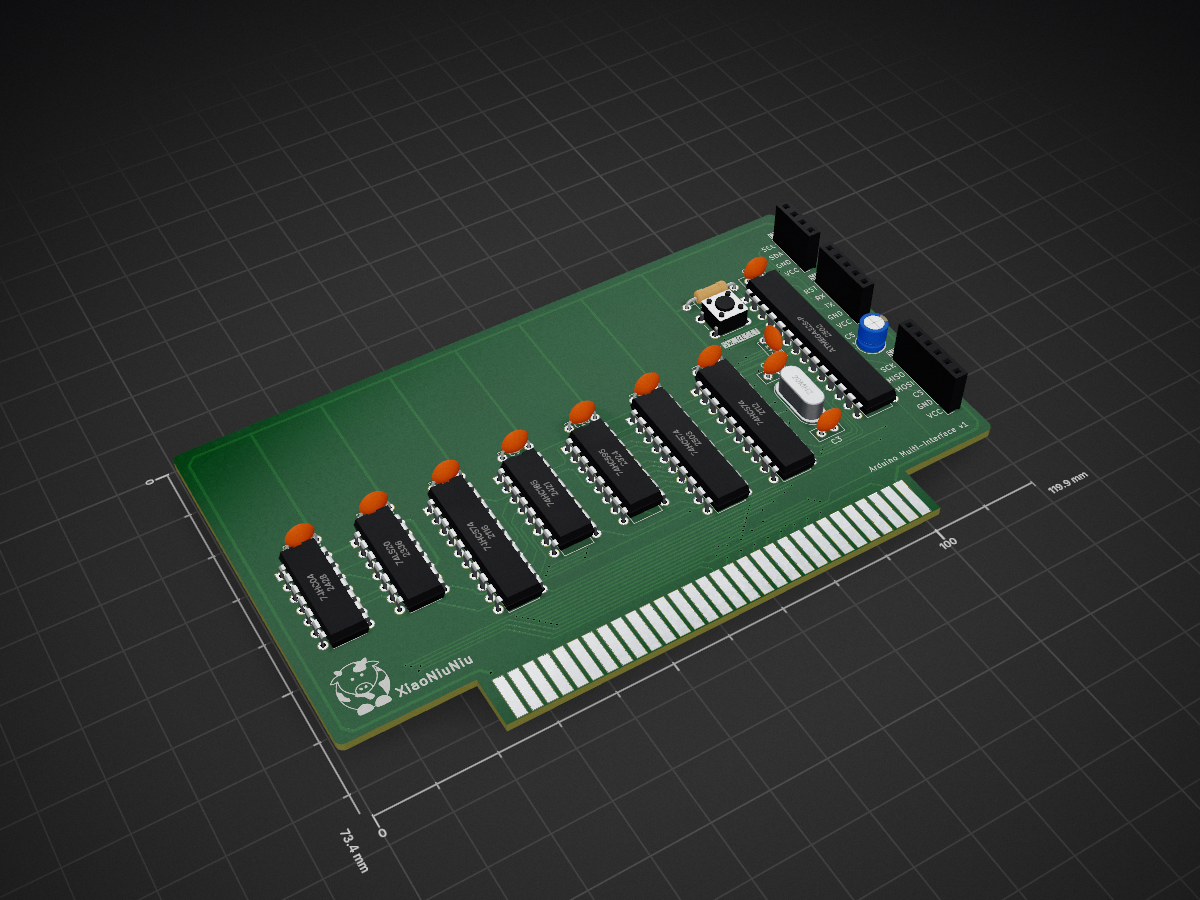
ArduinoMultiInterface is an open-source printed circuit board by RomualdRousseau, from the RomualdRousseau/Miniish repository on GitHub, published under the GPL-3.0 licence. It is a 2-layer board of 119.9 × 73.4 mm with 28 parts on 112 nets, routed with 517 tracks and 68 vias.
It is built around the ATMEGA328-PU, 74HC574D and 74HC04D, with the 74HC165D, 74HC595 and 74LS20P-E among its other parts. Its parts include 12 capacitors, 8 ICs, 4 connectors, 1 resistor and 1 switch. It belongs with the retro computing and games boards and the AVR (ATmega, ATtiny) boards of this library.


The goal of this project is to build a 8bit game console based on 6502 CPU. The entire project is strongly inspired by the work and videos of Ben Eater, but also Javidx9 and his emulator.
It is basically the same hardware design presented by Ben Eater. I just cleaned up the adress control logic to have as mush of the 32K RAM available.
The address plan is:
0000 --------------------------------
// RAM
8000 --------------------------------
// LO ROM
D000 --------------------------------
// IRQ Status
D100 --------------------------------
// PICTURE PROCESSING UNIT (PORT1B)
D200 --------------------------------
// AUDIO PROCESSING UNIT (PORT2B)
D300 --------------------------------
// I/O
D400 --------------------------------
// Reserved
E000 --------------------------------
// HI ROM
FFFF --------------------------------
The card is built using a FPGA and strongly inspired to the NES PPU and the capability of PICO-8.
The overall specs of the VGA card is 16 colors with a 128x128 display area using the VGA 640x480 60Hz standard. The 16 colors are the PICO8 palette.
The VGA card is interfaced to the motherboard through a sprite based unit. The video ram is not mapped to the computer ram but instead, the CPU sends instructions to a sprite generator very similar to the NES (greatly based on Javidx9 explanations).
The overall spec of the sprite generator is:
1 nametables for the background composed of 16 * 16 tiles. Each tile is 8x8 pixels. Scrolling vertical and horizontal modes are supported.
256 sprites with tansparency support. Each sprite is also a tile of 8x8 pixels.
64 simultaneous sprites on screen and 16 sprites per scanline
NMI is generated at each vertical blank
The card is built using a ATMEGA328p at 20Mhz with the library the_synth of Edgar.
The synthetizer has the overall spec:
4 channels at 20KHz
4 waveforms: triangle, square, sinus + noise
4 envelopes
modulation
IRQ0 is generated as the next data frame callback
| Qty | Value | Footprint | References |
|---|---|---|---|
| 8 | 10nF | Capacitor_THT:C_Disc_D5.0mm_W2.5mm_P5.00mm | C6, C7, C8, C9, C10, C11, C12, C13 |
| 3 | 74HC574 | Package_DIP:DIP-20_W7.62mm | U4, U5, U6 |
| 2 | 22pF | Capacitor_THT:C_Disc_D5.0mm_W2.5mm_P2.50mm | C2, C3 |
| 1 | 100nF | Capacitor_THT:C_Disc_D5.0mm_W2.5mm_P2.50mm | C1 |
| 1 | 10K | Resistor_THT:R_Axial_DIN0207_L6.3mm_D2.5mm_P10.16mm_Horizontal | R1 |
| 1 | 10uF | Capacitor_THT:CP_Radial_D5.0mm_P2.00mm | C5 |
| 1 | 20MHz | Crystal:Crystal_HC49-4H_Vertical | Y1 |
| 1 | 74HC04 | Package_DIP:DIP-14_W7.62mm | U7 |
| 1 | 74HC165 | Package_DIP:DIP-16_W7.62mm | U2 |
| 1 | 74HC595 | Package_DIP:DIP-16_W7.62mm | U3 |
| 1 | 74LS20 | Package_DIP:DIP-14_W7.62mm | U9 |
| 1 | ATmega328-P | Package_DIP:DIP-28_W7.62mm | U1 |
| 1 | I2C | Connector_PinSocket_2.54mm:PinSocket_1x04_P2.54mm_Vertical | J2 |
| 1 | LOGO | Cow:VerySmallCow | XiaoNiuNiu |
| 1 | PORT1 | Connector_NES:NES_PCBEdge | J1 |
| 1 | SER | Connector_PinSocket_2.54mm:PinSocket_1x05_P2.54mm_Vertical | J4 |
| 1 | SPI | Connector_PinSocket_2.54mm:PinSocket_1x06_P2.54mm_Vertical | J3 |
| 1 | SW_RESET | Button_Switch_THT:SW_PUSH_6mm | SW1 |


slu4coder/Minimal-64-Home-Computer
Legacy: Full TTL-only home computer with VGA and PS/2 and twice the processing power of a Commodore 64


rjw57/simplest-80s-computer
This is my rough scratch repo where I keep experiments to do with desiging 80s computer peripherals. It is not in any sensible shape to be used by others yet, apologies.

slu4coder/Minimal-64x4-Home-Computer
My DIY TTL home computer with VGA and PS/2 and 4x the processing power of a Commodore C64 or Apple II.

gianluca-rainis/Z80DevBoard
An advanced development board for the Z80 microprocessor, powered by an RP2040.

It measures 119.9 × 73.4 mm and has 2 copper layers, 1.6 mm thick.
28 parts, built around the ATMEGA328-PU, 74HC574D, 74HC04D and 74HC165D. The full list of its parts is on this page, with links to each part's symbol and footprint where PCBKit's library has them.
From the RomualdRousseau/Miniish repository on GitHub, at the commit this page was made from: the board is Hardware/ArduinoMultiInterface/ArduinoMultiInterface.kicad_pcb and its schematic Hardware/ArduinoMultiInterface/ArduinoMultiInterface.kicad_sch. PCBKit opens the board in the browser, with nothing to install.
Its repository publishes it under the GPL-3.0 licence: you may reuse it on that licence's terms (keep the author's notice, and for a copyleft licence share your changes alike).