2 layers
Nrf bga
github-linguist/linguist
Language Savant. If your repository's language is being reported incorrectly, send us a pull request!
12 parts14kMIT

 Pollyyaooo/515_monopoly
A smart Monopoly system that automatically tracks board state and enforces rules, so players can focus on strategy and fun.
Player device is an open-source printed circuit board by Pollyyaooo, from the Pollyyaooo/515_monopoly repository on GitHub. It is a 2-layer board of 65 × 115 mm with 12 parts on 17 nets, routed with 80 tracks and 5 vias.
Its parts include 6 switches, 3 connectors and 1 IC.
A smart Monopoly system that automatically tracks board state and enforces rules, so players can focus on strategy and fun.
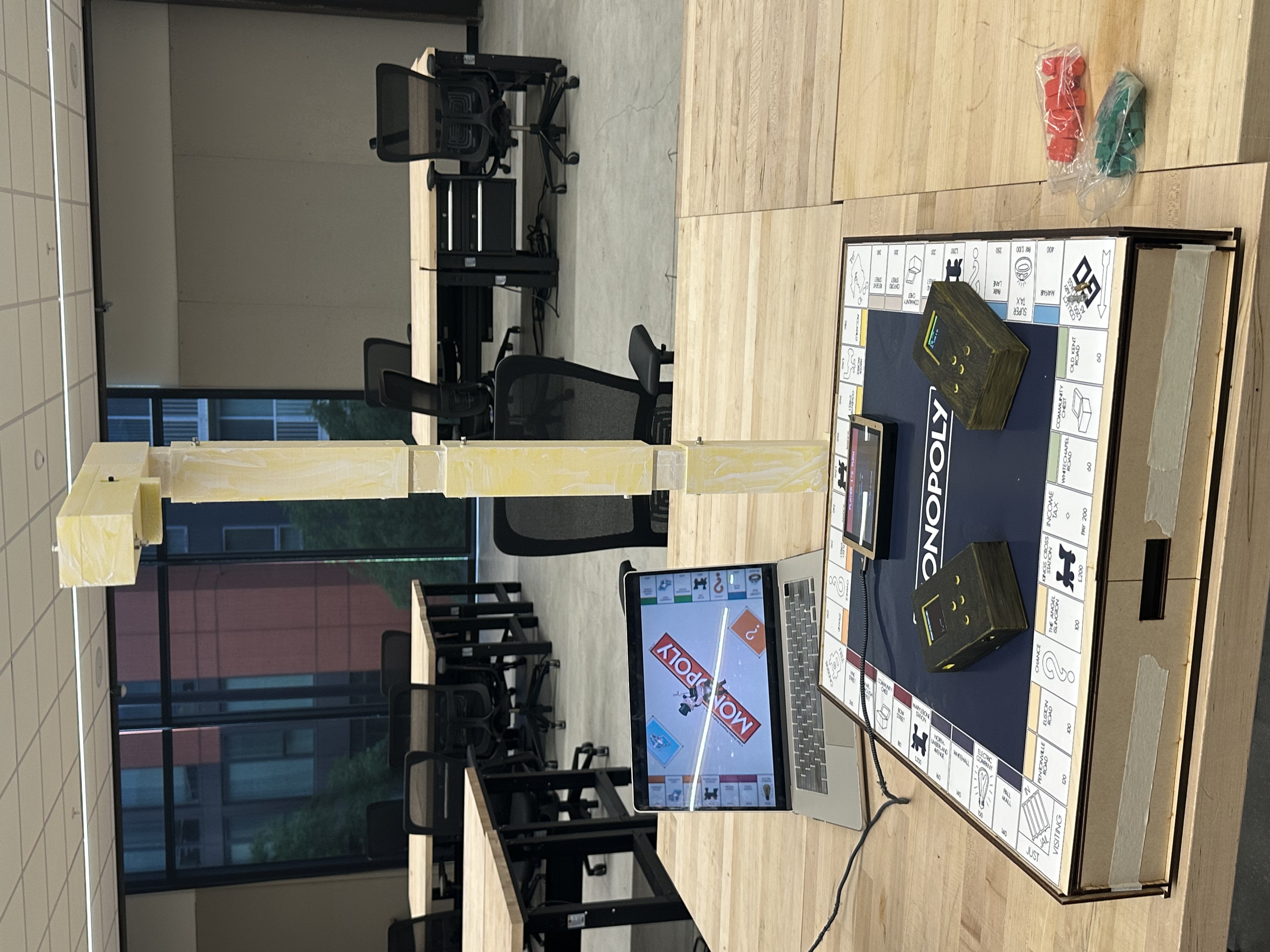
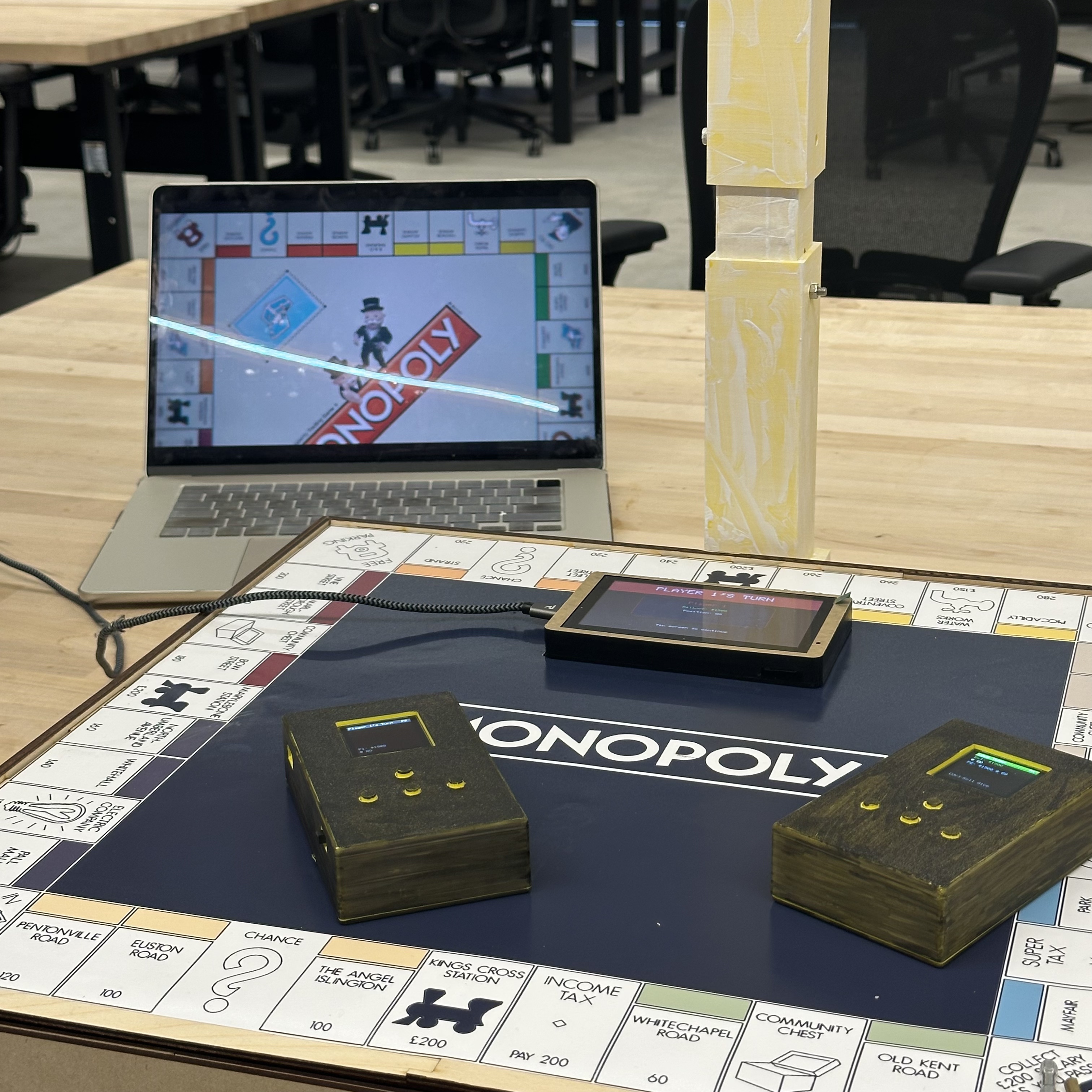
| Scenario | Link |
|---|---|
| Vision detection — green house | Watch |
| Vision detection — red hotel | Watch |
| Auction | Watch |
| NFC payment | Watch |
The system consists of three main components:
515_monopoly/
├── README.md
├── assets/
│   ├── full_view.jpg
│   └── details.jpg
├── software/
│   ├── README.md               # Code running instructions
│   ├── central_bank/           # CrowPanel ESP32 game logic & display
│   ├── player_card/            # XIAO ESP32-S3 player device firmware
│   ├── vision/                 # Grove Vision AI V2 + ESP32-C3 (ESP-NOW sender)
│   ├── central_display_test/   # Display UI testing
│   └── player_device_test/     # Player device testing
├── hardware/
│   ├── playbox+vision.f3z      # Fusion 360 enclosure & camera mount
│   ├── playbox_lasercut/       # SVG files for laser cutting
│   ├── player_card.f3z         # Fusion 360 player card enclosure
│   ├── player_card_pcb/        # PCB design files
│   ├── player_card_model/      # Player card 3D model files
│   └── vision_archi/           # Vision module hardware files
├── docs/
│   ├── milestone1.pdf
│   ├── milestone2.pdf
│   └── milestone3.pdf
└── test/ # Early-stage hardware experiments (abandoned)| Component | Role |
|---|---|
| Grove Vision AI V2 | House / hotel detection |
| ESP32-C3 | Coordinate processing & ESP-NOW transmission |
| CrowPanel ESP32 5" | Central bank — game logic & public display |
| XIAO ESP32-S3 (×2) | Player devices |
| OLED SSD1351 (×2) | Player display |
| NFC reader (×2) | Rent payment between players |
| Link | Protocol |
|---|---|
| Grove Vision AI V2 → ESP32-C3 | UART |
| ESP32-C3 → CrowPanel | ESP-NOW |
| CrowPanel ↔ Player devices | BLE |
| Player device ↔ Player device | NFC |
The test/ folder contains early-stage hardware experiments (RFID, Hall Effect, FSR) that were explored during Milestone 1 but later abandoned in favour of the vision-based detection approach.
| Qty | Value | Footprint | References |
|---|---|---|---|
| 1 | BAT | Connector_JST:JST_SH_SM02B-SRSS-TB_1x02-1MP_P1.00mm_Horizontal | J3 |
| 1 | DOWN | TS04-66-70-BK-260-SMT:SW_TS04-66-70-BK-260-SMT | SW2 |
| 1 | LEFT | TS04-66-70-BK-260-SMT:SW_TS04-66-70-BK-260-SMT | SW3 |
| 1 | NFC | Connector_PinHeader_2.54mm:PinHeader_1x04_P2.54mm_Vertical | J2 |
| 1 | OK | TS04-66-70-BK-260-SMT:SW_TS04-66-70-BK-260-SMT | SW5 |
| 1 | OLED | Connector_PinHeader_2.54mm:PinHeader_1x07_P2.54mm_Vertical | J1 |
| 1 | RIGHT | TS04-66-70-BK-260-SMT:SW_TS04-66-70-BK-260-SMT | SW4 |
| 1 | SW_SPDT | Connector_PinHeader_2.54mm:PinHeader_1x03_P2.54mm_Vertical | SW6 |
| 1 | UP | TS04-66-70-BK-260-SMT:SW_TS04-66-70-BK-260-SMT | SW1 |
| 1 | ~ | GIX_ESP32:XIAO_ESP32 | U1 |
The 10 most common of 12 parts.
github-linguist/linguist
Language Savant. If your repository's language is being reported incorrectly, send us a pull request!


google/mozc-devices
Circuit diagrams and firmware source code for Gboard DIY keyboards


hackclub/OnBoard
💡 Join 1,000 teenagers and make your first PCB with a $100 grant!

VoronDesign/Voron-Tap
Tap is a nozzle-based z-probe for the V2 and Trident printer designs. The entire toolhead moves to trigger an optical switch. Tap offers many advantages:

stacksmashing/pico-tpmsniffer
A simple, very experimental TPM sniffer for LPC bus
It measures 65 × 115 mm and has 2 copper layers, 1.6 mm thick.
12 parts. The full list of its parts is on this page, with links to each part's symbol and footprint where PCBKit's library has them.
From the Pollyyaooo/515_monopoly repository on GitHub, at the commit this page was made from: the board is hardware/player_card_pcb/player device.kicad_pcb and its schematic hardware/player_card_pcb/player device.kicad_sch. PCBKit opens the board in the browser, with nothing to install.
Its repository states no licence, so its author keeps all rights: ask Pollyyaooo before reusing the design.