2 layers137.9 × 92.7 mm
ErgoTravel
jpconstantineau/ErgoTravel
A Portable Ergonomic Split Keyboard inspired from the ErgoDox, Let's Split and Minidox
195 parts284MIT

 NyxInTime/my-keeb
The mockup shows the basic skeleton of the keyboard. The keyboard resembles a 96% keyboard, but with some extra keys that will be remappable.
My keep kicad is an open-source printed circuit board by NyxInTime, from the NyxInTime/my-keeb repository on GitHub. It is a 2-layer board of 385 × 140 mm with 195 parts on 148 nets, routed with 353 tracks and 0 vias.
Its parts include 97 diodes and 97 switches. It belongs with the RP2040 boards of this library.
To start, I created a 3d Mockup in blender. This took around 30 minutes.
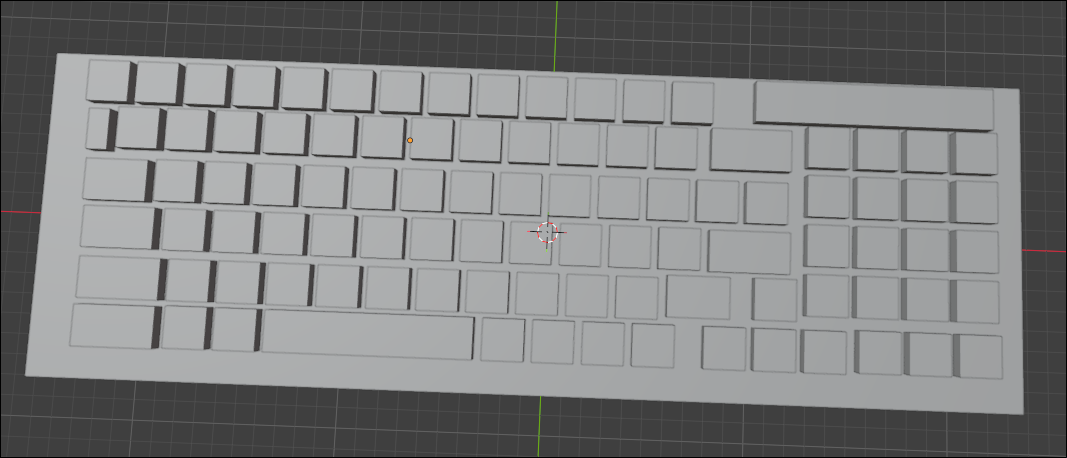
The mockup shows the basic skeleton of the keyboard. The keyboard resembles a 96% keyboard, but with some extra keys that will be remappable.
I then added a label to each key. This took around 15 minutes.
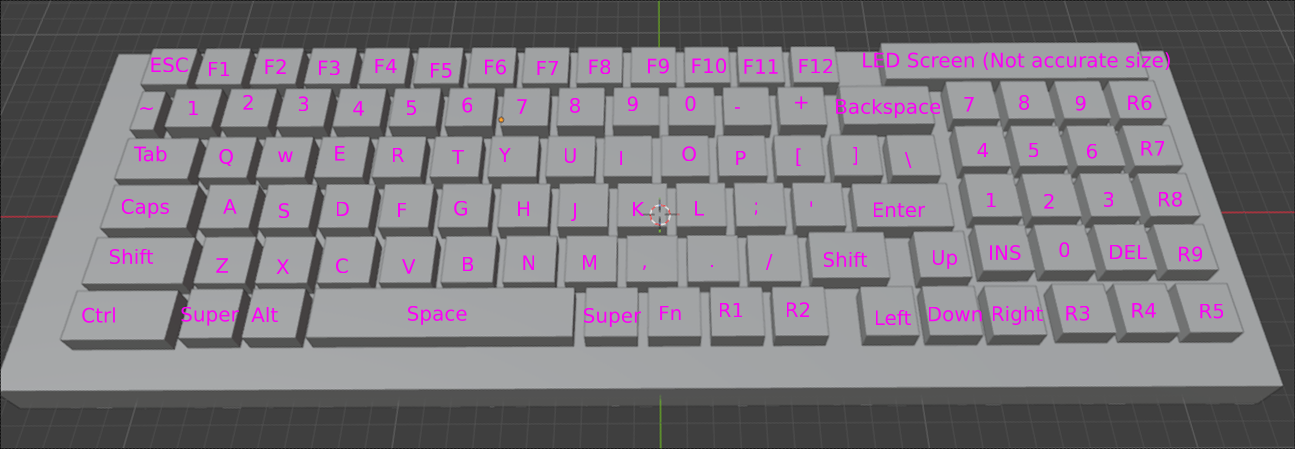
The R keys are hopefully going to be remappable keys that make it easy to have Hyprland keybinds or keybinds for other apps.
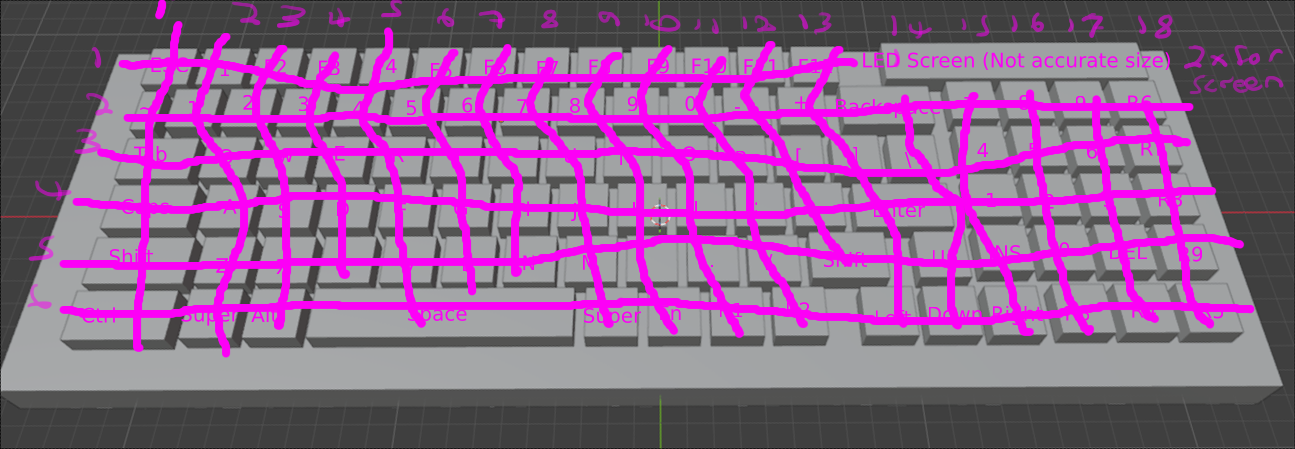
I tried to see how adding a matrix over the keyboard would work to see if the PICO had enough pins. It does, since my matrix and the OLED use 26 combined. This took a bit, since I had to learn the difference between the GPIO and GPIO_ADC pins to see if there was a difference. For this use case, I found there was no real difference. This took around 45 minutes.
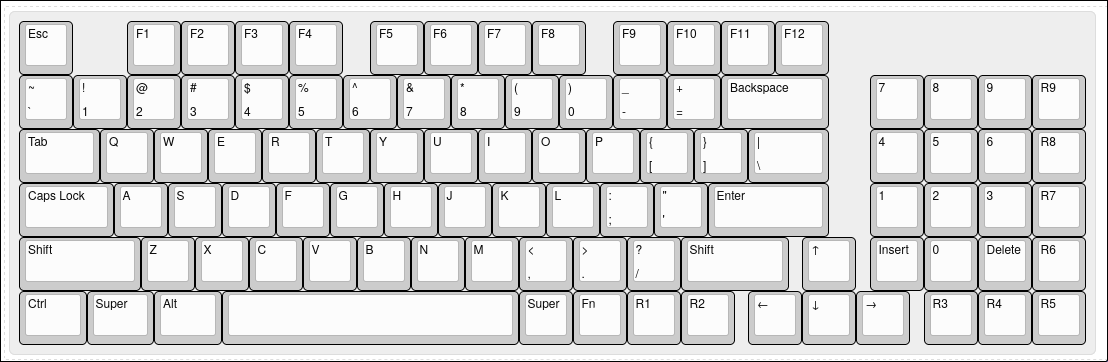
Today I did not have much time, so I decided to use a tool my friend suggested. I used Keyboard Layout Editor to create a better mockup of the keyboard, which can apparently be imported into KiCad. This took about 30 minutes.
Today I decided to start working on the PCB. Using KiCad as suggested, I made this
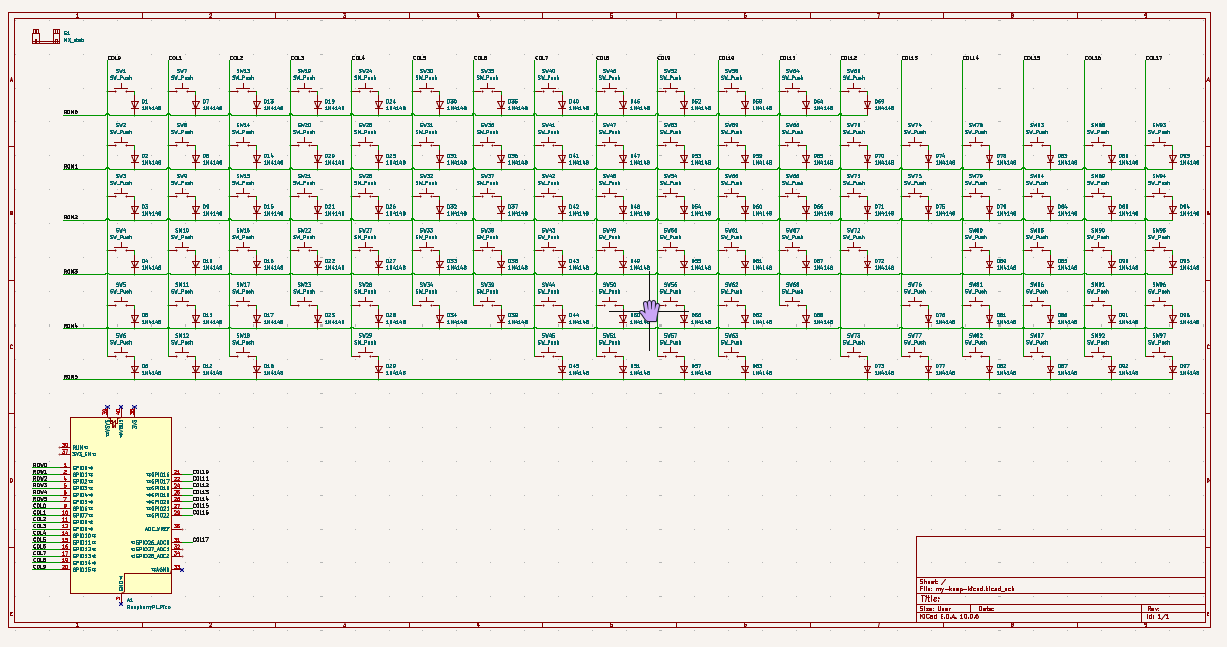 I have not yet added stabilizers other than the placeholder one in the corner, but this is the rough layout so far. This took around 1h.
I still do want to add the OLED, but I am not sure yet how to add it into the KiCad schematic
| Qty | Value | Footprint | References |
|---|---|---|---|
| 97 | 1N4148 | Diode_THT:D_DO-35_SOD27_P7.62mm_Horizontal | D1, D2, D10, D11, D12, D13, D14, D15, D16, D17, D18, D19, D20, D21, D22, D23 +81 |
| 92 | SW_Push | Button_Switch_Keyboard:SW_Cherry_MX_1.00u_PCB | SW1, SW2, SW10, SW11, SW12, SW13, SW14, SW15, SW16, SW17, SW18, SW19, SW20, SW21, SW22, SW23 +76 |
| 2 | SW_Push | Button_Switch_Keyboard:SW_Cherry_MX_2.25u_PCB | SW61, SW77 |
| 2 | SW_Push | Button_Switch_Keyboard:SW_Cherry_MX_2.00u_PCB | SW28, SW54 |
| 1 | RaspberryPi_Pico | Module:RaspberryPi_Pico_Common_Unspecified | A1 |
| 1 | SW_Push | Button_Switch_Keyboard:SW_Cherry_MX_6.25u_PCB | SW95 |
jpconstantineau/ErgoTravel
A Portable Ergonomic Split Keyboard inspired from the ErgoDox, Let's Split and Minidox


ericrlau/SP56
Bluetooth low engery keyboard. Layout based on Sofle keyboard with some modifications. NRF52840 powered. Designed around Kaihl Choc switches and spacing.

PubInv/krake
The Krake™ is a Wi-Fi–enabled server using an MQTT broker, which means it can be controlled remotely by other devices ("clients") via the internet.


EchelonForce/noise_pcb
A PCB design for a Eurorack module based on the Noise2 chip

It measures 385 × 140 mm and has 2 copper layers, 1.6 mm thick.
195 parts. The full list of its parts is on this page, with links to each part's symbol and footprint where PCBKit's library has them.
From the NyxInTime/my-keeb repository on GitHub, at the commit this page was made from: the board is my-keep-kicad/my-keep-kicad.kicad_pcb and its schematic my-keep-kicad/_restore_backup_2026-09-28T17-25-00-325/my-keep-kicad.kicad_sch. PCBKit opens the board in the browser, with nothing to install.
Its repository states no licence, so its author keeps all rights: ask NyxInTime before reusing the design.