
2 layers50 × 35 mm
 Neofoxx/SWD_Isolator
An isolator for SWD programming. Useful for UART, I2C and others as well
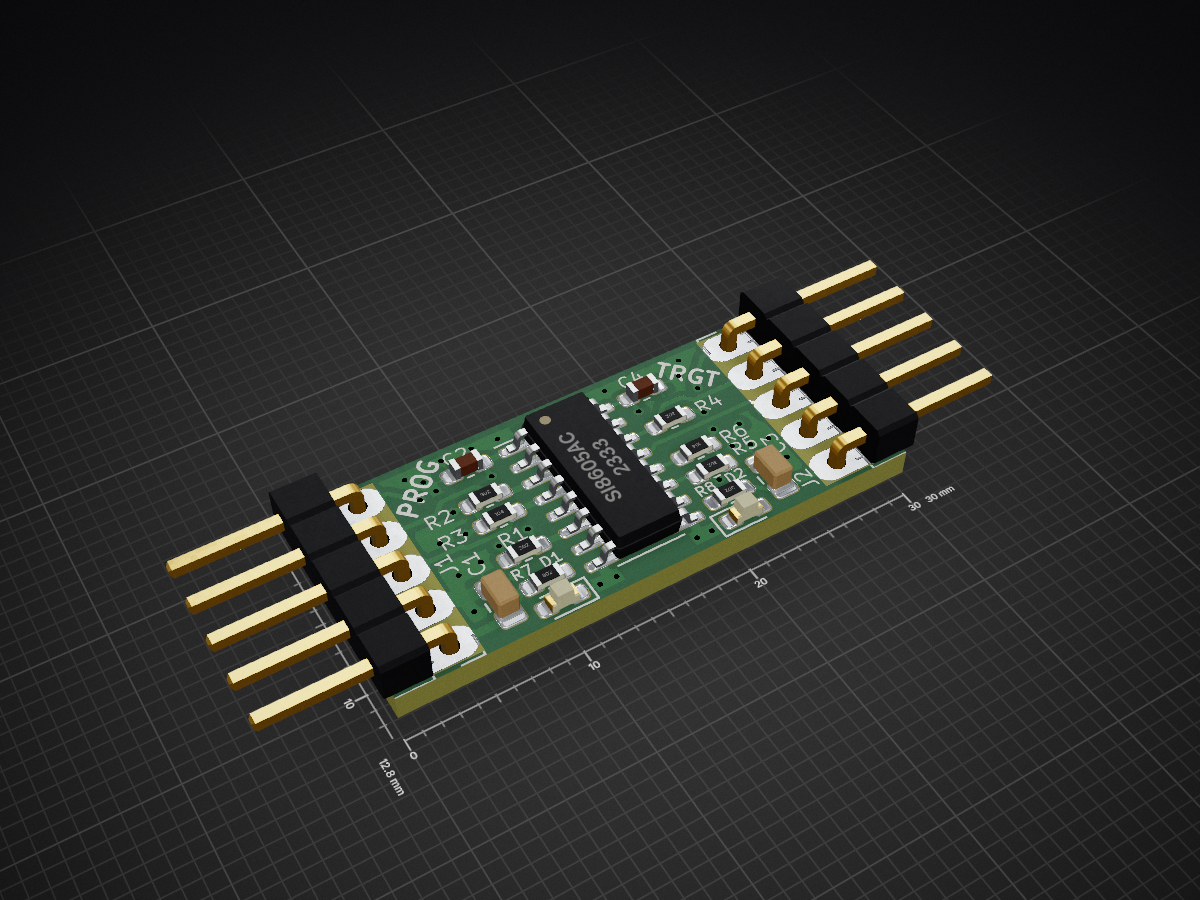
SWD Isolator is an open-source printed circuit board by Neofoxx, from the Neofoxx/SWD_Isolator repository on GitHub. It is a 2-layer board of 30 × 12.8 mm with 17 parts on 13 nets, routed with 137 tracks and 34 vias.
It is built around the SI8605AC-AS1. Its parts include 8 resistors, 4 capacitors, 2 diodes, 2 connectors and 1 IC. It belongs with the interfaces and adapters boards of this library.
Generic isolator for SWD, I2C, UART, ...
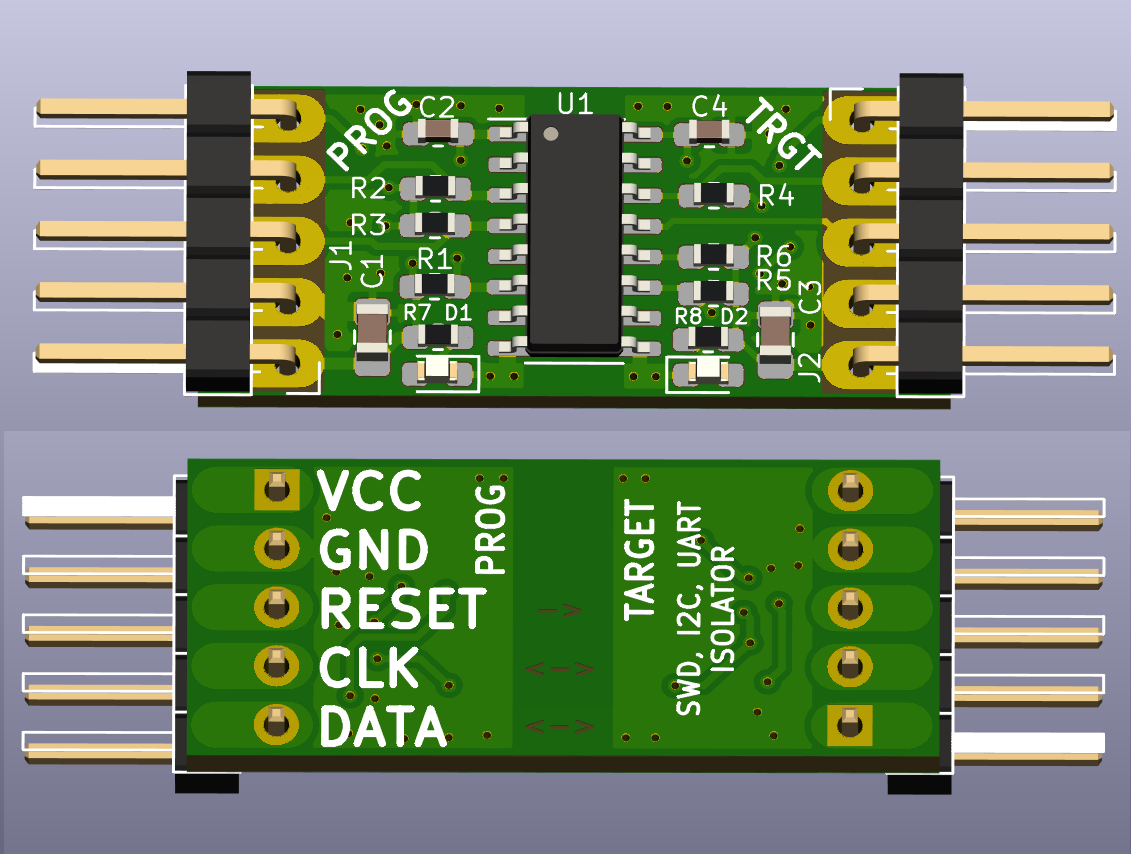
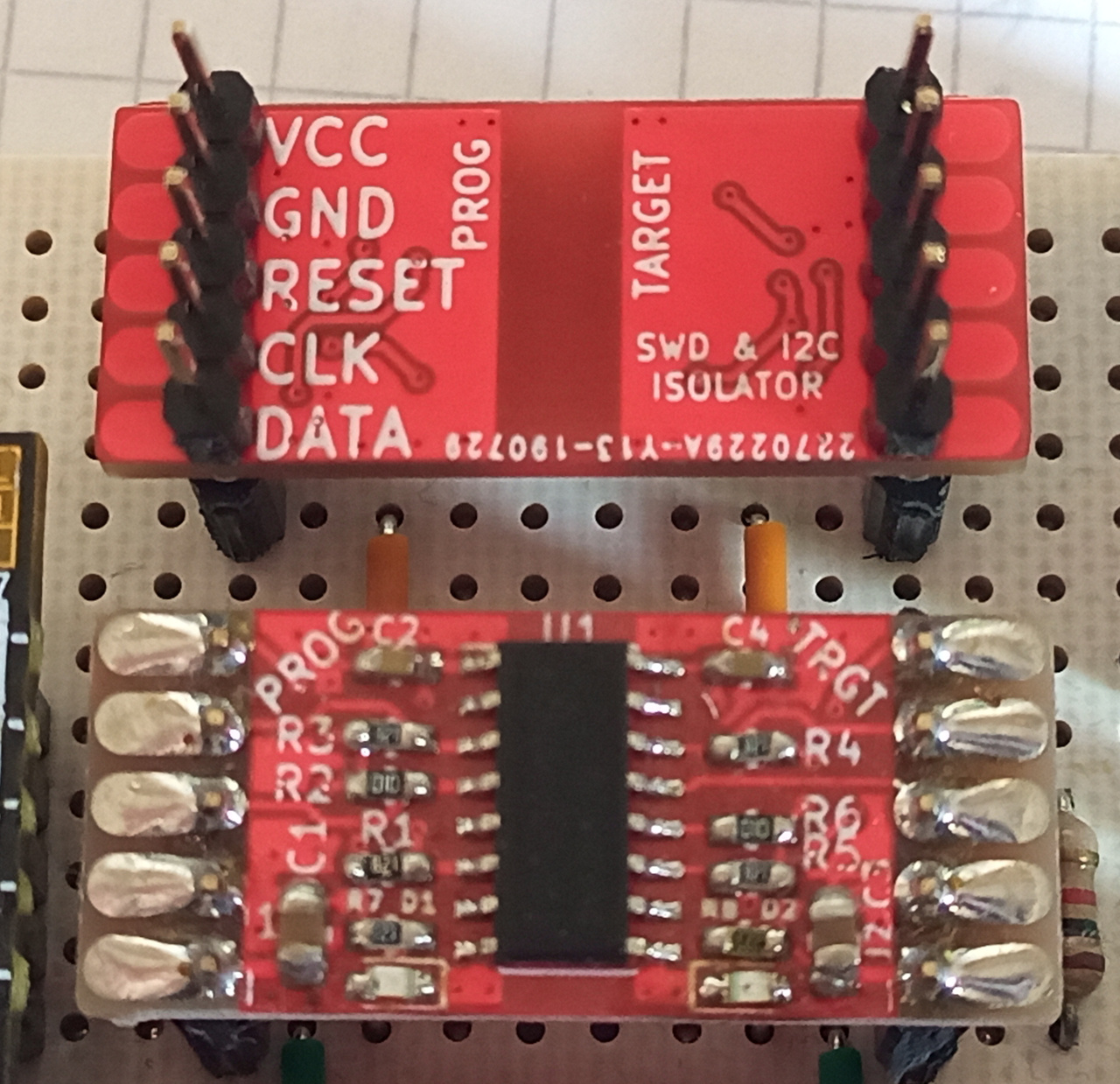
This is a quick'n'dirty isolator, that was used for SWD programming & I2C comms, with PSoC microcontrollers. It solves a very "sparky" situation, of connecting a mains earthed computer, to a device that does not have an earth (PE) connection. Because devices without a PE connections can be elevated by 1/2 mains voltage (so 115V in 230V systems), there is a real chance of zapping devices that get connected to it. This adapter solves that particular issue.
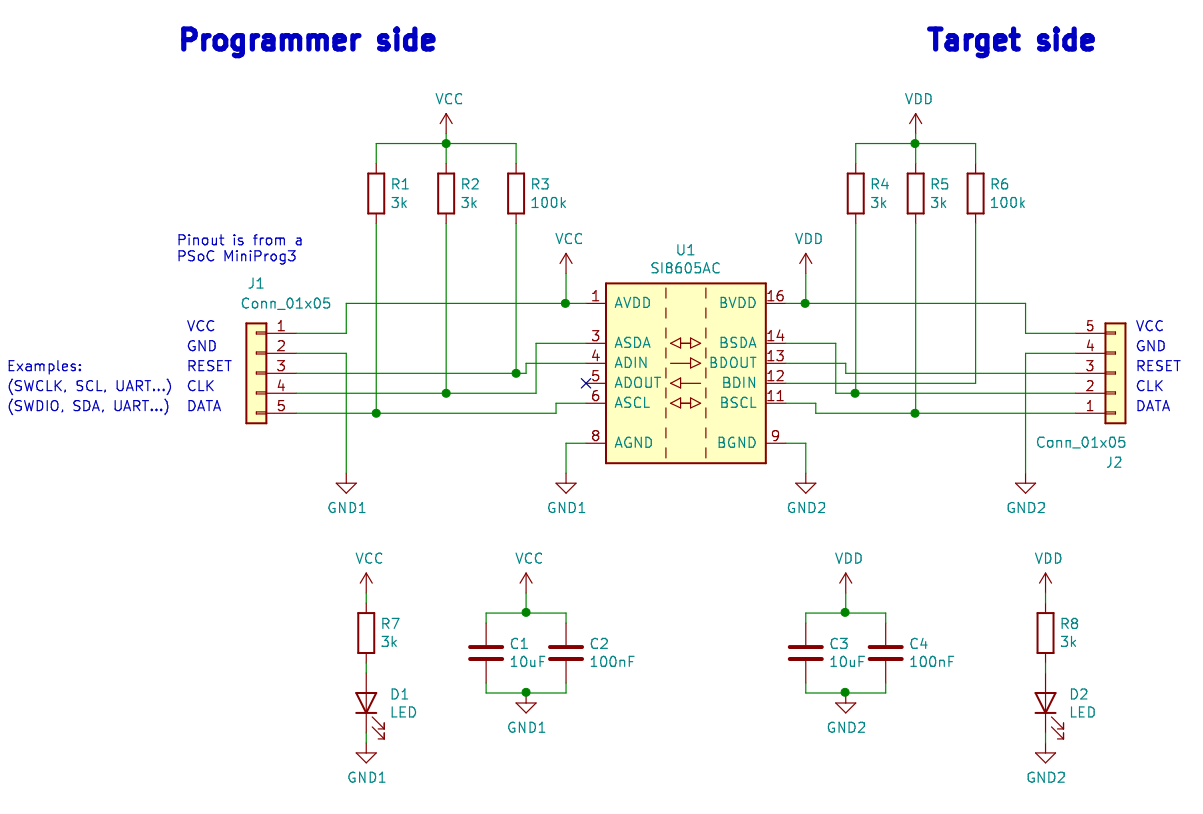
The chip has 2x open-drain bidirectional pins, making it suitable for a range of protocols. SWD, I2C and UART have all been tested. There are also two unidirectional pins (one to each side), but only one is used (as RESET) in programming.
The schematic calls for 3k resistors on bi-directional lines. In practice 820R resistors were used without issues, with good rising edges & high (couple of MHz) frequencies
The headers are aligned to a 0.1" grid - 0.9" from pin to pin. Headers can be soldered straight-through, or can be laid flat and soldered onto the exposed traces, making for a nice in-between module.
| Qty | Value | Footprint | References |
|---|---|---|---|
| 6 | 3k | Resistor_SMD:R_0603_1608Metric_Pad1.05x0.95mm_HandSolder | R1, R2, R4, R5, R7, R8 |
| 2 | 100k | Resistor_SMD:R_0603_1608Metric_Pad1.05x0.95mm_HandSolder | R3, R6 |
| 2 | 100nF | Capacitor_SMD:C_0603_1608Metric_Pad1.05x0.95mm_HandSolder | C2, C4 |
| 2 | 10uF | Capacitor_SMD:C_0805_2012Metric_Pad1.15x1.40mm_HandSolder | C1, C3 |
| 2 | Conn_01x05 | Connector_PinHeader_2.54mm:PinHeader_1x05_P2.54mm_Horizontal | J1, J2 |
| 2 | LED | LED_SMD:LED_0603_1608Metric_Pad1.05x0.95mm_HandSolder | D1, D2 |
| 1 | SI8605AC | Package_SO:SOIC-16_3.9x9.9mm_P1.27mm | U1 |


hoglet67/RGBtoHDMI
Bare-metal Raspberry Pi project that provides pixel-perfect sampling of Retro Computer RGB/YUV video and conversion to HDMI


hackclub/OnBoard
💡 Join 1,000 teenagers and make your first PCB with a $100 grant!

DDeGonge/OS-ARM
This arm is not industrial and it will not be fast, but that is not my goal. But it will hopefully be a very nice looking arm fully capable of 6dof motion, cheap enough to keep it accessable but capable enough to…


It measures 30 × 12.8 mm and has 2 copper layers, 1.6 mm thick.
17 parts, built around the SI8605AC-AS1. The full list of its parts is on this page, with links to each part's symbol and footprint where PCBKit's library has them.
From the Neofoxx/SWD_Isolator repository on GitHub, at the commit this page was made from: the board is HW/SWD_Isolator.kicad_pcb. PCBKit opens the board in the browser, with nothing to install.
Its repository states no licence, so its author keeps all rights: ask Neofoxx before reusing the design.