2 layers
Nrf bga
github-linguist/linguist
Language Savant. If your repository's language is being reported incorrectly, send us a pull request!
12 parts14kMIT
 Merliss/Self-Balancing-Robot
Self balancing robot on esp32 platform.
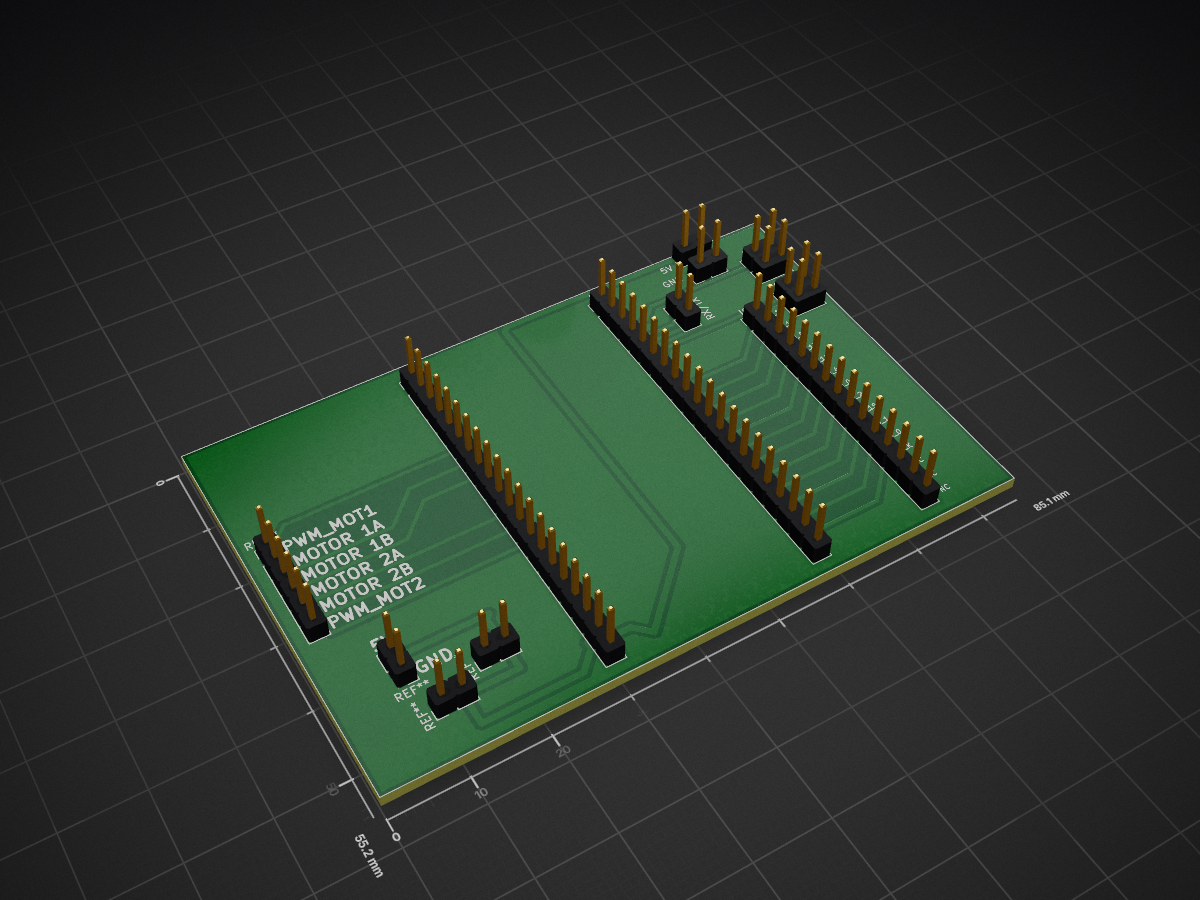
Plytka robot is an open-source printed circuit board by Merliss, from the Merliss/Self-Balancing-Robot repository on GitHub. It is a 2-layer board of 85.1 × 55.2 mm with 12 parts on 2 nets, routed with 112 tracks and 0 vias.
It belongs with the robots and motor control boards of this library.
Self balancing robot on esp32 platform.
For the project a balancing mobile robot was constructed and programmed. Balancing is
carried out parallel to the trajectory. As part of the research, simulations were carried out
in Matlab and Simulink software. In addition, theoretical issues related to the inverted
pendulum balancing problem were presented. A PID controller was implemented in the
microcontroller. The control algorithm is based on data taken from the gyroscope and
accelerometer. In addition, the control of the robot via a smartphone application using
Bluetooth communication was realized.
For the project there was created a pcb schema but not produced becasue lack of time. PCB was made in KiCad.
| Qty | Value | Footprint | References |
|---|---|---|---|
| 3 | PinHeader_1x02_P2.54mm_Vertical | Connector_PinHeader_2.54mm:PinHeader_1x02_P2.54mm_Vertical | 5V, GND, RX/TX |
| 2 | PinHeader_1x20_P2.54mm_Vertical | Connector_PinHeader_2.54mm:PinHeader_1x20_P2.54mm_Vertical | L, R |
| 2 | PinHeader_2x02_P2.54mm_Vertical | Connector_PinHeader_2.54mm:PinHeader_2x02_P2.54mm_Vertical | SCL, SDA |
| 1 | PinHeader_1x15_P2.54mm_Vertical | Connector_PinHeader_2.54mm:PinHeader_1x15_P2.54mm_Vertical | IO |
The 8 most common of 12 parts.
github-linguist/linguist
Language Savant. If your repository's language is being reported incorrectly, send us a pull request!


google/mozc-devices
Circuit diagrams and firmware source code for Gboard DIY keyboards


hackclub/OnBoard
💡 Join 1,000 teenagers and make your first PCB with a $100 grant!

VoronDesign/Voron-Tap
Tap is a nozzle-based z-probe for the V2 and Trident printer designs. The entire toolhead moves to trigger an optical switch. Tap offers many advantages:

stacksmashing/pico-tpmsniffer
A simple, very experimental TPM sniffer for LPC bus
It measures 85.1 × 55.2 mm and has 2 copper layers, 1.6 mm thick.
12 parts. The full list of its parts is on this page, with links to each part's symbol and footprint where PCBKit's library has them.
From the Merliss/Self-Balancing-Robot repository on GitHub, at the commit this page was made from: the board is PCB/Plytka_robot.kicad_pcb and its schematic PCB/Plytka_robot.kicad_sch. PCBKit opens the board in the browser, with nothing to install.
Its repository states no licence, so its author keeps all rights: ask Merliss before reusing the design.