

2 layers100 × 100 mm
COPIE 0
AssaadMH/shadow-4wd-motor-shield-pcb
The 24-signal interface board that replaces SHADOW's perfboard wiring — and the two pin conflicts that only appeared on re-checking the spec.
154 parts2MIT
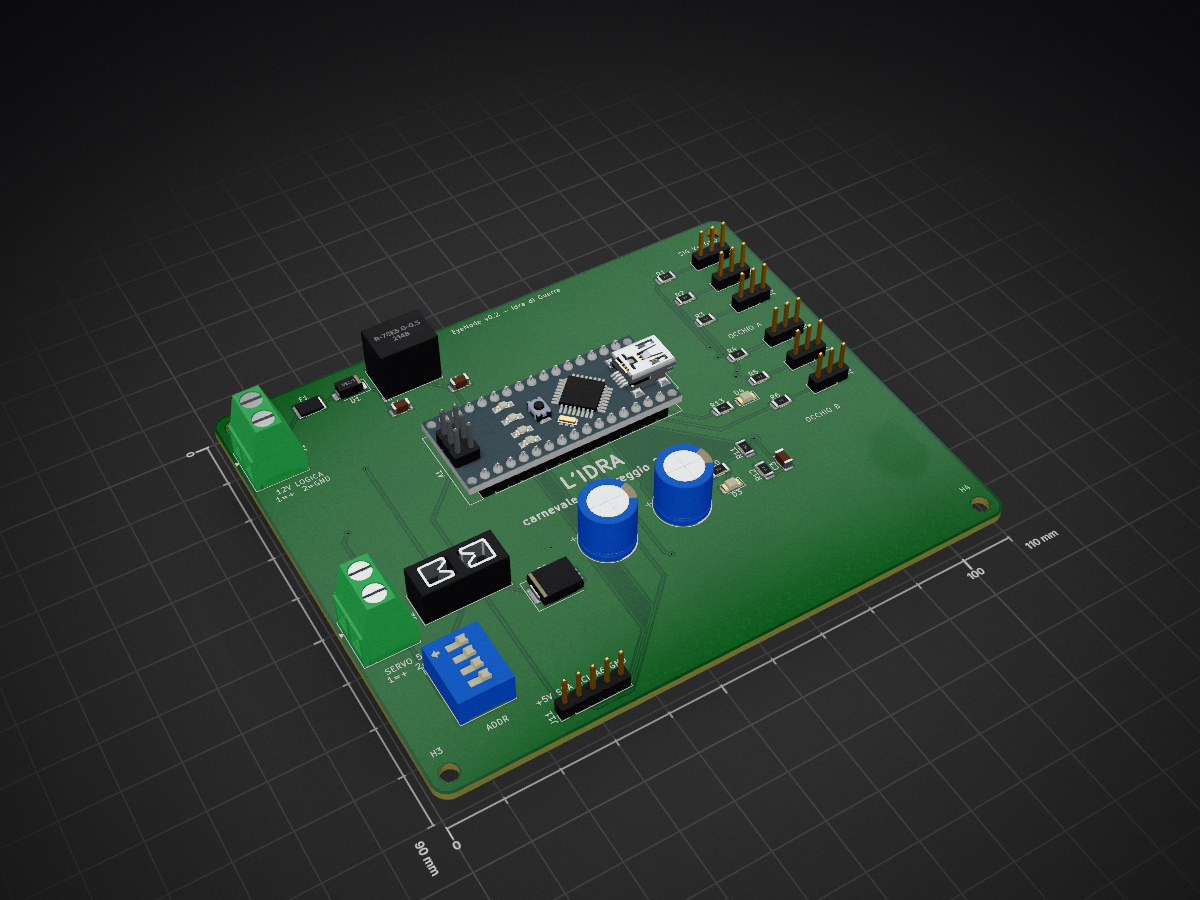
 MenchiniDev/Idra2027
Elettronica e meccanica per il carro "Idra di Guerra" — Carnevale di Viareggio.
EyeNode is an open-source printed circuit board by MenchiniDev, from the MenchiniDev/Idra2027 repository on GitHub. It is a 2-layer board of 110 × 90 mm with 37 parts on 42 nets, routed with 225 tracks and 11 vias.
It is built around the R-78E5.0-0.5 and SS34. Its parts include 10 resistors, 9 connectors, 5 capacitors, 4 diodes and 2 fuses.
Elettronica e meccanica per il carro "Idra di Guerra" — Carnevale di Viareggio.
docs/                  requisiti, budget energetico, cablaggio
hardware/kicad/        progetto KiCad (schematico + PCB)
hardware/datasheets/   datasheet componenti
mechanical/eyes/       original/ = 2 modelli di partenza, eyemech_D85/ = occhi in uso, idra_version/ = versione in scala di Will
mechanical/legs/       pezzi delle gambe
mechanical/enclosures/ chassis per l'elettronica
mechanical/scripts/    script di generazione/scalatura dei modelli
firmware/ codice delle schede EyeNode (movimento casuale autonomo)Il bulbo va ingrandito a diametro ≥ 50 mm, ma la sede del servo resta in scala 1:1 (i servomotori sono fissi e non cambiano dimensione).
| Qty | Value | Footprint | References |
|---|---|---|---|
| 6 | 220 | Resistor_SMD:R_1206_3216Metric | R1, R2, R3, R4, R5, R6 |
| 4 | M3 | MountingHole:MountingHole_3.2mm_M3 | H1, H2, H3, H4 |
| 2 | 1000uF 10V | Capacitor_THT:CP_Radial_D10.0mm_P5.00mm | C1, C2 |
| 2 | 10k | Resistor_SMD:R_1206_3216Metric | R11, R12 |
| 2 | 1k | Resistor_SMD:R_1206_3216Metric | R10, R13 |
| 1 | 0.5A | Fuse:Fuse_1812_4532Metric | F1 |
| 1 | 100nF | Capacitor_SMD:C_1206_3216Metric | C3 |
| 1 | 10uF 16V | Capacitor_SMD:C_1206_3216Metric | C5 |
| 1 | 10uF 50V | Capacitor_SMD:C_1206_3216Metric | C4 |
| 1 | 12V IN logica | TerminalBlock_Phoenix:TerminalBlock_Phoenix_MKDS-1,5-2-5.08_1x02_P5.08mm_Horizontal | J1 |
| 1 | 5-6V IN servo | TerminalBlock_Phoenix:TerminalBlock_Phoenix_MKDS-1,5-2-5.08_1x02_P5.08mm_Horizontal | J2 |
| 1 | 7.5A blade | Fuse:Fuseholder_Blade_Mini_Keystone_3568 | F2 |
| 1 | ADDR | Button_Switch_THT:SW_DIP_SPSTx04_Slide_9.78x12.34mm_W7.62mm_P2.54mm | SW1 |
| 1 | AUX I2C/A6 | Connector_PinHeader_2.54mm:PinHeader_1x05_P2.54mm_Vertical | J11 |
| 1 | Arduino Nano v3 | Module:Arduino_Nano | A1 |
| 1 | R-78E5.0-0.5 | Converter_DCDC:Converter_DCDC_RECOM_R-78E-0.5_THT | U1 |
| 1 | SERVO A_LID | Connector_PinHeader_2.54mm:PinHeader_1x03_P2.54mm_Vertical | J5 |
| 1 | SERVO A_LR | Connector_PinHeader_2.54mm:PinHeader_1x03_P2.54mm_Vertical | J3 |
| 1 | SERVO A_UD | Connector_PinHeader_2.54mm:PinHeader_1x03_P2.54mm_Vertical | J4 |
| 1 | SERVO B_LID | Connector_PinHeader_2.54mm:PinHeader_1x03_P2.54mm_Vertical | J8 |
| 1 | SERVO B_LR | Connector_PinHeader_2.54mm:PinHeader_1x03_P2.54mm_Vertical | J6 |
| 1 | SERVO B_UD | Connector_PinHeader_2.54mm:PinHeader_1x03_P2.54mm_Vertical | J7 |
| 1 | SS34 | Diode_SMD:D_SMA | D1 |
| 1 | SS54 (crowbar inv. pol.) | Diode_SMD:D_SMC | D2 |
| 1 | blu STATO | LED_SMD:LED_1206_3216Metric | D4 |
| 1 | verde VSERVO | LED_SMD:LED_1206_3216Metric | D3 |
AssaadMH/shadow-4wd-motor-shield-pcb
The 24-signal interface board that replaces SHADOW's perfboard wiring — and the two pin conflicts that only appeared on re-checking the spec.

dhruxraj/stm32-can-ecu
A compact, "ECU-style" CAN node for learning and prototyping automotive-type embedded software. It has an STM32G4 MCU, a CAN transceiver with protection and switchable termination, a 6-axis IMU, a protected 8-18 V…

cepr/daly-to-lithium-balance-adapter
Replacement traction battery for a 2018 Energica Ego. The original Lithium Balance s-BMS master (BMCU) stays in the bike.


ohmtech-rdi/eurorack-blocks
Software to Hardware Prototyping for Eurorack using C++, Max/Gen~ or Faust

cvonk/OPNpool
Integrates the functionality of a Pentair pool controller into the smart home using ESP32 SoC.

Edging-Machines/Edging-Machines
This repository is intended to contain as much information as possible about building, designing, prototyping, and using automated edging machines.
It measures 110 × 90 mm and has 2 copper layers, 1.6 mm thick.
37 parts, built around the R-78E5.0-0.5 and SS34. The full list of its parts is on this page, with links to each part's symbol and footprint where PCBKit's library has them.
From the MenchiniDev/Idra2027 repository on GitHub, at the commit this page was made from: the board is hardware/kicad/EyeNode/EyeNode.kicad_pcb and its schematic hardware/kicad/EyeNode/EyeNode.kicad_sch. PCBKit opens the board in the browser, with nothing to install.
Its repository states no licence, so its author keeps all rights: ask MenchiniDev before reusing the design.