2 layers142.5 × 106.4 mm

 MasterSpoon/IS31FL3743x_Breakout_Board1
Breakout board for IS31FL3743A & IS31FL3743A LED drivers
IS31FL3743x Breakout is an open-source printed circuit board by MasterSpoon, from the MasterSpoon/IS31FL3743x_Breakout_Board repository on GitHub, published under the GPL-3.0 licence. It is a 2-layer board of 21.3 × 46.8 mm with 34 parts on 56 nets, routed with 420 tracks and 9 vias.
Its parts include 21 resistors, 4 capacitors, 2 connectors and 1 IC. It belongs with the interfaces and adapters boards of this library.
At present I have the PCB made and have them sitting on my desk but have not yet been able to test them. As far as I'm aware they should be fully functional but use them as your own risk. There is no warranty supplied or implied.
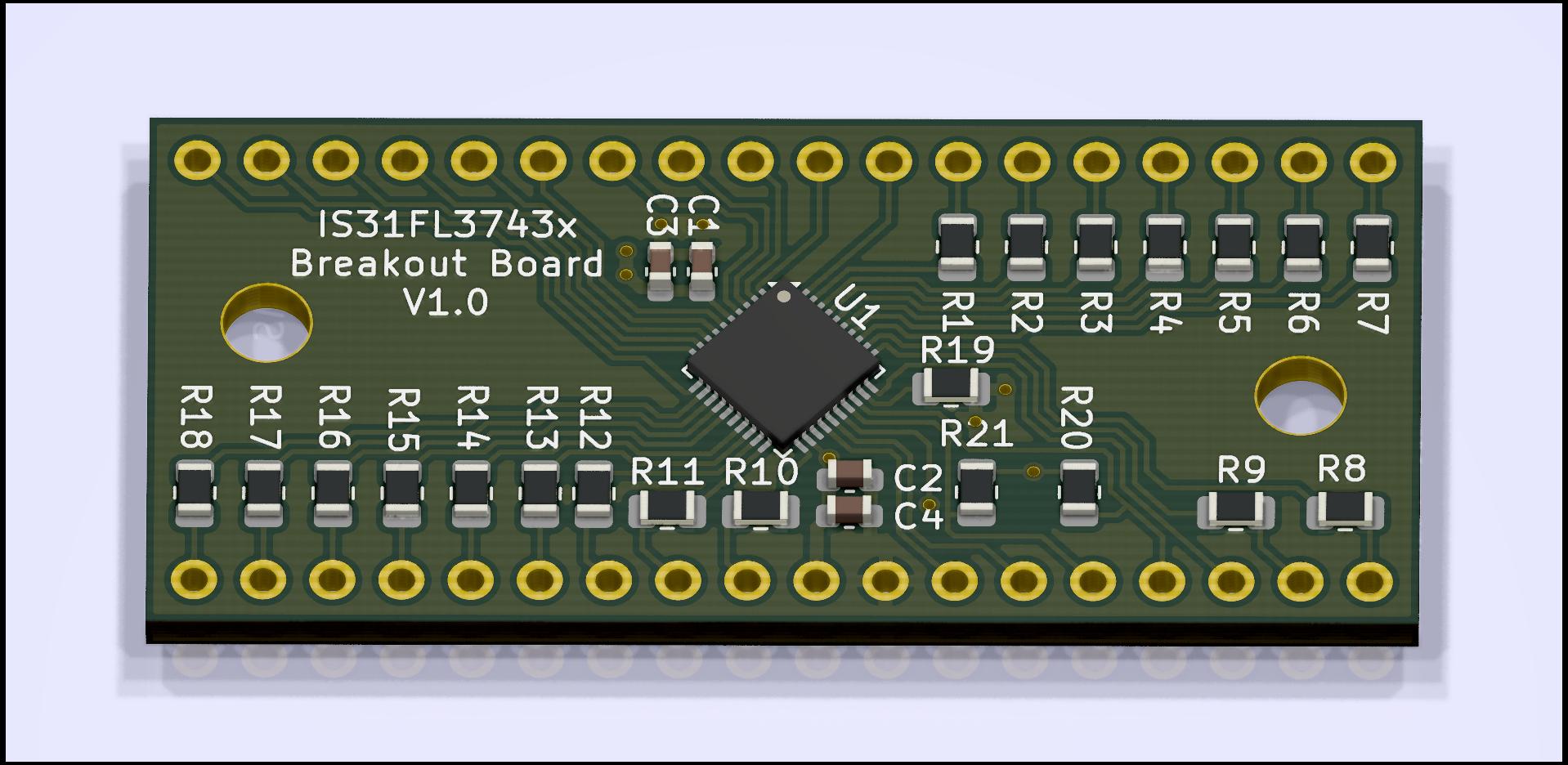
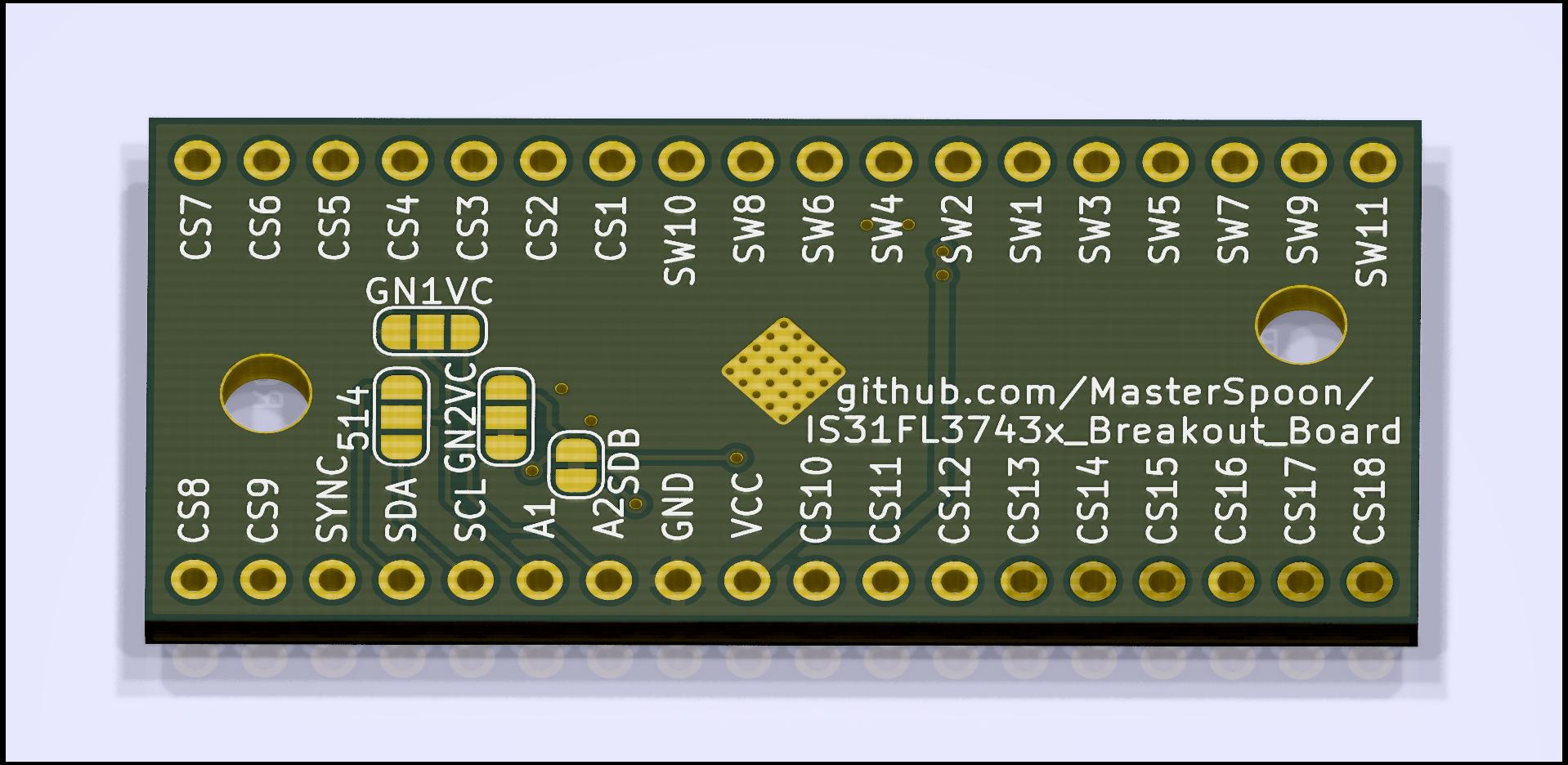
This ia a Dev board for the LUMISSIL Microsystems IS31FL3743A & IS31FL3743B LED drivers with the main difference being the A variant is I2C-1MHz and the B variant SPI-12MHz.
The are both 18 x 11 matrix drivers capable of supporting up to 198 LEDs / 66 RGB LEDs. With an average current on each LED of 3.03mA they are suitable for SMD LEDs. Eg. Foshan NationStar Optoelectronics FM-B2020RGBA-HG
| Part | Package | Location | Notes |
|---|---|---|---|
| ISSI Driver | UQFN-40(5x5) | U1 | IS31FL3743A or IS31FL3743B |
| 100nF Capacitor | 0603 | C1 & C2 | LED driver Capacitors |
| 1uF Capacitor | 0603 | C3 & C4 | LED driver Capacitors |
| 20ohm Resistor | 0805 | R1-R18 | Series Resistors for CS1-CS18 respectively |
| 10K Resistor | 0805 | R19 | ISET Resistor |
| 2K Resistor | 0805 | R20 & R21 | I2C pull up Resistors |
| Silkscreen | Function |
|---|---|
| SDA | MOSI |
| SCL | SCK |
| A1 | CS |
| A2 | MISO |
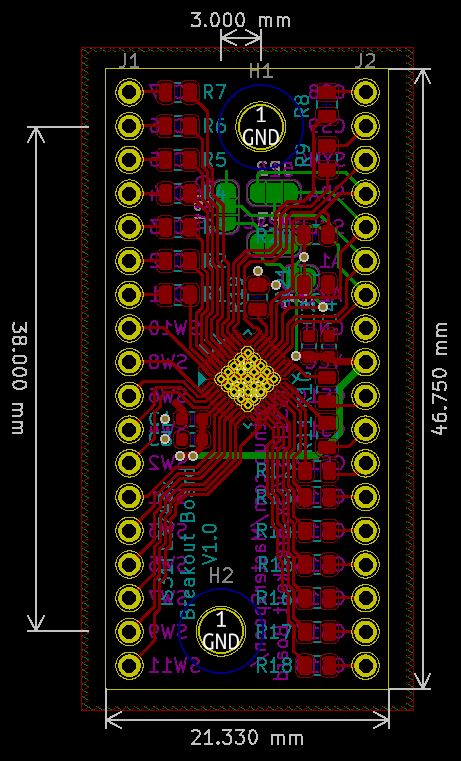
The board has been designed to be compatible with a standard 2.54mm breadboard. It has two rows of 18x2.54mm pins spaced 7x2.54mm (17.78mm) apart. There are two M3 mounting holes spaced 38mm apart but with a 3mm offset due to limited space. Both holes are equally 19mm from board centre however the top hole near the solder jumpers is 1mm to the right with the bottom hole 2mm to the left.
| Qty | Value | Footprint | References |
|---|---|---|---|
| 18 | 20R | Resistor_SMD:R_0805_2012Metric | R1, R2, R3, R4, R5, R6, R7, R10, R11, R12, R13, R14, R15, R16, R17, R18 +2 |
| 2 | 100nF | Capacitor_SMD:C_0603_1608Metric | C1, C2 |
| 2 | 1uF | Capacitor_SMD:C_0603_1608Metric | C3, C4 |
| 2 | 2K | Resistor_SMD:R_0805_2012Metric | R20, R21 |
| 2 | Conn_01x18 | is31fl3743:PinHeader_1x18_P2.54mm_Vertical | J1, J2 |
| 2 | MountingHole_Pad | is31fl3743:MountingHole_3.2mm_M3 | H1, H2 |
| 2 | SolderJumper_3_Bridged12 | is31fl3743:SolderJumper-3_P1.3mm_Bridged12_RoundedPad1.0x1.5mm | JP1, JP3 |
| 1 | 10K | Resistor_SMD:R_0805_2012Metric | R19 |
| 1 | IS31FL3743x | is31fl3743:QFN-40-IS31FL3743A_extended | U1 |
| 1 | SolderJumper_2_Bridged | Jumper:SolderJumper-2_P1.3mm_Bridged_RoundedPad1.0x1.5mm | JP5 |
| 1 | SolderJumper_3_Open | is31fl3743:SolderJumper-3_P1.3mm_Open_RoundedPad1.0x1.5mm | JP2 |

FrameworkComputer/ExpansionCards
Reference designs and documentation to create Expansion Cards for the Framework Laptop

mntmn/amiga2000-gfxcard
MNT VA2000, an Open Source Amiga 2/3/4000 Graphics Card (Zorro II/III), written in Verilog

hackclub/OnBoard
💡 Join 1,000 teenagers and make your first PCB with a $100 grant!


strangeparts/niubi-headphones
Flexible circuit board design for adding a headphone jack to an iPhone 7


baldengineer/bit-preserve
Project for capturing vintage, classic, aka old computer schematics in KiCad.
It measures 21.3 × 46.8 mm and has 2 copper layers, 1.6 mm thick.
34 parts. The full list of its parts is on this page, with links to each part's symbol and footprint where PCBKit's library has them.
From the MasterSpoon/IS31FL3743x_Breakout_Board repository on GitHub, at the commit this page was made from: the board is PCB/IS31FL3743x_Breakout.kicad_pcb. PCBKit opens the board in the browser, with nothing to install.
Its repository publishes it under the GPL-3.0 licence: you may reuse it on that licence's terms (keep the author's notice, and for a copyleft licence share your changes alike).