2 layers50 × 30 mm
LM317 Regulator
JulioCesar-ai/KiCad-autorouter-plugin
Enrutador automático de una sola capa como complemento en KiCad
15 partsGPL-3.0

 JulioCesar-ai/KiCad-autorouter-plugin
Enrutador automático de una sola capa como complemento en KiCad
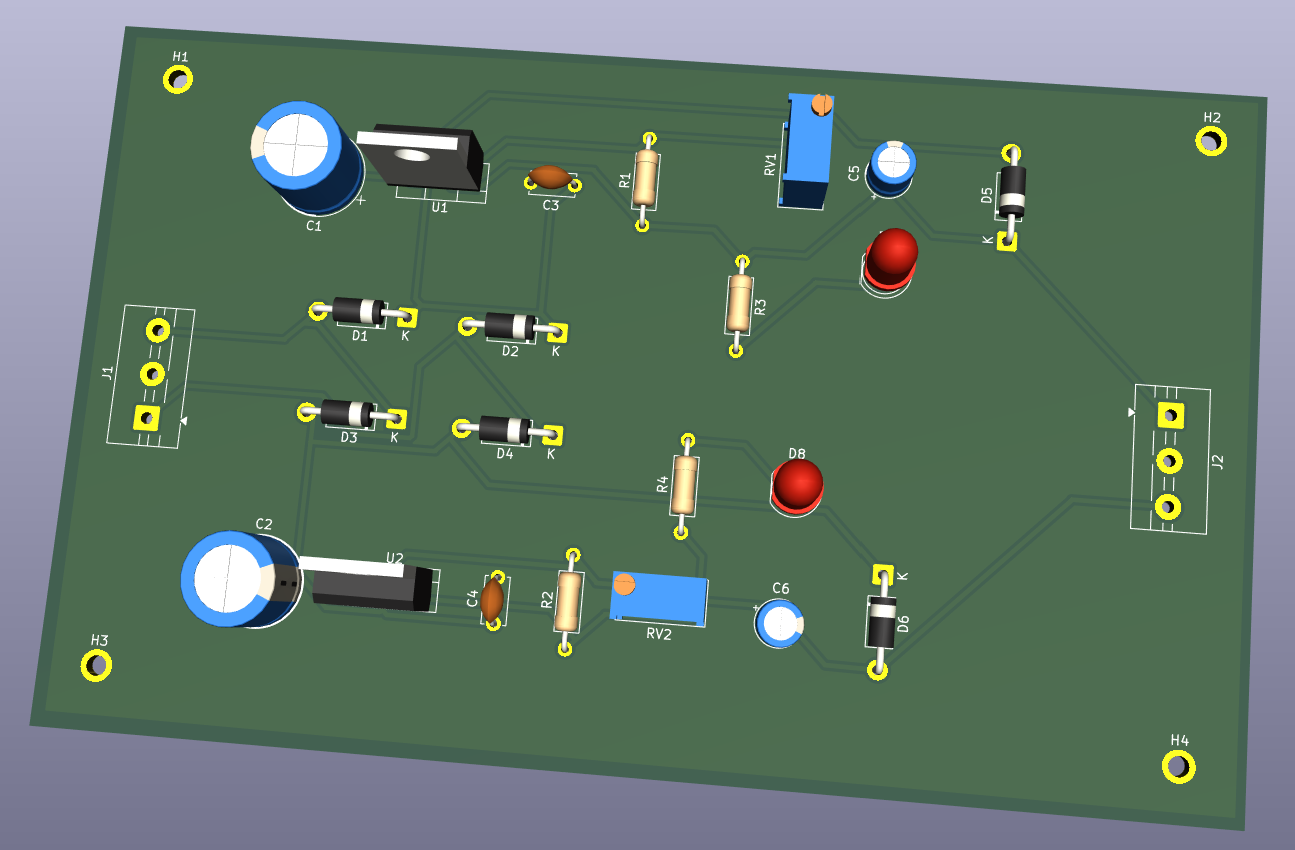
FuenteAlimentacionDual is an open-source printed circuit board by JulioCesar-ai, from the JulioCesar-ai/KiCad-autorouter-plugin repository on GitHub, published under the GPL-3.0 licence. It is a 2-layer board of 130.5 × 80 mm with 28 parts on 11 nets.
Its parts include 8 diodes, 6 capacitors, 4 resistors, 2 ICs and 2 connectors.
Single-layer autorouter for KiCad 10: A* pathfinding with a genetic algorithm for net ordering. Pure Python, no external dependencies.
It runs as a KiCad 10 Action Plugin or from the command line.
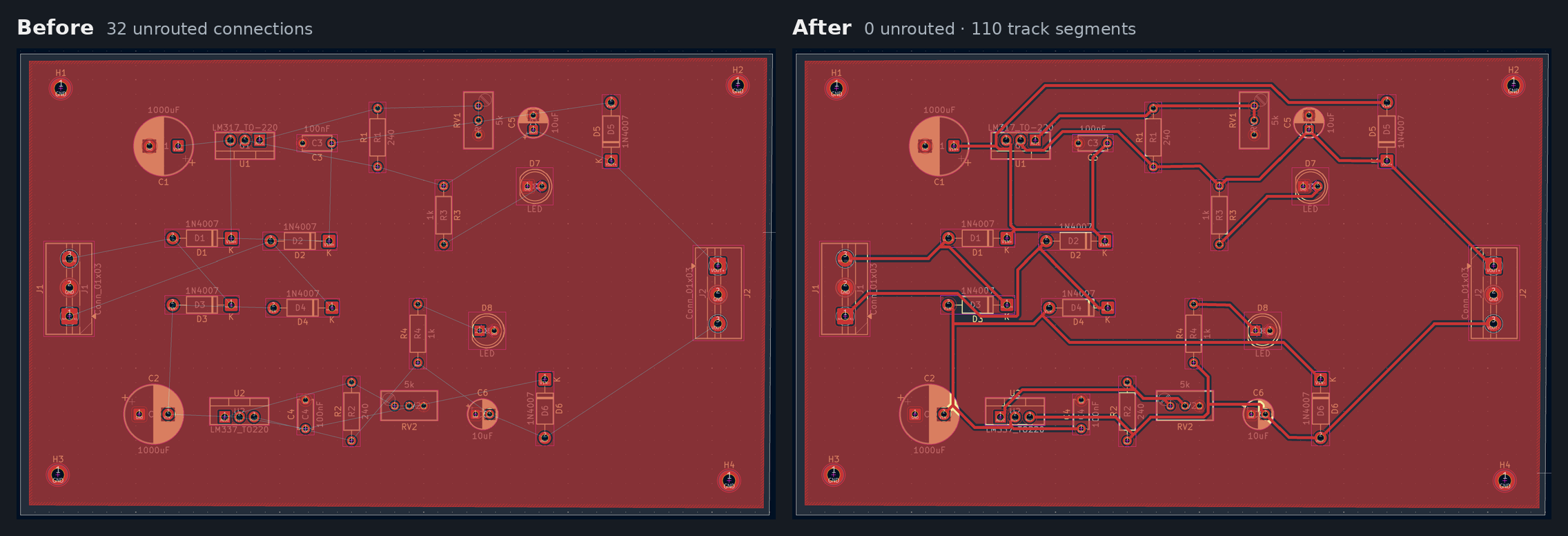
It routes the tracks of a single-layer (F.Cu) PCB using two algorithms:
Nets covered by a copper zone (typically GND) are treated as connected through the pour and are not routed with individual tracks.
Please read this before trying it on your board:
--ancho = width, --paso = grid step, etc.). The tables below translate them.If it fails on your board, please open an issue and attach the .kicad_pcb file. That's exactly the feedback I'm looking for.
The repository includes example boards in PCBs Taller KiCad/:
FuenteAlimentacionDual/: dual adjustable power supply (LM317/LM337), 28 components, already placed. Open it in KiCad and route it directly.pcb_test_01.kicad_pcb/: hands-on exercise from the validation workshop. The schematic is complete but the board is intentionally empty: update the PCB from the schematic, place the components, then run the autorouter. Includes custom design rules for the VCC net.| Component | Version |
|---|---|
| KiCad | 10.0 |
| Python (as a plugin) | KiCad 10's embedded interpreter (3.11 in the version used for development) |
| Python (command line and installer) | Any recent Python 3 |
| Operating system | Tested on Windows. macOS and Linux untested |
| Dependencies | Python standard library only. The GUI uses wxPython, which ships with KiCad; you only need to install it separately to test the GUI outside KiCad |
git clone https://github.com/JulioCesar-ai/KiCad-autorouter-plugin.git
cd KiCad-autorouter-plugin
Or use the green Code → Download ZIP button on GitHub and extract it.
python instalar_plugin.pyThe installer detects KiCad 10's plugin folder automatically for your operating system. Other options:
# Show what would be installed, without copying anything
python instalar_plugin.py --ver

# Use a specific plugin folder instead of the detected one
python instalar_plugin.py --ruta "/path/to/scripting/plugins"

# Uninstall
python desinstalar_plugin.py

# Uninstall without confirmation
python desinstalar_plugin.py --forzar
Auto-detection tries the usual scripting/plugins locations for KiCad 10 on the detected OS, in order, and uses the first one that exists (or the first one with content, if several exist). If none exists, it creates the first one in the list and tells you which path it chose.
Documents\KiCad\10.0\scripting\plugins (or the same path under OneDrive).asistente_pcb_KiCad inside it.plugin_kicad/ (the files, not the folder itself)lector_pcb.py, enrutador_astar.py, optimizador_genetico.py, escritor_pcb.py and analisis_zona.py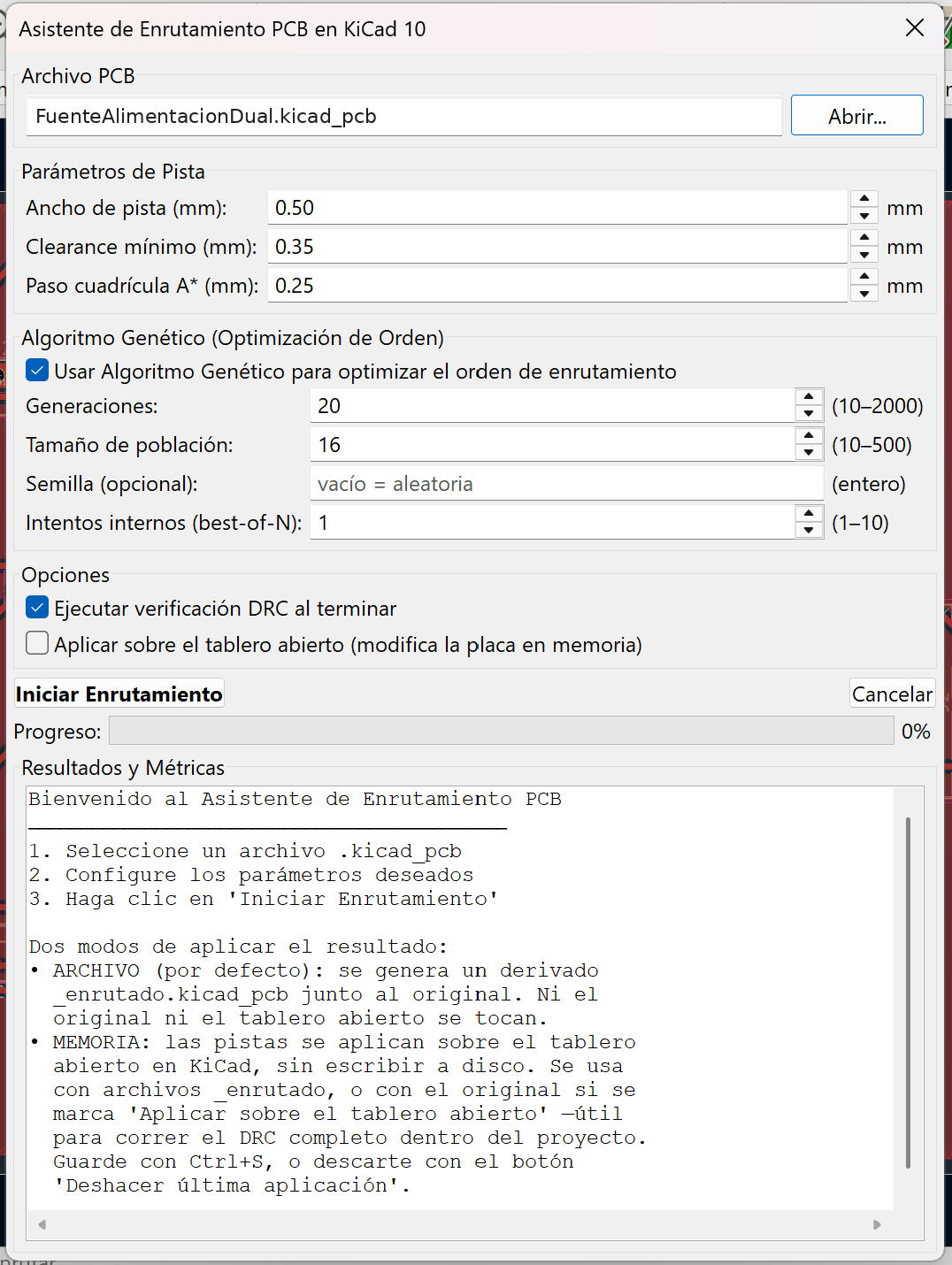
The plugin has two ways of applying the result:
<name>_enrutado.kicad_pcb to disk without touching the open board. This is the default when the selected file is not the one open in KiCad.*_enrutado.kicad_pcb), or you can check "Aplicar sobre el tablero abierto" (apply to the open board) to work directly on the original. It includes a "Deshacer" (undo) button that removes only the tracks the plugin added, without touching tracks you routed by hand.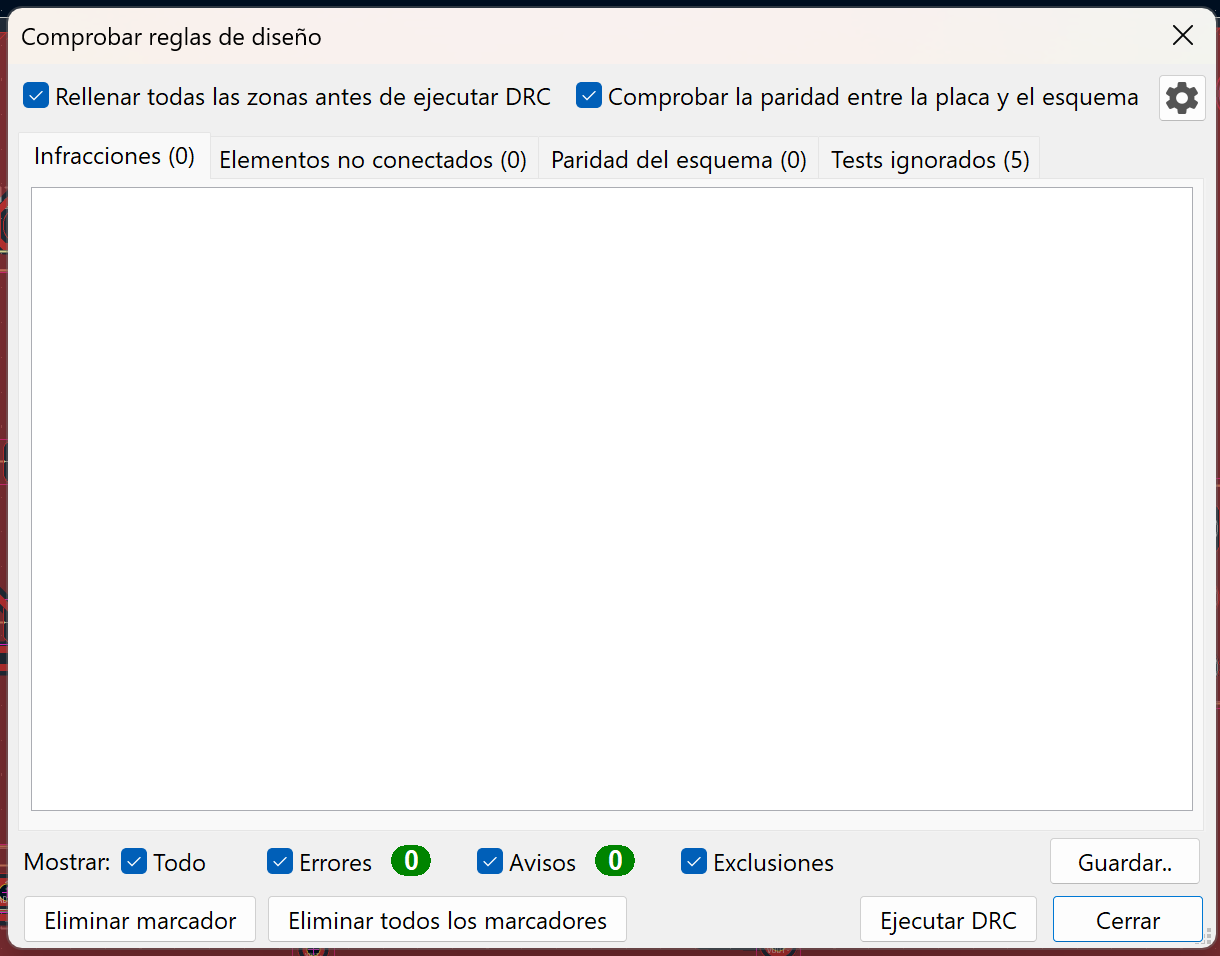
# Route a board with default parameters (MPS order + A*; the GA is enabled
# with --orden ag. The plugin GUI, on the other hand, enables it by default)
python escritor_pcb.py casos_prueba/mi_pcb.kicad_pcb

# Custom track width and clearance
python escritor_pcb.py my_board.kicad_pcb --ancho 0.25 --clearance 0.15

# More GA generations for better optimization
python escritor_pcb.py my_board.kicad_pcb --orden ag --generaciones 200 --poblacion 80

# Best-of-N: run the full routing 3 times and apply only the best result
python escritor_pcb.py my_board.kicad_pcb --intentos 3

# All options
python escritor_pcb.py --help
By default, the output file is always <name>_enrutado.kicad_pcb and it is overwritten on each run, so files don't pile up while you iterate on parameters. --con-timestamp adds the date and time to the name instead (mi_pcb_enrutado_20260510_143022.kicad_pcb); --salida <path> sets an explicit output path.
| Parameter | CLI | Default | Description |
|---|---|---|---|
| Track width | --ancho | 0.3 mm | Width of routed tracks |
| Per-net width | --ancho-red | — | Width for a specific net, e.g. --ancho-red "GND=1.0" (repeatable) |
| Nominal clearance | --clearance | 0.2 mm | Minimum copper-to-copper spacing |
| Minimum manufacturable clearance | --clearance-minimo | 0.127 mm | Floor used when retrying with reduced clearance; never goes below this |
| Grid step | --paso | 0.25 mm | A* grid resolution |
| Routing order | --orden | mps | distancia (distance) | mps | ag (genetic algorithm): what decides the connection order. The plugin GUI uses the GA by default; the CLI uses MPS unless --orden ag is given |
| GA fitness | --fitness | surrogate | surrogate (coarse A*, accurate) | aproximada (progressive occlusion, fast). Only with --orden ag |
| Surrogate grid step | --paso-surrogate | 0.5 mm | Grid resolution for the surrogate fitness |
| GA generations | --generaciones | 40 | GA iterations |
| GA population | --poblacion | 24 | Individuals per generation |
| Attempts (best-of-N) | --intentos / --repeticiones | 1 | Runs the full routing N times with different seeds and applies only the best |
| Seed | --semilla | Random | Fixes the GA seed to reproduce a run |
| No GA | --sin-ag | — | (Compatibility) Same as --orden mps |
| No DRC | --sin-drc | — | Disable the built-in basic DRC check |
| Output | --salida | — | Explicit output file path |
| With timestamp | --con-timestamp | — | Add date/time to the output name instead of overwriting |
enrutador_astar.py)Grid: configurable step (0.25 mm by default)
Movement: 8 directions (H, V, 45°)
Heuristic: octile h(n) = max(|Δx|,|Δy|) + (√2-1)·min(|Δx|,|Δy|)
Obstacles: pads + previously routed tracks + clearance
Turns: configurable penalty (COSTO_GIRO = 2.0)Includes bounded rip-up and reroute: a connection that fails, or that routes with a pathological detour (≥3.0× the direct distance), can trigger a full reroute of its net, within a limited attempt budget.
optimizador_genetico.py)Individual: permutation of connection indices
Fitness: sequential and order-dependent: surrogate (real coarse A*)
or approximate (progressive occlusion), never a sum that
ignores the order in which connections are routed
Selection: tournament (k=3)
Crossover: Order Crossover (OX)
Mutation: swap of two positions (prob = 0.15)
Elitism: the best individual passes directly
Seeding: the initial population includes the MPS and distance ordersanalisis_zona.py)Nets with a zone (typically GND) are not routed with tracks; they are assumed to be connected through the pour. But the pour only connects them if it stays in one piece: the other nets' tracks, with their clearance, can split it into isolated regions. This module rasterizes the board and counts connected components of the copper that would be filled, to detect that fragmentation without depending on pcbnew. It runs the same way in the headless CLI and inside the plugin, and it is used as a selection criterion in best-of-N.
escritor_pcb.py)PCB file
│
├─→ lector_pcb.leer_pcb()
│ └─→ DatosPCB (pads, nets, copper zones, bounds)
│
├─→ obtener_conexiones_a_enrutar() [MST per net, excludes nets with a zone]
│
├─→ optimizar_orden_enrutamiento() [GA, if --orden ag]
│ └─→ optimally ordered connections
│
├─→ enrutar_todos() [A* per connection, with rip-up and reroute]
│ └─→ list of segments {x1,y1,x2,y2,net,width}
│
├─→ analizar_fragmentacion_zona() [per attempt, if there are zones]
│
├─→ drc_basico() [basic DRC check]
│
└─→ escribir_pcb_enrutado() → <name>_enrutado.kicad_pcbWith --intentos N > 1, this whole flow runs N times with different seeds and only the best result is applied or written, using a strictly lexicographic criterion: failed connections → incomplete nets → pour fragments → reduced clearance → pathological routes → length. Length is deliberately last, so a run with open nets can never beat a complete one just by being shorter.
Rules applied when writing the file:
(net "GND"), without a numeric ID(layer "F.Cu")(uuid "xxxxxxxx-...")KiCad-autorouter-plugin/
├── lector_pcb.py — .kicad_pcb parser (KiCad 10)
├── enrutador_astar.py — A* in pure Python, configurable grid
├── optimizador_genetico.py — Genetic algorithm, OX crossover, swap mutation
├── analisis_zona.py — Detects whether tracks split the ground pour (e.g. GND),
│ pure Python, no pcbnew dependency
├── escritor_pcb.py — Main orchestrator + output writing
├── instalar_plugin.py — Installs the plugin into KiCad 10
├── desinstalar_plugin.py — Uninstalls the plugin
├── requirements.txt — Dependencies (Python stdlib only)
├── plugin_kicad/
│ ├── __init__.py — Plugin package init
│ ├── action_plugin.py — KiCad ActionPlugin (entry point)
│ ├── panel_asistente.py — wxPython GUI
│ └── icono_asistente_64.png — Plugin icon
├── casos_prueba/ — Unrouted test boards (KiCad 10)
└── PCBs Taller KiCad/ — Example boards from the validation workshoppython lector_pcb.py casos_prueba/mi_pcb.kicad_pcb # parser only
python optimizador_genetico.py # GA only
python enrutador_astar.py # A* only
python escritor_pcb.py casos_prueba/mi_pcb.kicad_pcb # full flow
# Pour fragmentation analysis (run escritor_pcb.py first to generate the routed file)
python analisis_zona.py casos_prueba/mi_pcb_enrutado.kicad_pcbExtra scripts in the project root, used during development and validation. They are not part of the plugin (the installer doesn't copy them).
Checking results
verificar_conectividad.py: checks that each net's pads are joined by the resulting copper.verificar_pads.py: checks that track endpoints land on the pads they should touch.verificar_enrutado.py: compares the routed file against the original.Genetic algorithm analysis
validar_surrogate.py: measures how faithful the fast fitness evaluator (surrogate) is compared to real routing.medir_sesgo_surrogate.py: quantifies the surrogate's deviation from real routing, permutation by permutation.test_regresion_aptitud.py: regression test for a bug found during development (a fitness that didn't depend on connection order).Inspection
analizar_angulos.py, analizar_rutas.py, ver_segmentos.py, comparar_final.py.Julio César Fuentes.
Technical reference: KiCadRoutingTools.
GPL-3.0. See LICENSE.
| Qty | Value | Footprint | References |
|---|---|---|---|
| 6 | 1N4007 | Diode_THT:D_DO-41_SOD81_P10.16mm_Horizontal | D1, D2, D3, D4, D5, D6 |
| 4 | MountingHole_2.2mm_M2_ISO7380_Pad | MountingHole:MountingHole_2.2mm_M2_ISO7380_Pad | H1, H2, H3, H4 |
| 2 | 1000uF | Capacitor_THT:CP_Radial_D10.0mm_P5.00mm | C1, C2 |
| 2 | 100nF | Capacitor_THT:C_Disc_D5.0mm_W2.5mm_P5.00mm | C3, C4 |
| 2 | 10uF | Capacitor_THT:CP_Radial_D5.0mm_P2.50mm | C5, C6 |
| 2 | 1k | Resistor_THT:R_Axial_DIN0207_L6.3mm_D2.5mm_P10.16mm_Horizontal | R3, R4 |
| 2 | 240 | Resistor_THT:R_Axial_DIN0207_L6.3mm_D2.5mm_P10.16mm_Horizontal | R1, R2 |
| 2 | 5k | Potentiometer_THT:Potentiometer_Bourns_3296W_Vertical | RV1, RV2 |
| 2 | Conn_01x03 | TerminalBlock:TerminalBlock_MaiXu_MX126-5.0-03P_1x03_P5.00mm | J1, J2 |
| 2 | LED | LED_THT:LED_D5.0mm | D7, D8 |
| 1 | LM317_TO-220 | Package_TO_SOT_THT:TO-220-3_Vertical | U1 |
| 1 | LM337_TO220 | Package_TO_SOT_THT:TO-220-3_Vertical | U2 |
JulioCesar-ai/KiCad-autorouter-plugin
Enrutador automático de una sola capa como complemento en KiCad

JulioCesar-ai/KiCad-autorouter-plugin
Enrutador automático de una sola capa como complemento en KiCad

JulioCesar-ai/KiCad-autorouter-plugin
Enrutador automático de una sola capa como complemento en KiCad

joeycastillo/Sensor-Watch
A board replacement for the classic Casio F-91W wristwatch

TalismanDesign/PocketMage_PDA
An E-Ink PDA device using the ESP32 S3.

rusefi/rusefi
rusefi - GPL internal combustion engine control unit

hackclub/OnBoard
💡 Join 1,000 teenagers and make your first PCB with a $100 grant!

asterics/esp32_mouse_keyboard
ESP32 implementation for HID over GATT Keyboard and Mouse (Bluetooth Low Energy). Including serial API for external modules (similar to Adafruit EZKey HID)


Luos-io/luos_engine
Open-source and real-time orchestrator for cyber-physical-systems, to easily design, test and deploy embedded applications and digital twins.

Chrismettal/EleLab_v2
Cheap DIY lab system for hobbyists and the tinkering folk
It measures 130.5 × 80 mm and has 2 copper layers, 1.6 mm thick.
28 parts. The full list of its parts is on this page, with links to each part's symbol and footprint where PCBKit's library has them.
From the JulioCesar-ai/KiCad-autorouter-plugin repository on GitHub, at the commit this page was made from: the board is PCBs Taller KiCad/FuenteAlimentacionDual/FuenteAlimentacionDual.kicad_pcb and its schematic PCBs Taller KiCad/FuenteAlimentacionDual/FuenteAlimentacionDual.kicad_sch. PCBKit opens the board in the browser, with nothing to install.
Its repository publishes it under the GPL-3.0 licence: you may reuse it on that licence's terms (keep the author's notice, and for a copyleft licence share your changes alike).