
2 layers56 × 65 mm
SeaTalk1
dotnet/iot
This repo includes .NET Core implementations for various IoT boards, chips, displays and PCBs.
24 parts2.4kMIT

 HMS-RIC/HMS-8-Valve-Driver
A circuit for driving up to 8 small valves.
HMS-8-Valve Driver is an open-source printed circuit board by HMS-RIC, from the HMS-RIC/HMS-8-Valve-Driver repository on GitHub, published under the MIT licence. It is a 2-layer board of 101.6 × 50.8 mm with 24 parts on 18 nets, routed with 132 tracks and 5 vias.
It is built around the ULQ2803A. Its parts include 14 connectors, 4 switches and 1 IC. It belongs with the audio and music boards of this library.
A circuit for driving up to 8 small valves.
The board takes 8 channels of digital inputs (3.3V or 5V) and can drive valves at up to 50V and 500mA. Inputs can be connected via BNC connectors (channels 1–4) or a 0.1" header (all 8 channels). Optional push buttons on channels 1–4 allow for manual valve activation (e.g., to flush or clean the valve lines).
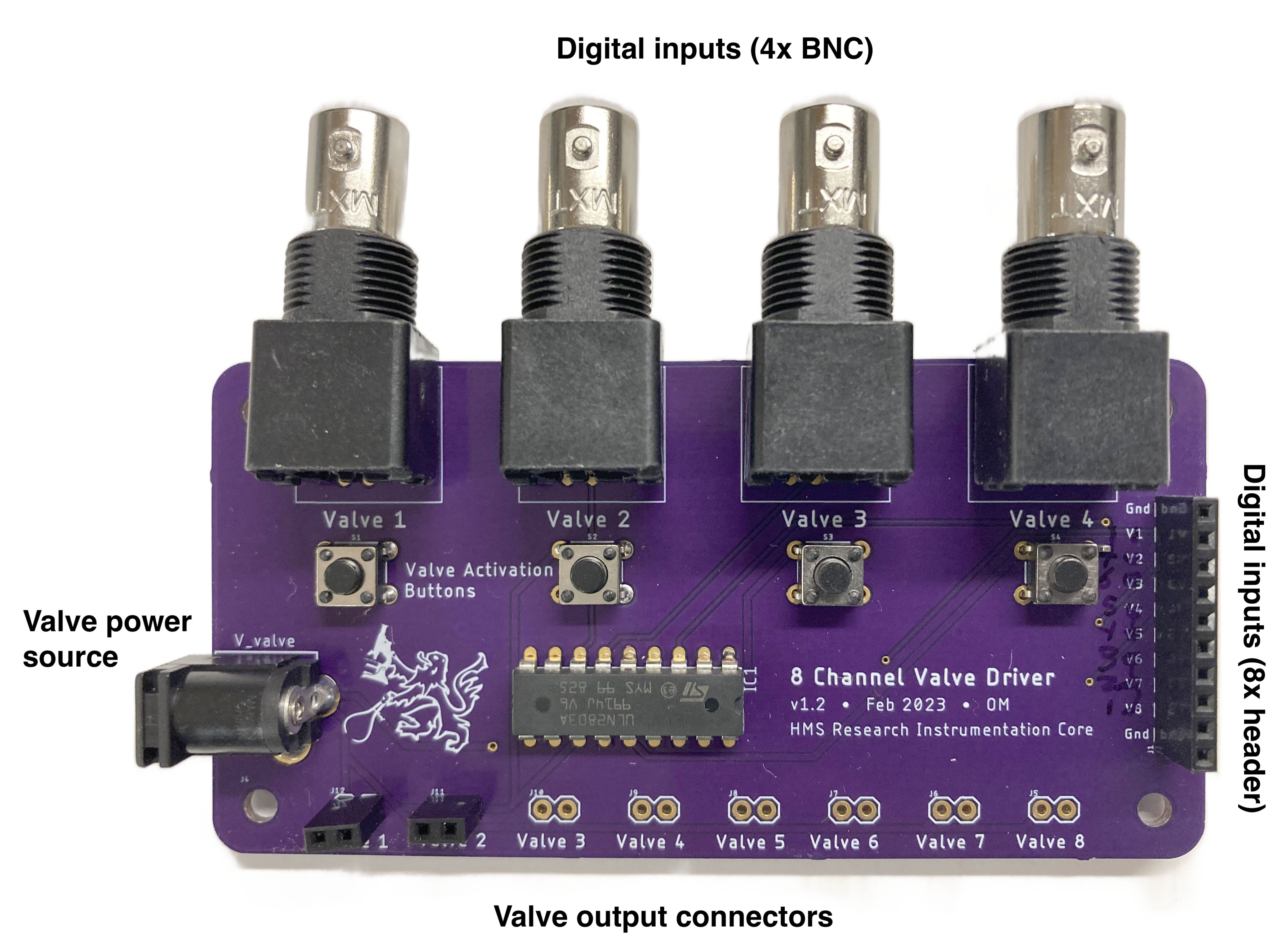
Order a batch of printed circuit boards (PCBs) using the provided Gerber files.
Order the components listed in the Bill of Materials, and solder them into the PCB as shown in the photo above.
Notes
You have several choices for the output connectors to the valves since the holes in the board have standard 0.1" spacing. Two options are shown in the images below:
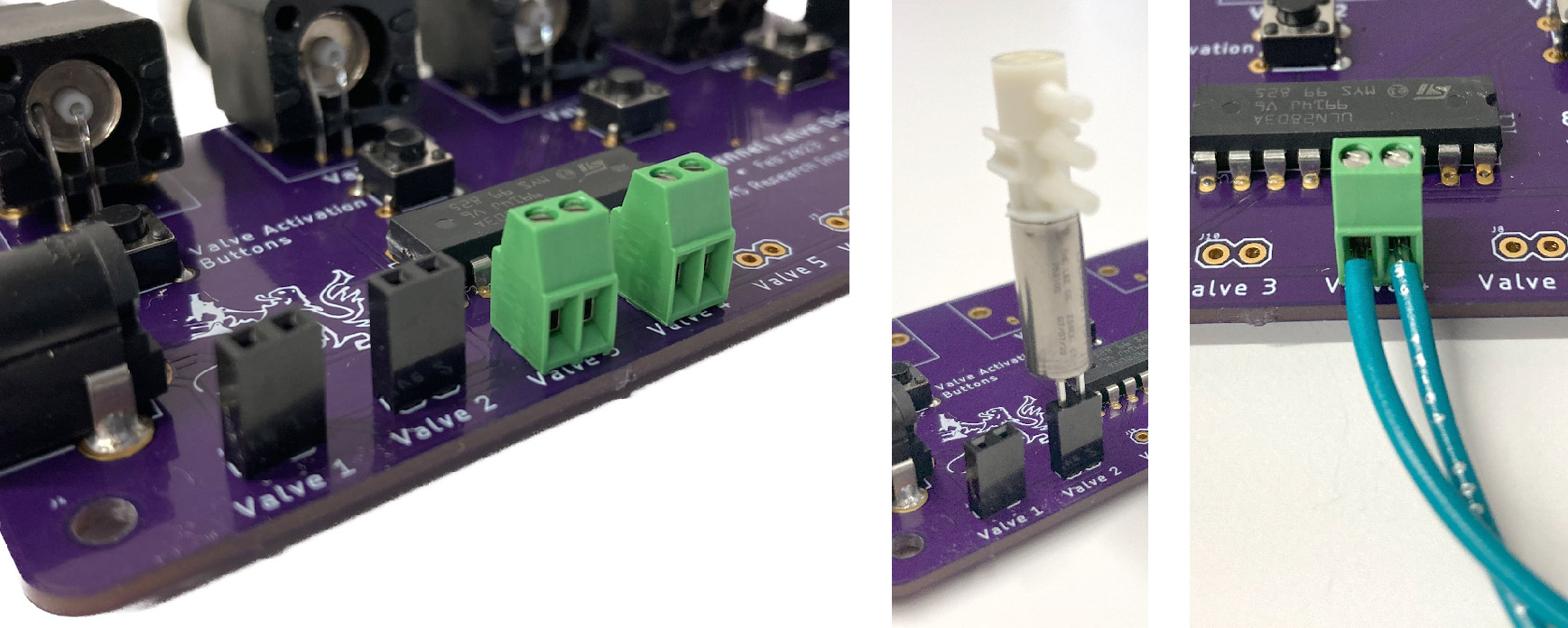
Plug in a "wall-wart" power supply with the correct voltage for your valves (likely 5V, 12V, or 24V). Make sure the power supply can provide enough current for all the valves you plan to use (or at least as many valves as might be on at once).
Connect valves to the output connectors. NOTE: Make sure the valves draw 500mA or less.
Provide digital signals to the valve input lines. These may be 3.3V or 5V signals, and might come from a device like an Arduino or a DAQ (data acquisition) board. Make sure that the valve driver and the signal generating device share a common ground connection, either through the BNC shield, or the GND pin on the input header. The circuit will energize the valves in response to a HIGH (3–5V) input signal.
If needed, you can also use the buttons to manually energize the valves.
| Qty | Value | Footprint | References |
|---|---|---|---|
| 4 | BNCPTH | HMS_8ValveDriver:BNC | J15, J16, J17, J18 |
| 4 | MOMENTARY-SWITCH-SPST-PTH-6.0MM | HMS_8ValveDriver:TACTILE_SWITCH_PTH_6.0MM | S1, S2, S3, S4 |
| 4 | STAND-OFF | HMS_8ValveDriver:STAND-OFF | H1, H2, H3, H4 |
| 1 | HMS_8ValveDriver:RIC_LOGO_BIG | U$7 | |
| 1 | CONN_10" | HMS_8ValveDriver:1X10 | J1 |
| 1 | POWER_JACK | HMS_8ValveDriver:POWER_JACK_PTH | J4 |
| 1 | ULQ2803A | HMS_8ValveDriver:DIL18 | IC1 |
| 1 | Valve 1 | HMS_8ValveDriver:1X02 | J12 |
| 1 | Valve 2 | HMS_8ValveDriver:1X02 | J11 |
| 1 | Valve 3 | HMS_8ValveDriver:1X02 | J10 |
| 1 | Valve 4 | HMS_8ValveDriver:1X02 | J9 |
| 1 | Valve 5 | HMS_8ValveDriver:1X02 | J8 |
| 1 | Valve 6 | HMS_8ValveDriver:1X02 | J7 |
| 1 | Valve 7 | HMS_8ValveDriver:1X02 | J6 |
| 1 | Valve 8 | HMS_8ValveDriver:1X02 | J5 |
dotnet/iot
This repo includes .NET Core implementations for various IoT boards, chips, displays and PCBs.

pascallanger/DIY-Multiprotocol-TX-Module
Multiprotocol TX Module (or MULTI-Module) is a 2.4GHz transmitter module which controls many different receivers and models.


rusefi/rusefi
rusefi - GPL internal combustion engine control unit

DraftShift/StealthChanger
Tool changing system for Vorons and other front mount printer motion systems, not just stealthburner.

VoronDesign/Voron-Hardware
Cool Hardware designed by the Voron Design group

hackclub/OnBoard
💡 Join 1,000 teenagers and make your first PCB with a $100 grant!

It measures 101.6 × 50.8 mm and has 2 copper layers, 1.6 mm thick.
24 parts, built around the ULQ2803A. The full list of its parts is on this page, with links to each part's symbol and footprint where PCBKit's library has them.
From the HMS-RIC/HMS-8-Valve-Driver repository on GitHub, at the commit this page was made from: the board is PCB-KiCad/HMS_8ValveDriver.kicad_pcb and its schematic PCB-KiCad/HMS_8ValveDriver.kicad_sch. PCBKit opens the board in the browser, with nothing to install.
Its repository publishes it under the MIT licence: you may reuse it on that licence's terms (keep the author's notice, and for a copyleft licence share your changes alike).