
2 layers140.5 × 30 mm
Type e
google/mozc-devices
Circuit diagrams and firmware source code for Gboard DIY keyboards
16 parts3kApache-2.0
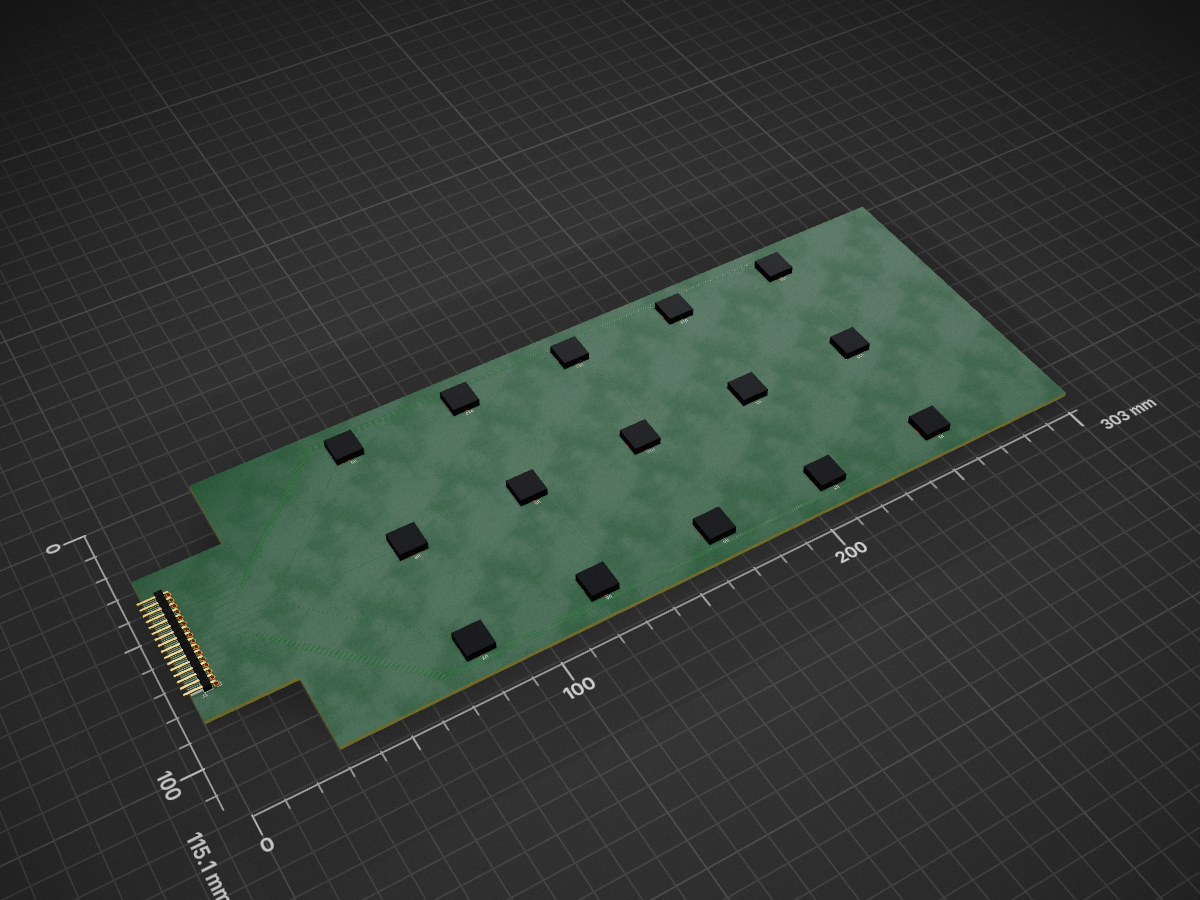
This repository contains the hardware documentation, embedded firmware, experimental-control software, CAD files, representative experimental protocols, and 3D reconstruction tools associated with the HEartLab…
TankPCB 1 is an open-source printed circuit board by HEartLab-ufabc, from the HEartLab-ufabc/HEartLab-Multimodal-Mapping repository on GitHub. It is a 2-layer board of 303 × 115.1 mm with 16 parts on 16 nets, routed with 62 tracks and 0 vias.
Its parts include 15 ICs and 1 connector.
A modular research platform for synchronized optical, contact-electrical, and torso-tank mapping of ex vivo perfused hearts.
Repository status: Active development. Documentation, design files, protocols, and software are being prepared for the first archived release accompanying the associated Scientific Reports manuscript.
This repository contains the hardware documentation, embedded firmware, experimental-control software, CAD files, representative experimental protocols, and 3D reconstruction tools associated with the HEartLab multimodal mapping platform for ex vivo cardiac electrophysiology.
The platform integrates complementary experimental modalities within a common workflow:
The system is modular rather than tied to one preparation. Perfusion interfaces, mechanical supports, electrode arrangements, optical geometry, and selected experimental procedures can be adapted according to preparation size, scientific objective, and available equipment.
Validated in Langendorff-perfused rabbit hearts. Depending on the experiment, the configuration supports:
Validated in porcine and human ex vivo hearts. Depending on the experiment, the configuration supports:
Developed for isolated perfused ventricular-wall preparations. Depending on the experiment, the configuration supports:
The configuration defines the available platform modules, while the scientific objective determines which modules and protocols are used in a particular experiment.
HEartLab is organized around interoperable experimental modules:
HEartLab-Multimodal-Mapping/
├── README.md
├── DISCLAIMER.md
│
├── cad/
│   ├── README.md
│   ├── small_heart/
│   ├── large-heart/
│   └── epi-endo/
│
├── docs/
│   ├── getting_started.md
│   └── protocols/
│
├── firmware/
│   ├── sensors/
│   ├── gateway/
│   ├── stepper_motor_control/
│   └── synchronization_controller/
│
├── hardware/
│   ├── README.md
│   ├── BOM_overview.md
│ ├── perfusion/A high-level setup and validation workflow is provided in:
A typical workflow is:
The platform does not require every subsystem to be used in every experiment.
Representative experimental procedures are provided in:
These documents describe examples of HEartLab implementations rather than universal mandatory procedures. Parameters can vary according to preparation type, species or donor source, heart size, mapping modality, scientific objective, equipment, pharmacological intervention, stimulation protocol, and the applicable approved experimental protocol.
Users are responsible for confirming that concentrations, calculations, settings, and procedures are appropriate for their own experimental implementation.
Custom mechanical designs are provided in:
The CAD library is organized according to the configuration in which the components were developed:
Depending on the component, files include Autodesk Inventor (.ipt), Autodesk Fusion (.f3d / .f3z), STEP/STP, STL, and PDF drawings.
The repository focuses on custom fabricated components. Commercial motors, bearings, pulleys, shafts, fasteners, clamps, and similar off-the-shelf parts are described in the relevant documentation rather than redistributed as proprietary CAD models.
Hardware documentation is located in:
Subsystem documentation includes:
hardware/perfusion/ – perfusion and fluidic hardware;hardware/physiological_monitoring/ – flow, pressure, temperature, sensor nodes, and gateway hardware;hardware/optical_mapping/ – cameras, optics, illumination, and mirror-assisted optical access;hardware/electrical_mapping/ – MEAs, small-heart torso-tank hardware, and large-heart tank PCB files;hardware/stimulation/ – experimental constant-current stimulation hardware;hardware/synchronization/ – timing and trigger-distribution hardware;hardware/mechanical/ – assembly-level mechanical documentation linked to the CAD library;hardware/reconstruction_3d/ – motorized rotational acquisition hardware.A high-level component inventory is provided in hardware/BOM_overview.md.
Editable KiCad source, electrode mapping, Gerber/drill outputs, and manufacturing previews are provided under:
hardware/electrical_mapping/large-heart-tank-pcb/
The large-heart tank uses six PCB faces with 15 electrode pads per face.
Embedded firmware is located in:
The current implementation includes:
Subsystem-specific README files describe the associated interfaces and operating assumptions.
Software is located in:
software/experiment_control/ contains the Python-based application used for experimental session organization, physiological monitoring, stimulation control, synchronization-related operations, metadata, and event logging.
software/3D_reconstruction_capture_labview/ contains the LabVIEW application used with the EVT camera implementation.
The acquisition workflow rotates the preparation at defined angular increments and stores the image sequence used for subsequent 3D reconstruction.
A RHYTHM-derived LabVIEW VI included in this folder retains its original third-party attribution and MIT license notice.
software/3D_reconstruction_capture_python/ contains the Python/OpenCV implementation used with the Imaging Source USB-camera setup.
software/3d_reconstruction_processing/ contains the silhouette-processing and space-carving workflow used to produce experiment-specific surface meshes.
Camera calibration is performed using MC-Calib; its calibration procedure is not duplicated in this repository.
The repository documents the implementation used to develop and validate the HEartLab platform. Because the platform is modular, exact equipment combinations and experimental procedures can differ among preparations.
For reproducibility, experimental records should preserve the relevant hardware configuration, firmware/software versions, acquisition settings, channel mapping, and protocol parameters used for a given dataset.
Commercial acquisition software, manufacturer drivers, SDKs, and proprietary third-party design files are not redistributed unless their licenses permit redistribution.
This repository accompanies:
Silva, V. P. et al. An Open-Source Platform for Multimodal Electrical and Optical Mapping of Ex Vivo Hearts.
Status: manuscript under review.
This repository uses a multi-license structure:
| Material | License |
|---|---|
| Original software and firmware | MIT License |
| Original hardware and CAD designs | CERN Open Hardware Licence Version 2 – Permissive |
| General documentation and experimental protocols | Creative Commons Attribution 4.0 International |
| Third-party components | Original third-party licenses |
See LICENSE.md for the complete scope and
THIRD_PARTY.md for third-party exceptions.
Third-party software remains subject to its original license terms.
In particular, the LabVIEW reconstruction-acquisition folder contains a VI derived from the RHYTHM open-source imaging toolkit. Attribution and the applicable MIT license notice are provided in:
software/3D_reconstruction_capture_labview/THIRD_PARTY.md
For technical questions or reproducibility issues, please open a GitHub issue.
For research collaboration or questions regarding the associated manuscript, contact HEartLab at Universidade Federal do ABC (UFABC).
The hardware designs, firmware, software, protocols, CAD files, and documentation provided in this repository are supplied "as is", without warranties or guarantees of any kind, either express or implied.
The materials are intended exclusively for experimental research involving ex vivo cardiac preparations. They have not been designed, validated, or approved as medical devices and must not be used for clinical diagnosis, treatment, patient monitoring, or direct use in humans.
Users are responsible for independently reviewing and validating hardware, software, calculations, procedures, electrical connections, experimental parameters, concentrations, and safety measures before use.
The individual researcher or institution conducting an experiment remains responsible for determining whether the platform and associated procedures are appropriate for the intended application and for ensuring compliance with applicable ethical approvals, institutional requirements, laboratory procedures, and safety regulations.
See the complete DISCLAIMER.md.
| Qty | Value | Footprint | References |
|---|---|---|---|
| 15 | ~ | Library:Round_Pad | U1, U2, U3, U4, U5, U6, U7, U8, U9, U10, U11, U12, U13, U14, U15 |
| 1 | Conn_01x16_Pin | Connector_PinHeader_2.54mm:PinHeader_1x16_P2.54mm_Horizontal | J1 |
google/mozc-devices
Circuit diagrams and firmware source code for Gboard DIY keyboards

conorpp/u2f-zero
U2F USB token optimized for physical security, affordability, and style

rusefi/rusefi
rusefi - GPL internal combustion engine control unit

VoronDesign/Voron-Hardware
Cool Hardware designed by the Voron Design group

hoglet67/RGBtoHDMI
Bare-metal Raspberry Pi project that provides pixel-perfect sampling of Retro Computer RGB/YUV video and conversion to HDMI

hackclub/OnBoard
💡 Join 1,000 teenagers and make your first PCB with a $100 grant!


It measures 303 × 115.1 mm and has 2 copper layers, 1.6 mm thick.
16 parts. The full list of its parts is on this page, with links to each part's symbol and footprint where PCBKit's library has them.
From the HEartLab-ufabc/HEartLab-Multimodal-Mapping repository on GitHub, at the commit this page was made from: the board is hardware/electrical_mapping/large-heart-tank-pcb/source/TankPCB_1.kicad_pcb and its schematic hardware/electrical_mapping/large-heart-tank-pcb/source/TankPCB_1.kicad_sch. PCBKit opens the board in the browser, with nothing to install.
Its repository states no licence, so its author keeps all rights: ask HEartLab-ufabc before reusing the design.