Skip to the content
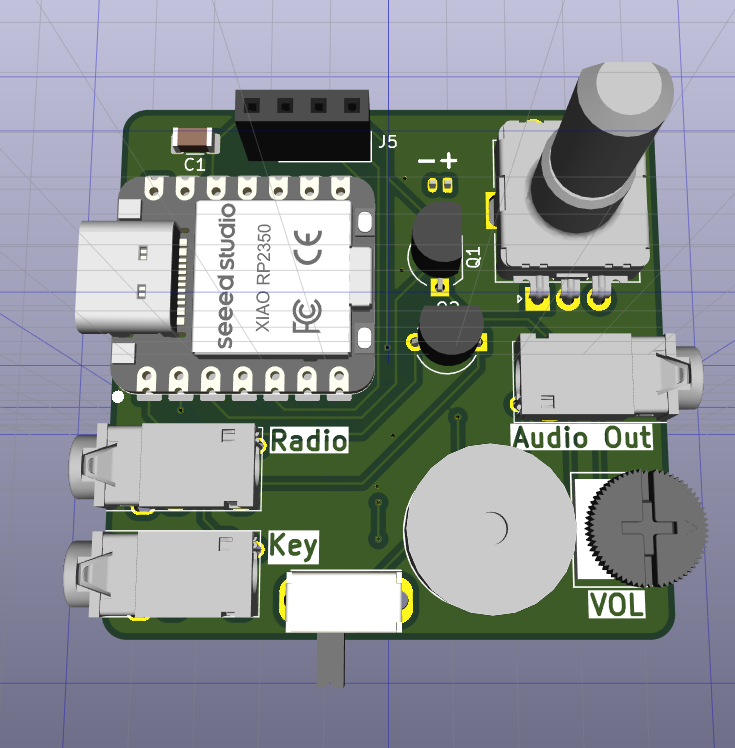
2 layers44.5 × 43.3 mmMicro keyer, the printed circuit board in 3D

The Micro Keyer is a small morse code keyer that can be used as a practice oscillator and computer keyer.

Size
44.5 × 43.3 mm
Copper layers
2
Thickness
1.6 mm
Parts
20
Nets
41
Pads
90
Tracks, vias
136, 30
Pours
1
Routed
Yes
KiCad
KiCad 10.0 (file 20260206)
Created
8 Aug 2026
Updated
7 Nov 2026

Overview

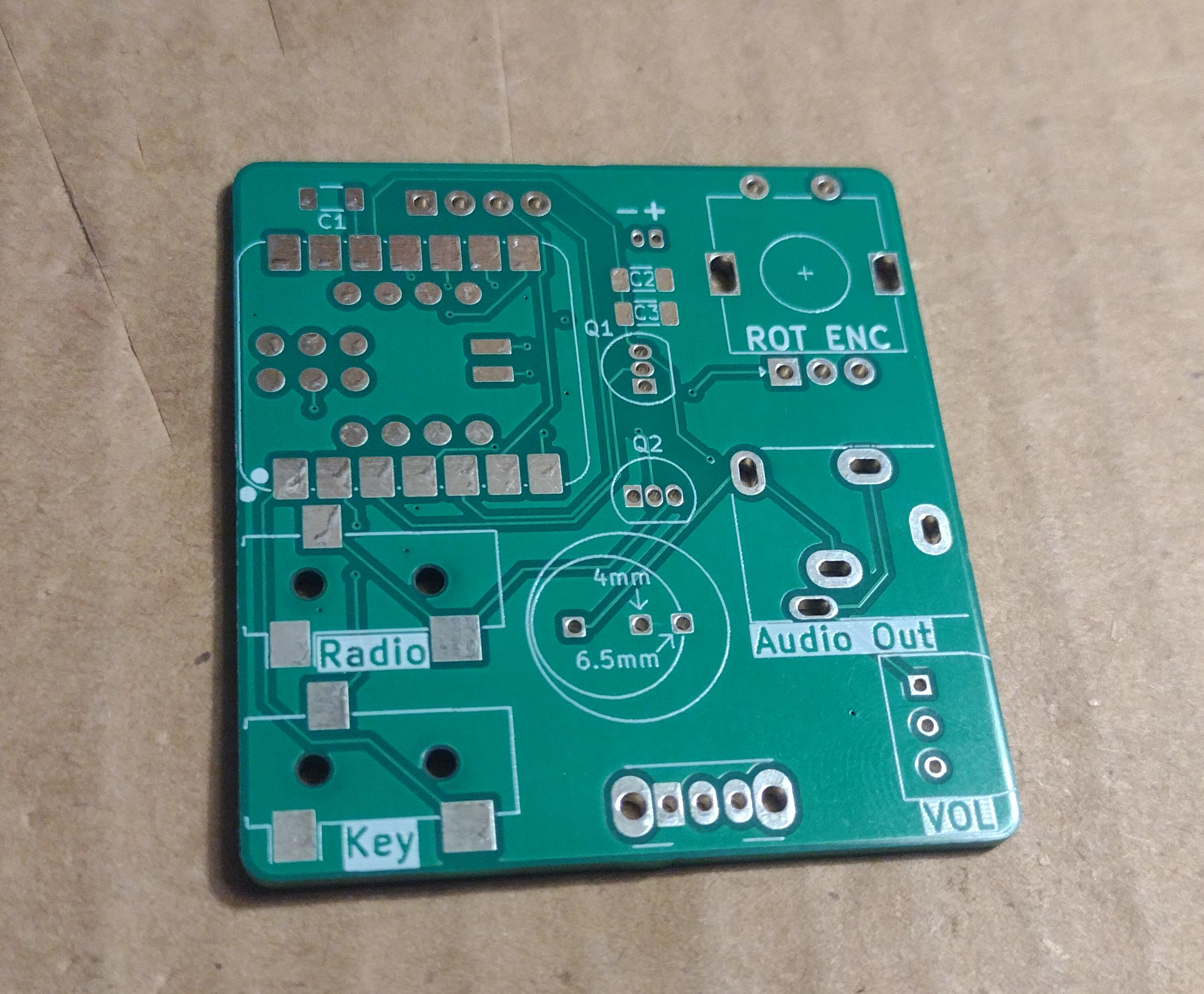
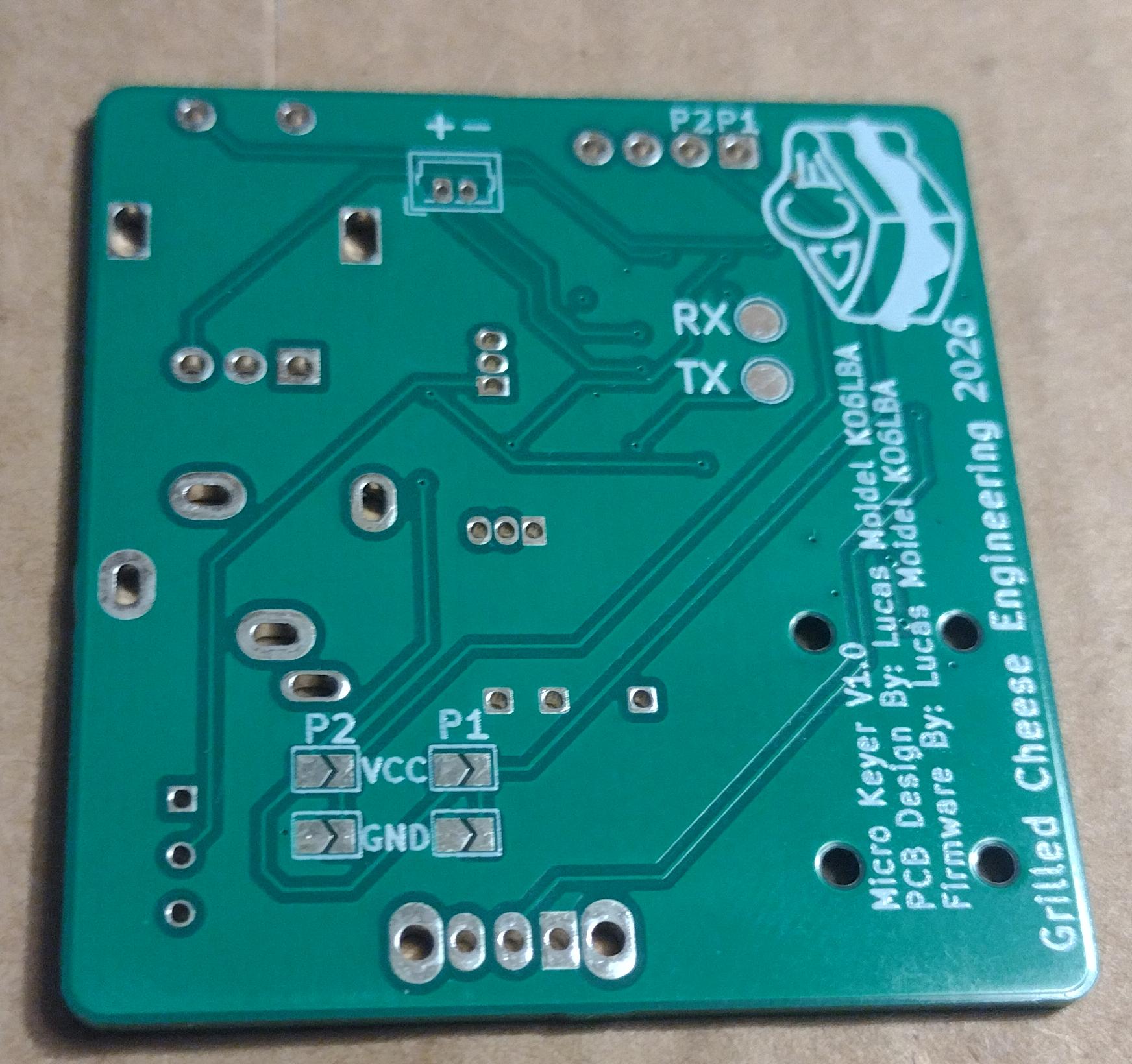
Micro keyer is an open-source printed circuit board by Grilled-Cheese-Engineering, from the Grilled-Cheese-Engineering/micro-keyer repository on GitHub, published under the GPL-3.0 licence. It is a 2-layer board of 44.5 × 43.3 mm with 20 parts on 41 nets, routed with 136 tracks and 30 vias.

Its parts include 5 connectors, 2 transistors, 2 switches, 1 capacitor and 1 IC. It belongs with the RP2350 boards of this library.

README

README.md

Micro Keyer

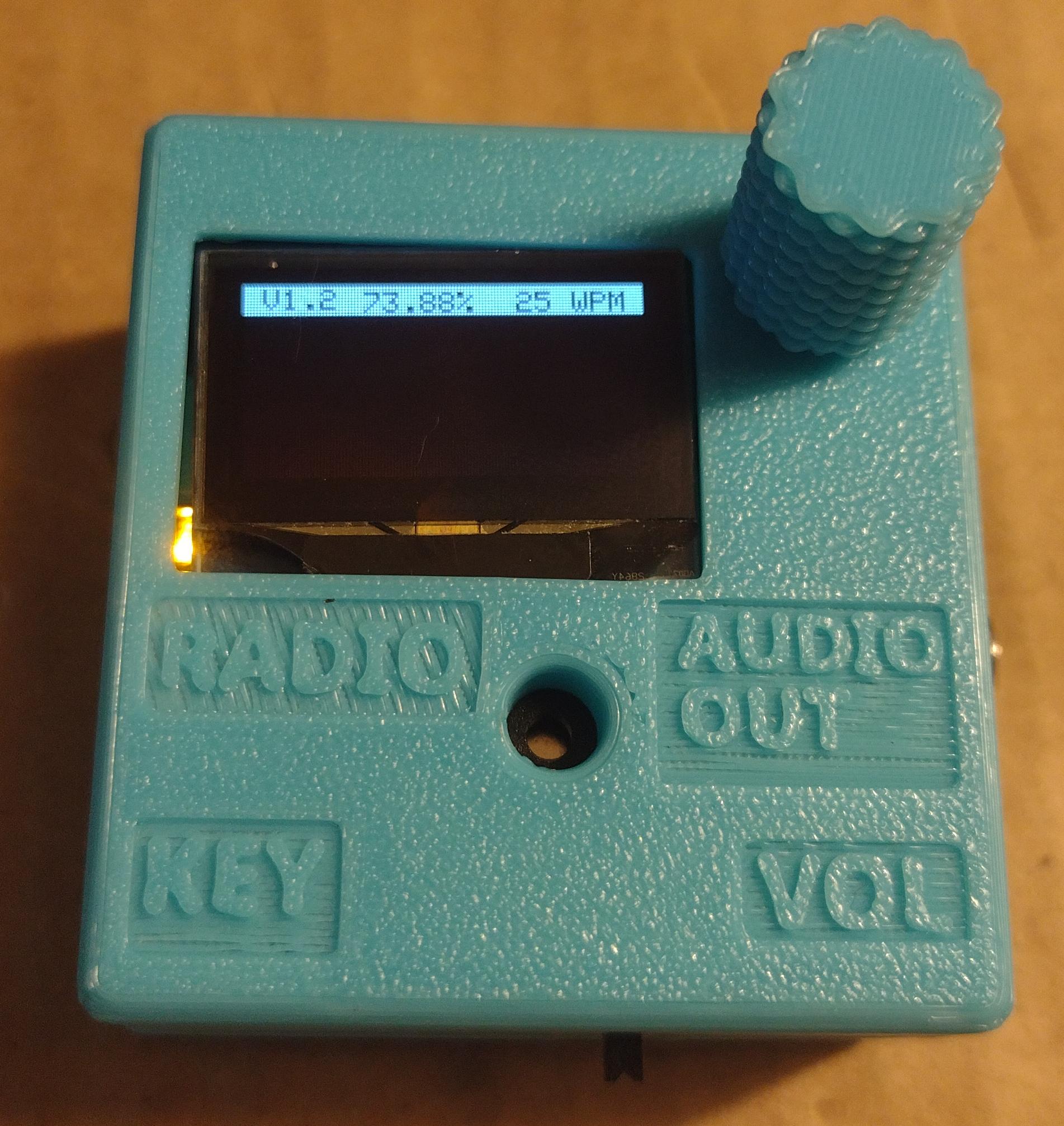
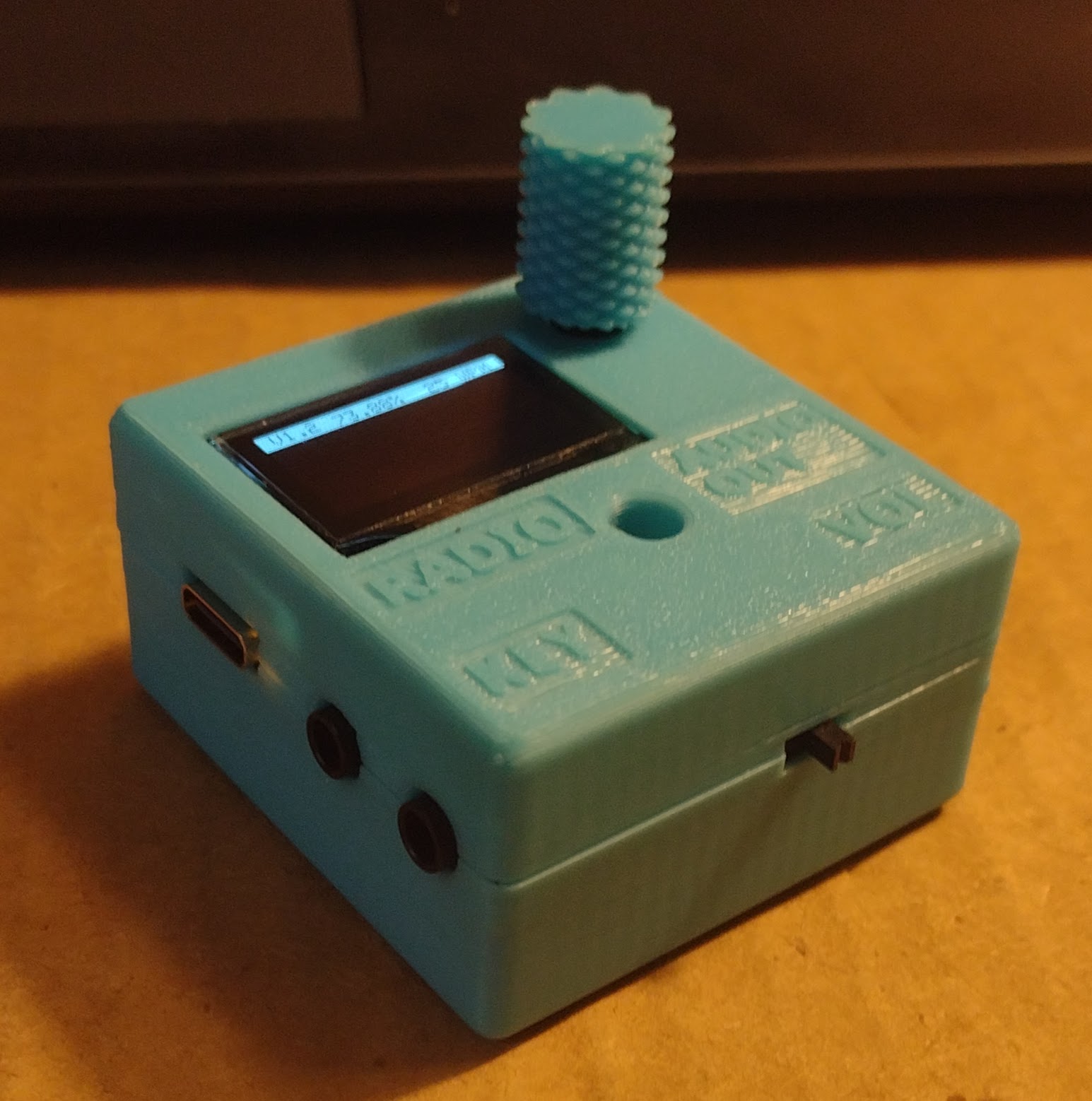
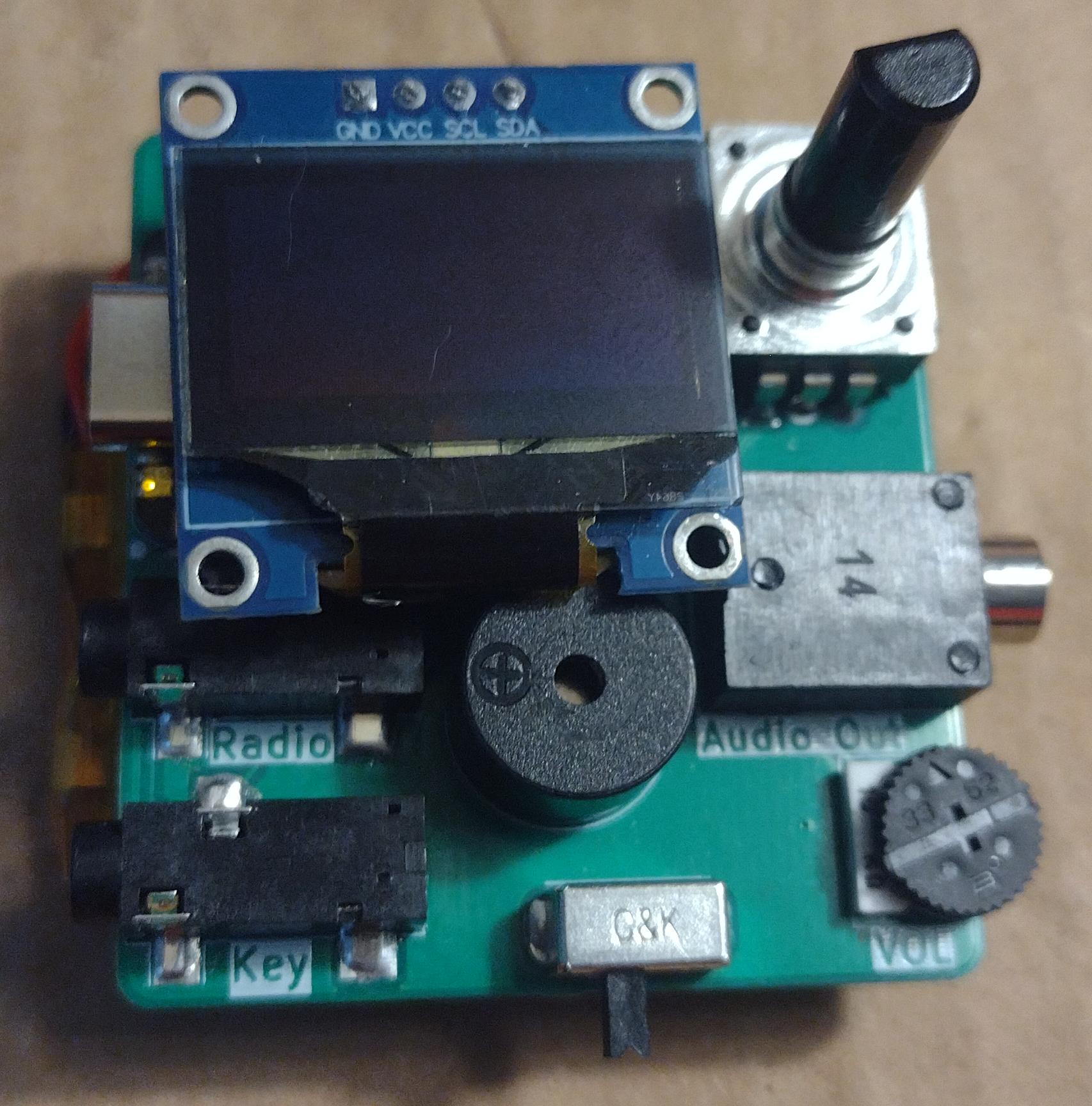
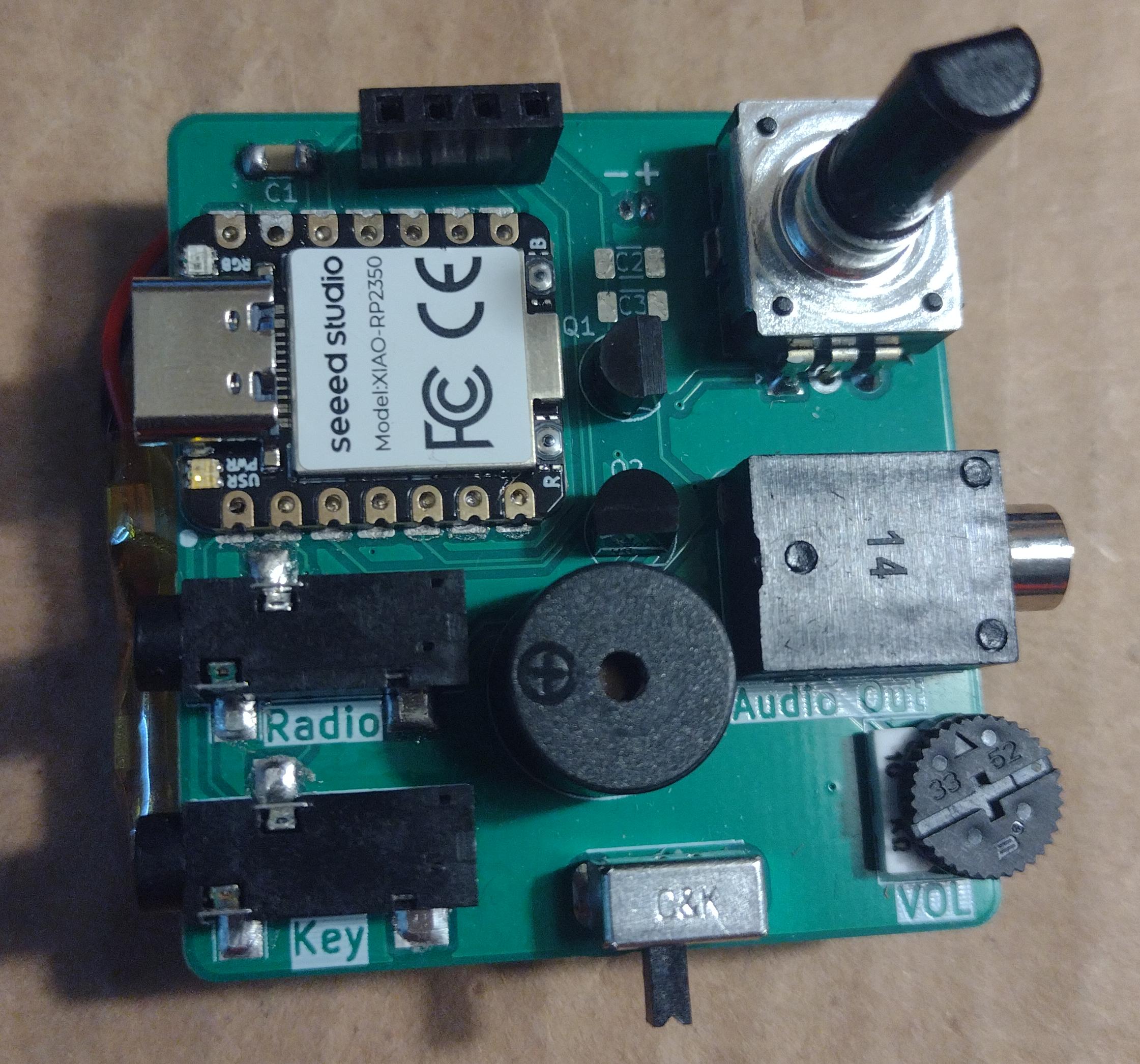
Alt text Alt text
Alt text Alt text Alt text Alt text Alt text


The Micro Keyer is a small morse code keyer that can be used as a practice oscillator and computer keyer. It supports Iambic A, Iambic B, bug emulation, and straight key keying modes.

We will start selling the Micro Keyer on grilled-cheese-engineering.com soon. We will probably offer both a kit version and a pre-assembled version.

If you want to build it yourself then you can get the parts from DigiKey. You can also view the bill of materials here


Usage:


  • You can clear the decoded text by holding the knob down for 2 seconds.
  • You can put the micro keyer in to firmware flashing mode my holding down the knob while turning it on. (V1.1 Board only)

  • Menu:

    • Speed: Sending speed in words per minute.
    • Tone: Audio tone for sending in hetrz. (It may not sound exactly right on the built in buzzer compared to a real speaker.)
    • Mode:
      1. Iambic A: This is for a morse code paddle and it sends exactly what you are holding once the current element finishes being sent.
      2. Iambic B: This is for a morse code paddle and it has a memory for what has been pressed so for if you press the dit side during a dah and let go of the paddle then it will send a dit once it finishes the dah.
      3. Stright Key: This can be used with a straight key/bug or it can be used with a paddle to emulate a cootie. It sends only when the key is being pressed.
      4. Bug Emu: This is for using a paddle as a bug. It will automaticaly send dits at the set speed but the dah side will act as a straight key
    • Reverse: This reverses which side of the paddle is dit and which is dah.
    • Mute: This will mute the audio from both the built in buzzer and the head phone jack.
    • Serial: This will enable the ability to do computer keying over serial.
    • HID: This will enable the ability to use it as a USB keyboard.
    • MIDI: This will enable the ability to use it as a USB MIDI device.
    • Dumb MIDI: This disables some features and only puts out the paddle state over midi. (Experimental)
    • Flash Firmware: This puts the device into boot mode to allow for firmware flashing. It will appear on a computer as a USB mass storage device. To flash the firmware just copy the .UF2 firmware file onto it.

Version Notes:

  • V1.0 Board:
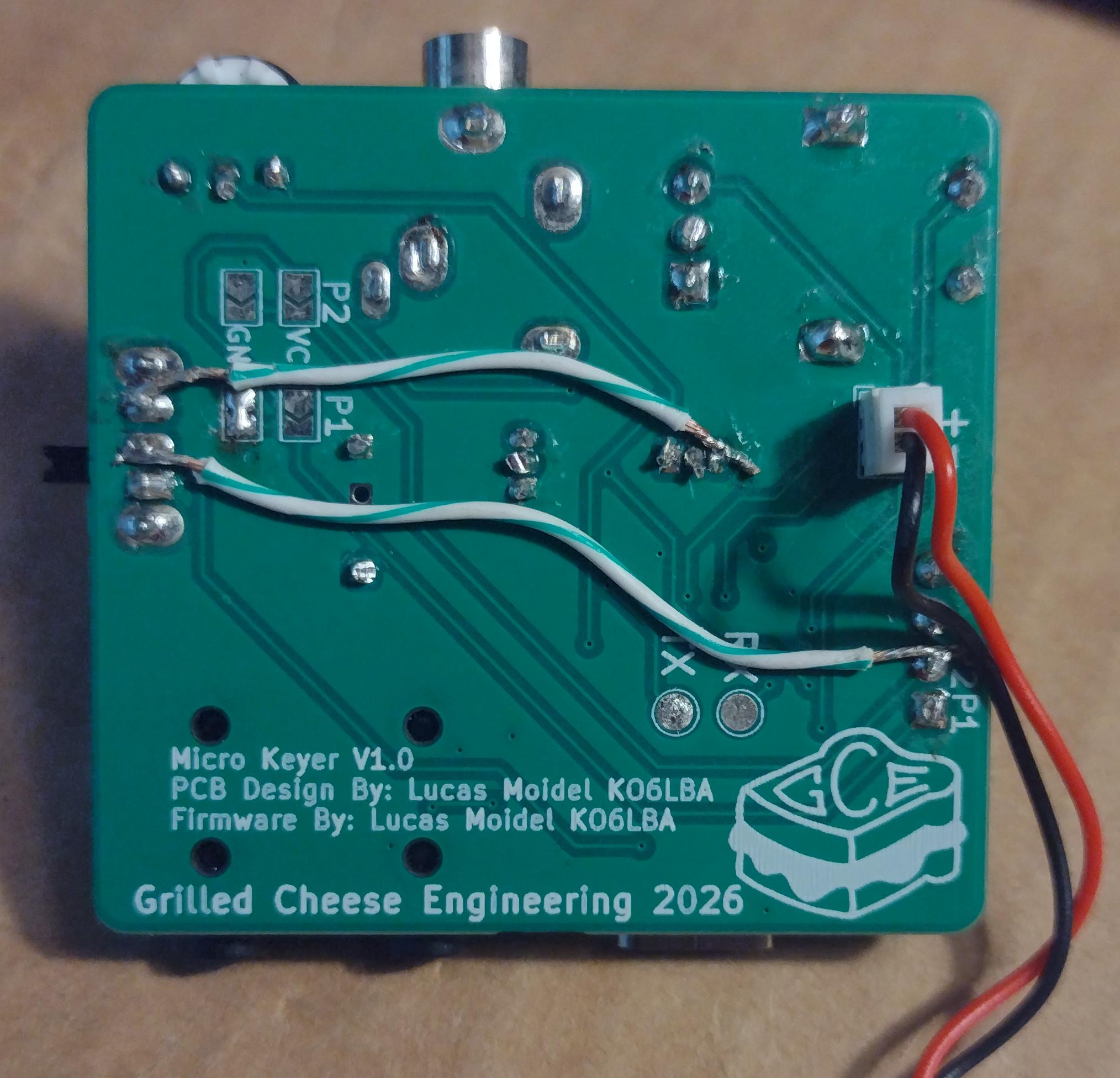
    There is a problem with the V1.0 board where the display does not turn off when the device is turned off with the power switch.
    Fix:
    1. Do not solder the jumper pad that connects the display to power.
    2. Connect a jumper wire between top leg of Q1 (3V) to the left side of the power switch.
    3. Solder a wire from the center pin of the switch to the power pin on the display.
    (Note: the two side pins on the switch are not connected to anything so it is okay if the jumper wire is making contact with them.)

    Alt text
  • V1.1 Board:
    This version has not been ordered yet but it will have the following improvements:
    • Slightly shorter board.
    • More sturdy 3.5mm jacks for the radio and keyer ports.
    • Have the ability to put it into flashing mode by holding down the knob while turning it on.

    Alt text

Parts

20
QtyValueFootprintReferences
3Audio Jackaudio_connector:54-00299J2, J3, J4
10.1uFCapacitor_SMD:C_1206_3216MetricC1
12N3904Package_TO_SOT_THT:TO-92_Inline_WideQ1
12N7000Package_TO_SOT_THT:TO-92_Inline_WideQ2
13V3-P1Jumper:SolderJumper-2_P1.3mm_Open_TrianglePad1.0x1.5mmJP1
13V3-P2Jumper:SolderJumper-2_P1.3mm_Open_TrianglePad1.0x1.5mmJP3
1Buzzerbuzzer:buzzer_P4mm_9mmBZ1
1Conn_01x02connector_battery:Molex_PicoBlade_53047-0210_1x02_P1.25mm_VerticalJ1
1Conn_01x04_SocketConnector_PinSocket_2.54mm:PinSocket_1x04_P2.54mm_VerticalJ5
1GND-P1Jumper:SolderJumper-2_P1.3mm_Open_TrianglePad1.0x1.5mmJP2
1GND-P2Jumper:SolderJumper-2_P1.3mm_Open_TrianglePad1.0x1.5mmJP4
1LOGOLOGOG***
1RotaryEncoder_Switch_MProt_enc:RotaryEncoder_Alps_EC11E-Switch_Vertical_H20mmSW1
1SW_SPDTButton_Switch_THT:SW_Slide_SPDT_Angled_CK_OS102011MA1QSW3
1UART1 RXTestPoint:TestPoint_Pad_D2.0mmTP1
1UART1 TXTestPoint:TestPoint_Pad_D2.0mmTP2
1Vol Knobpot:TRIM_3352T-1-103LFRV1
1XIAO-RP2350-SMDSeeed_Studio_XIAO_Series:XIAO-RP2350-SMD-MODELU1

More from Grilled-Cheese-Engineering/micro-keyer

3
  • 2 layers44 × 48 mmMicro keyer, the printed circuit board in 3D

    Micro keyer

    Grilled-Cheese-Engineering/micro-keyer

    The Micro Keyer is a small morse code keyer that can be used as a practice oscillator and computer keyer.

    16 parts2GPL-3.0
  • 2 layers44 × 44.6 mmMicro keyer, the printed circuit board in 3D

    Micro keyer

    Grilled-Cheese-Engineering/micro-keyer

    The Micro Keyer is a small morse code keyer that can be used as a practice oscillator and computer keyer.

    13 parts2GPL-3.0
  • 2 layersMicro keyer, the printed circuit board in 3D

    Micro keyer

    Grilled-Cheese-Engineering/micro-keyer

    The Micro Keyer is a small morse code keyer that can be used as a practice oscillator and computer keyer.

    7 parts2GPL-3.0

Similar boards

  • 2 layers66.9 × 74.5 mmDeskHop Rev1, the printed circuit board in 3D

    DeskHop Rev1

    hrvach/deskhop

    Fast Desktop Switching Device

    20 parts7.9kGPL-3.0
  • 2 layers86.4 × 64.8 mmSlot machine, the printed circuit board in 3D

    Slot machine

    google/google-ctf

    Google CTF

    20 parts5.1kApache-2.0
  • 2 layers36.2 × 26.8 mmEsp32 minimal, the printed circuit board in 3D

    Esp32 minimal

    atopile/atopile

    Design circuit boards with code! ✨ Get software-like design reuse 🚀, validation, version control and collaboration in hardware; starting with electronics ⚡️

    20 parts4kMIT
  • 2 layers108.1 × 393.8 mmSweep compact ble, the printed circuit board in 3D

    Sweep compact ble

    davidphilipbarr/Sweep

    Sweep - a small promicro based keyboard inspired by the Ferris.

    20 parts2.1k
  • 2 layers26 × 15.9 mmTPS54340 Buck Regulator, the printed circuit board in 3D

    TPS54340 Buck Regulator

    rusefi/rusefi

    rusefi - GPL internal combustion engine control unit

    20 parts1.2k
  • 2 layers67.6 × 30.5 mmRgb to hdmi, the printed circuit board in 3D

    Rgb to hdmi

    hoglet67/RGBtoHDMI

    Bare-metal Raspberry Pi project that provides pixel-perfect sampling of Retro Computer RGB/YUV video and conversion to HDMI

    20 parts1kGPL-3.0
  • 2 layers44.3 × 28.7 mmLin bus adapter esp32, the printed circuit board in 3D

    Lin bus adapter esp32

    hackclub/OnBoard

    💡 Join 1,000 teenagers and make your first PCB with a $100 grant!

    20 parts915
  • 2 layers89.5 × 61.6 mmFreeDeck TH 2020-02, the printed circuit board in 3D

    FreeDeck TH 2020-02

    FreeYourStream/freedeck-hardware

    all the stuff you need to build your own FreeDeck

    20 parts772

Questions

How big is the Micro keyer PCB?

It measures 44.5 × 43.3 mm and has 2 copper layers, 1.6 mm thick.

What parts does the Micro keyer use?

20 parts. The full list of its parts is on this page, with links to each part's symbol and footprint where PCBKit's library has them.

Where can I download the Micro keyer KiCad files?

From the Grilled-Cheese-Engineering/micro-keyer repository on GitHub, at the commit this page was made from: the board is pcb/micro-keyer.kicad_pcb and its schematic pcb/_restore_backup_2026-08-08T10-38-05-555/micro-keyer.kicad_sch. PCBKit opens the board in the browser, with nothing to install.

Can I use the Micro keyer design in my own project?

Its repository publishes it under the GPL-3.0 licence: you may reuse it on that licence's terms (keep the author's notice, and for a copyleft licence share your changes alike).