2 layers
Encoder
byrantech/laptop
anyon_e, a highly integrated, high end, open source laptop. Attempt the impossible.
7 parts4.3kMIT

 FirasObieda/mobile-vitals
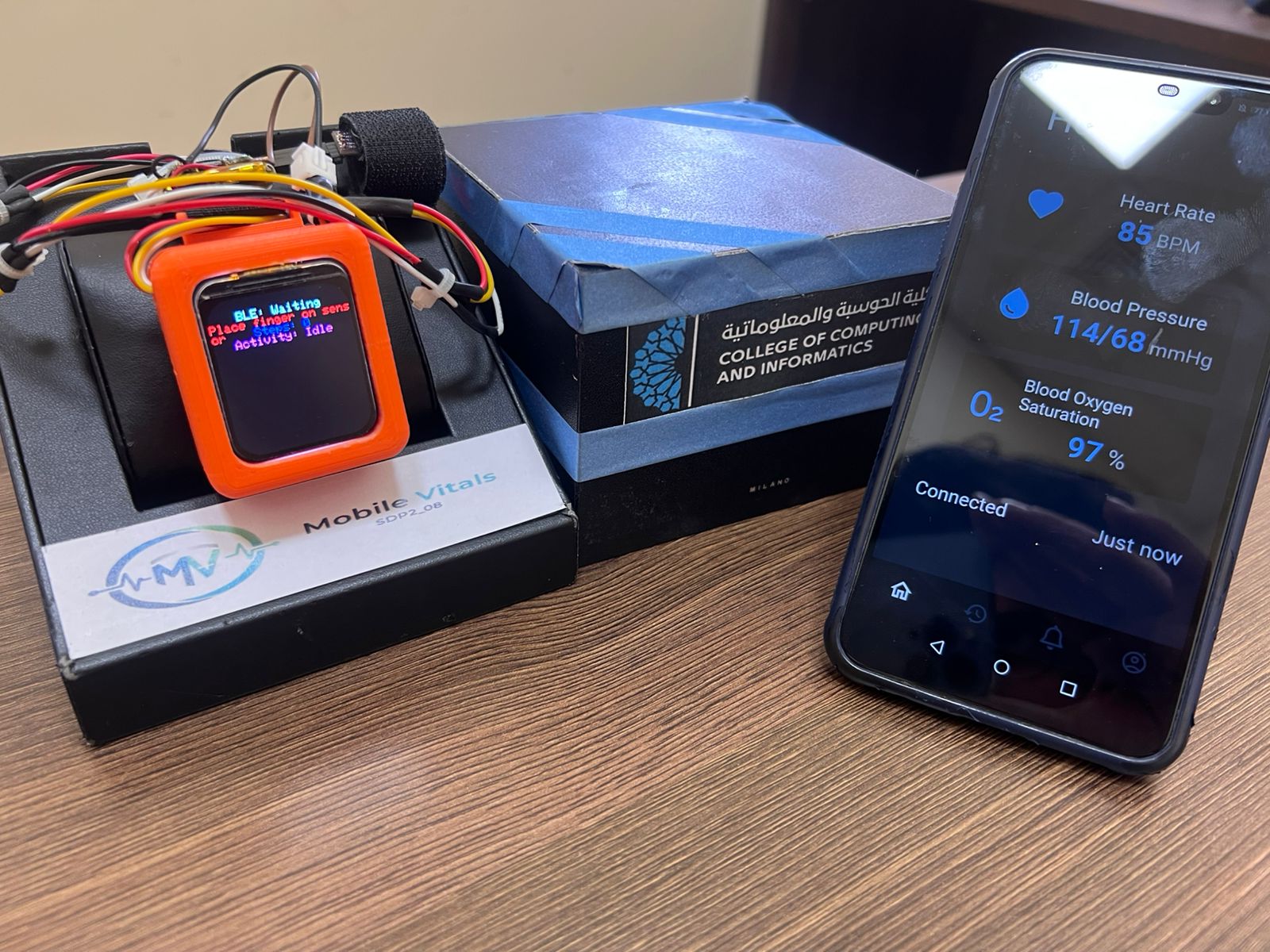
Wearable health tracker that estimates heart rate, blood pressure, and SpO₂ from PPG signals in real time using ML — ESP32 firmware, Firebase backend, Flutter app, and custom PCB.
Wearable device sdp new design is an open-source printed circuit board by FirasObieda, from the FirasObieda/mobile-vitals repository on GitHub. It is a 2-layer board of 27.5 × 48 mm with 7 parts on 23 nets.
Its parts include 6 ICs and 1 connector. It belongs with the wearables boards of this library.
Senior Design Project — Department of Computer Engineering, University of Sharjah (Fall 2025–2026)
Team: Majid M. Almheiri · Firas Obieda Abu-Bader · Abdullah Kaddoura Supervisor: Dr. Bassel Soudan
Chronic conditions like hypertension, hypoxemia, and heart-rate irregularities are hard to catch early because the standard measurement tools (cuffs, pulse oximeters) are manual, invasive, and non-continuous. Mobile Vitals is a wearable device that continuously and non-invasively estimates heart rate (HR), blood pressure (BP), and blood oxygen saturation (SpO₂) from a PPG (photoplethysmography) signal, streams the data to the cloud, runs it through a trained ML model, and alerts the user through a companion mobile app when a reading falls outside a normal range.
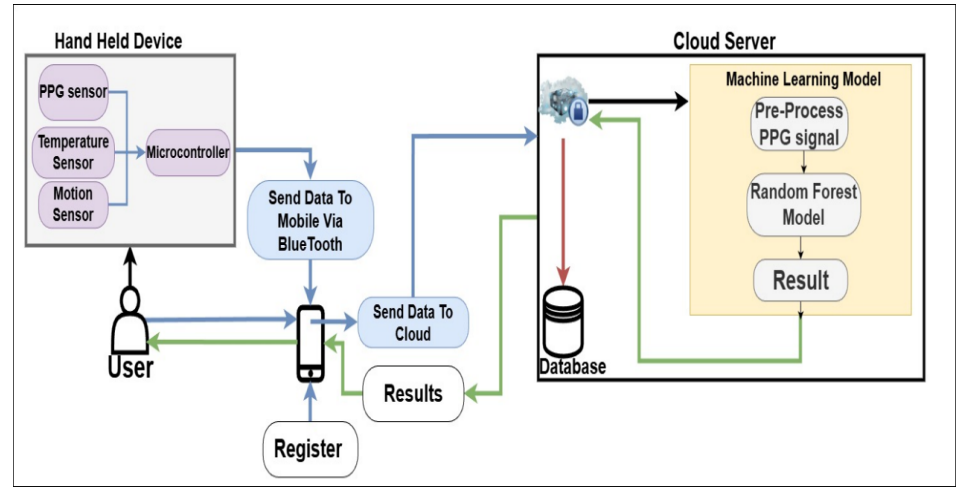
firmware/     ESP32 (Arduino) firmware — sensor capture & Bluetooth transmission
backend/      Firebase Cloud Function (Python) that runs the ML inference model
mobile-app/   Flutter/FlutterFlow app — pairing, live vitals, history, alerts
ml/ppg-bp/    ML pipeline trained on the PPG-BP dataset (superseded, kept for reference)
ml/ptt-ppg/   ML pipeline trained on the PTT-PPG dataset — the one used in the final model
hardware/ KiCad PCB design files for the wearable| Component | Model | Purpose |
|---|---|---|
| Microcontroller | Seeed Studio XIAO ESP32-C3 | Main processing unit |
| PPG sensor | MAX30105 | Captures the PPG waveform used for inference |
| Temperature sensor | MLX90614 | Contactless skin temperature (IR) |
| IMU | LSM6DS3 | Motion/orientation, for motion-artifact handling |
| Display | Waveshare 1.69" LCD | Shows HR, SpO₂, temperature, BP |
| Power | 3.7V 800mAh Li-Po + TP4056 charger | Portable power + USB charging |
| Enclosure | Custom 3D-printed casing (Onshape) | Protection & wearability |
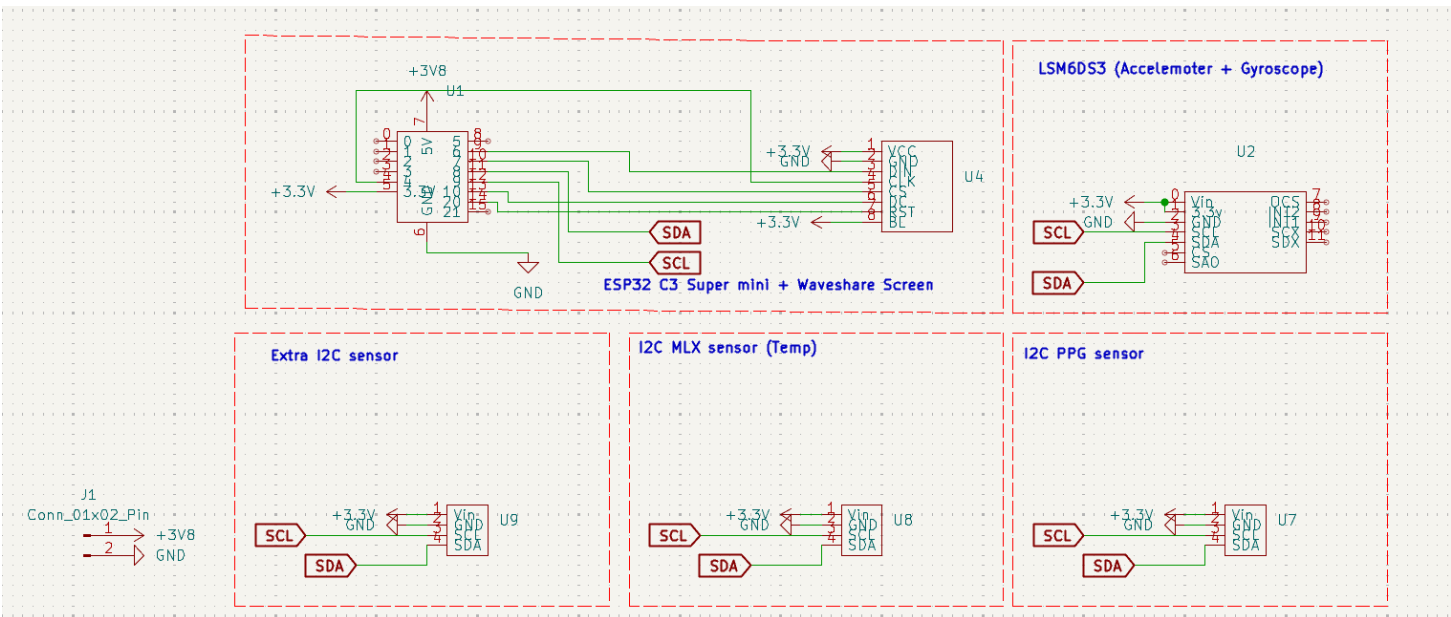
Communication between sensors uses I²C/SPI on the wearable; wearable↔phone is Bluetooth; phone↔cloud is Wi-Fi.
Two datasets were evaluated:
Preprocessing pipeline: linear interpolation for gaps → Butterworth low-pass filter (15 Hz, 8th order) → Savitzky–Golay smoothing → normalization to [0,1] → segmentation into 10-second windows.
| Tool / Library | Version | Purpose |
|---|---|---|
| Arduino IDE | 2.3.2 | Firmware upload for the XIAO ESP32-C3 |
| Pandas | 2.2.3 | Data cleaning/manipulation |
| NumPy | 1.26.4 | Numerical computation |
| SciPy | 1.13.1 | Filtering & feature extraction |
| scikit-learn | 1.4.2 | Model training/evaluation |
| Joblib | 1.4.2 | Model persistence |
| firebase-admin (Python) | 6.4.0 | Cloud Function ↔ Firebase access |
| functions-framework | 3.6.0 | Serves the Python Cloud Function |
| cloudevents | 1.11.0 | Event handling for Cloud Functions |
Each subfolder has more detail — start here:
firmware/ESP32_SOURCE_CODE.ino in the Arduino IDE with the
ESP32 board package installed.backend/functions/requirements.txt.
Requires your own Firebase service account key (not included — see Configuration note).mobile-app/README.md.ml/ppg-bp/ or ml/ptt-ppg/ in Jupyter.hardware/wearable_device_sdp.kicad_pro in KiCad.backend/)cd backend/functions
python -m venv venv
source venv/bin/activate # venv\Scripts\activate on Windows
pip install -r requirements.txtThis uses the Firebase Admin SDK, which needs a service account key that is not included in this repo:
GOOGLE_APPLICATION_CREDENTIALS at it..gitignore).Deploy: firebase deploy --only functions from backend/.
This repo doesn't include environment-specific credentials (Firebase service
account key, API keys) — that's standard practice for any public repo. See the
Backend and mobile-app/README.md sections for how to supply your own.
The full SDP2 report (architecture rationale, literature review, testing, and results in detail) is available separately and covers material summarized above, including the design evolution from the SDP1 proposal (dual PPG sensors → single MAX30105; BME280 → MLX90614; Wi-Fi → Bluetooth for the wearable link; breadboard → custom PCB).
| Qty | Value | Footprint | References |
|---|---|---|---|
| 2 | ~ | Connector_PinHeader_2.54mm:PinHeader_1x04_P2.54mm_Vertical | U7, U9 |
| 1 | Conn_01x02_Pin | Connector_PinHeader_2.54mm:PinHeader_1x02_P2.54mm_Vertical | J1 |
| 1 | ~ | ESP32_mini:ESP32_C3_SuperMini_Flipped | U1 |
| 1 | ~ | Sensors_2025:MLX_Temp_Sensor | U8 |
| 1 | ~ | Sensors_2025:LSM6DS3 | U2 |
| 1 | ~ | Connector_PinHeader_2.54mm:PinHeader_1x08_P2.54mm_Vertical | U4 |
byrantech/laptop
anyon_e, a highly integrated, high end, open source laptop. Attempt the impossible.


AxxAxx/AxxSolder
STM32 Based soldering station for JBC cartridges, 9-24 VDC and USB-PD power


jamro/tiny-engineer
A small desktop robot that brings an AI coding assistant to life, physically acting out when it reads files, thinks, writes code, and finishes work.

hoglet67/RGBtoHDMI
Bare-metal Raspberry Pi project that provides pixel-perfect sampling of Retro Computer RGB/YUV video and conversion to HDMI

It measures 27.5 × 48 mm and has 2 copper layers, 1.6 mm thick.
7 parts. The full list of its parts is on this page, with links to each part's symbol and footprint where PCBKit's library has them.
From the FirasObieda/mobile-vitals repository on GitHub, at the commit this page was made from: the board is hardware/wearable_device_sdp_new_design.kicad_pcb and its schematic hardware/wearable_device_sdp.kicad_sch. PCBKit opens the board in the browser, with nothing to install.
Its repository states no licence, so its author keeps all rights: ask FirasObieda before reusing the design.