4 layers20.6 × 51.1 mm
 FinnKrass/MX-Break-In-Machine15
64 Slot Break In Machine for MX Style Switches
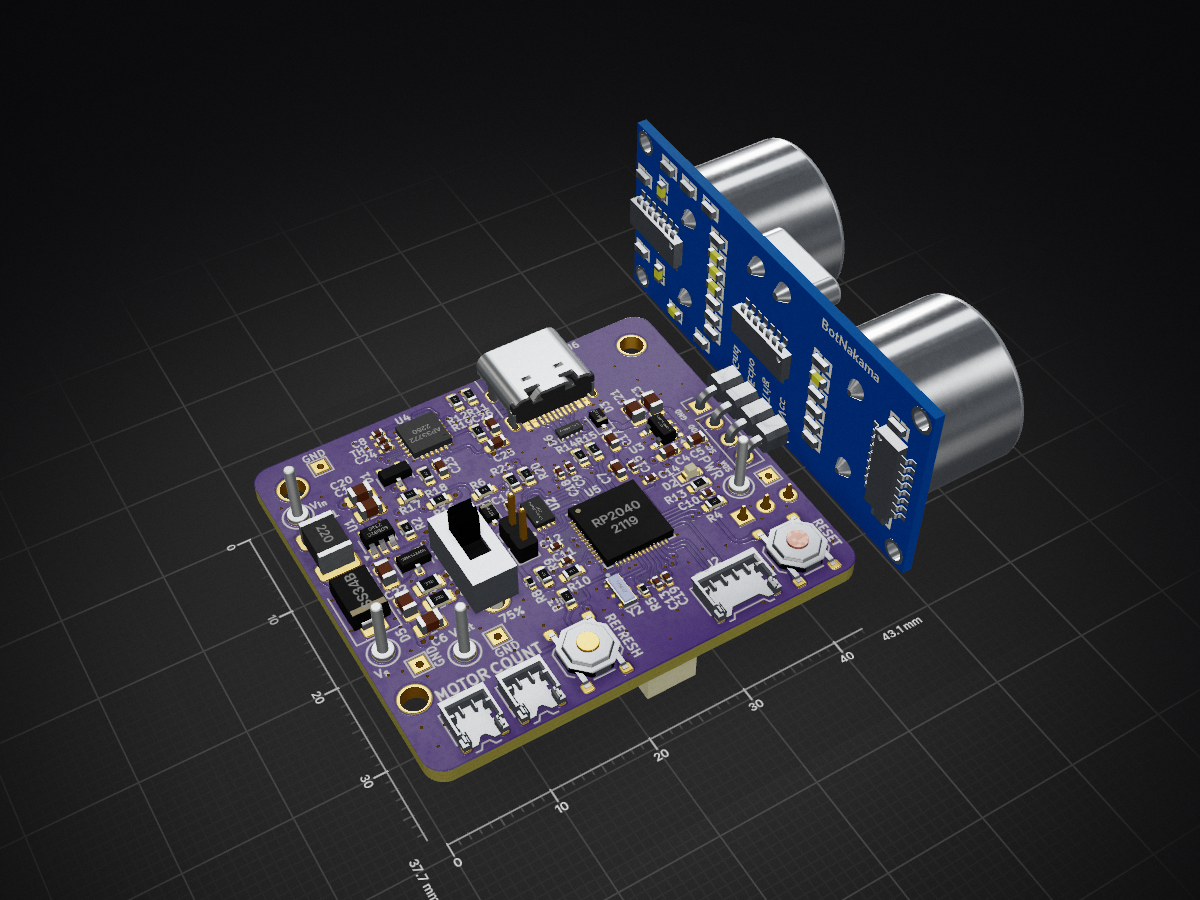
Machine Controller is an open-source printed circuit board by FinnKrass, from the FinnKrass/MX-Break-In-Machine repository on GitHub, published under the CERN-OHL-S-2.0 licence. It is a 4-layer board of 43.1 × 37.7 mm with 84 parts on 86 nets, routed with 424 tracks and 206 vias.
It is built around the RP2040, SDB628 and W25Q16JVUXIQ, with the AP33772DKZ, SS34B and SSM3J340R,LF among its other parts. Its parts include 26 capacitors, 21 resistors, 6 diodes, 6 connectors and 5 ICs. It belongs with the RP2040 boards of this library.


Repository is still a work in progress!
A unique take on the switch break in machine intended to streamline the process and maximise outcomes. Useful for those who want to improve the sound and feeling of MX style keyboard switches that come scratchy/inconsistent from the factory.

Table of Contents:
This project started when I first fell in love with Cherry MX Black's. I wanted a way to break in the switches for all of my builds, but had absolutely no understanding of electronics and CAD at the time, so took it upon myself to learn how to use Fusion360 and eventually design a circuit. Once the design had come together, I started selling broken in switches with a fleet of these machines running around the clock, which helped me vet the design and iron out any problems as well as optimize certain things to make the labor involved with operating and maintaining the machines easier. I worked on this project on and off over about a year and was planning to sell the machines themselves once they were in a state I was proud of, but some life events got in the way, so I've decided to work back and open source it for others to enjoy as much as I have.
The machine is quite rugged, I've had customers request their switches broken in for 2.5 million + actuations and the machines have handled that no problem. For good measure, I give them 1 hour break every 12 hours, and have had machines comfortably surpass total lifetime actuations of 75 million. This isn't guaranteed of course, it depends on a plethora of variables, including materials used to print, print profiles, the motor manufacturer, bearing quality etc. Regardless, here is a list of features:
Linear bearings (inspired by Feng Studio's machine)
Full capacity (64 switches) off centre operation.
Noise reducing plates
USB Power Delivery compatible controller & power supply.
128x64 OLED display for information on progress.
Actuation counter with programmable profiles to disable/enable the motor after x number of actuations. Currently programmed to turn off after 250,000 actuations to ensure an even distribution of off centre actuations on all 4 sides.
Two speeds can be selected via a switch on the PCB.
Rugged 24V motor, capable 564 actuations/minute. (Faster is not recommended)
Non-volatile flash memory, will recall number of actuations recorded in the event of power loss.
Here are a few video's showing off the operation. Video A, Video B.
Some older video's of their operation can be found here and here.
Finalise documentation
User guide and tips on operating the machine
General clean up, more coherent structure.
Acceptable print tolerance specifications
Piston bearing socket tolerance calibration print
PCB BoM optimisations (more details in PCB doc)
PCB BoM sheet for mouser to automate adding to cart (should be done very soon)
The individual who helped me most requested not to be named, but a deep thank you goes out to them for the help they have provided me and continue to provide to the community. Their help is the reason I became more interested in the intricacies of electronics, and that passion has continued far beyond this project now.
Kee Keen's open source break in machine helped me greatly in the beginning, definitely check it out if you're interested in the roots of this project!
| Qty | Value | Footprint | References |
|---|---|---|---|
| 12 | 0.1uF | Capacitor_SMD:C_0402_1005Metric | C8, C9, C10, C11, C12, C13, C14, C15, C16, C18, C19, C24 |
| 6 | 22uF | Capacitor_SMD:C_0805_2012Metric | C1, C3, C6, C20, C21, C22 |
| 5 | 1uF | Capacitor_SMD:C_0603_1608Metric | C7, C17, C23, C25, C26 |
| 5 | 5K1 | Resistor_SMD:R_0603_1608Metric | R11, R12, R13, R20, R21 |
| 4 | 10k | Resistor_SMD:R_0603_1608Metric | R3, R4, R9, R10 |
| 4 | GND | TestPoint:TestPoint_THTPad_1.5x1.5mm_Drill0.7mm | TP5, TP7, TP8, TP9 |
| 3 | 10K | Resistor_SMD:R_0603_1608Metric | R2, R6, R17 |
| 3 | MountingHole | Finn-Lib:M2_Screw_PTH | H1, H2, H3 |
| 2 | 1N4148 | Diode_SMD:D_SOD-323F | D3, D4 |
| 2 | 1k | Resistor_SMD:R_0402_1005Metric | R5, R8 |
| 2 | 22uF | Capacitor_SMD:C_0603_1608Metric | C4, C5 |
| 2 | 27R | Resistor_SMD:R_0603_1608Metric | R14, R15 |
| 2 | 78171-0002 | Finn-Lib:Molex_Pico-EZmate_78171-0002_1x02 | J4, J7 |
| 1 | 100R | Resistor_SMD:R_0603_1608Metric | R16 |
| 1 | 10m | Resistor_SMD:R_0603_1608Metric | R19 |
| 1 | 12MHz | Finn-Lib:OSC_CSTNE12M0G520000R0 | Y2 |
| 1 | 1uF | Capacitor_SMD:C_0805_2012Metric | C2 |
| 1 | 22uH | Finn-Lib:TDK-VLS5045-5x5.3x4.5 | L1 |
| 1 | 29K | Resistor_SMD:R_0805_2012Metric | R1 |
| 1 | 39K | Resistor_SMD:R_0805_2012Metric | R7 |
| 1 | 3K8 | Resistor_SMD:R_0603_1608Metric | R18 |
| 1 | 3V3 | Finn-Lib:Keystone_5000-5004_Miniature | TP4 |
| 1 | AP33772 | Finn-Lib:QFN50P400X400X80-25N-D | U4 |
| 1 | AP7370-33W5-7 | Package_TO_SOT_SMD:SOT-23-5 | U3 |
| 1 | BTN_R | Finn-Lib:SW_SPST_TL3342 | SW4 |
| 1 | BTN_UR | Finn-Lib:SW_SPST_TL3342 | SW3 |
| 1 | BZX84C22-7-F | Package_TO_SOT_SMD:SOT-23-3 | D1 |
| 1 | Conn_01x03 | Connector_JST:JST_SH_BM03B-SRSS-TB_1x03-1MP_P1.00mm_Vertical | J5 |
| 1 | Conn_01x03 | Connector_PinSocket_2.54mm:PinSocket_1x03_P2.54mm_Vertical | J3 |
| 1 | Conn_01x05 | Finn-Lib:Molex_Pico-EZmate_78171-0004_1x04-1MP_P1.20mm_Vertical | J2 |
| 1 | LED | LED_SMD:LED_0603_1608Metric | D2 |
| 1 | PUSB3FS4Z | Finn-Lib:DFN2510A-10 | D6 |
| 1 | RP2040 | Finn-Lib:RP2040-QFN-56 | U5 |
| 1 | SDB628 | Package_TO_SOT_SMD:SOT-23-6 | U1 |
| 1 | SS34B | Diode_SMD:D_SMB | D5 |
| 1 | SSD1306 | Finn-Lib:Display_128x64_096_I2C | Brd1 |
| 1 | SSM3J340R | Finn-Lib:SOT-23-3F | Q1 |
| 1 | SW_Push | Connector_PinHeader_2.00mm:PinHeader_1x02_P2.00mm_Vertical | SW2 |
| 1 | SW_SPDT | Finn-Lib:SW_Slide_1P2T_CK_OS102011MS2Q | SW1 |
| 1 | Thermistor_NTC | Capacitor_SMD:C_0402_1005Metric | TH1 |
| 1 | USB_C_Receptacle_USB2.0 | Finn-Lib:USB_C_Receptacle_HRO_TYPE-C-31-M-12 | J6 |
| 1 | V_{in} | Finn-Lib:Keystone_5000-5004_Miniature | TP6 |
| 1 | V_{out} | Finn-Lib:Keystone_5000-5004_Miniature | TP2 |
| 1 | V_{s} | Finn-Lib:Keystone_5000-5004_Miniature | TP1 |
| 1 | W25Q16JVUXIQ | Finn-Lib: USON-8_2x3x0.6mm | U2 |


entropia/Teebeutel-Hardware
Teebeutel (eng. Teabag) is an electronic, Entropia themed con-badge for the GPN20, featuring an ESP32 microprocessor running micropython.


libertathiest/fs10-atmega32u4-monitor
A standalone USB monitor and configuration tool for the FCI FS10 Flow Switch, built around the ATmega32U4 on an Arduino Leonardo–compatible board.

It measures 43.1 × 37.7 mm and has 4 copper layers, 1.6 mm thick.
84 parts, built around the RP2040, SDB628, W25Q16JVUXIQ and AP33772DKZ. The full list of its parts is on this page, with links to each part's symbol and footprint where PCBKit's library has them.
From the FinnKrass/MX-Break-In-Machine repository on GitHub, at the commit this page was made from: the board is PCB/Machine-Controller.kicad_pcb and its schematic PCB/Machine-Controller.kicad_sch. PCBKit opens the board in the browser, with nothing to install.
Its repository publishes it under the CERN-OHL-S-2.0 licence: you may reuse it on that licence's terms (keep the author's notice, and for a copyleft licence share your changes alike).