4 layers41 × 33 mm
Darknet smao
dcbokonon/darknet-smao
Darknet SMAO: Meshtastic LoRa+BLE mesh node SAO for DEF CON 34
36 parts4
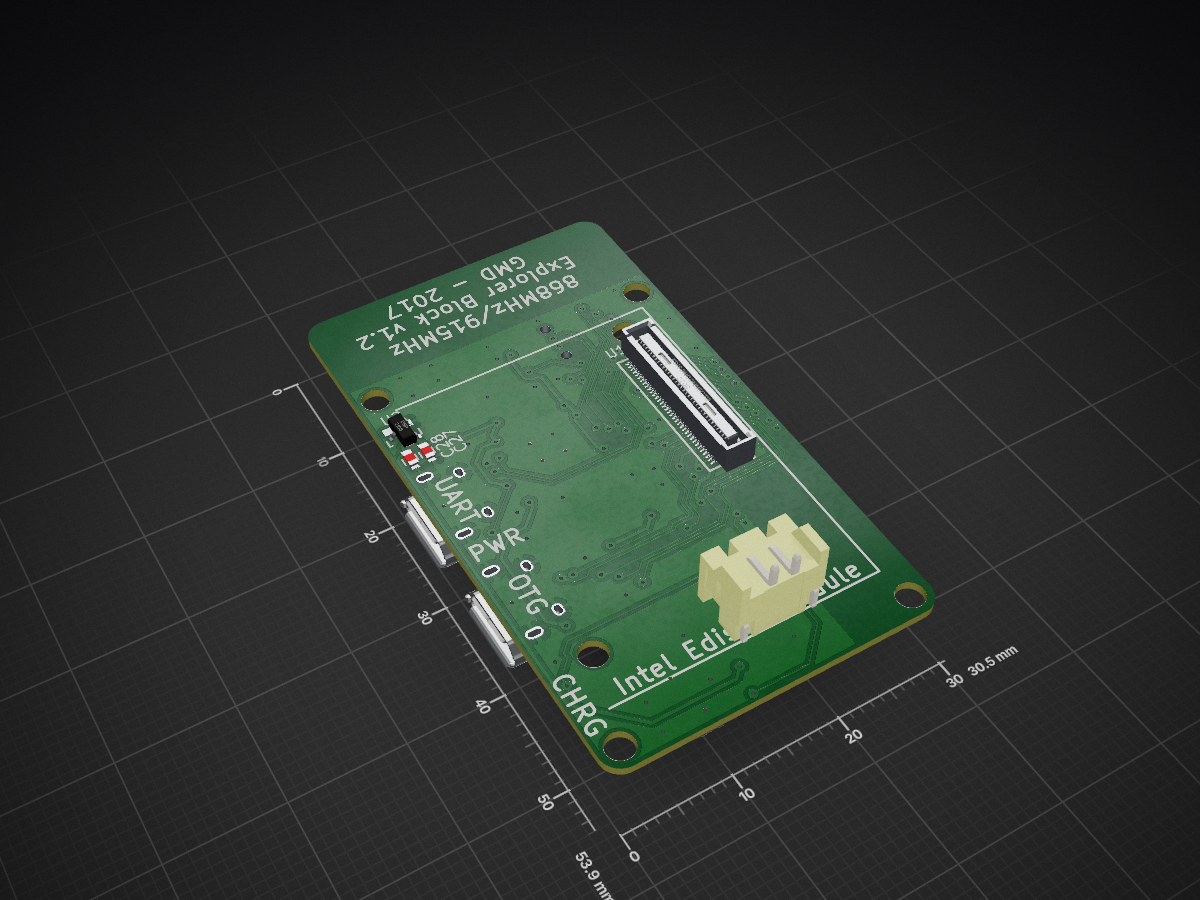
 EnhancedRadioDevices/915MHzEdisonExplorer26
A 915MHz block for the Intel Edison.
EdisonBlock 915MHz is an open-source printed circuit board by EnhancedRadioDevices, from the EnhancedRadioDevices/915MHzEdisonExplorer repository on GitHub. It is a 2-layer board of 30.5 × 53.9 mm with 117 parts on 127 nets, routed with 921 tracks and 73 vias.
It is built around the FT230XQ-R, 0915BM15A0001E and AP7365, with the MCP73831, MIC2039AYM-T5 and TPS2113APW among its other parts. Its parts include 30 capacitors, 21 resistors, 10 ICs, 5 diodes and 3 connectors. It belongs with the radio and wireless boards of this library.


This Edison Block makes use of a TI CC1110 RF transciever to allow a connected Edison to communicate on the 915MHz band. It is also capable of transmitting at 868MHz (a small antenna alteration will make it much more efficient at that band).
The 915MHz Edison Explorer Block allows an Intel Edison to serve as a bridge from WiFi or Bluetooth to a 915MHz protocol, such as Z-wave, Zigbee, or other manufacturer specific protocols.
The files in this repo are for the 915MHz Explorer hardware. To open them, you'll need KiCAD:
It may also be helpful to use these libraries:
For use with Z-wave, 6LowPan, etc.
For Smart Meters, see Wireless-M bus: http://www.ti.com/tool/wmbus
For the firmware that goes on the CC1110 itself, see:
For the software that runs on the Edison to communicate with the CC1110, see :
We also have an RFCat port available
The Explorer block is currently for sale:
| Qty | Value | Footprint | References |
|---|---|---|---|
| 9 | 4.7u | Capacitors_SMD:C_0603 | C1, C2, C13, C15, C16, C24, C26, C29, C30 |
| 8 | 0.1u | Capacitors_SMD:C_0402 | C4, C5, C11, C12, C19, C20, C21, C25 |
| 6 | CONN_01X01 | Mounting_Holes:MountingHole_2.5mm | MH1, MH2, P2, P3, P4, P5 |
| 4 | 10k | Resistors_SMD:R_0402 | R7, R8, R15, R20 |
| 4 | 330 | Resistors_SMD:R_0402 | R1, R9, R10, R11 |
| 3 | RED | LEDs:LED_0603 | D1, D2, D6 |
| 2 | 100 | Resistors_SMD:R_0402 | R16, R17 |
| 2 | 10n | Capacitors_SMD:C_0402 | C6, C8 |
| 2 | 18p | Capacitors_SMD:C_0402 | C10, C14 |
| 2 | 27 | Resistors_SMD:R_0402 | R18, R19 |
| 2 | 287 | Resistors_SMD:R_0402 | R6, R13 |
| 2 | 47p | Capacitors_SMD:C_0402 | C22, C23 |
| 2 | Amphenol 10118194-0001LF | mogar_modules_new:USB_Micro-B | P6, P7 |
| 2 | DNP | Capacitors_SMD:C_0603 | C27, C28 |
| 2 | DNP | Resistors_SMD:R_0402 | R3, R4 |
| 1 | 0.5p | Capacitors_SMD:C_0603 | C18 |
| 1 | 0915AT43A0026E | mogar_modules_new:ANT_SMD_0868AT43A0020E_labeled | A1 |
| 1 | 0915BM15A0001 | mogar_modules_new:0915BM15A0001 | U6 |
| 1 | 100k | Resistors_SMD:R_0402 | R14 |
| 1 | 100p | Capacitors_SMD:C_0603 | C17 |
| 1 | 10n | Capacitors_SMD:C_0603 | L7 |
| 1 | 1u | Capacitors_SMD:C_0402 | C3 |
| 1 | 220p | Capacitors_SMD:C_0402 | C9 |
| 1 | 24MHz | mogar_modules_new:Crystal_4-SMD_TXC-7V | X1 |
| 1 | 2p2 | Capacitors_SMD:C_0402 | C7 |
| 1 | 3k | Resistors_SMD:R_0402 | R21 |
| 1 | 4.7n | Capacitors_SMD:C_0603 | L6 |
| 1 | 4k | Resistors_SMD:R_0402 | R2 |
| 1 | 56k | Resistors_SMD:R_0402 | R5 |
| 1 | 698 | Resistors_SMD:R_0402 | R12 |
| 1 | AP7365 | TO_SOT_Packages_SMD:SOT-23-5 | U7 |
| 1 | B3U-1000P | mogar_modules_new:SW_SPST_B3U-1000P | SW1 |
| 1 | CC1110 | mogar_modules_new:QFN-36-1EP_6x6mm_Pitch0.5mm | U4 |
| 1 | CONN_01X01 | Measurement_Points:Measurement_Point_Round-SMD-Pad_Small | V5 |
| 1 | DNP | TO_SOT_Packages_SMD:SOT-23 | U2 |
| 1 | DNP | mogar_modules_new:SOD-323 | D5 |
| 1 | DNP | mogar_modules_new:M05x2_FTSH_MTR | P1 |
| 1 | EdisonConnector | mogar_modules_new:DF40HC(3.0)-70DS | U1 |
| 1 | FT230X | Housings_DFN_QFN:QFN-16-1EP_4x4mm_Pitch0.65mm | U10 |
| 1 | GREEN | LEDs:LED_0603 | D3 |
| 1 | M02JST-PTH-2 | mogar_modules_new:JST_PH_S2B-PH-SM4-TB_02x2.00mm_Angled | JP1 |
| 1 | MCP73831 | TO_SOT_Packages_SMD:SOT-23-5 | U3 |
| 1 | MIC2039AY | TO_SOT_Packages_SMD:SOT-23-6 | U8 |
| 1 | TE_1909763-1 | mogar_modules_new:MiniRFHeader | A2 |
| 1 | TPS2113A | mogar_modules_new:SON-8 | U9 |
| 1 | TXB0108-DFN20 | mogar_modules_new:UFDFN-20_4x2mm_Pitch0.4mm | U5 |
The 83 most common of 117 parts.
dcbokonon/darknet-smao
Darknet SMAO: Meshtastic LoRa+BLE mesh node SAO for DEF CON 34


antevens/omnilink
A derrative of the Rileylink that magnetically snaps to the back of a Pelican phone case


mogar/EdisonBlockTemplate
A KiCAD template for an Intel Edison Block (works with SparkFun block form factor)

vul-os/sirboard
Open hardware: 107 KiCad PCB designs — SMD-to-THT breakout adapters, ATTiny/ATMega/ESP development boards, and a 39-part sensor line on a common JST-SH connector.

It measures 30.5 × 53.9 mm and has 2 copper layers, 0.8 mm thick.
117 parts, built around the FT230XQ-R, 0915BM15A0001E, AP7365 and MCP73831. The full list of its parts is on this page, with links to each part's symbol and footprint where PCBKit's library has them.
From the EnhancedRadioDevices/915MHzEdisonExplorer repository on GitHub, at the commit this page was made from: the board is EdisonBlock_915MHz.kicad_pcb. PCBKit opens the board in the browser, with nothing to install.
Its repository states no licence, so its author keeps all rights: ask EnhancedRadioDevices before reusing the design.