2 layers121.9 × 121.9 mm
Registers StackPointer
DutchMaker/DM-02
8-bit computer built (almost) entirely out of TTL logic chips
23 parts14
 DutchMaker/DM-0214
8-bit computer built (almost) entirely out of TTL logic chips
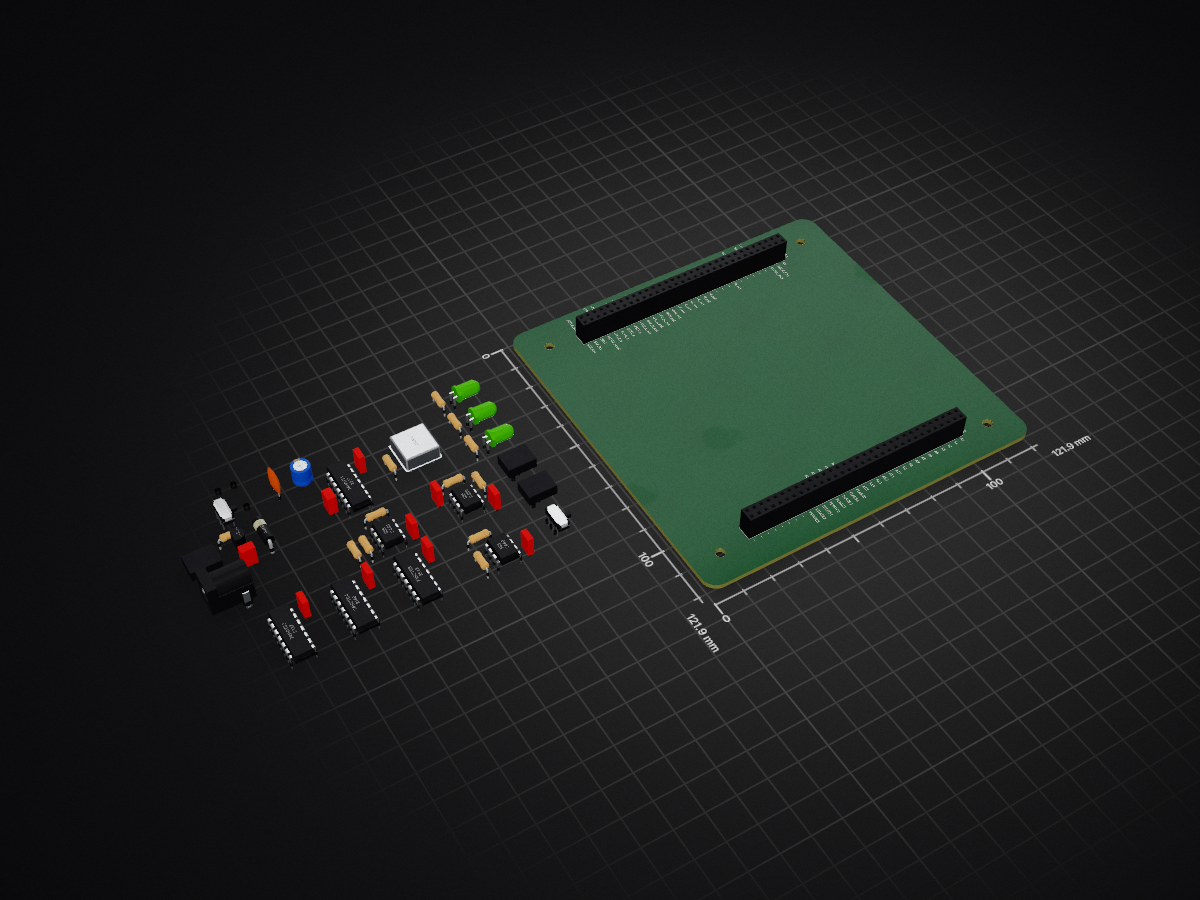
Power Clock is an open-source printed circuit board by DutchMaker, from the DutchMaker/DM-02 repository on GitHub. It is a 2-layer board of 121.9 × 121.9 mm with 49 parts on 38 nets.
It is built around the 74HCT04D, 74HCT08D and 74HCT14D, with the 74HCT32D, MCP100-450DI/TO and 1N5340B among its other parts. Its parts include 12 resistors, 11 capacitors, 8 ICs, 5 switches and 4 diodes. It belongs with the lEDs and displays boards of this library.


Pronounced: "Dee-Em Zero Two"
An 8-bit computer built (almost) entirely out of TTL logic chips
This project started in September 2019 and is currently in progress.
Please refer to the documentation for the project status.
Start by reading the introduction
If you would like to see the computer in action, the best I can offer you now is the DM-02 Emulator while the electronic version is under development.
| Qty | Value | Footprint | References |
|---|---|---|---|
| 8 | 5K | Resistor_THT:R_Axial_DIN0207_L6.3mm_D2.5mm_P7.62mm_Horizontal | R1, R3, R5, R6, R7, R8, R11, R12 |
| 5 | 100nF | Capacitor_THT:C_Rect_L4.6mm_W2.0mm_P2.50mm_MKS02_FKP02 | C2, C4, C5, C7, C8 |
| 4 | MountingHole | MountingHole:MountingHole_3.2mm_M3 | H1, H2, H3, H4 |
| 3 | 10nF | Capacitor_THT:C_Rect_L4.6mm_W2.0mm_P2.50mm_MKS02_FKP02 | C1, C6, C9 |
| 3 | 330 | Resistor_THT:R_Axial_DIN0207_L6.3mm_D2.5mm_P7.62mm_Horizontal | R4, R9, R10 |
| 3 | 555 | Package_DIP:DIP-8_W7.62mm | U1, U3, U4 |
| 2 | Conn_02x32_Odd_Even | Connector_PinSocket_2.54mm:PinSocket_2x32_P2.54mm_Vertical | BUS1, BUS2 |
| 1 | 1 MHz | 74xx-Computer-Footprints:Oscillator_DIP-8_v2 | Y1 |
| 1 | 100 nF | Capacitor_THT:C_Rect_L4.6mm_W3.0mm_P2.50mm_MKS02_FKP02 | C10 |
| 1 | 100K | Resistor_THT:R_Axial_DIN0207_L6.3mm_D2.5mm_P7.62mm_Horizontal | R2 |
| 1 | 1N5340B | Diode_THT:D_5W_P10.16mm_Horizontal | D1 |
| 1 | 1nF | Capacitor_THT:C_Rect_L4.6mm_W3.0mm_P2.50mm_MKS02_FKP02 | C11 |
| 1 | 220µF | Capacitor_THT:CP_Radial_D6.3mm_P2.50mm | C3 |
| 1 | 74HCT04 | Package_DIP:DIP-14_W7.62mm | U2 |
| 1 | 74HCT08 | Package_DIP:DIP-14_W7.62mm | U6 |
| 1 | 74HCT14 | Package_DIP:DIP-14_W7.62mm | U7 |
| 1 | 74HCT32 | Package_DIP:DIP-14_W7.62mm | U8 |
| 1 | CONTINUE | Button_Switch_THT:SW_Tactile_SKHH_Angled | SW3 |
| 1 | HALT | LED_THT:LED_D5.0mm_Horizontal_O1.27mm_Z3.0mm | D2 |
| 1 | MCP100-450D | Package_TO_SOT_THT:TO-92 | U5 |
| 1 | POWER | LED_THT:LED_D5.0mm_Horizontal_O1.27mm_Z3.0mm | D3 |
| 1 | Polyfuse | Capacitor_THT:C_Disc_D9.0mm_W2.5mm_P5.00mm | F1 |
| 1 | Power | DM-02:Switch_DPST_Angled | SW2 |
| 1 | Power (5V) | Connector_BarrelJack:BarrelJack_Horizontal | J1 |
| 1 | RESET | Button_Switch_THT:SW_Tactile_SKHH_Angled | SW5 |
| 1 | STEP | LED_THT:LED_D5.0mm_Horizontal_O1.27mm_Z3.0mm | D4 |
| 1 | Single-step | Button_Switch_THT:SW_Tactile_SKHH_Angled | SW1 |
| 1 | Single-step | DM-02:Slide-switch | SW4 |
DutchMaker/DM-02
8-bit computer built (almost) entirely out of TTL logic chips


flypie/Gigatron
This is a version of the files from https://gigatron.io/ altered to work on a vanilla KiCAD 5.1.6. Changes are minimal in the schematic and PCB, layout has only been changed where dimensions or orientations changed as a…

schlae/snark-barker-mca
A Sound Blaster compatible sound card for Micro Channel bus computers

ksr/p8x
Generated by generators/genkicad.py from the canonical geneagle netlist (CARDS["peripheral-card"]), same standard as the memory card: 4-layer (F/B signals, In1=GND, In2=VCC planes), a bypass cap above each IC, a…

roberto314/EVA-1_Reproduction
Recreation of the very rare K-K Systems EVA-1 Display Adapter for the Epson HX-20 Computer


tebl/RC6502-Apple-1-Replica
An expandable SBC-version of the Apple 1 computer, easy to get started with and lot of cool stuff that can be added to it!
It measures 121.9 × 121.9 mm and has 2 copper layers, 1.6 mm thick.
49 parts, built around the 74HCT04D, 74HCT08D, 74HCT14D and 74HCT32D. The full list of its parts is on this page, with links to each part's symbol and footprint where PCBKit's library has them.
From the DutchMaker/DM-02 repository on GitHub, at the commit this page was made from: the board is Circuits/KiCad/Power-Clock/Power-Clock.kicad_pcb. PCBKit opens the board in the browser, with nothing to install.
Its repository states no licence, so its author keeps all rights: ask DutchMaker before reusing the design.